

Ningxia Hui Autonomous Region Launches China's First 'Internet + Healthcare' Demonstration Zone Construction Plan (2019–2022)
Today, the National Health Commission released an important document in response to the Notice issued by the People’s Government of the Ningxia Hui Autonomous Region on Printing and Distributing the Plan for Building a “Internet + Healthcare” Demonstration Zone in the Ningxia Hui Autonomous Region (2019–2022).
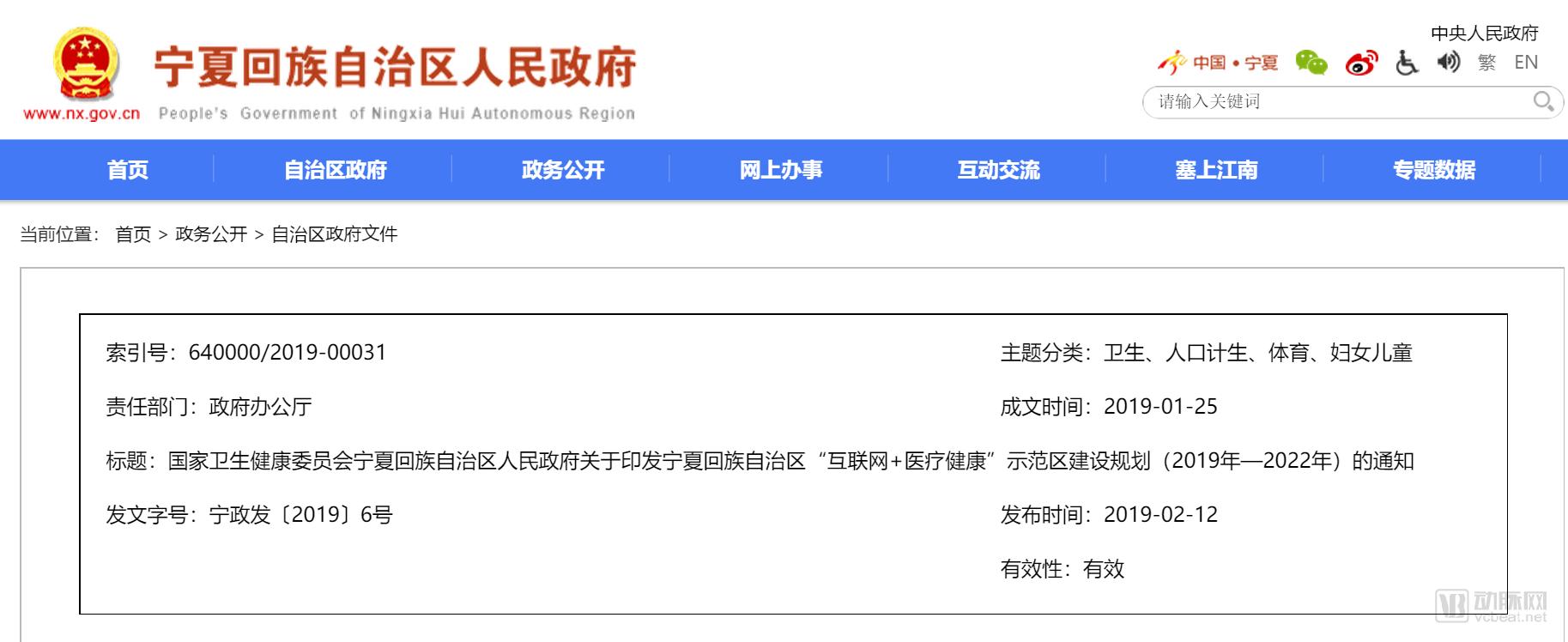
So why has the Ningxia Hui Autonomous Region become a national demonstration zone for “Internet + Healthcare”? What are its key experiences?
Below is the full text of the policy:
Development Plan for the “Internet + Healthcare” Demonstration Zone in Ningxia Hui Autonomous Region (2019–2022)
To advance the development of healthcare informatization in the new era and enhance the modernization of medical and health services, this Plan is formulated in accordance with the requirements set forth in the “Opinions of the General Office of the State Council on Promoting the Development of ‘Internet Plus Medical Health’” (Guo Ban Fa [2018] No. 26) and the National Health Commission’s “Letter on Agreeing to Support Ningxia in Building a Demonstration Province (Region) for ‘Internet Plus Medical Health’” (Guo Wei Gui Hua Han [2018] No. 174), taking into account the actual conditions in Ningxia.
I. General Requirements
(I) Guiding Principles.
(II) Basic Principles.
People-centered, improving people's livelihood. Adhere to demand-oriented, take improving people's livelihood as the fundamental task, apply "Internet + Medical Health" to various fields and links such as medical care, pharmaceuticals, medical insurance, and health management, help improve quality and efficiency, enhance service levels, and strengthen the sense of gain among the public.
Holistic Planning and Phased Implementation. Adhere to unified district-wide planning, prioritize easier tasks before tackling more difficult ones, and implement in phases. Improve infrastructure, expand application functionalities, enhance service capabilities, and build an “Internet + Healthcare” service system that meets the needs of the public.
Government-led, market-engaged. Leverage the decisive role of the market in resource allocation alongside the leading role of the government, guide active participation of social capital, pool resources from multiple stakeholders, and stimulate enterprise vitality in application innovation and achievement transformation within “Internet + Healthcare,” thereby maximizing benefits and optimizing efficiency.
Highlight Distinctive Features and Strengthen Demonstrative Role. Adhere to local characteristics, innovate service models, optimize service processes, promote integrated development, cultivate distinctive industries, and establish demonstrative experiences for nationwide adoption.
(III) Overall Approach.
To thoroughly implement major national strategic deployments such as the Outline of the Healthy China 2030 Plan, closely align with the requirements of the National Health Commission and the People’s Government of the Autonomous Region for jointly building an “Internet + Medical Health” demonstration zone, highlight Ningxia’s distinctive advantage in “easy coordination,” accelerate the deep integration of the internet with medical and health services, meet the multi-level and diversified healthcare needs of the public, and promote the construction of a region-wide “Internet + Medical Health” demonstration zone by consolidating one foundation, establishing two major centers, strengthening three safeguards, and building five major platforms.
— Solidify one foundation: the foundation for achieving interoperability of medical and health information among urban and rural residents in Ningxia.
—Establish two major centers: the National Health and Medical Big Data Center and the Regional Medical Center.
——Strengthen three safeguards: safeguarding Party building and professional conduct, safeguarding the integration of research and application, and safeguarding support through innovative industry policies.
——Build five major platforms: the National Health Information Platform, the Internet Healthcare Platform, the Internet Diagnostic Platform, the Internet Pharmaceutical Platform, and the Internet Operations and Supervision Platform.
(IV) Development Goals.
By 2020, achieve interconnectivity of medical and health information across the entire region, establish two major centers, and build five major service platforms, significantly improving residents’ healthcare experience. A preliminary comprehensive framework for “Internet + Medical Health” will be formed, encompassing mechanism guarantees, application services, and regulatory governance. By 2022, basically complete an “Internet + Medical Health” application service system and regulatory governance system that covers the full life cycle, features rich applications, distinct characteristics, and a well-structured design, enabling the public to access high-quality medical services and effective health management at their doorstep. Furthermore, through demonstration and innovation in four areas—interconnectivity, integrated application services, industry cultivation, and policy mechanisms—develop replicable, referenceable, and scalable experience in three aspects: standard specifications, operational mechanisms, and regulatory models for “Internet + Medical Health.”
Four Areas Demonstrating Innovation:
— Demonstrate innovation in the interconnectivity of “Internet + Healthcare.” Focusing on addressing the fragmented deployment of healthcare applications and the low level of data sharing, we will establish a unified database, promote the migration of medical institutions’ business applications to the cloud, expand interoperability channels, explore data-sharing mechanisms, and solidify the foundation for cross-regional, cross-level, and cross-departmental interconnectivity.
— Demonstrate innovation in the integrated application services of “Internet + Healthcare.” Focusing on addressing uneven distribution of medical resources and insufficient service capacity, upgrade infrastructure, build a unified platform, enrich healthcare applications, and deliver integrated application services covering the full life cycle, all business domains, and the entire process.
——Demonstrating innovation in cultivating the “Internet + Healthcare” industry. Focusing on addressing insufficient endogenous industrial momentum and weak innovation capabilities, we will coordinate existing resources, promote ecological agglomeration, encourage incubation of mass entrepreneurship and innovation, foster win-win cooperation, facilitate the transformation and upgrading of traditional enterprises, and cultivate new business models within the “Internet + Healthcare” sector.
— Demonstrate innovation in the policy mechanisms for “Internet + Healthcare.” Focusing on addressing inadequate medical service quality and weak industry governance capabilities, actively explore and refine standards and norms in areas such as information sharing, data security, regulatory models, health insurance payment methods, and benefit distribution.
Promoting Experience in Three Aspects:
——Standards and specifications for “Internet + Healthcare.” This includes establishing standards for resident health records, electronic medical record data and information exchange, integration of healthcare institution information systems, and health management information, as well as technical specifications for diagnosis and treatment in healthcare institutions.
——Operational Mechanisms of “Internet + Healthcare”. Establish policy mechanisms and benefit distribution and incentive systems in areas such as information sharing, data security, pricing and fee structures, pharmaceutical distribution, and health insurance payment methods.
—Regulatory Model for “Internet + Healthcare”. Establish a comprehensive regulatory framework covering health insurance funds, healthcare institutions, order in the medical industry, healthcare professionals, drug quality and bidding/procurement, public health services, and healthcare evaluation.
II. Key Tasks
(1) Strengthen the foundation for interoperability.
Unify data standards and specifications. Adhere to existing national and industry-related standards and specifications, establish data access and sharing rules, build a data quality evaluation system, form unified data standards and technical specifications, and promote the interoperability of industry data standards. By 2020, standardized and unified management and maintenance of medical and health data information will be achieved across the region.
Unified Information Private Network.Leveraging the region-wide e-government extranet, upgrade and modernize the existing medical health information network to construct a multi-layered, converged network architecture. This will ensure the secure transmission of medical health data and establish a dedicated medical health information network covering the entire region, thereby providing support for interconnectivity. By 2020, relying on the existing fiber-optic private network and utilizing new technologies such as 5G and satellite communications, achieve information interconnectivity among healthcare institutions at the autonomous region, municipal, county, township, and village levels.
Unified Cloud Platform.Leveraging the Ningxia E-Government Public Cloud Platform, a dedicated medical cloud zone will be established to provide services such as cloud hosts, cloud storage, cloud databases, cloud load balancing, cloud security protection, and cloud migration. Various “Internet + Healthcare” business systems will be constructed, gradually promoting the cloud deployment of existing business applications. By 2020, a unified cloud platform covering healthcare institutions at all levels across the entire region will be built.
Unified Database.Integrate healthcare data across the entire region, including medical services, health insurance, public health, drug supply, traditional Chinese medicine, physicians, and population statistics. Establish data-sharing channels with national, departmental, regional, and industry-level systems, and improve data repositories such as electronic health records (EHRs), electronic medical records (EMRs), and the comprehensive population database. By 2022, establish three foundational healthcare databases—covering EHRs, EMRs, and the comprehensive population—as well as more than ten specialized databases, to promote the shared use of data resources among all medical institutions in the region.
Unified Security Assurance System.Advance the construction of a security protection system for “Internet + Healthcare,” promote the application of digital certificates and electronic signatures, strengthen comprehensive governance of cybersecurity protection for infrastructure, and achieve synchronized development of information sharing and protection to ensure information security. By 2022, establish a comprehensive security assurance system covering all domains and aspects.
(II) Establish two major centers.
1. Health and Medical Big Data Center and Industrial Park.
Leveraging the Zhongwei Western Cloud Base as a carrier, we will highlight the core leading role of big data centers to achieve intensive management of data storage, exchange, and application, thereby building a cloud computing and big data industrial park based in Ningxia, radiating across Northwest China, and serving the entire nation. Relying on existing high-tech industrial parks in Yinchuan as carriers, we will capitalize on advantages such as abundant medical resources and complete infrastructure. Through market-oriented operations and with medical applications at the core, we will form an internet hospital industry cluster and establish a health and medical big data industrial park.
2. Regional Medical Centers.
Adhering to the strategic positioning of “being rooted in Ningxia, radiating to surrounding areas, and serving the Belt and Road Initiative,” we will implement the “1+2+2+N” model (with one key Grade III Class A general hospital as the leader, two other Grade III Class A general hospitals, two Grade III Class A traditional Chinese medicine hospitals, and N specialized hospitals and independently established medical institutions). By leveraging national professional medical centers, relying on national-level platforms for diagnosis and treatment innovation and R&D, and utilizing “Internet Plus,” we will build one comprehensive regional medical center and several specialized regional medical centers characterized by clear division of labor, interconnected information, shared resources, and efficient, convenient services. With a focus on increasing the supply of high-quality medical service resources and enhancing clinical specialty capabilities, we will extensively promote domestic and international medical exchanges and cooperation. We will establish new models of medical services, improve medical service efficiency, and foster the emergence of new business formats in “Internet Plus Medical Health.”
By 2022, it had initially taken shape as a regional medical center that gathers domestic and international medical experts and advanced diagnostic and therapeutic technologies, integrating medical services, scientific research and teaching, and the health industry. The center provides diagnosis and treatment for complex and critical cases, thereby radiating influence and driving the development of medicine and the enhancement of healthcare service capabilities in western China.
(3) Strengthen three safeguards.
1. Guarantee of Party Building and Conduct Development.
Establish an "Online Party School" for the health and wellness system, offering online party lectures to all party members and cadres within the system. Provide services in ideological and political education, party affairs knowledge, integrity education, and personalized learning support. Promote the normalization and institutionalization of the "Two Studies, One Action" learning initiative and carry out thematic education on "Remaining True to Our Original Aspiration and Keeping Our Mission Firmly in Mind." Achieve digital management of party member records and the transfer of organizational affiliations across the entire system. Launch online showcases highlighting the exemplary conduct of outstanding party members to inspire all members to play a vanguard and model role. Build a platform for evaluating professional conduct, establish and improve assessment mechanisms for professional ethics development, guide medical personnel to uphold and practice professional spirit, and shape a positive industry ethos. By 2022, the party building system encompassing "education and exchange, dissemination, and evaluation" will cover the entire health and wellness sector in the region, achieving informatized and standardized management of party building work.
2. Integrated Safeguards for Research and Application.
Coordinate resources and pool capabilities to establish a research institution for the development of health and medical big data; introduce domestic “Internet + Healthcare” enterprises, universities, and medical institutions to conduct joint research, promote the deep integration of the Internet with clinical applications, advance comprehensive governance of medical data across all domains, and foster the growth of Ningxia’s “Internet + Healthcare” service ecosystem.
Establish the Ningxia “Internet + Healthcare” Association. Organize internet hospitals and internet enterprises to establish the “Internet + Healthcare” Association, standardize online diagnosis and treatment practices, establish a mechanism for industry self-regulation, define the boundaries of sector development, and provide policy support for the standardized management and supervision of internet healthcare. By 2020, develop comprehensive industry self-regulatory norms and related standards.
3. Support and Safeguard through Innovative Industry Policies.
Promote institutional innovation in the industry.Establish conduct guidelines for “Internet+” healthcare, “Internet+” pharmaceuticals, and “Internet+” medical insurance; clarify responsibilities; implement both punitive and preventive measures; and, on the basis of clearly defined boundaries, explore the establishment of a fault-tolerance and correction mechanism. Promote the integration of government services with healthcare and medical services to create a one-stop service system that is convenient and beneficial to the public.By 2022, establish comprehensive institutional frameworks and standards for internet-based diagnosis and treatment pricing, regulatory models, and health insurance reimbursement, thereby fostering an open and inclusive innovation environment for the development of “Internet + Healthcare” demonstration zones.
Explore Innovations in Cooperation Mechanisms. Encourage medical institutions to collaborate with third-party platforms, allowing them to entrust third-party medical diagnostic and testing platforms to expand service offerings, explore pricing and fee structures, and establish benefit distribution and incentive mechanisms to mobilize the enthusiasm of medical institutions, third-party platforms, and internet hospitals. By 2022, a cooperation model suitable for the development of the demonstration zone will be basically established, improving relevant cooperation mechanisms such as investment promotion and government-enterprise partnerships, thereby fostering a favorable environment for industrial development.
Promote Innovation in Medical Science, Education, and Research. Leverage internet-based innovations to transform teaching models, enrich instructional methods and resources, and improve disciplinary systems, thereby ensuring that science, education, and research resources in health cover all medical institutions across the district. Improve management and training systems, highlight the advantages of “Internet+” assessment, comprehensively monitor the training status of professional technical personnel in health throughout the district, and continuously enhance their professional competence. Strengthen health management capabilities by delivering health science popularization and education via the internet, promoting health management and health promotion, and improving residents’ health literacy and self-health management abilities. By 2022, establish an integrated information management system for health science, education, and research that supports functions including educational science popularization, talent development, and health management.
(4) Build five major platforms.
1. National Health Information Platform.
Establish an integrated health information platform for the entire district.Improve the platform’s supporting architecture and basic functions to enable capabilities such as data collection, storage, exchange, and retrieval services; enhance the management mechanism for health information resources; integrate with public-benefit service applications and business supervision systems; and achieve interoperability with the Autonomous Region’s Government Information Platform and the National Population Health Information Platform. By 2022, establish a unified, interoperable, integrated regional population health information platform that achieves vertical interoperability with the National Population Health Information Platform and horizontal connectivity with specialized systems of medical institutions—including hospitals, centers for disease control and prevention, health inspection agencies, and blood centers—thereby facilitating seamless data exchange across departments, regions, and professional domains.
Promote comprehensive data management.Establish a unified core database framework for the data center, and complete the modeling and ingestion of data related to individuals (patients, healthcare workers, administrators, etc.), devices, institutions, and business operations (medical services, public health services, family planning, and medical insurance) under existing conditions. By 2022, build a big data application service system for healthcare that meets residents’ multi-level health needs, features vertical integration and coordination, and ensures complementary connectivity.
Accelerate the widespread adoption of electronic health cards.Improve the district-wide electronic health card management system, promote the integrated application of the electronic social security card and the electronic health card, gradually popularize the use of electronic health cards, and facilitate the widespread adoption of the “two cards (two codes)” in public health, medical services, medical expense settlement, and health management. This will enable functions such as resident identity verification, cross-institutional medical care across the entire district, sharing of electronic medical records, authorized access to and inquiry of health records, and financial payments. Strengthen the development of the application environment for residents’ electronic health cards to provide the public with high-quality medical, public health, and preventive healthcare services. By 2022, achieve district-wide普及 of electronic health cards with full integration across all service areas, and comprehensively enhance health data management capabilities.
Improve the immunization management service system.Centered on the electronic supervision code for vaccines, establish a nationwide, full-process information-based regulatory and traceability system that tracks vaccines down to the smallest packaging unit, thereby achieving comprehensive oversight of vaccine distribution. Building upon childhood immunization services, accelerate the development of digital vaccination clinics to promote end-to-end digital integrated management, data collection, and service quality control spanning from appointment scheduling to vaccine administration. By 2022, roll out digital clinics for the Expanded Program on Immunization (EPI) across the entire region, enhance capabilities in EPI data analysis and regulatory oversight, and achieve full-process supervision and service delivery for immunization.
Create a New Model for Maternal and Child Health Services.Implement information-based management of the “Mother and Child Health” program to establish a maternal and child health service system that integrates mother and child, coordinates online and offline services, ensures continuity throughout the entire process, and provides full-cycle management. Establish a continuous tracking mechanism for maternal and child healthcare based on the life cycle, offering standardized services such as health monitoring and vaccination. By 2022, achieve intelligent, end-to-end, and full-life-cycle management of maternal and child health services.
Strengthen dynamic monitoring of disease prevention and control.Based on the national health information platform, and leveraging electronic medical records, electronic health records, the national population database, and the Chinese Disease Prevention and Control Information System, Ningxia has established a disease prevention and control business information platform. This platform integrates multiple operational application systems, including those for infectious diseases, chronic diseases and their risk factors, immunization programs, mental health, health hazard factors, comprehensive disease control management, and patriotic health campaigns. It achieves interconnectivity of disease prevention and control information across various medical and health institutions, fostering a regional health collaborative service model characterized by unified efficiency, information interoperability, and collaborative sharing, as well as a management model for the dynamic monitoring of disease prevention and control service activities. By 2022, a dynamic monitoring system for disease prevention and control was established, effectively enhancing the capacity to prevent and control major diseases and respond to public health emergencies.
Improve the full-process blood services.Streamline the end-to-end blood supply process, improve the regional blood donation and utilization service system, and comprehensively provide integrated mobile internet services. Promote business coordination in blood safety management, strengthen information-based monitoring of the blood cold chain, implement full-process information management from “vein to vein,” and establish a safe, rapid, and quality-compliant express logistics channel for blood transport. By 2022, achieve integrated regional services for blood donation and utilization, and enable in-hospital reimbursement of blood usage fees for blood donors.
2. Internet Healthcare Platforms.
Optimize the medical service process for residents.Encourage medical institutions to apply “Internet Plus” technologies to expand the scope of medical services, and establish comprehensive online healthcare services covering the entire patient journey—pre-consultation, during consultation, and post-consultation. Develop a shared resource pool for internet-based medical services, and implement end-to-end services including appointment scheduling, intelligent triage, online consultations, result inquiries, point-of-care settlement, bedside settlement, medication delivery, discharge medication guidance, online follow-up visits, and physician interpretation of laboratory and imaging reports. By 2022, all secondary-level and tertiary hospitals across the region shall fully launch convenient online healthcare services.
Establish Internet-based outpatient clinics.Permit the development of internet hospitals based on medical institutions, leveraging internet technology to provide safe and appropriate medical services on the foundation of physical hospitals, and support medical and health institutions as well as qualified third-party organizations in establishing internet information platforms. Build a Ningxia Internet Outpatient Service that covers the entire region internally and radiates to surrounding areas externally, offering online specialist appointments, consultations, network outpatient services, and strengthening remote online guidance and specialized diagnosis and treatment services. By 2022, all primary healthcare institutions across the region will have established internet consulting rooms, major departments in secondary-level and above hospitals will be able to provide remote internet services, and achieve a "primary examination, superior diagnosis" remote medical model, promoting the construction of an orderly tiered diagnosis and treatment system.
Improve the two-way referral mechanism.Establish a two-way referral collaborative service system to accelerate the vertical integration of medical resources, enable interoperability and information sharing, and facilitate efficient operational coordination. This will effectively guide residents to seek initial consultations at primary care facilities and encourage patients from tertiary hospitals to return to grassroots institutions for rehabilitation, thereby fostering an orderly two-way referral framework. By 2022, achieve full coverage of two-way referrals within all medical consortia in the district, comprehensively enhancing regional medical collaboration capabilities.
Enhance the intelligent service network for 120.Leveraging the district-wide integrated 120 emergency medical services (EMS) system, we coordinate EMS network stations at the municipal, county, and township levels to effectively reduce the emergency response radius. We promote the application of priority-based triage dispatch technology to shift emergency care interventions upstream. An emergency medical rescue monitoring and early warning system has been established to enable 24-hour monitoring, alerting, and intelligent response to critical values, thereby supporting dynamic allocation of emergency resources and remote emergency rescue operations. We have constructed a collaborative EMS service system linking Stroke Centers, Chest Pain Centers, and Trauma Centers. In 2022, 120 EMS services were extended to townships, and the 120 emergency dispatch system was transformed into an emergency early warning platform to conduct real-time analysis, assessment, and early warning of pre-hospital emergency medical data across the district.
Improve the family doctor contract service.Promote “Internet+” specialist–general practitioner integrated family doctor team services, empower family doctors, and enhance the service capacity of family doctor teams. Strengthen the application of dynamic health management, provide online and offline diagnosis and treatment services, and expand the scope of family doctor contract services. Reinforce technical support from higher-level hospitals to primary care institutions, offering contracted residents online and offline interactive services such as health consultations, chronic disease follow-up, health management, expedited referrals, extended prescriptions, and health monitoring for special populations. Explore online assessment, evaluation, and incentive mechanisms to improve the quality and efficiency of contract services and strengthen public trust in family doctors. By 2022, achieve full coverage of “Internet+” family doctor contract services.
Enhance the capacity of traditional Chinese medicine health services.Improve the provincial traditional Chinese medicine (TCM) health information platform and regional TCM medical systems, strengthen data sharing and business coordination among TCM hospitals across the region, and facilitate continuous and cross-institutional medical care for patients. Promote the construction of “TCM Halls” in township health centers throughout the region, develop smart TCM pharmacies, and effectively enhance the supply of primary-level TCM medical resources. By 2022, establish a TCM “preventive treatment of disease” service system to provide health guidance services such as preventive healthcare and disease rehabilitation for the public.
Establish an integrated medical and elderly care service model.Centered on health services for the elderly, and focusing on disease prevention and control, medical care, mental health, and compassionate support, we will leverage big data centers and medical diagnostic service platforms to integrate medical institutions and elderly care resources at all levels. This will promote information interoperability among hospitals, elderly care facilities, communities, and households. By utilizing telemedicine, remote consultations, and wearable smart devices, we will extend medical health resources and corresponding services to every elderly individual. Led by public hospitals and grounded in primary healthcare institutions, we will establish medical-elderly care consortia to provide integrated services such as health management for the elderly, while guiding social forces to employ “Internet+” approaches to develop smart health and elderly care services. By 2022, a diversified health and elderly care landscape with a virtuous cycle of service resource allocation will be established.
Establish a Continuous Health Management System.Promote mobile telemedicine services for primary care, conduct disease screening, focus on residents' health, and provide health management services such as disease prevention, follow-up, and assisted rehabilitation. For different diseases, explore health management service pathways, establish a standardized health management service system across the district, and promote collaboration between primary care physicians and specialists within the region to provide integrated continuous health management services both in and out of hospitals. By 2022, achieve standardization of health management pathways for major diseases, with tertiary hospitals and some primary care institutions collaboratively providing personalized health management services based on different conditions.
3. Internet Diagnostic Platform.
Establishment of Regional Medical Imaging Diagnostic Centers.Establish a benefit distribution and incentive mechanism, enhance cloud storage capabilities for electronic films, promote the circulation of cross-institutional imaging data, strengthen the rational allocation and integrated utilization of medical imaging equipment resources, and conduct regional remote imaging diagnostics—including remote image interpretation, expert diagnosis, and report transmission—to improve the efficiency of healthcare resource utilization.
Establish a Regional Electrophysiology Diagnostic Center.Connect medical institutions at different hierarchical levels and establish an information exchange system to achieve integrated storage, exchange, query, and services for electrophysiological data (including electrocardiography, electroencephalography, and electromyography) across the entire region. The system enables classification and summarization of electrophysiological data, case discussions, alert-based case tracking, and personalized case management, thereby providing clinical cases for teaching and research, as well as evidence for formulating healthcare policies and regulations.
Establish Regional Pathology Diagnosis Centers.Integrate pathological diagnosis resources across the entire district, expand the reach of high-quality medical resources, and promote interconnectivity among pathology departments and healthcare information systems in all medical institutions within the region. Empower small and medium-sized medical institutions in the district with pathological diagnosis capabilities by enabling cross-institutional circulation of pathological specimens, thereby facilitating remote diagnosis and report access.
Establish Regional Medical Laboratory Centers.Establish a cross-institutional referral mechanism to facilitate the downward allocation of laboratory resources, implement full-process data quality control for pre-analytical, analytical, and post-analytical phases of outsourced samples, achieve centralized testing at regional clinical laboratory centers, and enhance laboratory capabilities. Allow third-party submission of specimens and promote mutual recognition of medical laboratory test results among secondary and tertiary healthcare institutions across the region. By 2022, the radiating effect of regional medical diagnostic centers will be fully realized, injecting new momentum into medical development and the enhancement of healthcare service capabilities.
Establish an AI-assisted diagnostic system.Implement intelligent medical image recognition, ECG interpretation and analysis, chronic disease early warning, multidisciplinary consultations, and clinical quality management and decision-making. Expand the application of intelligent voice systems and AI-assisted medical research systems across various healthcare scenarios to enhance the diagnostic and treatment capabilities as well as service efficiency of primary care physicians. By 2022, all secondary-level and above medical institutions in the region will achieve voice-enabled electronic medical records and AI-assisted diagnosis, while primary care institutions will implement AI-assisted diagnosis and family doctor support services.
4. Internet Pharmaceutical Platforms.
Establish regional prescription review and distribution mechanisms.Promote the interconnectivity of prescription information from medical and health institutions with drug retail consumption data, and establish a mechanism whereby medical institutions and pharmaceutical distributors entrust third-party agencies to deliver medications listed in online prescriptions for common and chronic diseases after review by qualified physicians. By 2022, achieve effective supervision of pharmaceutical distribution across the entire region, one-stop services, and convenient access to medication pickup at local community levels.
Deepen the centralized procurement management of pharmaceuticals and medical consumables.Through market price comparisons and leveraging robust supply chain systems, we will strengthen the monitoring and control of procurement prices to ensure rapid delivery of government-procured pharmaceuticals. By establishing a database of medical consumable prices and conducting market analysis through data mining, we aim to promote sunshine-based, transparent, and low-cost procurement. By 2022, unified centralized procurement and management of pharmaceuticals and medical consumables will be implemented across all public medical institutions in the region.
5. Internet Operations Supervision Platform.
Build a "one-stop" settlement system for medical and healthcare services.Integrate settlement platforms for fiscal funds, basic medical insurance, poverty alleviation programs, and commercial insurance to promote business convergence and application integration. Establish a “one-stop” settlement mechanism for inpatient medical expenses, enhance the real-time settlement capabilities of basic medical insurance and commercial insurance, and expand the adoption of convenient and beneficial settlement services. By 2022, establish a “one-stop” real-time settlement system for medical expenses.
Establish a comprehensive system for medical expense settlement and reconciliation.Based on the “one-stop” instant settlement system for medical and health services, and integrating with cost settlement systems such as basic medical insurance and commercial insurance, we will implement unified clearing and reconciliation of medical expenses, expand online payment services for medical costs, and establish a unified clearing mechanism for medical expenses. By 2022, a unified clearing management system for medical expenses will be established.
Establish a health insurance monitoring and management system.Leveraging a unified interoperable database, track medical insurance data to conduct real-time monitoring and comprehensive evaluation of key indicators, including medical service pricing, medical insurance fundraising and payment, and control of residents’ medical expenditure burden. Strengthen supervision of the “one-stop” medical insurance settlement process, optimize procedures for cross-regional and online settlements, and establish a closed-loop system for internet-based medical insurance management. By 2022, establish a closed-loop system for internet-based medical insurance management and achieve end-to-end monitoring of the entire medical insurance settlement process.
Establish a Supervision and Management Mechanism for Healthcare.Establish a comprehensive regulatory system for public hospitals, focusing on indicators such as social benefits, service delivery, medical practices, integrated management, and sustainable development. Implement the reporting and comprehensive analytical application of hospital economic operation data to basically achieve full-spectrum oversight of human resources, finances, and materials in public hospitals. Establish process-based regulatory systems in all hospitals across the region, formulate information standards for regulating internet-based medical services, and conduct real-time monitoring of core activities such as online consultations, prescriptions, and referrals, thereby achieving whole-process and all-element regulation of internet healthcare. Advance the construction of an informatized drug traceability system and explore the establishment of a data tracking mechanism covering the entire drug lifecycle. Strengthen health regulation in key areas and enhance the capacity for health supervision and law enforcement. By 2022, establish a unified regional mechanism for coordinated regulation of medical institutions, clinical practices, and public health.
Establish a healthcare evaluation system.Establish an evaluation index system for “Internet + Healthcare” to conduct comprehensive assessments of key indicators and enhance capabilities for guiding integrated decision-making. Develop a management and evaluation framework for health professionals, refine the performance appraisal system for medical personnel, and encourage licensed physicians to engage in remote consultations and multi-site practice. By 2022, establish a digital evaluation system covering diverse entities, including healthcare quality, professional competencies, and medical institutions.
III. Safeguard Measures
(1) Strengthen organizational leadership.Establish a Leading Group for the Joint Construction of “Internet + Medical Health” Demonstration Provinces (Autonomous Regions), co-chaired by a Deputy Director in charge of the National Health Commission and a leader in charge from the Autonomous Region People’s Government. The Group is responsible for reviewing and approving the development plans, implementation schemes, and relevant policy measures for the demonstration zones; coordinating with relevant ministries to formulate and implement supportive policies; overseeing the execution of all tasks related to the joint construction efforts; coordinating the resolution of major issues arising during implementation; and summarizing and promoting successful experiences and outcomes. Annual work plans and implementation schemes shall be formulated, with clear timelines and roadmaps established, and a regular working meeting system instituted to jointly advance the construction of the demonstration zones.
(II) Strengthening Collaboration and Coordination.Establish a collaborative mechanism led by the government, with responsibilities assigned to relevant departments, participation from medical institutions and the broader society, clearly defined roles, and coordinated efforts. This will form a long-term working mechanism characterized by vertical promotion across the autonomous region, municipal, and county levels, and horizontal communication and implementation among departments. All member units involved in the construction of the “Internet + Healthcare” Demonstration Zone shall adopt an internet-oriented mindset, focus closely on key tasks, designate responsible entities and individuals, decompose tasks layer by layer, and advance implementation separately to ensure the comprehensive completion of the demonstration zone’s construction objectives.
(3) Increase financial investment.Adhere to the principle of government leadership and multi-channel investment, establish a funding guarantee system for the joint construction by the Commission and the district of the “Internet + Medical Health” demonstration zone, increase investment efforts, build a multi-level, multi-channel, and diversified investment and financing system, encourage and support third parties to jointly build medical service platforms, form a diversified investment and collaborative promotion mechanism, and accelerate the construction of the “Internet + Medical Health” demonstration zone.
(4) Strengthen supervision and assessment.Establish a scientific and standardized evaluation system for the development of “Internet + Healthcare,” incorporate “Internet + Healthcare” as a key indicator into the “Healthy Ningxia” indicator system, improve incentive and penalty mechanisms, strengthen process supervision and assessment, ensure the implementation of key tasks, and guarantee the smooth progress and effectiveness of the demonstration zone construction.
(V) Conduct effective publicity and guidance.By organizing press conferences, on-site observation meetings, and exhibitions of application achievements related to “Internet + Healthcare,” we will promptly summarize and systematize new service models and valuable experiences in this field, while promoting and disseminating the successful practices of pilot provinces (autonomous regions) in developing “Internet + Healthcare.” Adhering to an integrated approach that combines traditional and new media, we will establish a comprehensive, multi-tiered publicity mechanism to foster a favorable environment for advancing the development of “Internet + Healthcare” pilot provinces (autonomous regions).