

How Domestic Smartphone Makers Are Strategizing Against Apple's Mature Health Ecosystem
Introduction: In an era where smartphones are indispensable, we have witnessed firsthand how they are transforming healthcare. By pioneering the integration of its product line into a comprehensive health ecosystem, Apple has seized a strategic advantage in the broader smart device market. However, as Apple’s health services remain unavailable in China, how can domestic smartphone manufacturers differentiate themselves amidst the “Apple model” and an increasingly competitive market? For smartphone companies, what is the key to meeting users’ health-related needs?
Apple’s Comprehensive Push into Healthcare: Personal Health Data as Its Killer App
Before the advent of WeChat Step Count, it seemed that many people had not noticed the Health app on the iPhone. Upon opening the app, users were greeted by only four short videos, each lasting less than a minute, and a sparse record of simple data. Apart from step count and sleep duration, much of the data required users to reinterpret and manually input the information. At first glance, the app appeared to offer little assistance in improving users’ health, with its features being largely superfluous.
But with the release of Apple’s Health Record and the Apple Watch featuring a single-lead ECG,Apple’s Ambitions in the Healthcare SectorGradually coming into view. Why is tech giant Apple entering the healthcare sector, even positioning health and medical care as a core component of its strategy for apps, services, and wearable devices?
With the advent of the Internet of Everything era, it has become an industry consensus that competition in the smartphone market is no longer merely about devices, but rather about ecosystems. As competition among technology companies intensifies and other “territories” become increasingly saturated or even encroached upon by numerous competitors, Apple has identified significant opportunities in the healthcare market and seeks to differentiate its products by entering this sector. Apple’s health ecosystem now appears to have taken shape and reached initial maturity.
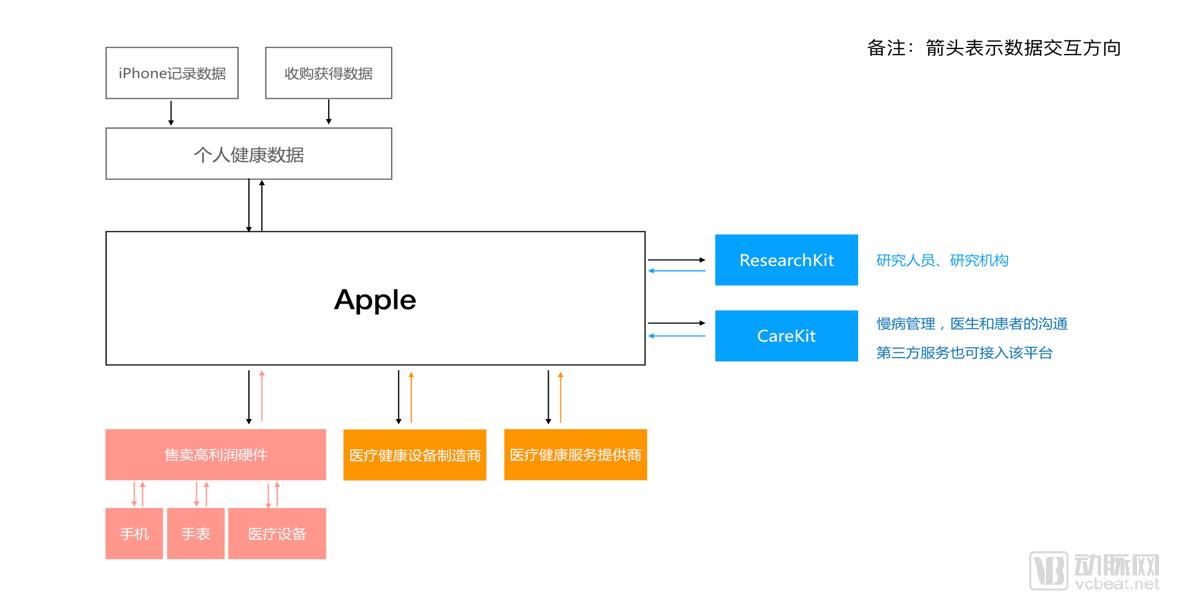
With the smartphone as the entry point, an ecosystem built on health big data has quietly taken shape (as shown in the figure above), encompassing doctors, patients, medical institutions, medical device manufacturers, medical software service providers, and more. This vast ecosystem has become an industry barrier that competitors find difficult to breach. Apple’s personal health database is growing increasingly extensive and specialized.
What Is the Key for Chinese Smartphone Companies to Break Through the “Apple Model” of a Healthy Ecosystem?
With the rapid economic development in China, public demand for health services has intensified over the past two years. In response to this trend, smartphone manufacturers such as Huawei, OPPO, VIVO, and Samsung have all strategically entered the medical and healthcare sector.
As the world’s second-largest smartphone manufacturer, Huawei has long established a presence in the health sector. By deploying smart wearables and sports-health products—including smartwatches, fitness bands, smart body fat scales, heart-rate-monitoring earphones, and third-party blood pressure monitors—Huawei has built an increasingly comprehensive ecosystem for sports and health scenarios. With data integration from wearable devices, six key metrics—blood glucose, blood pressure, sleep, weight, stress, and heart rate—can be monitored in real time via smartphones, thereby connecting cloud-based health data across different terminals. Among Chinese smartphone manufacturers, Huawei is a pioneer in sports and health initiatives; however, it still lags behind Apple, which has a clearer strategy and a nearly mature health ecosystem.
In contrast, within the entire “Apple Inc. model” health ecosystem, the key element linking healthcare providers, patients, and all other endpoints is Apple’s personal health data.
If Chinese smartphone manufacturers intend to build their capabilities from the ground up, akin to Apple, and maintain complete control over their data, they will inevitably incur substantial labor and financial costs, achieve suboptimal results, and forfeit their first-mover advantage in the market. Setting aside the scale of their mobile user base, even if they were to command a user base comparable in magnitude to Apple’s, they would still face significant challenges in acquiring and accumulating specialized medical and health data.
Unlike the mature health industries in developed countries, China’s health industry is still in its early stages. Health management companies vary widely in quality, and data sharing within these organizations remains difficult. Moreover, wearable devices on the market typically collect only limited types of data, and differences among brand manufacturers result in a lack of data interoperability, posing significant challenges to data integration.
Currently, Apple’s Health Records API is available only in the United States, and its Health app has not yet seen substantial improvements in functionality. It appears that Apple’s health ecosystem is still being piloted domestically, with the company exercising considerable caution in offering more direct health services to users.
In any case, as an issue of enduring importance to humanity, health will only garner increasing attention in the future. This is precisely why major smartphone manufacturers are strategically positioning themselves in the health sector amidst today’s fiercely competitive domestic smartphone market.
For users, the smartphone serves as a health platform centered on personal health data, enabling convenient access to various health services in daily life; for device manufacturers, it not only enhances user experience but also expands product sales channels; for smartphone manufacturers, equipping smartphones with health functions represents a transformative shift in user experience and a significant enhancement in device performance.
How Smartphone Companies Leverage Their Devices’Entry Advantage,One Step AheadAchieving Ecological Effects Across Different Fields,Pioneering the Establishment of Industry Barriers, is an issue that smartphone companies need to consider.
As shown in the figure below, the “Apple Model” leverages its user base to accumulate data—launching ResearchKit and CareKit to engage participants in medical research and healthcare professionals, thereby acquiring more specialized data—onboarding third-party software and hardware vendors, building an ecosystem, and then using its service capabilities to attract and retain users, thus forming a closed-loop ecosystem.
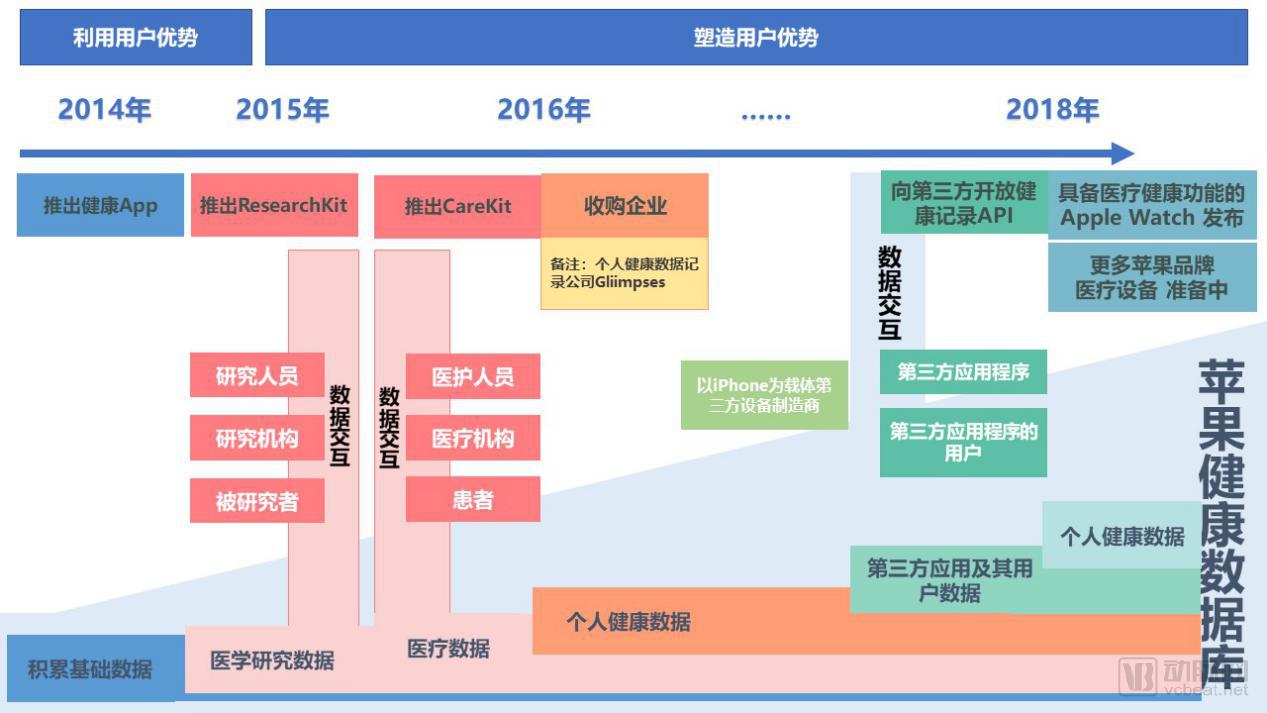
If we can leapfrog the preceding stages, rapidly build an ecosystem, or even integrate into an existing one, we can directly attract users through the service capabilities enabled by ecosystem effects, making it no longer difficult to break through the current impasse.
The focus lies on speedThose who rapidly enhance their health service capabilities will be the first to capture users’ mindshare, thereby seizing the first-mover advantage in the market.。
Building a Health Ecosystem: Integration Capabilities Are Core
Regarding the ecosystem layout in the health sector, if we look beyond the smartphone industry and take a broader view of the general health industry, there are already some health management companies in China that have been continuously deepening their expertise in health big data.
For instance, Miao Jiankang, which has been committed to building an interactive platform for the IoT health data ecosystem chain, jointly developed a health data interaction platform with the CAICT of the Ministry of Industry and Information Technology and the National Center for Chronic and Noncommunicable Disease Control and Prevention of the Chinese Center for Disease Control and Prevention. Based on the technological applications of this platform, interoperability standards for smart device data have been gradually established, covering more than 300 models of smart wearable devices.
In 2018, two standards on health data information interaction initiated and drafted by Miao Health—“General Technical Requirements for Health Information Interaction Business Systems Based on Mobile Internet” and “Service Indicator Requirements and Evaluation Methods for Open Platforms of Smart Hardware Based on Mobile Internet”—were approved as industry standards.
In 2015, Miao Health recognizedHealth DataRecognizing its importance in health management services, the company has made concerted efforts to build a platform with health data connectivity capabilities. Leveraging its IoT technology and capabilities, it first integrated various smart hardware devices and manufacturers to establish a health data center, and subsequently consolidated medical service resources. By the end of 2018, Miao Jiankang had signed contracts with more than 100 medical and health service providers, covering over 30 service categories and more than 400 service products. The company also participated in assisting smartphone manufacturers such as Huawei and Samsung in building their health platforms, and Miao Jiankang has developed its own strategic insights regarding smartphone companies’ expansion into the health industry.
Kong Fei, CEO of More Health, stated, “For smartphone companies, negotiating individually with the numerous hardware manufacturers in the market and integrating with each of their interfaces is a highly complex task. The workload involved in interface integration, data consolidation, and subsequent output is substantial.”
“Over the first four years, Miao Health has achieved considerable maturity in device connectivity, rapidly transforming smartphone hardware terminals into access points and ecosystem platforms. This is the ultimate goal we help smartphone manufacturers achieve.” Benefiting from its ongoing research in connectivity capabilities, Miao Health’s smartphone solutions business officially commenced development in 2017.
According to reports, Miao Health can provide customized health management services for major mobile phone brand operators, helping mobile phone brand manufacturers achieveFrom Traditional Single-Function “Step Counting” to a One-Step Upgrade to the “Mobile HealthKit Platform”, and enhance the capacity to provide specialized health management services.
With the large-scale rollout of 5G planning and infrastructure construction, the Internet of Things (IoT) is poised for explosive growth. The variety of electronic devices for smart health management will inevitably expand. By integrating Miao Health’s data capabilities, mobile phones can rapidly connect to various health wearables available on the market.
In addition to providing health advice and wellness plans to users, health data can be accumulated. User-generated data fed back into the system can also help application developers create diverse applications to better serve mobile phone users. Meanwhile, research institutions and healthcare organizations can leverage de-identified health data to conduct corresponding health studies, providing theoretical support for continuous health improvement.
From this perspective, if smartphone manufacturers collaborate with health management companies that possess robust health ecosystem capabilities, breaking away from the “Apple model” will no longer be merely an empty promise.
As previously mentioned, personal health data plays a pivotal role in the development of health services and even the broader health ecosystem. In the battle for users, the essence of the smartphone war is not a war over data, but a competition among the phone products themselves. The key to victory lies in rapidly enhancing user service capabilities, seizing market share, leveraging all available resources, transforming smartphones into premier gateways to various ecosystems, and delivering differentiated product experiences to users.