

How Bourne Elder Care Breaks Through with a Community-Embedded Model Amid 'Capital Giants' Dominating the Senior Care Market
“Before putting the plan into action, I first needed to answer a question in my own mind: How wide is the gap between ideal and reality? Am I someone who has high ambitions but low capabilities? I hold this ideal, but when it comes to interacting with the elderly on a daily basis, can I truly endure it?” In April 2016, Liu Jin resigned from his position as a senior bank executive and registered a company, subsequently submitting his resume to an elderly care institution…
Liu Jin chose to start her journey as a caregiver, attending to every aspect of daily life—clothing, food, housing, transportation, and companionship. Of course, this “part-time” caregiving role did not distract her from her original aspirations. In early 2017, she and her close friend Xiong Xiangyi embarked on an arduous yet rewarding entrepreneurial path: conducting market research, initiating projects, raising capital, selecting locations, overseeing renovations, and recruiting staff.
On August 1, 2017, the first Bao’entang Elderly Care Center opened its doors, marking the realization of Liu Jin’s decade-long dream to “establish a nursing home with warmth.”
Unlike most nursing homes on the market, Bao’en Elderly Care targets the elderly who are advanced in age, disabled or semi-disabled, and suffering from dementia or mild cognitive impairment. In reality, this group is often unwelcome due to being perceived as “demanding and difficult to care for.” So, how does Bao’en Elderly Care position itself? As a pure residential care facility, how does it address the medical needs of this population? Amidst the industry downturn, what unique features have enabled Bao’en Elderly Care to secure strategic investment from China Resources Weilin?
In response to the above issues, VCBeat (WeChat: vcbeat) conducted an exclusive interview with Liu Jin, founder of Bao’en Elderly Care.
Exosomes in Monoculture Systems
(Image source: Provided by the company)
“For over a decade, we have consistently prioritized the pure elderly care model. Although the state later advocated for the integration of medical and elderly care services, we ultimately decided against pursuing this path after conducting field visits, engaging in discussions with industry veterans, and carefully weighing various factors,” Liu Jin stated candidly to the reporter. “Given our current limitations in both capital and professional expertise, we are not equipped to venture into the healthcare sector.”
However, healthcare is an indispensable component of elderly care, particularly for the target demographic selected by Bao’en Elderly Care, who cannot do without medical services. Since “embedding” healthcare services is not feasible, the alternative is to “graft” them. To this end, Bao’en has established an “External Liaison Consortium,” which serves to integrate medical resources on one hand, and collaborate with institutions such as universities for the elderly, other organizations, companies, and non-profit entities on the other, thereby addressing these challenges through the consortium model.
Liu Jin told reporters that, adhering to the principle of proximity in medical care, Bao’en Elderly Care has partnered with several nearby hospitals—reachable within a few minutes by car—including Chengdu Third People’s Hospital, Sichuan Fifth People’s Hospital, and Chengdu Jinsha Hospital. These institutions, rated as Grade A Tertiary or Grade A Secondary hospitals, ensure that elderly residents receive timely emergency assistance within the critical “golden hour” should an urgent situation arise.
Apart from emergency situations, Liu Jin stated that these hospitals also provide on-site support for the elderly. This approach not only addresses issues related to chronic disease management, rehabilitation, and ongoing healthcare monitoring but also, compared with telemedicine, offers face-to-face consultations with physicians, thereby providing greater psychological comfort and reassurance to older adults.
So, how can one find a suitable hospital nearby? This is closely related to the site selection of Bao'en.
Embedded Elderly Care Facilities
Bao’en Elderly Care adopts a chain-based, community-embedded model within urban areas. On one hand, its facilities are located near communities, close to seniors’ original places of residence; on the other hand, Bao’en also selects sites in proximity to high-quality medical resources. This arrangement facilitates family visits and ensures convenient access to medical care for the elderly.
Liu Jin believes that site selection is a crucial embodiment of the business model. In fact, embedded elderly care institutions were Liu Jin’s “vision” more than a decade ago, and with the passage of time, this model has become increasingly clear.
From a capital perspective, as major players from the insurance, real estate, and pharmaceutical sectors enter the elderly care market—driving cross-industry integration and innovation—China’s elderly care market will become increasingly internationalized, personalized, and refined. For companies with limited financial resources, it is not necessary to become “industry giants”; establishing small, exquisite “embedded” nursing homes in prime locations represents a viable and attractive alternative.
From an operational perspective, embedded elderly care facilities are relatively small in scale, making risk management more manageable. Liu Jin told VCBeat that Bao’en has broken down operational tasks into more than 300 items, with further decomposition based on different scenarios, users, job levels, processes, and time points.
Taking morning care as an example, who are the individuals involved? What are the standard operational procedures? What risks are inherent in these actions, and what are their respective risk levels? Bao'en Elderly Care uses text or color codes—green, yellow, orange, red, and dark red—to represent five distinct risk levels, ranging from Level 1 to Level 5. Different levels of care are provided according to the risk level, enabling caregivers to deliver more intuitive and meticulous care to each elderly resident.
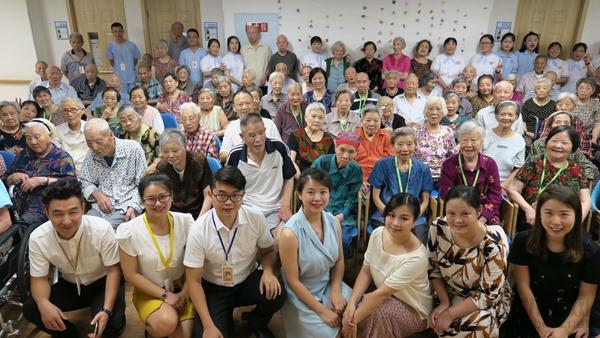
Moreover, the compact scale makes it easier to cultivate a positive atmosphere. Liu Jin told reporters that visitors to Bao’en would observe daily playful interactions between residents and caregivers, creating an overall joyful and harmonious environment within the facility. To maintain this atmosphere, Bao’en also conducts preliminary screening of elderly applicants; only those who pass medical examinations and trial stays are approved for formal admission.
(Image source: Provided by the company)
There are always systematic approaches to institutional expansion. So, how can we help the elderly understand and embrace Bao’en Elderly Care?
The Allure of Referrals
Liu Jin stated that Bao’entang’s current development pace is within expectations—neither particularly rushed nor overly slow—with both caregivers and clients primarily acquired through referrals from existing acquaintances.
At the 2016 Two Sessions, CPPCC member Wu Youying pointed out that the annual turnover rate of elderly care workers exceeded 30%. According to industry insiders, the current turnover rate is even higher. However, VCBeat has learned that Bao’en Elderly Care kept its full-year caregiver turnover rate below 8% in 2018 (including caregivers dismissed by Bao’en itself), without violating market principles by offering exorbitant salaries.
Liu Jin jokingly referred to this as the charm of referrals. In her view, “older” caregivers are preferable; with greater nursing experience, more refined technical skills, and higher staff stability, older caregivers possess a stronger competitive edge. It is understood that the average age of Bao’entang caregivers is over 45 years.
In reality, if a company lacks cultural identity and appeal, it will not be able to retain talent. At Chengdu Bao'entang Elderly Care Service Co., Ltd., caregivers undergo one to two weeks of training before joining the team. The first session focuses on corporate culture, helping employees understand the value of their work and acquire knowledge in a harmonious atmosphere. Following the training, the company employs a “mentorship” system to help new caregivers gradually get up to speed.
In addition, Bao'en Elderly Care has introduced the concept of “Meticulous Care, Joyful Health” and launched 12 major categories of activities for seniors. These activities are designed to train their visual, auditory, gustatory, tactile, and motor functions, thereby facilitating successful aging.
VCBeat has learned that, to date, Bao’en Elderly Care has opened three facilities, with over 350 operational beds in the Yongling and Guanghua areas. All three facilities are expected to commence operations in 2019.
It is reported that, following the establishment of a strategic partnership with China Resources Weilin, China Resources Weilin will leverage the resources of China Resources Group in real estate, healthcare, and pharmaceuticals, as well as the advantages of its big health industry platform—a key focus during the 13th Five-Year Plan period. Additionally, by drawing on the advanced experience of leading domestic and international elderly care enterprises such as Shanghai Hongri Elderly Care and Armonea, a leading European elderly care chain brand, China Resources Weilin will provide resources and assistance to Bao’en Elderly Care in multiple areas, including improving the quality of elderly care operations, enhancing professional management, and expanding projects.