

Trump Alarmed as U.S.-China AI Supremacy Battle Intensifies, Especially in Healthcare
The United States, which touts itself as a leader in artificial intelligence, has issued an executive order in the name of the White House, with the primary aim of maintaining its AI dominance. The plan encompasses five dimensions—policy, objectives, responsibilities, government investment, and AI resources—and addresses key concerns of the AI industry, including R&D capabilities, resource allocation, approval processes, ethical standards, and talent development.
The United States’ prowess in artificial intelligence is unquestionable, with no rival having surpassed it to date. However, given the multitude of R&D teams across the globe, any team still has the potential to overtake the leaders in this evolving technological landscape.
Since Trump took office, such proactive measures have not been common. However, this political directive directly targeting technology has undoubtedly provided a significant boost to AI companies, signaling an intent to elevate AI to the status of an “era” as monumental as the “Internet Age,” underscoring the palpable sense of urgency.
Can artificial intelligence shoulder the heavy responsibilities of this era and bring about another revolution in productivity? At least in the healthcare sector, AI entrepreneurs firmly believe so and are making continuous efforts. In this field, the competition between China and the United States has long been underway.
For an emerging technology, government-level influence is crucial to the development of AI. Medical artificial intelligence, which emerged in the second half of the internet boom, has faced a mature regulatory framework since its inception. Unlike traditional medical devices and pharmaceuticals, which experienced a period of unregulated growth, every move in medical AI is subject to strict regulations. Here, we explore future possibilities from the perspectives of data and approval processes.
For artificial intelligence technology, algorithms, computing power, and data constitute its three core elements, with data being the most critical among them. Any algorithm must undergo rigorous training with data, and the quality, completeness, and accuracy of such data directly determine AI’s performance in real-world applications. Therefore, regardless of whether in China or the United States, controlling the sources of data is tantamount to holding the lifeline of AI development.
Part II of this Executive Order states: “Enhance access to high-quality and fully traceable Federal data, models, and computing resources to increase the value of such resources for AI R&D, while maintaining safety, security, privacy, and confidentiality protections consistent with applicable laws and policies.” This provision unequivocally reflects the U.S. government’s efforts to advance AI development through initiatives focused on data.
In comparison, China has not fallen behind; on the contrary, under the leadership of the National Medical Products Administration (NMPA), we are pursuing a path of independent innovation. In 2018, databases for pulmonary nodules and fundus imaging were initially established, many AI products received Class II medical device certification from the NMPA, and the approval process and guidelines for Class III devices have been publicly released...
These actions demonstrate the state’s determination to promote technological innovation. However, it remains unclear whether new policy combinations—such as opening public databases or easing approval processes—will be introduced to accelerate the commercialization of AI, thereby attracting more talent and capital investment into the AI sector through market mechanisms. What is certain is that the advancement of approval policies, along with the establishment of industry standards such as data standardization and de-identification (similar to those in the United States), will become the primary focus of the National Medical Products Administration (NMPA), reflecting a strategy of “seeking progress while maintaining stability.”
Regarding regulatory approval, the FDA has accumulated far more experience than China’s former CFDA. To date, the FDA has approved multiple AI-based medical products, including Aterys’ oncology AI solution from the United States, Viz.ai’s stroke AI product, Israel’s Aidoc brain imaging analysis AI tool, and Subtle Medical’s PET-related AI product developed by a Chinese-American team.
Enterprise | Country | Functional Value |
Arterys | United States | Oncology AI, applied to the heart, liver, and lungs. It received FDA clearance in 2017, while the liver and lung AI modules obtained FDA 510(k) clearance in 2018, assisting clinicians in rapidly measuring and tracking organ lesions and nodules on MRI and CT scans. |
Viz.ai | United States | Analyze contrast-enhanced CT images to assess the severity of stroke |
IDx | United States | IDx-DR, the world’s first FDA-approved AI-powered medical device, features a built-in camera that captures images of patients’ eyes to detect diabetic retinopathy. |
Imagen Technologies | United States | OsteoDetect uses AI algorithms to help doctors determine carpal fractures and fracture locations more quickly. |
DreaMed Diabetes | United States | AI-Based Clinical Decision Support Software for Diabetes Treatment |
Cognoa | United States | Class II Diagnostic Medical Device for AI-Assisted Autism Screening |
Zebra Medical Vision | United States | Analysis of Coronary Artery Calcium Scoring Using CT Images Acquired with Electrocardiogram Gating Technology |
Aidoc | Israel | Analyze patients' brain CT images to assess the likelihood of suspected acute intracranial hemorrhage, helping radiologists optimize their workflow. |
iCAD | United States | Detects breast density to assist in early screening for breast cancer |
Max Q | Israel | Analysis of Non-Contrast Cranial CT Scans for the Diagnosis of Intracranial Hemorrhage |
Subtle Medical | United States | Subtle PET, which received FDA clearance in December 2018, can significantly accelerate PET imaging speed and reduce contrast agent usage. |
Domestic companies have also remained vigilant in their regulatory approval efforts. In addition to pursuing certifications for innovative medical devices and Class II device approvals from the National Medical Products Administration (NMPA), many enterprises have submitted product applications to the U.S. Food and Drug Administration (FDA) and achieved notable success. Beyond the numerous AI companies that obtained Class II device approvals in 2018, Lepu Medical’s “AI-ECG Platform,” an artificial intelligence-based automated ECG analysis and diagnostic system, received FDA clearance at the end of 2018, becoming the first ECG AI product from China to be approved by the FDA.
Although U.S. AI startups raised $1.9 billion in venture capital in the first quarter of 2018 alone, statistics from the first three quarters show that only a negligible amount flowed into the healthcare sector. According to data from VCBeat, between January and August 2018, there were only 14 AI healthcare startup projects in the United States, with total financing of approximately $470 million, whereas China had 55 such projects, with total financing reaching $792 million.
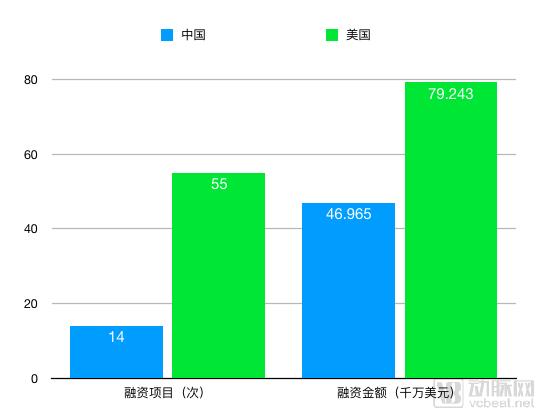
From the perspective of overall financing trends, although there are fewer projects in the United States, the amount raised per round is larger, the projects are more mature, and their distribution is relatively balanced. In contrast, most AI products in China are concentrated in the field of AI-based medical imaging. Excluding Yitu’s $200 million and Unisound’s nearly $200 million in funding, the total financing for the remaining 53 Chinese projects is less than the combined total raised by just 14 projects in the United States.
However, from the perspective of startups, both Chinese and American investments have their respective advantages and disadvantages. Although the financing amounts for various projects in the United States are substantial, the lack of early-stage projects means there is insufficient fresh blood to participate in competition, which is not what one would expect from cutting-edge technology. While China has numerous new projects, they tend to cluster in the imaging sector, leading to intense competition, whereas fields such as new drug development and hospital management see little participation.
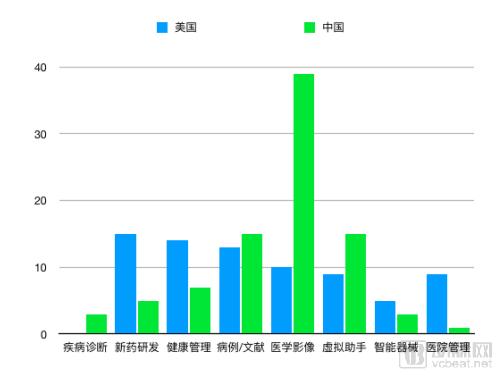
Overview of the Layout of Medical AI Companies in China and the United States (Data sourced from Liu Shiyuan’s presentation at the inaugural Medical Imaging Conference)
Ultimately, the difficulty of commercialization is a shared challenge for both China and the United States, and it remains the core factor restricting capital inflows. As Dr. Fan Wei, head of Tencent AI Lab, stated, “We are focused on R&D and are not considering commercialization at this time.” Although artificial intelligence has been a hot topic for several years, it has only been a few years after all.
In this regard, we can see that,In the section titled “Government Investment in and Development of Artificial Intelligence” in Part IV, the author states: “Projects overseen by AI project leads will be treated as priorities and shall have priority eligibility for R&D budget funding.”This will address the issue of project funding, second only to data. Perhaps we will see more U.S. AI startups emerge across various sectors in the new year.
Recently, CB Insights announced its Global AI 100 list. Six Chinese companies were honored with inclusion: SenseTime, Yitu Technology, Megvii, Momenta, Horizon Robotics, and 4Paradigm.
If startups represent the vitality of a sector, then unicorns symbolize its hope. Among the 11 unicorns on the list, five are from China and five from the United States, resulting in a tie.
Company | Field | Country | Peak Valuation (USD 100 Million) |
SenseTime | Security, Autonomous Driving | China | 45 |
Yitu Technology | Security, Finance, Healthcare | China | 23.65 |
4Paradigm | Finance,Insurance,Internet | China | 12 |
Megvii | Facial Recognition | China | 10 |
Momenta | Environmental Perception, Autonomous Driving | China | 10 |
UiPath | Corporate Technology | United States | 30 |
Automation Anywhere | Corporate Technology | United States | 26 |
C3 | Industry | United States | 15.64 |
Butterfly Network | Medical | United States | 12.5 |
Pony.ai | Autonomous Driving | United States | 10 |
Graphcore | Semiconductor | United Kingdom | 17 |
Among these companies, SenseTime, 4Paradigm, and Yitu have all made strategic moves in the healthcare sector. Yitu, in particular, has positioned healthcare as its core business and established Yitu Healthcare as a separate entity to develop artificial intelligence applications in medicine, achieving significant breakthroughs in areas such as pulmonary nodule imaging and natural language processing (NLP). Recently, the prestigious international medical research journal Nature Medicine published an article titled “Evaluation and accurate diagnoses of pediatric diseases using artificial intelligence,” which employed Yitu’s NLP technology.
Thus, while Trump’s move was radical, it remained within the bounds of reason; how could ingrained American pride allow him to endure the slight of being treated as an equal?
Even in terms of innovation, China has amassed sufficient capital to compete. However, when comparing strengths, we must take into account global giants such as Silicon Valley’s FAANG companies, with Google in particular having invested substantial resources.
In November 2018, DeepMind announced that its health division, DeepMind Health, along with the team responsible for advancing “Streams” (a mobile app designed to help physicians more rapidly identify and diagnose patient conditions), would be reorganized and merged into Google’s newly established “Google Health” division. The former subsidiary, DeepMind Health, would no longer exist as an independent brand; however, other divisions of DeepMind would remain independent.
By comparison, BAT’s strategic footprint in the field of artificial intelligence shows no signs of lagging behind.
In the field of medical artificial intelligence, Tencent regards it as a strategic initiative to establish its business-to-business (B2B) presence. In addition to the core Tencent Medical AI Laboratory, related entities such as Youtu Lab and AI Lab have also contributed expertise to Tencent’s medical AI ecosystem. In late 2018, Tencent was awarded another key special project on “Research and Development of Digital Diagnostic and Therapeutic Equipment,” aimed at developing an Artificial Intelligence-Assisted Clinical Decision Support System (AIACDSS). Through this initiative, Tencent will gain substantial training data and AI development experience from scientific research collaborations, while Tencent Cloud will play a more profound role in the AI healthcare sector.
Alibaba has deployed its ET Industrial Brain, ET City Brain, ET Agricultural Brain, and ET Healthcare Brain by leveraging its robust cloud services. In the healthcare sector, Alibaba Cloud is committed to collaborating with stakeholders in the medical field to apply data intelligence in a focused, prudent, and intelligent manner, thereby assisting doctors and nurses in delivering superior medical care to patients and saving more lives.
Baidu’s AI capabilities have consistently ranked among the world’s best, backed by robust computational power. Given that the vast majority of AI imaging algorithms are based on transfer learning, Baidu—which focuses on computer vision and autonomous driving technologies—could easily enter the medical AI sector. The key question is whether direct investment in this field is necessary. Currently, Baidu Lingyi is already beginning to make its presence felt in the healthcare industry.
Today, the United States’ advantage is no longer as pronounced as it once was, while the FAAGE companies themselves continue to pose challenges for the federal government due to issues such as monopolistic practices and data concerns. Tencent’s recent acquisition of Reddit, often dubbed the “American Tieba,” further underscores the global M&A ambitions of China’s BAT (Baidu, Alibaba, and Tencent). From any perspective, it is imperative for the United States to urgently safeguard its hegemonic position in frontier technologies.
Although the gap in artificial intelligence technology between China and the United States is continually narrowing, the U.S. still retains means to constrain China’s progress.
VCBeat has learned that in the field of medical artificial intelligence, nearly all companies rely on chips (or cloud computing) from NVIDIA and Intel to provide computational power for algorithm training. Although DeepThinking has independently developed AI-related medical chips, it still depends on NVIDIA’s support when training algorithms.
Huawei is not the first company to be restricted by the United States through legal means. Over the past decade, U.S. judicial and regulatory agencies have launched extraterritorial enforcement actions against dozens of large foreign corporations. The former French energy giant Alstom, for instance, was ultimately acquired by GE following intervention by the U.S. Department of Justice.
Although the chip industry features high technical barriers, long R&D cycles, and stringent requirements for capital and talent, the United States has already accumulated substantial advantages. Nevertheless, Trump is indeed apprehensive. The rise of Huawei’s 5G chips has significantly undermined the dominant position of U.S. internet technology. What Trump truly fears may be the emergence of another “Huawei.”
Therefore, Trump’s executive order also warrants the attention of enterprises in China. In national-level competition, science has borders; as our fortunes are intertwined, the development of artificial intelligence requires concerted efforts from all enterprises.