

BioNTech Raises $695 Million in Two Rounds in 2018, Attracting Global Investor Interest

BioNTech
Developer of Novel Biologics
2018 was a year of robust growth in the biotechnology sector. According to VCBeat’s “2018 Investment and Financing Report on Healthcare,” biotechnology emerged as the hottest subsector within the global healthcare industry in 2018, with total financing reaching $13.845 billion, accounting for 35.68% of the total and far outpacing other sectors.
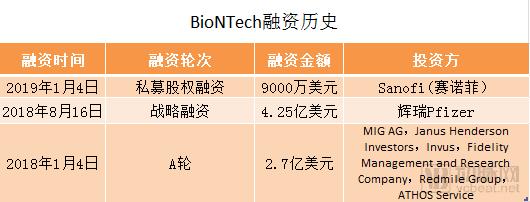
As Europe’s largest privately held biopharmaceutical company, BioNTech secured a total of $695 million in financing in 2018, emerging as a leader in global biotechnology fundraising. In fact, although BioNTech was founded in 2008, it did not close its $270 million Series A round, led by Redmile Group, until January 2018. How did BioNTech achieve rapid growth and attract significant investor interest during its ten years of relative obscurity?
BioNTech possesses a diverse portfolio of cutting-edge technologies, including personalized mRNA drug candidates, innovative chimeric antigen receptor (CAR) therapies, T-cell receptor (TCR)-based compounds, novel checkpoint immunomodulators, small-molecule drugs, and companion diagnostic products.
BioNTech’s personalized mRNA technology has established three therapeutic platforms: cancer immunotherapy, infectious disease vaccines, and protein replacement therapy.
The cancer immunotherapy platform uses next-generation sequencing (NGS) and proprietary analytical algorithms to define these tumor-specific antigen profiles. Using these profiles, or “variants,” therapies are customized for each tumor, thereby activating each patient’s immune system to recognize, target, and combat their individualized cancer.
The infectious disease platform is primarily dedicated to developing vaccines against novel viruses. Conventional vaccines, produced through inactivation or engineering of viruses, are often constrained by seasonal factors and struggle to achieve mass production in the shortest possible timeframe to curb large-scale outbreaks of infectious diseases. BioNTech is developing an innovative self-amplifying RNA platform, A.I.R. (Amplified Immune Response), which holds the promise of producing millions of doses of preventive vaccines against specific viruses within the shortest possible time.
The protein replacement platform targets rare genetic diseases, using BioNTech’s non-immunogenic mRNA platform and proprietary technology to deliver mRNA encoding therapeutic proteins or antibodies into the human body.
BioNTech’s CAR and TCR platforms are rapid and flexible, enabling the isolation of TCRs from a patient’s single T cell in as little as 11 days. The company has developed a broad and diverse portfolio of immune receptor candidates, including: more than 160 functional, experimentally validated TCRs targeting over 20 different tumor antigens; and more than 60 T cell products with modified antigen epitopes.
BioNTech also possesses two key protein therapeutic platforms: bispecific antibodies and nanoparticles. Furthermore, in 2010, BioNTech acquired Microbody technology, which led to the development of the SAPHIR® platform—highly immunogenic, self-assembling nanoparticles that can induce specific and effective immune responses in the human body against cancer and for vaccines.
BioNTech has developed small-molecule drug therapies for oncology indications, with several small-molecule candidates having successfully advanced into preclinical or clinical research stages. The company also launched MammaTyper, a molecular subtyping assay for breast cancer, in 2015.®. Studies have demonstrated that MammaTyper®With extremely high diagnostic accuracy, MammaTyper, compared to current conventional clinical detection methods,®Not only does it hold an advantage in predicting disease-free survival and overall survival, but it also demonstrates significant technological advancement. BioNTech's MammaTyper®It also reached a commercialization partnership with China Shuwen Biotechnology.
BioNTech’s successful fundraising owes much to its seasoned founding team, whose members have established expertise in drug development, corporate management, and mergers and acquisitions. The key members of the founding team include:
Professor Ugur Sahin, the company’s CEO and Co-Founder, as well as Co-Founder and Chairman of the Translational Oncology at the University Medical Center of Johannes Gutenberg University Mainz (TRON), co-developed the SEREX and MicroGATE™ technologies. He is also an entrepreneurial researcher and inventor who has made significant contributions to more than 60 independent patents in the life sciences and biotechnology sectors, and his TRON project was awarded the BMBF Spitzencluster Award.
Sean Marett, the Company’s CBO and CCO, brings 30 years of international experience in operations, sales and marketing licensing, mergers and acquisitions (M&A), and new product development management. He has previously worked at major pharmaceutical companies such as GSK and Pfizer, where he successfully completed multiple large-scale pharmaceutical service transactions and negotiated numerous M&A deals.
Dr. Sierk Poetting serves as Vice President and Chief Financial Officer of Sandoz’s North American division. He has eight years of experience at Novartis in quality control and process planning for mergers and acquisitions, acquisitions, facility management, IT, and procurement, and has participated in the negotiation and planning of multiple M&A transactions.
Dr. med. Özlem Türeci, a member of the Executive Committee of the Cancer Immunotherapy Association (CIMT), has published more than 110 peer-reviewed articles and holds over 80 patents. She possesses profound expertise in cancer research and immuno-oncology, with more than 25 years of R&D experience, particularly in identifying drug targets for immunotherapies, developing antibodies, and creating vaccine-based therapies.

BioNTech Management Team (from left to right)
Personalized mRNA therapies are BioNTech’s primary focus. In 2018, BioNTech entered into three agreements concerning mRNA technology with the University of Pennsylvania, Pfizer, and Genevant Sciences.
Furthermore, in 2018, several major transactions involving mRNA technology were completed globally. In October, Eli Lilly and CureVac signed a blockbuster deal worth $1.8 billion to jointly develop five novel mRNA-based cancer vaccines. In November, CRISPR Therapeutics announced an investment in CureVac to develop Cas9 mRNA for in vivo gene editing. Another mRNA research company, Moderna, also secured substantial investor support and initiated clinical studies on its personalized cancer vaccine, mRNA-4157.
From the current perspective, investors are showing great enthusiasm for mRNA therapies. In the case of BioNTech, multiple mRNA research projects have entered Phase I clinical trials.
James Sabry, Senior Vice President of Partnering and Global Head at Genentech, stated, “Through our collaboration with BioNTech, we aim to truly advance cancer therapies tailored to individual patients by leveraging a common molecular platform—mRNA.” By rapidly sequencing the patient’s cancer genome, unique mutation profiles—referred to as “neoantigens” or “neoepitopes” (“variants”)—present in the tumor of each specific patient are identified. mRNA vaccines encoding the selected neoepitopes are then manufactured based on the variant profile of each tumor, thereby eliciting highly specific anti-tumor immune responses that ultimately target cancer cells with precision.
Dr. Drew Weissman, Professor of Medicine in the Division of Infectious Diseases at the Perelman School of Medicine, University of Pennsylvania (Penn), stated: “Nucleoside-modified mRNA vaccines hold potential beyond that of traditional vaccines, as they can encode virtually any antigen for nearly any pathogen, while being more cost-effective and faster to produce. By combining Penn’s strengths in immunotherapy, molecular biology, and mRNA expertise with BioNTech’s innovative technology platform, we can develop more personalized vaccines targeting a wide range of infectious diseases.”
In fact, mRNA therapy is not a new technology. As early as 1990, the foundations of mRNA therapy were laid when scientists injected in vitro-transcribed messenger RNA (mRNA) into mice. Subsequent analysis revealed that the mRNA was biologically active in vivo, leading to the production of relevant proteins and eliciting an immune response.
mRNA influences immune responses by participating in the intermediate steps of DNA transcription and protein synthesis. Currently, two types of RNA are used in vaccine manufacturing: non-replicating mRNA and self-amplifying mRNA. Traditional mRNA vaccines contain only the 5ʹ and 3ʹ untranslated regions (UTRs) in addition to the antigen-encoding sequence, whereas self-amplifying RNA not only encodes antigens but also includes sequences resembling viral replication processes, enabling intracellular replication and enhanced protein expression.
Simply put, in vitro transcribed RNA utilizes DNA templates and RNA polymerases, including T7, T3, or SP6 bacteriophage polymerases, to generate an open reading frame with protein-coding functionality. Two critical components of this reading frame are a 5’ cap structure and a polyadenylated (poly-A) tail.
In addition, this reading frame contains a non-coding region that enhances the stability of the complex during transcription, enabling synthetically produced mRNA to facilitate transcriptional assembly in a manner similar to mature mRNA molecules. Naked mRNA is highly susceptible to catalytic degradation by extracellular ribonucleases; therefore, mRNA is typically delivered via various vectors to improve its uptake efficiency in the human body. Once the mRNA enters the cytoplasm, the cellular translation machinery directs the assembly of amino acid sequences, followed by post-translational modifications and proper folding to form functional proteins.
The efficacy of vaccine-induced adaptive immunity is heavily dependent on the magnitude of the initially triggered innate immune response. mRNA is recognized by intracellular Toll-like receptors (such as TLR7 and TLR8) and cytoplasmic sensors (such as RIG-I and MDA-5), thereby triggering these receptors to produce pro-inflammatory cytokines, which confers intrinsic adjuvant activity. In terms of efficacy, an advantage of mRNA vaccines is that they do not need to cross the nuclear membrane, unlike DNA. Compared with peptide chains, mRNA vaccines are not restricted by MHC haplotypes.
Compared with traditional vaccines, mRNA vaccines offer superior safety profiles; they do not induce insertional mutagenesis, are degradable by normal cells, and their half-life can be modulated through sequence modifications and delivery vectors.
In June 2009, BioNTech acquired EUFETS GmbH and JPT Peptide Technologies GmbH. EUFETS is a company providing GMP and GLP services for innovative biopharmaceuticals, while JPT Peptide Technologies GmbH specializes in research on innovative peptide-related compounds. In September 2017, BioNTech obtained a license to use CELLSCRIPT’s nucleoside-modified RNA technology. BioNTech’s series of acquisitions and collaborations have further strengthened its proprietary mRNA technology.
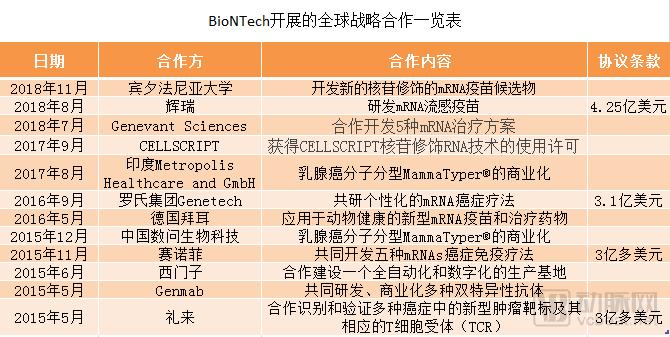
Faced with substantial R&D expenditures, collaborating with pharmaceutical giants on research and development is a viable strategy. Since 2015, BioNTech has engaged in global strategic partnerships with multiple leading biotechnology companies to jointly develop personalized mRNA cancer therapies, mRNA influenza vaccines, and other products.
In its strategic collaboration with Pfizer, BioNTech received a $120 million upfront payment and is eligible for $305 million in future milestone payments. In its partnership with Sanofi, BioNTech secured $60 million in near-term milestone payments and will receive $300 million covering development, regulatory, milestone, and other payments per product. The collaboration with Genentech, a member of the Roche Group, yielded $300 million in upfront and near-term milestone payments. Additionally, under the 2015 cooperation agreement with Eli Lilly, BioNTech received a $30 million signing fee. For each potential drug that reaches the market, BioNTech is entitled to over $300 million in development, regulatory, and commercial milestone payments. Upon successful commercialization, BioNTech is also eligible for double-digit royalty rates.
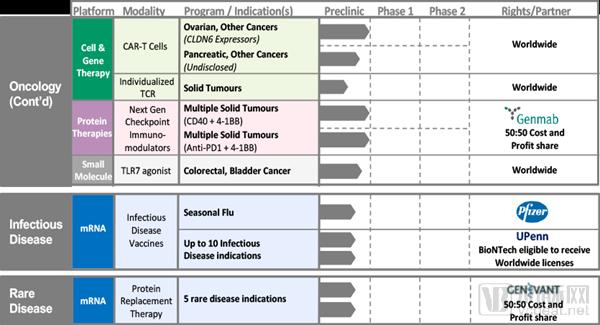
Multi-Project Early-Stage R&D Pipeline
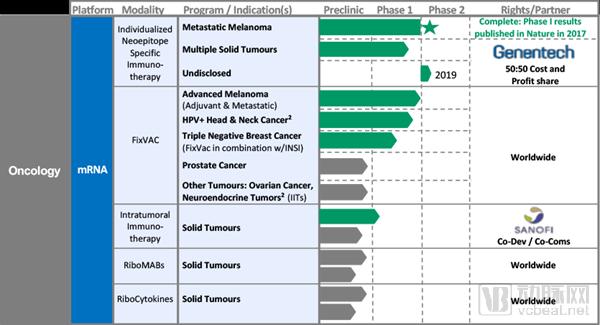
Oncology mRNA Drug Development Pipeline
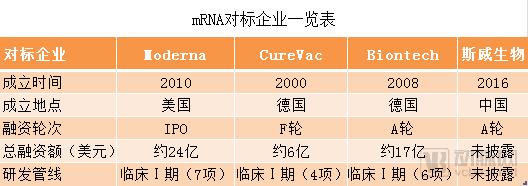
The use of mRNA technology for vaccine development, cancer treatment, and other applications is not exclusive to BioNTech. U.S.-based Moderna focuses on the research and development of mRNA vaccines for infectious diseases, oncology, immunological disorders, and rare diseases, completing a $604 million initial public offering (IPO) on December 6, 2018. The company currently has nine mRNA vaccine candidates in its pipeline, seven of which have entered Phase I clinical trials.
CureVac’s mRNA platform in Germany is not limited to the development of vaccines for influenza, rabies, and other diseases; it also encompasses mRNA-based cancer therapies and molecular therapies. The company has more than ten candidates in its pipeline, including three mRNA-based cancer therapies that have entered Phase I clinical trials, as well as one mRNA rabies vaccine that has also advanced to Phase I clinical trials.
Stemirna Therapeutics, a Chinese enterprise developing mRNA platforms, was founded in 2016 and has completed its Series A financing. Its novel, independently developed lipid-polymer nanoparticle (LPP) delivery platform, LPP/mRNA®, ensures the safety and efficacy of mRNA drug delivery through a unique bilayer structure. Stemirna currently has over ten self-developed mRNA new drug R&D projects, focusing on personalized mRNA cancer vaccines, mRNA infectious disease vaccines, mRNA therapeutics for protein-deficiency disorders, and mRNA treatments for genetic diseases. The company planned to submit its first product for clinical trial approval in China and the United States in 2020, with several innovative drugs expected to enter clinical studies by 2022.
BioNTech primarily focuses on the development of mRNA-based therapeutic cancer vaccines, while also maintaining programs in CAR-T cell therapy, bispecific antibodies, and small-molecule drugs. Compared with CureVac and Moderna, BioNTech boasts a more comprehensive product portfolio, with up to 20 candidates in its pipeline, six of which have entered Phase I clinical trials. Furthermore, BioNTech places greater emphasis on the development of personalized vaccines, a key area of interest for its strategic partners such as Genentech and the University of Pennsylvania.
Looking back at BioNTech’s development over the past decade, its core competitiveness lies in acquiring technologies and companies to develop multiple personalized technology platforms, while global strategic partnerships have served as a crucial pathway for the R&D and commercialization of its multi-product pipeline. In contrast, immunotherapies in China are predominantly concentrated in the CAR-T field. Statistics show that there have been a total of 26 IND applications for CAR-T therapies in China, with minimal involvement in the mRNA sector.
On the other hand, Shanghai Siwei Biotechnology, a domestic mRNA platform R&D enterprise, started relatively late but has established China’s first mRNA GMP manufacturing center for the production of mRNA drugs and related formulations. Although the mRNA field presents high technical barriers and limited experience, both domestic and international benchmark companies have developed or acquired mature mRNA delivery technologies and are engaging in joint research through strategic collaborations.