

Etu Medical's NLP-Based AI System for Pediatric Diagnosis Featured in Nature Medicine: A Milestone in Clinical AI
At 00:14 on the 12th (Beijing Time), the internationally renowned medical research journal Nature Medicine published an article online titled “Evaluation and accurate diagnoses of pediatric diseases using artificial intelligence.”
This research finding was achieved by a collaborative effort involving Professor Huimin Xia and Professor Kang Zhang (University of California, San Diego) from Guangzhou Women and Children’s Medical Center, Dr. Huiying Liang from the Data Center, Director Xin Sun from the Medical Affairs Department, and Director Liya He from the Pediatric Internal Medicine Outpatient Clinic, together with top-tier industry research teams including Hao Ni’s team at Yitu Healthcare and Kangrui Intelligent Technology, as well as the Guangdong Provincial Key Laboratory of Regenerative Medicine, leveraging artificial intelligence technology for the diagnosis of pediatric diseases.
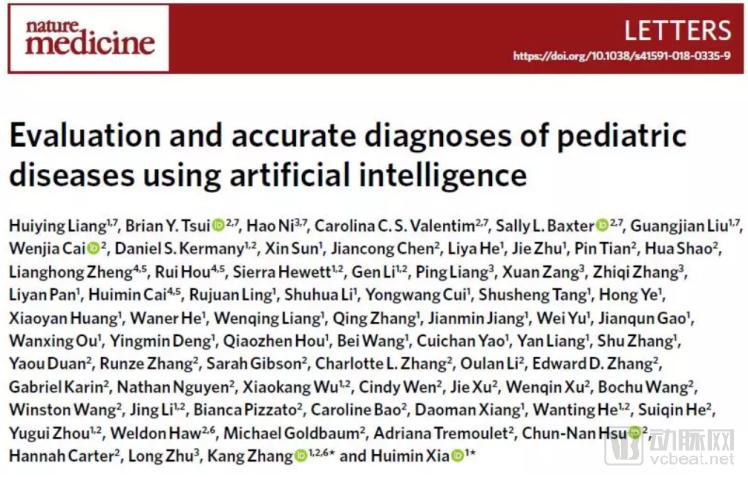
This marks the first time globally that research findings on using natural language processing (NLP) technology for clinical intelligent diagnosis based on Chinese text-based electronic medical records (EMRs) have been published in a top-tier medical journal. At its core, the study leverages textual case data of pediatric diseases to train artificial intelligence, aiming to achieve intelligent diagnosis.
So, why is this considered a milestone victory? VCBeat interviewed Yitu Healthcare CEO Ni Hao and Dr. Liang Huiying from Guangzhou Women and Children’s Medical Center to uncover the story behind this project.
Natural Language Processing is a critical branch of artificial intelligence technology. Its purpose is to enable AI, building upon image recognition capabilities, to automatically learn diagnostic logic from medical record text data (encompassing physicians’ knowledge and language), thereby gradually acquiring the ability to reason through clinical analysis. This allows AI to further comprehend and analyze complex cases, progressively empowering it to “think” like a physician.
The aim of this research is to embody human intelligence in machine form; therefore, artificial intelligence (AI) learning involves mastering the daily clinical workflow of physicians. Routine clinical consultations encompass the traditional Chinese medical diagnostic methods of inspection, auscultation and olfaction, inquiry, and palpation, as well as the Western medical techniques of inspection, palpation, percussion, and auscultation. In other words, when diagnosing patients, physicians must integrate multiple sources of information—including the patient’s chief complaints, symptoms, personal history, physical examination findings, laboratory test results, imaging study results, and even medication history prior to hospital visitation—to make a comprehensive assessment of the condition. If AI can ingest, digest, and absorb all these data inputs, it will be able to generate a diagnostic output when physicians or patients enter symptom information.
Liang Huiying stated, “To achieve AI simulation of physician consultations and clinical reasoning, the following must be accomplished: First, it must automatically learn diagnostic logic from textual medical records. While physicians learn from textbooks, artificial intelligence learns from millions of electronic health records (EHRs). Second, after learning, the AI must possess certain reasoning capabilities for disease analysis. Third, it must be able to interpret various types of pediatric textual medical records like human physicians do and provide accurate intelligent recommendations. In simple terms, once this algorithm matures, patients will be able to obtain professional diagnostic results without needing to search on Baidu when they notice symptoms.”
In practice, Ni Hao believes that this process will unfold in two stages: “The first stage involves deconstructing responsibilities and data across various domains. So-called deconstruction refers to extracting information points from data. A crucial foundation of this article is the establishment of a high-quality, structured disease-specific database based on deconstructed electronic medical record (EMR) data, upon which diagnostic models are built. The second stage is semantic understanding, i.e., training machine learning models to fully comprehend human language. This stage is considerably challenging, and the entire industry still has a long way to go; however, Yitu’s work has already achieved the initial phase of semantic understanding.”
Previous studies published in top-tier journals utilized datasets on the order of 100,000 records. In contrast, the artificial intelligence system in this experiment analyzed data from nearly 600,000 pediatric patients, encompassing 1.36 million electronic medical records (EMRs). All patients were children, with a mean age of 2.5 years, and 40% were female. The data structure covered multiple domains, including chief complaints, symptoms, personal history, physical examination findings, laboratory test results, imaging findings, and medication information. The cohort included 55 diseases across specialties such as gastroenterology and pulmonology, covering more than 75% of common pediatric conditions. For critical conditions such as meningitis, specific experimental designs were implemented to enhance the diagnostic capability of the artificial intelligence system.
The research team leveraged Yitu Healthcare’s natural language processing (NLP) technology to develop an intelligent medical record analysis system that deeply mines and analyzes information within medical texts, transforming unstructured clinical data into normalized, standardized, and structured formats to enable AI to accurately and comprehensively “interpret” medical records. To achieve this, physicians, scientists, and technologists collaborated closely; a multidisciplinary expert panel comprising more than 30 senior pediatricians and over 10 informatics researchers manually annotated more than 6,000 charts in electronic health records and continuously validated and iterated the model.
Charts serve as auxiliary codes for researchers studying diseases, with the purpose of identifying the characteristics of a specific disease. If a disease has approximately 300 meaningful characteristics, artificial intelligence can diagnose it once these features are input. In practice, the most comprehensive electronic medical records documented by physicians contain around 100 characteristic features.
Meanwhile, the chart structures vary across different diseases; some conditions lack diagnostic data, while others encompass multidimensional information such as family history, chief complaints, laboratory tests, imaging studies, and ultrasound examinations. Researchers must differentiate between charts under these varying circumstances.
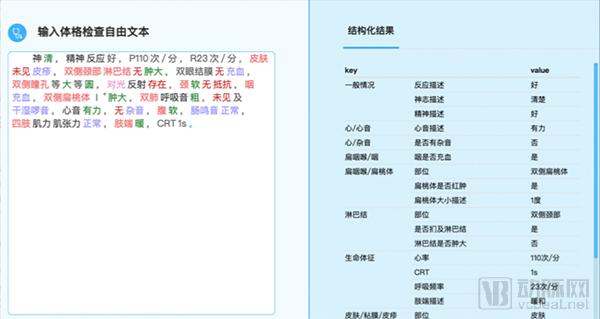
Supported by a comprehensive database, the trained model has demonstrated excellent performance. For certain diseases, for example: the accuracy for nervous system disorders was 0.98, for respiratory system disorders 0.92, and for systemic diseasesFor0.87, with the lowest accuracy for the digestive system at 0.85. When disease classification is further refined, the accuracy for the upper respiratory tract is 0.89, while that for the lower respiratory tract is 0.87.
Variations in accuracy across different diseases stem from differences in data and features. The more disease-specific symptoms a condition presents, the easier it is for AI models to learn, as these specificities provide the necessary prerequisites for differentiation. Meanwhile, AI systems trained on larger datasets demonstrate superior accuracy, a principle that applies equally to both humans and machines.
Ni Hao provided a pertinent example: “If a patient suffers from acute laryngitis, but the location and symptoms resemble those of bronchitis, differentiating between the two conditions requires identifying symptoms specific to laryngitis. Since physicians may fail to document relevant symptoms, such information is often missing from medical records, leading to misdiagnosis. To address this, we have implemented the following solution: If the system suspects acute laryngitis but does not rank it as the most likely diagnosis (i.e., it is not the top-confidence prediction), the artificial intelligence will proactively inquire whether inspiratory stridor—a characteristic feature of acute laryngitis—is present. This is a clinical step that physicians frequently overlook. Although the current accuracy has reached a certain level, there is still room for improvement. By adopting this approach, we can gradually enhance the system’s accuracy beyond its existing baseline.”
When asked why pediatrics was chosen as the breakthrough point, in addition to the comprehensive data provided by Guangzhou Women and Children’s Medical Center, the challenging reality of pediatric care was also a significant factor in Ni Hao’s team’s decision to conduct experiments in this field. “Pediatricians are extremely scarce in China, and tertiary hospitals are always overwhelmed during flu season. Furthermore, pediatrics is often referred to as a ‘silent specialty,’ as many young children lack strong language skills and cannot provide detailed accounts of their symptoms. This is precisely why we have remained committed to making substantial investments in pediatrics.”
“I have long envisioned a scenario in which, upon the conclusion of the doctor–patient consultation, a speech recognition assistant linked to the electronic medical record (EMR) system has already generated the EMR documentation, while an auxiliary diagnostic system has analyzed the case and provided recommendations for further examinations. This approach would significantly enhance hospital efficiency and effectively liberate physicians from administrative burdens.”
Overall, this study represents a successful endeavor, laying a solid foundation for the development of NLP technology in other medical departments. In future research, Yitu Healthcare will extend its product offerings along the patient care journey, including but not limited to treatment plans, nursing protocols, health guidance for patients’ parents, and internet hospital scenarios.
By leveraging internet technology to transcend geographical barriers, utilizing speech recognition to overcome limitations in consultation methods, and employing intelligent diagnostics to break through constraints on hospital efficiency, Yitu Healthcare is continuously disrupting traditional healthcare models with technology, making artificial intelligence accessible to more patients. Perhaps the idealized model of healthcare we envision is no longer out of reach...