

Hengrui Medicine 2018 Annual Report: Revenue of RMB 17.4 Billion, Oncology Portfolio Contributed 42%; R&D Investment Reached RMB 2.67 Billion, Up 51%
Source: PharmCube
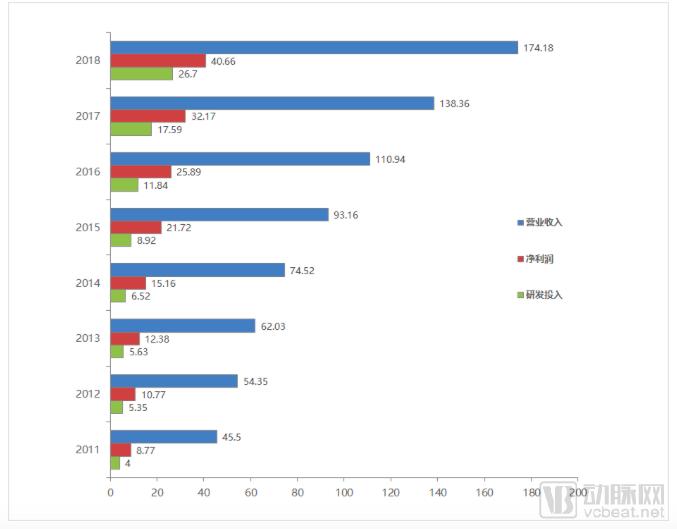
Hengrui Medicine Announced Its 2018 Annual Report, with Operating Revenue of RMB 17.418 Billion (+25.89%), Net Profit Attributable to Shareholders of the Listed Company of RMB 4.066 Billion (+26.39%), and Net Profit Deducting Non-recurring Gains and Losses of RMB 3.803 Billion (+22.60%). Hengrui's R&D Investment in 2018 Reached RMB 2.670 Billion, a Year-on-Year Increase of 51.81% Compared to 2017. Earnings Per Share Were RMB 1.10. Hengrui Plans to Distribute Two Bonus Shares for Every Ten Shares Held and Pay a Cash Dividend of RMB 2.2 per Ten Shares.
Hengrui Medicine is one of the largest research and production bases in China for anti-tumor drugs, surgical medications, and contrast agents. The company’s product portfolio covers a wide range of fields, including anti-tumor drugs, anesthesiology products for surgery, specialty infusion solutions, contrast agents, and cardiovascular medications, forming a relatively comprehensive product layout. Among these, its market share in anti-tumor drugs, surgical anesthesia, and contrast agents ranks among the top in the industry. During the reporting period, Hengrui Medicine received numerous honors from the China Pharmaceutical Industry Association, including “Top 100 Comprehensive Strength Industrial Enterprises in China’s Chemical Pharmaceutical Industry (2018)” and “Innovative Excellent Enterprise Brand in China’s Chemical Pharmaceutical Industry (2018).”
Hengrui Medicine’s Revenue, Net Profit, and R&D Investment Over the Past 8 Years (Unit: CNY 100 million)
Trend of R&D Investment Growth at Hengrui Medicine Over the Past 8 Years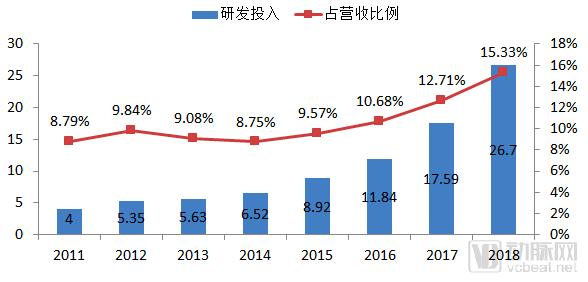
The above images are from PharmaCube.
Hengrui’s various economic indicators grew steadily in 2018, primarily driven by the following factors: First, the harvest of innovation outcomes. The gradual realization of innovative achievements has played a pulling role in the company’s performance growth. Second, optimization of the company’s product portfolio. With the adjustment of its product structure, Hengrui’s non-oncology products—represented by those for surgical anesthesia, contrast agents, and specialty infusion solutions—have gradually expanded their market share within their respective therapeutic areas, maintaining a trend of stable growth.
In the future, Hengrui Medicine will continue to steadily advance R&D innovation and the internationalization of its formulation products, while also focusing on optimizing and upgrading its product portfolio to ensure sustainable growth in corporate performance.
Hengrui Medicine’s core business encompasses the research and development, manufacturing, and sales of pharmaceuticals. Its main product portfolio spans a wide range of therapeutic areas, including oncology drugs, anesthesiology medications, specialty infusions, contrast agents, and cardiovascular drugs.
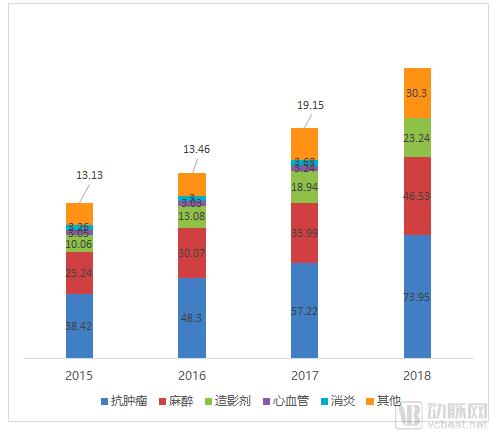
It is worth noting that oncology drugs contributed RMB 7.395 billion to Hengrui’s total operating revenue of RMB 17.418 billion in 2018. The primary drivers of Hengrui’s revenue growth were as follows: sales of oncology drugs increased by 29.23% year-over-year, sales of contrast media products rose by 22.67% year-over-year, and sales of anesthetic products grew by 29.25% year-over-year. In 2018, as in previous years, Hengrui did not separately disclose revenue from cardiovascular and anti-inflammatory products.
Performance of Hengrui's Major Product Business Segments (RMB 100 million)
The most striking feature of Hengrui’s 2018 annual report was the continued surge in R&D expenditures. In 2018, Hengrui invested a total of RMB 2.67 billion in research and development, representing a year-on-year increase of 51.81%, which exceeded the 48.53% growth recorded in 2017. This performance placed Hengrui far ahead among pharmaceutical companies that had released their annual reports, providing strong support for project development and innovative growth.
Second, we improved the R&D quality system, strengthened compliance management, and promoted cross-departmental project management to ensure that research activities are conducted in an orderly, effective, and compliant manner. Third, we actively advanced the consistency evaluation of quality and efficacy for generic drugs. Fourth, patent application and maintenance proceeded smoothly. During the year, we filed 144 new domestic patent applications and 78 new international PCT applications, and obtained 26 domestic patent grants and 39 foreign patent grants. Fifth, project registration and submission progressed in an orderly manner.
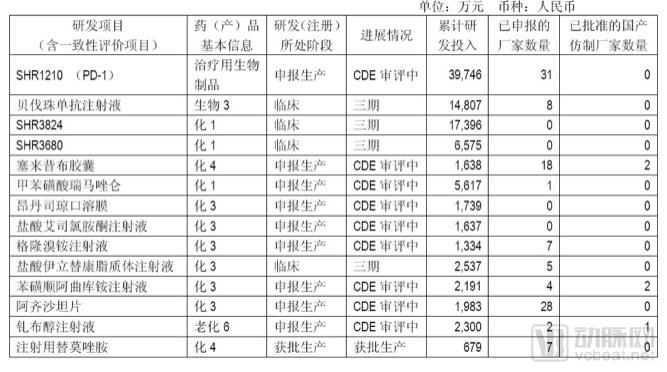
As of the release of its annual report, Hengrui Medicine has had four innovative drugs approved for marketing: imrecoxib, apatinib, pegylated recombinant human granulocyte colony-stimulating factor (PEG-rhG-CSF) injection, and pyrotinib. A pipeline of innovative drugs is under clinical development, with several candidates undergoing clinical trials in the United States. The financial report indicates that in 2018, Hengrui obtained two production approvals for innovative drug formulations and 16 clinical trial approvals for innovative drugs. PEG-rhG-CSF injection was successfully approved for marketing; pyrotinib demonstrated breakthrough efficacy in Phase II clinical trials and received conditional marketing approval; and camrelizumab (for the indication of lymphoma) was granted priority review status and has completed technical evaluation.
Hengrui's Investment in Key R&D Projects (Unit: 10,000 Yuan)
In addition to investments in innovative drug projects, Hengrui Medicine has actively promoted the quality and efficacy consistency evaluation of generic drugs. Financial reports show that during the 2018 reporting period, Hengrui obtained three approval documents for consistency evaluation, submitted reference preparation filing materials for 18 products, completed bioequivalence (BE) studies for 10 products, and filed consistency evaluation applications for 15 products.
Hengrui’s Products That Have Passed the Consistency Evaluation
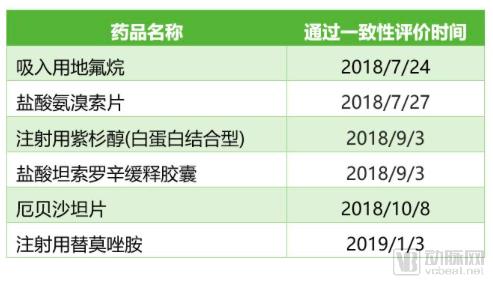
Financial Report Shows: Hengrui Continued to Strengthen the Implementation of Its Internationalization Strategy in 2018, Actively Expanding Overseas Markets and Achieving Overseas Sales Revenue of RMB 651 Million.
In terms of the internationalization of generic drugs, desflurane, thiotepa for injection, and fondaparinux sodium injection have been approved in the United States; iodixanol injection has been approved in the United Kingdom and the Netherlands; and dexmedetomidine hydrochloride injection has been approved in Japan. In 2018, Hengrui submitted registration applications to the U.S. FDA for two injectable products and one active pharmaceutical ingredient (API), and to Japan for one API. The company has also gradually intensified its registration efforts in other emerging markets, such as Australia, South Africa, and the Middle East.
In terms of the internationalization of innovative drugs, three products—SHR0302 tablets, INS068 injection, and SHR0410 injection—have been approved to conduct clinical trials overseas.
12 ANDA Products Approved for Hengrui in the United States
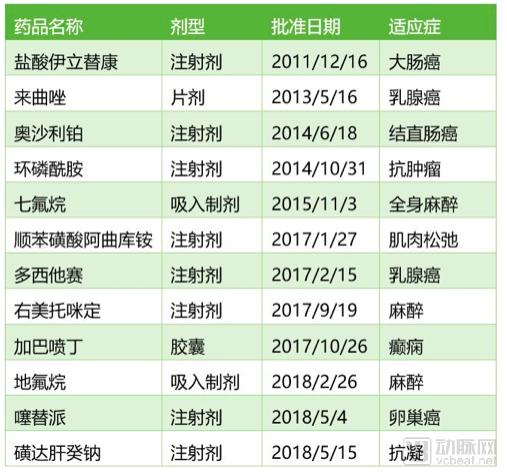
Source: FDA Orange Book
The annual report’s development plan indicates that Hengrui will continue to adhere to its two core strategies of “technological innovation” and “internationalization” in 2019, enhance crisis awareness, integrate advantageous resources, improve operational efficiency, comprehensively lay out its presence in China, and strive to build a global Hengrui. Key efforts will focus on five major areas: sales, research and development (R&D), internationalization, production and quality, and talent development.
In terms of sales, Hengrui stated that it will adopt a market-oriented and customer-centric approach, allocate resources rationally, further expand its sales network, and strengthen specialized and brand-driven sales. The company will strive to excel in the following areas: First, in response to the current new landscape, it will leverage specialized teams to address market access issues in a systematic and standardized manner. Second, it will enhance regional management by actively, rationally, and effectively utilizing local resources to truly establish Hengrui China’s network architecture. Third, it will advance the professionalization of its sales operations, strengthen talent development and management, and boost performance through team-based efforts.
In terms of R&D, Hengrui stated that it will continue to improve R&D efficiency, emphasizing both quality and timeliness, and diligently execute its R&D registration and filing plans. By building a professional and resilient team of Clinical Research Associates (CRAs), the company aims to accelerate innovative clinical research and expedite the market launch of Phase II and Phase III clinical candidates, thereby fostering a virtuous cycle between R&D and sales. Regarding specific operational measures: first, cultivate a spirit of reform and innovation, daring to break through established mindsets and address entrenched issues with new approaches and methodologies; second, strengthen execution and performance evaluation, using projects as focal points and introducing competitive mechanisms to ensure effective promotion and implementation of all tasks; third, safeguard the smooth implementation of R&D plans through measures such as “scientific planning + process management + resource allocation + team stability.”
Regarding internationalization, Hengrui stated that going global has been the company’s consistent strategic direction for many years and serves as a crucial pillar for achieving leapfrog growth in the future. In terms of generic drugs, Hengri expressed its commitment to expanding sales of its products in regions including Europe, the United States, Japan, Hong Kong, and South America, striving to reach new heights in overseas revenue. With respect to innovative drugs, the company emphasized a steady, step-by-step approach to advancing overseas clinical trials, aiming to secure early market approval and commercialization of its innovative therapies abroad.
In terms of production and quality, Hengrui stated that it will continue to implement the policy of “compliance, efficiency, intelligence, and green development.” First, it will proactively break down annual production plans to ensure market supply and collaborate with R&D on clinical sample preparation and launch verification for new products. Second, it will allocate resources reasonably and dynamically manage staffing and equipment hardware needs under the premise of compliance management. Third, it will strengthen automation and intelligentization by formulating three-year and five-year plans, striving to bring the company’s automation level up to European and American standards within the next 3–5 years. Fourth, it will enhance supplier management, reinforce employee training, and raise quality awareness across all staff.
Regarding talent development, Hengrui stated that it will primarily focus on three areas. First, further enhance the professional competence of the human resources (HR) department, improve job and professional promotion pathways, and align incentive mechanisms more closely with the company’s development needs. Meanwhile, strengthen performance evaluations and foster close collaboration between the HR department and other functional departments to address personnel-related issues, thereby improving overall work capability and efficiency. Second, embrace open-minded thinking; the company will adhere to the principle of prioritizing individuals who are both capable and results-driven, combining external recruitment with internal training to build a robust talent pipeline. Third, strengthen the development of managerial personnel, enhancing their learning agility and adaptability to new developments.