

Can Digital Therapeutics Solve America's Addiction Epidemic? Insights and Product Landscape from Recent FDA Approvals and Emerging Startups
In recent years, drug abuse has remained a focal point of concern in American society, with the U.S. government and healthcare system striving to curb the opioid epidemic.
Previously, U.S. President Donald Trump signed a bipartisan bill to address the opioid crisis in the United States. Known as the SUPPORT for Patients and Communities Act, the legislation was hailed by lawmakers as a milestone in turning the tide of the nation’s opioid epidemic, enhancing access to addiction treatment, and raising awareness about appropriate pain management.
In many respects, the opioid crisis has become the signature healthcare issue of the Trump administration. Actions taken by the administration to combat this addiction epidemic include the U.S. Department of Health and Human Services (HHS) code-a-thon, a blockchain pilot project jointly launched by the U.S. Centers for Disease Control and Prevention (CDC) and IBM, rare bipartisan legislation aimed at improving telehealth and electronic prescribing resources, and several other initiatives.
But for some experts and activists, this is just the beginning.
How to Address the Primary Healthcare Issue Plaguing American Society?
From Instagram becoming a marketplace for illegal drug advertisements to the role of fentanyl in the rising number of cocaine-related deaths, addiction-related fatalities in the United States continue to dominate headlines. In 2016, 63,600 people in the U.S. died from drug overdoses, a 21% increase from 2015 and three times the number recorded in 1999. The East Coast has been particularly hard hit, with West Virginia, Ohio, New Hampshire, the District of Columbia, and Pennsylvania reporting the highest overdose death rates in the nation.
This rise is driven not only by opioids and fentanyl but by all types of drugs, with overdose deaths increasing across all racial, gender, age, and urbanization groups. No community has been spared, and the vast majority of Americans consider substance use disorder a serious problem in their communities.
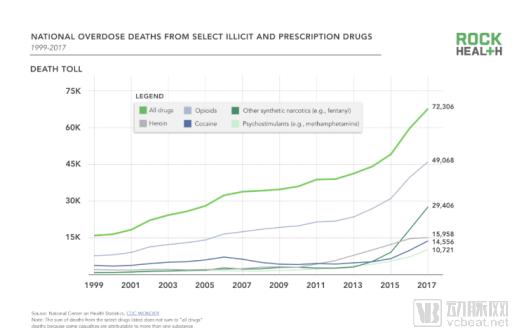
Image source: Rock Health
According to the 2016 Surgeon General’s Report on Addiction, only 10% of Americans with a substance use disorder receive specialized treatment. This means that even if hospitals follow protocols for referring patients to treatment centers, their communities may not offer the relevant care.
Data released by the CDC shows that in 2017, there were 48,000 opioid-related deaths in the United States. The dual effects of prescription overdoses and insufficient treatment resources have led to a growing epidemic, disproportionately affecting the Midwest and rural areas of the U.S. This indicates that relevant parties need to invest more funding into addressing this crisis.
Although the new legislation is a step in the right direction, the United States needs an unprecedented number of healthcare “transformers” dedicated to improving effective treatments and reducing addiction.
In light of the current situation, several technology-driven initiatives have emerged, directly targeting the treatment and recovery of the addiction epidemic. Meanwhile, legislative bodies supporting telemedicine programs for opioid use disorder have gained bipartisan recognition, and social media networks have begun providing resource support following related searches.
The FDA also believes that new technologies can help address the crisis. In the second quarter of 2018, the agency approved at least two new devices aimed at tackling opioid misuse: a wearable auricular neurostimulation device designed by DeAnsys to treat opioid withdrawal symptoms, and reSET-O, a digital therapeutic from Pear Therapeutics for opioid use disorder. reSET-O received FDA Breakthrough Device designation in 2017. Pear Therapeutics is also part of the FDA’s Pre-Cert Pilot Program.
“Medical devices, including digital health technologies such as mobile medical apps, have the potential to play a unique and important role in addressing the opioid crisis,” said FDA Commissioner Dr. Scott Gottlieb when announcing the challenge in May 2018. “We must find new approaches and new tools to help address the human and economic toll of opioid addiction.”
The Discussion on How to Treat Opioid Addiction Has Entered the Tech World. Given the Devastating Impact of the Addiction Epidemic in the United States on People's Lives and Communities, Tech Startups Are Paving a New Path Forward. These Companies’ Solutions Focus on Providing Evidence-Based, Continuous, and Accessible Care for Individuals with Addiction.
As U.S. politicians engage in a tug-of-war over funding to expand investment in addiction treatment centers, startups such as OpenBeds and inRecovery are developing innovative approaches to address gaps in the addiction treatment system without political involvement. OpenBeds streamlines patient transfers and referrals by creating a patient “marketplace” that efficiently matches patients with the facilities best suited to their needs.
inRecovery operates on a deep understanding of patients, helping treatment centers deliver more engaging and personalized experiences to assist individuals with addiction in overcoming compulsive behaviors.
New Approach to Addiction Treatment: Digital Therapeutics
Digital tools may be one of the ways the United States is addressing this epidemic. A report released by Rock Health last November showed that 20.1 million Americans suffer from substance use disorder (SUD), and millions more who do not meet the threshold for clinical diagnosis would benefit from more evidence-based treatments. Although the road ahead is long, entrepreneurs have also figured out how to leverage technology to address three core issues plaguing addiction treatment. These three issues are:
1. There is a high degree of unguaranteed variability among available solutions.
Not all addiction treatment programs meet the same standards. In fact, the vast majority of individuals seeking treatment do not receive anything close to evidence-based care. In programs lacking empirical support, 40–60% of patients undergoing treatment for substance use disorders (SUD) relapse.
Technology-centric solutions offer evidence-based programs grounded in fundamental research on effective interventions. These digital solutions enable healthcare providers to access data on patient engagement and adherence more frequently, thereby facilitating the evaluation of outcomes and the iterative refinement of protocols over time. With the rise of application-based solutions, the data collected by addiction treatment providers has the potential to be richer than ever before.
2. Services are delivered intermittently rather than continuously
Addiction treatment often consists of fragmented, intensive interventions delivered over a short period. This pattern leaves patients without continuous support, and the cessation of treatment may trigger renewed cravings for substance use. Although many treatment centers assign care managers or sponsors to help patients reintegrate into daily life, few programs are able to meet the substantial market demand.
In this regard, technology has played an indispensable role. It enables individuals to carry their support networks and programs in their pockets. Furthermore, it extends the capabilities of care managers and sponsors by providing a scalable means to monitor and communicate throughout the entire patient treatment process.
3. Most patients with substance use disorder (SUD) do not seek any form of treatment
Surprisingly, only one in ten individuals with substance use disorder (SUD) has received treatment. Even when treatment costs are reasonable, approximately 40% of those who recognize they have a drug problem are not prepared to stop using drugs, and many feel their condition is not severe enough to warrant treatment.
However, this may represent technology’s greatest potential in addressing the epidemic: expanding access to treatment and lowering the barriers to care. Surveys indicate that many substance users maintain normal lives, attending school, working, and sustaining relatively healthy relationships. Technology can offer these individuals a digital solution, enabling them to seek help without waiting for their problems to escalate or disrupting their daily routines. Although in-person intervention remains necessary, applications can provide a simple entry point that ultimately guides patients toward appropriate self-intervention.
| The Role of Technology in Addiction Treatment: Addressing Three Core Challenges in the Current Standard of Care | ||||||||
| Core Challenges | Technical Solutions | |||||||
| There is a high degree of unwarranted variability among existing treatment regimens. | Supports frequent data capture to streamline the evaluation of digital solution effectiveness | |||||||
| "Medical treatment services are provided intermittently rather than continuously." | Expand providers' capabilities for remote support and patient monitoring, thereby enabling continuous care. | |||||||
| The vast majority of people do not seek any form of treatment. | Increasing access to care by providing low-cost, easy-to-use solutions on digital devices | |||||||
To verify the concrete progress of these theories in practice, Rock Health interviewed six startups focused on treating the addiction epidemic: Carrot, Chrono Therapeutics, DynamiCare Health, Pear Therapeutics, Marigold Health, and Workit Health.
| Startups: Creating Solutions for Patients with Addiction | |||||||
| Company | Core Products | ||||||
| Chrono Therapeutics | A nicotine replacement wearable patch with time-quantified drug delivery capabilities, and a mobile app leveraging data analytics to maximize adherence | ||||||
| Dynamicare Health | The platform integrates smartphone-based random breath/saliva testing, treatment attendance tracking, and monetary incentives. | ||||||
| Pear Therapeutics | Prescription Digital Therapeutics: One FDA-approved for the treatment of SUD (reSET), and another with Breakthrough Therapy Designation for the treatment of OUD (reSET-O) | ||||||
| Carrot | Carrot’s first digital health solution, pivot, is an FDA-cleared carbon monoxide breath sensor that features a user-facing mobile app and provides one-on-one specialized coaching to help users quit smoking. | ||||||
| Marigold Health | Chat-Based Support Group Therapy Software Leverages Natural Language Processing (NLP) to Reduce Addiction Relapse and Support More Effective Care Management | ||||||
| Workit Health | App-Based Addiction Recovery Programs Combine Telehealth Visits, Medication Management, Personalized Exercise, and Support from Coaches, Counselors, or Clinicians | ||||||
Digital solutions for addiction are still in their early stages, with most startups validating their offerings and scaling them up. While different substance use disorders require distinct approaches, the aforementioned companies have adopted all or some of the following four strategies to curb the incidence of SUD:
Pharmacotherapy:Use of drugs as a therapeutic approach to modulate neural pathways;
Psychotherapy:Identify and modify distressing thoughts and behaviors through Cognitive Behavioral Therapy (CBT) and Acceptance and Commitment Therapy (ACT);
Emergency Management:Tangible rewards (such as money) to reinforce positive behaviors, such as visiting a doctor or completing in-app activities;
Social Support:During the process of individual addiction recovery, therapeutic communities composed of other individuals with addictions provide support.
| Business Strategies + Models Employed by Six Companies | |||||||||||
| Pharmacological Treatment | Psychotherapy | Emergency Management | Social Support | Business Model | |||||||
| Chrono Therapeutics | Wearable Patch for Precise Transdermal Nicotine Delivery | Interactive Content Based on CBT and ACT in the App | None | None | Prior to FDA approval, the company plans to conduct online sales through retail outlets. | ||||||
| Dynamicare Health | N/A; Supplement to standard treatment | Static Content Based on CBD in the App | Users can earn up to $100 per month in rewards upon completing activities. | None | Sold to employers and health plans as a benefit for all employees/members | ||||||
| Pear Therapeutics | reSET-O was approved by the FDA in the fourth quarter of 2018 for the treatment of opioid use disorder. | Under the guidance of a clinician, static CBD-based content within the app (also available via face-to-face interaction with users) | Users receive rewards in the app, such as incentive notifications and gift cards. | None | FDA-approved treatment regimens will be prescribed by physicians and are expected to be reimbursed by health plans. | ||||||
| Carrot | In-app education and provision of branded nicotine replacement therapies (patches, gum, lozenges) | The company has hired certified health coaches with specialized training in tobacco cessation to provide one-on-one support. | Can be integrated with clients' smoking cessation incentive programs | Pivot Community Can Serve as a Long-Term Support System | Sold to employers and health plans as a benefit for all employees/members | ||||||
| Marigold Health | N/A; Supplement to Standard Treatment | Nursing Experience: Facilitating group chats with the assistance of NLP and providing additional one-on-one support as needed | None | Engage in anonymous group chats with 5-10 users | B2B SaaS Model – Charging health plans and providers a fixed per-member-per-month fee for white-label solutions | ||||||
| Workit Health | “Clinic” Track Supplements Vivitrol and Suboxone via Telemedicine Consultations | With the support of coaches, consultants, or clinicians | Users receive major events and reduce the required frequency of doctor visits (in the "clinic" track). | Online Peer Recovery Groups Formed Within One Week of Visit | Primarily claims-based insurance coverage; also offers consumer discounts ($25–$75 per week, with prices varying by region) | ||||||
The companies listed in the table have each adopted a unique combination of these four strategies, tailored to their target populations, business models, and therapeutic philosophies. Below, we examine Pear Therapeutics and Marigold Health as case studies to analyze how they integrate the right strategies to develop effective, evidence-based solutions.
Pear TherapeuticsTwo digital therapeutics focus on the addiction epidemic. reSET, for substance use disorder (SUD), and reSET-O, for opioid use disorder, combine cognitive behavioral therapy, contingency management, and fluency training, all conducted under clinician supervision. The reSET-O program is used in conjunction with medication-assisted treatment (MAT) and is currently undergoing FDA Breakthrough Device designation review.
In both products, users can learn skills to modify their behavior through in-app modules based on static CBT (a software development method based on program components) content (e.g., avoiding situations that trigger drug use). After patients complete the module activities and test negative for drug use, Pear Therapeutics rewards them with feedback or gift cards.
Pear plans to launch commercial operations by the end of this year, aiming to secure drug-like reimbursement from payers.
MarigoldChat-based group therapy software is a comprehensive service that augments patients’ current treatment regimens. Existing providers (typically care managers at addiction treatment facilities) refer patients to the platform via face-to-face counseling upon discharge. Users join an anonymous support group comprising 5 to 10 individuals with substance use disorders. A natural language processing system flags and removes abusive messages from patients in real time, 24/7, and submits relevant information to care managers for further review. Care managers may then provide psychological support and medical resources to affected users.
Marigold licenses its white-label platform to existing treatment providers and payers. In this process, the company generates patient touchpoints, assesses the capabilities of existing providers, and delivers ongoing support to patients to prevent relapse. Certain interactions with peer support specialists or care managers on Marigold’s platform are reimbursable, with fees paid directly by Marigold’s clients.
In mid-June 2018, DyAnsys, a medical device company specializing in the autonomic nervous system, announced that its wearable auricular neurostimulation device for treating opioid withdrawal symptoms had received FDA approval. The device, named Drug Relief, is now available to suppliers in the United States and is distributed in the European Union by DyAnsys’s European subsidiary.
Drug Relief is a non-addictive therapeutic device that can be worn continuously for 120 hours. According to its 510(k) submission, the device is worn on the head, with needles inserted at three specific points around the ears to deliver electrical stimulation. DyAnsys states that this therapy allows users to comfortably receive non-addictive treatment, with withdrawal symptoms alleviated within 30 to 60 minutes after initiation.
According to the DyAnsys official website, the product “minimizes the use of opioid agonists and may eliminate it in some cases.”
At the 2019 HIMSS Global Conference & Exhibition held last week, telehealth company American Well unveiled its new telehealth product—the American Well 250 Cart. The American Well 250 Cart is a telehealth cart that enables hospital physicians and patients to connect online with various specialists.
At the conference, American Well announced an expanded partnership with Netsmart, a provider of behavioral health EHR systems. Netsmart has integrated American Well’s telehealth solution into its EHR platform, and the two companies are collaborating on counseling services for opioid use disorder.
Through this integration, medical experts can conduct remote addiction treatment consultations with individuals, thereby providing timely and professional care to patients with opioid use disorder. This integrated workflow also enables patients to access addiction specialists in real time.
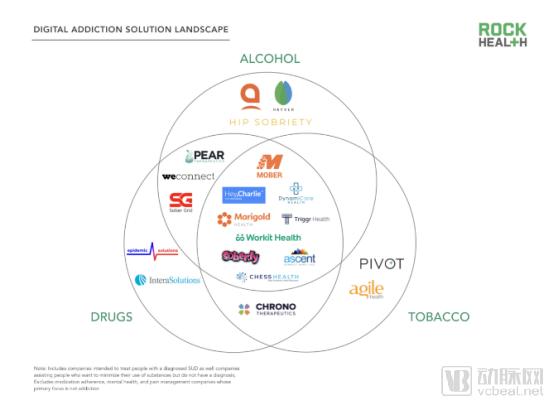
Digital Solutions for Drug Addiction (Image Source: Rock Health)
Although tech companies have made significant progress in providing effective treatments in a more accessible manner, key issues remain:
1. As frontier technologies advance and their centrality increases, how should humanity adapt?
Cognitive behavioral therapy has proven effective, but it is debatable to what extent human involvement is necessary when relying on technology rather than manpower for content optimization to achieve scalability.
2. Are current digital products sufficient to increase access to healthcare services?
Current technological advancements in addiction treatment offer evidence-based therapies delivered on a continuous basis. However, a persistent and difficult challenge remains: how to reach the approximately 90% of individuals with addiction who are not currently seeking treatment. While many platforms aim to increase access to care by lowering the barriers to seeking medical services, most solutions still require providers, payers, or employers as the entry point for delivering these interventions. This may continue to pose a barrier to access for the majority of people, particularly those who are unemployed or uninsured.
3. What are the limitations of digital solutions?
Digital solutions alone cannot address the epidemic of substance abuse. For patients with severe disabilities who are unable to meet their basic health and safety needs, digital solutions fail to provide adequate support. Furthermore, substance use disorders (SUD) are often accompanied by other serious mental health conditions (such as depression and anxiety) and chronic diseases (such as hepatitis C and HIV/AIDS). Consequently, some argue that digital solutions may be best suited for triaging patients to medical institutions or providing treatment to those with less severe conditions.
(Compiled by Nie Guanghong)