

Digital Transformation in Global Healthcare: How AI, Robotics, and IoT Are Reshaping the Industry
As the saying goes, “What goes up must come down,” but this adage was unlikely to apply to the global healthcare industry in 2019. Aging populations, population growth, the prevalence of chronic diseases, the exponential development of highly innovative yet costly digital technologies, and other advancements have continued to steadily drive up healthcare demand and expenditures.
Recently, Deloitte released a report titled “2019 Global Health Care Outlook: Shaping the Future,” which elaborates on the aforementioned situation and presents currently viable solutions. VCBeat (WeChat official account: vcbeat) has compiled and translated portions of this report for our readers. The key insights are as follows:
Image source: Deloitte
Global healthcare spending is projected to grow at an annual rate of 5.4% from 2018 to 2022, compared with an annual increase of 2.9% from 2013 to 2017.
This growth reflects the strengthening of the U.S. dollar against the euro and other currencies, the expansion of health insurance coverage in emerging markets, rising demand for elderly care, advances in medical technology, and increasing labor costs in the healthcare sector.
Per capita healthcare spending is projected to remain highly disparate, ranging from $11,674 in the United States to $54 in Pakistan in 2022. Efforts to narrow this gap will be constrained by accelerating population growth in developing countries.
Higher per capita spending does not always translate to higher-quality healthcare services. Compared with ten other developed nations, the United States ranks poorly in overall healthcare system performance, notably spending 50% more per capita than the next highest-spending country while ranking last in efficiency, equity, and healthy life expectancy.
Life expectancy appears to be continuing its upward trend. By 2022, the average life expectancy for the global population aged 65 and above is projected to increase from 73.5 years in 2018 to 74.4 years, with this demographic exceeding 668 million individuals and accounting for 11.6% of the world’s total population. The rise in life expectancy and health-adjusted life expectancy represents a significant achievement in healthcare, as increased per capita output is associated with growth in real per capita gross domestic product (GDP).
This impact is expected to be most pronounced in Japan, where the proportion could reach nearly 29%. In Western Europe, the figure is estimated to approach 22%. Even some developing countries, such as Argentina, Thailand, and China, are beginning to see similar trends.
Significant progress is being made in the fight against infectious diseases through improved sanitation, better living conditions, and broader access to healthcare services. Thanks to advances in medical technology, AIDS-related deaths decreased from 2.3 million in 2005 to 940,000 in 2017. Tuberculosis infections are declining by approximately 2% annually. Global malaria deaths fell from nearly 1 million in 2000 to 445,000 in 2016. The widespread use of new vaccines and insecticide-treated mosquito nets has reduced both the incidence and mortality rates of all mosquito-borne diseases.
Non-communicable diseases (NCDs)—including cancer, heart disease, and diabetes—accounted for 71% of the 56.9 million deaths reported globally in 2016. In most developed markets, this proportion has exceeded 80%. Urbanization, sedentary lifestyles, changing dietary patterns, and rising obesity levels are driving the growth of the NCD market in both developed and developing countries.
Healthcare stakeholders—healthcare providers, governments, payers, consumers, and other companies/organizations—are striving to address clinical, operational, and financial challenges. Looking ahead, with the aid of digital technologies, new business and healthcare delivery models may help resolve current issues and establish a sustainable foundation for affordable, accessible, and high-quality healthcare.
This vision has a high probability of becoming reality if all stakeholders actively participate in shaping the future. This requires shifting the philosophical focus from a disease-care system centered on treating patients after they fall ill to a healthcare system that supports health, prevention, and early intervention.
However, today’s healthcare system and its stakeholders are unlikely to achieve this transformation on their own. They may need to collaborate with other traditional sectors—such as employment, housing, education, and transportation—to address the social determinants of health, and partner with emerging sectors—including retail, banking, and technology giants—to improve data and platform interoperability.
Cutting-edge technologies visible to patients, members, and customers can help healthcare organizations stand out. However, it is the core technologies—those largely unseen by most people—that keep an organization running. Back-office systems and the quality of their integration with front-end enterprise functions constitute critical infrastructure, enabling timely access to pricing, product availability, logistics, quality, financial, and other “core business” information when needed.
Although healthcare organizations are pursuing digital empowerment from multiple angles, one issue remains paramount: leveraging emerging technologies to redefine how core systems and back-office processes enable the completion of daily work. Some vendors have already begun taking steps to enhance two key core functions—revenue cycle management and supply chain management—by employing machine learning, robotic process automation (RPA), cloud-based software-as-a-service (SaaS) solutions, and predictive analytics tools.
Significant advances in wireless technology, miniaturization, and computing power have led to an exponential increase in the speed and scale of digital health innovations. These innovations are emerging and impacting clinical and commercial operations. Such progress has also driven consumers to increasingly expect “digital” solutions, which appear to have become a new requirement for all healthcare institutions.
Digital innovations such as blockchain, cloud computing, virtual health, artificial intelligence and robotics, extended reality, and the Internet of Medical Things (IoMT) are helping to reshape the future of healthcare, making medical services more efficient and accessible. Enhanced data access and sharing through digital solutions are improving personalized self-care and patient experiences.
The additional benefits of digitalization may be just around the corner. For instance, blockchain has the potential to enhance collaboration, trust, interoperability, traceability, and auditability across a range of functions, including clinical trials, supply chain management, financial transactions, credentialing, and claims processing.
In the life sciences and healthcare sectors, the shift from individual blockchains to interconnected blockchain networks (i.e., networks of networks) is particularly noteworthy. In this field, diverse sectors operate together within a broadly interdependent ecosystem. Although industrial applications of blockchain are still in their infancy, a Deloitte survey revealed that the proportion of life sciences and healthcare organizations planning to deploy blockchain in 2017 (35%) exceeded similar expectations in other industries.
Health systems around the world are investing in digital technologies with varying degrees of enthusiasm:
AustraliaThe “My Health Record” (PHR) service is being launched, linking patients’ personal health record data with various segments of the healthcare value chain, and patients may opt out.
United KingdomA recent announcement of a €37.5 million investment to establish a Digital Innovation Centre aims to address the UK’s most significant health challenges. Amid other digital advancements, a growing number of people in the country are turning to Babylon Health, an innovative enterprise, as a means of accessing primary care. New entrants to the healthcare industry are joining the EHR market, which may reduce the overall costs of implementation. Furthermore, there is substantial activity in automated AI-assisted diagnosis, telehealth, and integrated health records.
2017,ChinaThe government has released the “13th Five-Year” National Science and Technology Innovation Plan, which aims to develop precision medicine technologies, integrate them into a multi-tiered knowledge base, and establish a national biomedical big data sharing platform. In time, with the support of evidence-based technologies, patients who are about to receive or are currently undergoing treatment will benefit from improved service quality and personalized care.
JapanA new law is expected to significantly increase the shared use of electronic medical record (EMR) data. Nearly all hospitals in Japan have EMRs, but the problem is that each hospital adopts a slightly different system. Consequently, the data are not designed for aggregation at the national level, nor do they represent the optimal approach for improving the national healthcare system. Furthermore, hospital EMRs should be linked with primary care datasets to provide a genuine understanding of patient pathways.
InNetherlands, patient-centered healthcare powered by e-health solutions is a top priority for hospitals and medical organizations. However, the goal of health systems is to move beyond pilot projects toward mainstream adoption.
BrazilSome companies’ human resources departments are boosting employee engagement in health and chronic disease management programs through gamification.
IndiaThe healthcare system is launching numerous conceptual and cutting-edge small-scale pilot projects centered on mobile health, telemedicine, and the Internet of Medical Things (IoMT), although these are rarely implemented at scale. Many public and private hospitals are transitioning to online patient registration and service delivery systems. Digital marketing is becoming increasingly prevalent through mobile applications that offer appointment scheduling, online payments, test report downloads, and health tip sharing.
The list of digital technologies capable of helping healthcare providers, payers, and governments achieve the three major goals of improving care, enhancing health, and reducing costs is continuously expanding and evolving. Let us take a closer look at three of these innovations: artificial intelligence and robotics, digital reality, and the Internet of Medical Things (IoMT).
Focusing on Digital Health Innovation
People expect artificial intelligence to transform the healthcare industry by performing clinical and commercial tasks currently carried out by humans faster, more accurately, and with fewer resources.
Artificial intelligence can provide decision support and assist physicians in tasks such as patient diagnosis and early detection of disease outbreaks; accelerate the development of new drugs and medical devices; and streamline administrative functions, including physician referrals, patient pathway coding, and claims approval.
An example of AI-assisted workflow management is Deloitte ASSIST, a patient communication solution that integrates speech recognition, natural language processing, and artificial intelligence. This enables patients to request assistance without pressing any buttons. By simply voicing their requests, patients allow nurses to understand their needs; the system then uses AI to prioritize these requests and intelligently route them to the appropriate resources—such as nursing assistants, patient support associates, or volunteers—to address patient needs effectively.
It is crucial for healthcare stakeholders to recognize that artificial intelligence technologies are designed to support and augment the workforce, rather than replace it, thereby enabling highly trained personnel to focus on higher-value, patient-facing activities. For instance, robotics can improve medication compounding and sterilize medical equipment, allowing human resources to be reallocated to more valuable areas.
Autonomous vehicles can transport patients to medical appointments, improving continuity of care. Drones can retrieve medications that elderly individuals have dropped on the floor. The application of robots in pharmacies and surgical procedures is currently in use, although the full potential of this technology has yet to be realized.
In certain application areas, such as surgical procedures, the cost of these technologies remains a challenge. It is currently unclear whether the use of robotics can enhance efficiency and effectiveness enough to justify the increased costs.
The application of artificial intelligence and robotics in healthcare remains in the early adoption stage among stakeholders and patients. Increased acceptance may depend on innovators’ ability to reduce costs and improve the accuracy of technologies such as natural language processing, big data, and cognitive computing, as well as on the willingness of healthcare professionals and patients to embrace and trust these new tools.
AliveCor, the manufacturer of the KardiaMobile ECG monitor for iPhone and the KardiaBand ECG recorder for Apple Watch, is collecting data from its devices, which may one day be fed into a machine learning system to help physicians detect diseases.
In one potential application, “bloodless testing” would monitor subtle changes in the electrocardiogram (ECG) that are characteristic of elevated serum potassium levels, a task at which artificial intelligence excels. Leveraging the convenience of smartphones or smartwatches to measure this parameter in real time could transform how clinicians manage patients following a heart attack.
Digital Reality (DR) is an umbrella term for augmented reality (AR), virtual reality (VR), mixed reality (MR), 360-degree, and immersive technologies. With the emergence of many new digital capabilities, these technologies first entered the consumer world in the form of gaming and entertainment.
Now, the use of these technologies is reaching a tipping point, with adoption by enterprises and organizations beginning to outpace entertainment applications. Barriers related to technology, cost, and content are starting to diminish, and early adopters are already working diligently to create solutions that help transform healthcare.
Deloitte and McLaren are joining forces to develop data-driven solutions that integrate specialized hardware and software with sophisticated algorithms to enhance performance across various functions and organizations. Healthcare applications may include creating digital twins of hospital processes, then applying advanced analytics and running millions of potential scenarios to identify root causes and test different interventions before implementation.
In the life sciences and healthcare sectors, the virtual patient simulation market is projected to grow at an annual rate of nearly 20%, becoming a $1.5 billion industry by 2025.
Among vendors, the use of AR and VR is currently concentrated in several fragmented areas. For patients, these technologies can accelerate their understanding of medical conditions or treatment plans. When employed for visualization and relaxation exercises, they can even serve as therapeutic interventions. Established applications include the treatment of opioid use disorder, phantom limb pain, and phobias, as well as cancer treatment planning, perioperative planning, management of post-traumatic stress disorder (PTSD), and general pain management.
DR tools can help maintain mental acuity by engaging users in specific scenarios, and some VR-based therapies are beginning to emerge to help Alzheimer’s patients improve their memory.
In clinical settings, AR and VR can assist physicians and nursing teams in delivering care. For instance, surgeons can use a head-up display to overlay patient data onto the body during surgery or to visualize the entire procedure during preoperative planning.
Integrated with medical imaging, augmented reality technology is beginning to empower clinicians to project medical images, such as CT scans, directly onto patients while maintaining alignment with their bodies. Even during patient movement, augmented reality continues to provide clinicians with a clearer view of internal anatomical structures.
In the educational context, curricula for undergraduate, graduate, and continuing medical education programs and institutions are increasingly incorporating AR and VR support. The following example illustrates VR training for physicians.
Physician VR Training
Virtual reality technology is transforming the medical training process by providing surgeons and emergency physicians with immersive experiences and realistic scenarios. Recent developments in VR training include:
Surgical Theater is a VR-specialized company that provides preoperative rehearsal platforms for complex surgeries.
Johnson & Johnson Institute recently launched a VR training program to help orthopedic surgeons and nurses prepare for total knee arthroplasty and hip fracture treatment procedures, with plans to further expand to other surgeries.
Oculus VR is conducting a trial to test VR simulations for emergency department (ED) staff in high-risk pediatric trauma scenarios.
London-based Fundamental VR has developed a virtual reality application called “Fundamental Surgery,” which can simulate surgical environments as well as the physical sensations of the human body.
Embodied Labs has developed a VR program titled “We Are Alfred,” in which the user assumes the role of Alfred, a 74-year-old man with macular degeneration. This experience places nurses or physicians in the first-person perspective of patients with severe conditions, enabling them to better understand their patients’ circumstances.
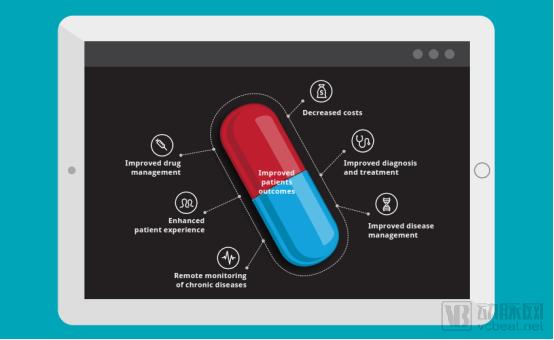
Seven Key Areas Where the IoMT Impacts Healthcare (Image Source: Deloitte)
# Medical Internet of Things (IoMT)The Medical Internet of Things (IoMT) is an infrastructure that connects medical devices, software applications, health systems, and services. IoMT integrates people (patients, caregivers, and clinicians), data (patient or performance data), processes (care delivery and patient support), and initiators (sensors, connected medical devices, and mobile applications) to more effectively improve patient outcomes.
The rising number of medical devices capable of generating, collecting, analyzing, or transmitting health data or images, and connecting to provider networks, cloud repositories, or internal servers, has driven the emergence of the Internet of Medical Things (IoMT). Importantly, IoMT can generate intelligent and measurable information to help enhance the speed and accuracy of diagnosis and treatment more effectively.
As new technologies emerge, novel business models will also arise. These new business models are expected to have a profound impact on the development of healthcare, as they blur boundaries and drive cross-sectoral and cross-industry integration. The resulting “super clusters,” comprising public and private providers, payers, and market disruptors, can leverage the smart health community approach to jointly promote innovation, enhance accessibility and affordability, improve quality, and reduce costs through more efficient delivery models.
(Compiled by Nie Guanghong)