

Global Healthcare IT Trends 2019: A Medical IT Entrepreneur's Observations from HIMSS19
On February 15, 2019, the five-day 2019 HIMSS Global Conference & Exhibition concluded in Orlando, USA. As the largest and most influential conference in the field of healthcare information technology globally, it attracts over 40,000 participants each year from around the world, including healthcare IT professionals, clinical staff, healthcare facility administrators, government policymakers, and corporate representatives. The event not only showcases the latest products and solutions in the health information technology (HIT) industry but also sets new trends for industry development.
The Healthcare Information and Management Systems Society (HIMSS) is one of the most renowned healthcare information organizations globally. Originating from the American Hospital Association’s Council on Medical Care Administration, established in 1961, HIMSS is a global, mission-driven nonprofit organization.

HIMSS19 Global Conference On-Site
As a medical IT entrepreneur, I have attended the HIMSS annual conference for several consecutive years. This article presents my observations and summary of the industry trends showcased at this year’s HIMSS. To state the conclusion briefly: In terms of mindset, consumerized healthcare is on the rise, while aging populations and demographic and financial challenges remain severe. “Value-Based Care” is gradually transforming the healthcare industry in the United States and worldwide. Technologically, digital health is advancing steadily, with new tools and technologies represented by AI rapidly moving from the testing phase to market implementation.
This year, I have had a distinct impression of the rise of Value-Based Care, which is reflected in the industry’s greater emphasis on patient-centeredness. Previously, hospitals and insurance companies played the dominant role in the market; now, however, the U.S. healthcare market and the broader industry are placing greater emphasis on the central role of patients. Many changes in the healthcare sector are occurring around this shift in perspective.
Another related topic that sparked intense discussion at HIMSS this year is the consumerization of healthcare, a highly indicative signal. In its official report released this year, *2019 Healthcare Trend Forecast: The Dawn of a Consumer-Driven Transformation*, HIMSS stated that consumer pressure will accelerate global healthcare reform and the shift toward value-based care. Meanwhile, consumers are increasingly demanding personalized, patient-centered care, opting for services that offer convenience, diverse options, and cost transparency.
In my view, the core of healthcare consumerization and Value-Based Care lies in the shift in the industry’s evaluation framework: moving from a hospital- and physician-centric model to one that is patient-centered and driven by consumer needs.
This concept is reflected in the financial system through the U.S. healthcare industry’s ongoing transition from fee-for-service to pay-for-value. In the past, hospitals operated under a fee-for-service model, billing based on the volume of services provided. Consequently, healthcare providers were incentivized by profit to order excessive tests and procedures for patients. In contrast, Value-Based Care reimburses based on treatment outcomes and service effectiveness, delivering care that patients truly need. This approach helps reduce unnecessary medical expenses, lower healthcare costs, improve the quality of care, and enhance doctor-patient relationships. Notably, many large healthcare institutions are moving in this direction.
This shift in the operational models of medical institutions has also had a certain impact on the entire industry. Vendors providing technology and equipment to medical institutions, including Subtle Medical, are striving to adapt to this change by developing consumer-oriented products. The technologies we have developed leverage artificial intelligence (AI) to enhance the quality of medical imaging. A significant value proposition is that it makes imaging examinations more efficient and safer, while also reducing the potential harm to patients from radiation exposure and contrast agents.
For another example, most mainstream EMR (Electronic Medical Record) vendors in the market are now placing greater emphasis on patient experience on their platforms, launching patient-facing features rather than focusing solely on ease of use for healthcare institutions. I have also observed some innovative teams developing Health Information Aggregators, which consolidate patients’ medical records and health information from different healthcare institutions, enabling patients to easily access their historical medical records and choose healthcare service providers that best suit their needs.
Some major consumer technology brand suppliers have also begun to prioritize personalized patient experiences and quality, as evidenced by the proliferation of personalized genomic testing services in the market. Furthermore, companies including Amazon, JPMorgan Chase, and Berkshire Hathaway are proposing the establishment of primary care clinics for their employees to reduce healthcare costs and improve quality. These initiatives garnered significant attention at this year’s HIMSS conference.
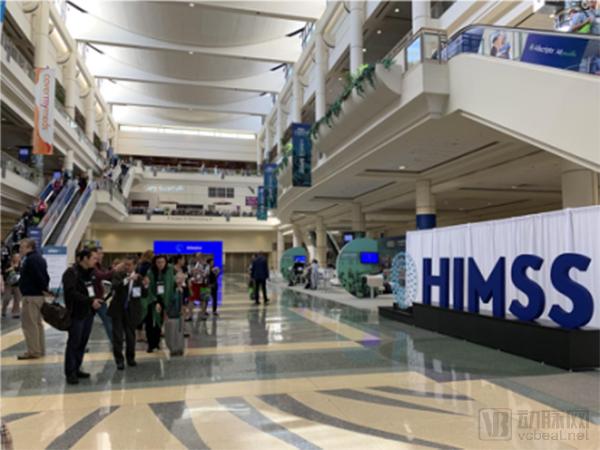
HIMSS19 Global Conference Site
Behind the lofty vision of Value-Based Care lie the increasingly severe challenges facing the future of healthcare, including population aging, a rapidly expanding cohort of patients with chronic diseases, rising consumer expectations, a growing shortage of healthcare professionals, and pressures from the financing system.
This year, the HIMSS19 Annual Conference has added several major themes, including “Healthy Aging and Technology” and “Population Health Management and Public Health.” This indicates that it has become an industry consensus that the growing healthcare demands driven by an aging society and population growth, along with escalating financial pressures, are significant challenges.
Under this pressure, healthcare institutions must do more with fewer resources and lower costs while delivering medical services that offer better efficacy and greater safety. This has given rise to two trends: one is the consolidation of the healthcare industry, and the other is the advancement of medical technology innovation and the development of Value-Based Care.
First, the healthcare industry is undergoing gradual consolidation. In the past, the sector was highly fragmented, with many suppliers offering identical products and services, and little differentiation among institutions. Over the past two years, there has been a clear trend toward industry alliance and resource concentration, both among hospitals and suppliers. This year, HIMSS introduced a new theme called “Clinically Integrated Supply Chain,” which highlighted a case of shared medical equipment. Through collaboration between healthcare institutions, millions of dollars in expenditures can be saved, while also benefiting from resource sharing and standardized processes.
In addition, many non-profit organizations and even government agencies are working on platform standardization. For example, New York established a state-level agency called Health Information Exchange, which is responsible for receiving millions of daily medical transaction records from various hospitals, standardizing the data across these institutions, and performing patient identity matching. I have observed an increasing number of such efforts being undertaken by both the private and public sectors.
Secondly, challenges such as population aging and financial pressures are also driving medical innovation and the development of Value-Based Care. An increasing number of large corporations and vendors are seeking solutions to enhance efficiency and reduce costs based on their existing equipment. For instance, SubtlePET, an intelligent rapid PET image enhancement platform developed by Subtle Medical, seamlessly integrates AI-based image enhancement algorithms into existing clinical imaging workflows. This helps hospitals and third-party imaging centers increase imaging speed by up to 4-fold and reduce radiation dose by up to 75%, while ensuring the image quality of routine acquisitions.
Compared with similar products based on empirical mathematical models, SubtlePET learns a model that more closely aligns with actual clinical images from data, enabling better restoration of image quality at faster speeds and lower doses. The product was also recognized by the renowned Chinese tech media Synced as one of the “Top 30 Most Innovative AI Products/Solutions of 2018.” Over the past two years, I have clearly observed growing market acceptance for such products that help hospitals reduce costs and improve efficiency, with many hospitals now proactively purchasing them.
Major imaging equipment vendors such as GE Healthcare, Siemens, Philips, and Neusoft Medical; imaging platforms including Google Cloud, Amazon Web Services (AWS), Microsoft Azure, and Nuance; as well as leading pharmaceutical companies are all making strides in this area. These organizations have also collaborated with Subtle Medical across various domains to promote the clinical adoption of AI-based medical image optimization and enhance the efficiency of imaging workflows within hospital systems. Recently, Dr. Ajit Shankaranarayanan, former Global Head of MRI Business and Neuro Imaging Applications at GE Healthcare, has joined Subtle Medical full-time, focusing on partnerships with industry players to advance AI solutions aimed at improving hospital imaging efficiency.
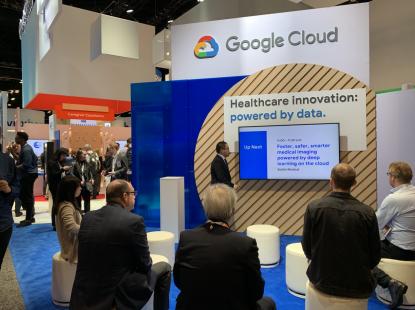
At HIMSS 2019, the head of Subtle Medical introduced SubtlePET’s technology at the Google Cloud booth.
At the HIMSS Conference, Dr. David Rhew, Chief Medical Officer and Vice President at Samsung, demonstrated how virtual reality (VR) can address healthcare challenges posed by the “silver tsunami.” For instance, VR can help patients better tolerate pain associated with certain chronic conditions by distracting elderly users, thereby serving as an alternative to analgesics. VR is also being used to treat ophthalmic diseases such as macular degeneration; by employing specific VR eye-tracking software, the system identifies and locks onto the patient’s optimal retinal fixation point and optimizes visual images. Furthermore, VR can help alleviate anxiety and support memory function.
Dr. David Rhew also believes that only by truly understanding and meeting patients’ needs can you ensure they actually use your product. “Older adults hope to slow the decline in their cognitive abilities; they do not want to lose their mental clarity and memory, nor do they want to feel lonely. If you can meet these needs, you will be able to get more older adults to use your product.”
Digital health was one of the key themes at this year’s HIMSS Annual Conference. In recent years, digital health has been steadily advancing as a major trend, and 2019 marked a pivotal year for the practical implementation of digital health tools. On this foundation, the development of cloud services should not be underestimated.
First, the growing adoption of digital health tools will enhance healthcare data sharing and care management, expand access to medical services, and narrow regional disparities. In the future, digital health platforms will meet patient needs for online appointment scheduling, bill payment, access to test results, teleconsultations, and e-prescriptions. Moreover, these electronic platforms will enable patients to compare drug prices across different providers, thereby promoting price transparency in both healthcare services and pharmaceuticals.
With the advancement of digital healthcare, government regulatory measures are steadily keeping pace to promote better development of the healthcare industry. Not long ago, the U.S. government launched the FDA Pre-Cert (Pre-Certification) Pilot Program and established the Center for Medicare & Medicaid Services (CMS) Innovation Center to reduce governmental barriers to digital innovation.
For medical suppliers, the establishment of the FDA Pre-Certification Program represents a significant benefit. Previously, the FDA’s certification process was based on physical medical hardware devices; therefore, manufacturers were required to undergo certification for each new generation of hardware launched. However, with the rise of digital health, updates to an increasing number of medical devices are now software-based. Since software iterates at a much faster pace than hardware, the original regulatory framework failed to keep pace with contemporary medical innovation. The new FDA Pre-Certification Program certifies the company and its development processes rather than individual products. As long as products are developed in compliance with standardized procedures and meet quality requirements, they can be marketed without undergoing the cumbersome certification process for each individual product. This change helps accelerate time-to-market, thereby improving healthcare efficiency and reducing the burden on healthcare service providers.
Secondly, hospitals are collectively and proactively migrating to the cloud. Historically, the healthcare sector has been perceived as highly conservative, prioritizing control over data and hardware security rather than service convenience. Consequently, hospitals have traditionally been reluctant to adopt cloud-based services, which are often viewed as modern and aggressive. However, I now clearly observe that many hospitals are no longer maintaining their own large-scale, costly hardware infrastructure; instead, they are actively seeking cloud-based solutions. As far as I know, numerous hospitals are discussing this transition, engaging with vendors, and some have already begun implementation.
A significant trend in this context is the migration of healthcare infrastructure to the cloud. Currently, when infrastructure upgrades are required, many hospitals opt against updating their physical equipment, choosing instead to migrate these services directly to the cloud. A previous research report on cloud computing applications by HIMSS Analytics pointed out that Infrastructure as a Service (IaaS) has experienced rapid growth in recent years, with healthcare institutions increasingly adopting this virtualized resource model to achieve greater flexibility and scalability in areas such as storage, data backup, and computing services. Meanwhile, the adoption of Software as a Service (SaaS) has remained at a high level and has seen further growth in recent years. This signals that hospitals are willing to place their trust in public cloud service providers to minimize infrastructure maintenance costs.
During HIMSS, Dr. Zhu Liren, Head of Medical Engineering at Deepwise, also engaged in in-depth discussions with multiple hospitals, Google Cloud, Amazon, and other stakeholders on plans to further collaborate in promoting cloud services and the deployment of AI applications.
In the aforementioned “2019 Healthcare Trend Forecast,” HIMSS analysts predicted that we would see increased real-world application of digital health tools, including artificial intelligence (AI), virtual reality/augmented reality (VR/AR), wearable devices, implantable medical devices, and speech recognition. Examples include using AI or machine learning to identify high-risk populations for certain diseases or to develop personalized treatment plans; employing wearable or implantable devices to monitor the physical condition and treatment outcomes of patients with chronic diseases; and adopting digital therapeutics as an adjunct to or replacement for traditional therapies in diabetes management.
From the perspective of healthcare suppliers, the scope of AI applications in healthcare is vast. Common AI-enabled products on the market include those for medical imaging, laboratory services, electronic medical records (EMR), and advanced analytics.
For instance, in the field of natural language processing (NLP), a significant application involves electronic health records (EHRs). As medicine is a highly experience-driven discipline and clinical conditions are often difficult to describe with precise language, most EHRs currently exhibit a low degree of standardization. Many hospitals have begun applying NLP techniques to process EHRs and are purchasing related services. This trend is also linked to the rise of Value-Based Care, as hospitals need to extract information from EHRs regarding patients’ health status, treatment outcomes, and patient satisfaction with the diagnostic and therapeutic services received.
At the HIMSS Conference, I observed many emerging teams leveraging VR and AR for surgical procedures, a technology that has already gained a certain level of market acceptance. In surgery, abundant 3D imaging data can be acquired; however, current technologies only allow physicians to view 2D images. Consequently, doctors require extensive training to interpret these 2D images and mentally reconstruct the patient’s anatomical structures. With VR, physicians can directly visualize 3D anatomical and pathological structures. I believe this is a highly promising direction, and many vendors, both large and small, will likely follow suit in the future.
This year, I have also observed many manufacturers developing telemedicine applications. Overall, the implementation of telemedicine is progressing faster in developing countries than in developed ones, as these regions often exhibit higher demand. One case that left a deep impression on me involved a Brazilian vendor that installed telemedicine hardware in remote areas of Brazil. In these locations, where only nurses are available and no doctors are present, the telemedicine equipment enables high-quality physicians in urban centers to promptly provide diagnostic opinions. Patients requiring treatment are then transferred to urban centers for care. Aligning with this trend, Deepwise Medical is actively expanding its presence in emerging markets such as Brazil, deploying and collaborating on AI-based medical imaging products.
In the United States, telemedicine is often implemented within a single healthcare institution to enhance standardization. For example, in radiology, a common telemedicine application is image interpretation: after imaging equipment acquires images, they are packaged and uploaded for centralized interpretation by trained physicians. Furthermore, many hospitals are increasingly accepting health data from outside the hospital, such as data recorded by patients’ daily wearable and monitoring devices. The collection and analysis of data from these wearable devices also rely on telemedicine technologies.
By Gong Enhao, Founder and CEO of Deepwise Healthcare.