

Short-, Medium-, and Long-Term Impact and Implementation Challenges of Blockchain Technology in the Healthcare Industry
The healthcare industry is plagued by inefficiencies and high administrative costs. Blockchain technology can help address the sector’s most pressing challenges in compliance, interoperability, and data security, while enabling new patient-centric business models. However, unlocking the potential of blockchain in healthcare will be a gradual process, and rapid change is unlikely.
Based on known stakeholders, scalability requirements, and necessary safeguards, a recent report by CB Insights analyzes the impact of blockchain on the healthcare industry in the short, medium, and long term.
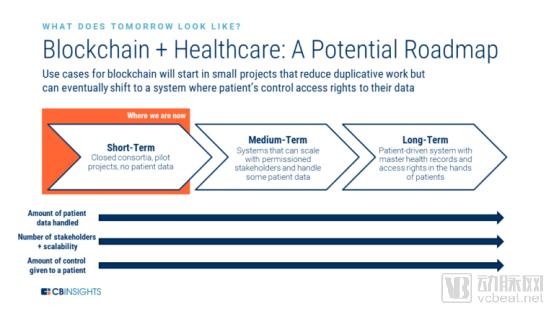
Image source: CBinsights
The main contents of this report are as follows:
1. Why Can Blockchain Technology Be Applied in Healthcare?
2. Short-term use;
3. Mid-term Applications;
4. Long-term use;
5. What are the challenges of applying blockchain technology in the healthcare industry?
Below is the main content of this report, compiled by VCBeat (WeChat Official Account: vcbeat):
Why Can Blockchain Technology Be Applied in Healthcare?
Blockchain technology enables transparent, decentralized, and secure data tracking across computing devices, creating a public, chronologically ordered database.
Blockchain has the potential to provide new solutions in the healthcare sector due to its following characteristics:
Consistency:By leveraging blockchain technology, data remains consistent across different databases, as there is only a single record. This reduces issues of data duplication or potential tampering, making the data itself more accessible rather than requiring it to be captured into separate record-keeping systems of different organizations;
Tamper-Proof:Users can only append transactions to a database, ensuring that all activities are traceable and auditable;
Available:Entities can “own” data and choose who has access to it. Unlike companies that sell individuals’ data to third parties, the entity can control where its data goes;
Explicit Rules:Use the same version of the database, and the rules regarding it are known;
Decentralized Distributed Storage:Database copies are stored in multiple locations, eliminating the need for a third-party administrator. This reduces administrative costs and reliance on intermediaries, a capability that the healthcare industry has undoubtedly achieved. It also prevents centralized systems from becoming completely locked out or inaccessible.
These features are critically important for institutions handling health data and for patients. Blockchain technology makes data more resistant to tampering and facilitates easier sharing among various parties. It also offers numerous cybersecurity advantages, including traceability and the ability to verify who has accessed specific data.
In 2017, capital began flowing into the blockchain sector, driven by initial coin offerings (ICOs) conducted by various companies, including several healthcare firms.
Since then, the hype surrounding cryptocurrency prices and ICOs has slowed sharply. However, equity financing for blockchain companies has been growing rapidly.
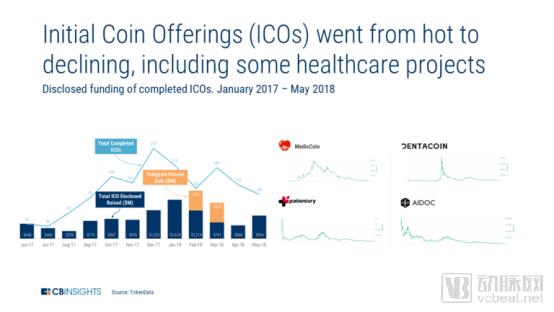
Image source: CB Insights
During earnings conference calls of major companies, mentions of the term “blockchain” have surged, with most healthcare companies referring to blockchain in the context of exploration or pilot projects.
As highlighted in the CBI platform’s patent search, the number of patents referencing “blockchain” or “distributed ledger” technologies in medical applications is also on the rise. IBM, Walmart, Bank of America, and several other companies are exploring various blockchain applications in emergency response, compliance, and data-sharing agreements.
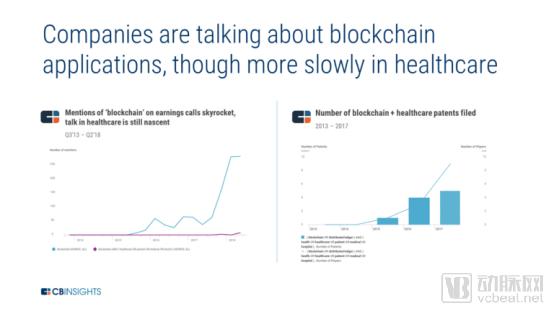
Image source: CB Insights
Despite the influx of increasing numbers of companies and capital into this field, blockchain and healthcare applications remain in their early stages.
Below, we will explore areas where we believe preliminary progress may be made, ranging from the short term to envisioning a future system centered on decentralized health records.
Short-Term Applications
Initial healthcare applications of blockchain and distributed ledger technology primarily focused on closed consortiums and back-office operations that did not involve patient data.
Enterprises are taking their first steps into blockchain projects by joining small, closed consortia that utilize distributed ledger systems or blockchain technology, thereby keeping data shared among relevant companies.
The initial projects aimed to share data through distributed ledger systems to prevent duplication of effort. However, none of these projects focused on patient data due to its high sensitivity.
One initiative has brought together UnitedHealthcare, Optum, Quest Diagnostics, Humana, and Multiplan to ensure their provider directories are up to date. The Centers for Medicare & Medicaid Services (CMS) imposes fines on these companies if their provider information is not current.
By sharing provider information with one another, these companies can reduce workload, as data is stored in a shared, accessible database and updated regularly.
Hashed Health is collaborating on projects with smaller consortia. For example, the company is developing a credential verification system for physicians to demonstrate that they hold licenses to practice in specific specialties.
Currently, physicians must obtain separate credentialing for each institution and state in which they plan to practice, with each certification process potentially taking 30 to 90 days.
If all parties authorized by physicians could access shared physician credential records, the process would be faster, simpler, and more cost-effective. Blockchain-based systems can enable this by providing physicians with private keys that allow them to authenticate with any institution requiring verification.
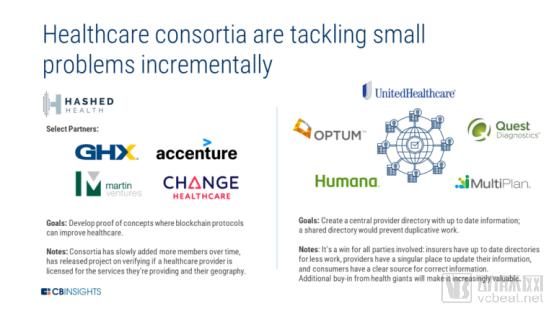
Image source: CBinsights
Another area where Hashed Health and several other companies are committed to developing blockchain solutions is the pharmaceutical supply chain. Counterfeit drugs and drug recalls (especially outside the United States) have made traceability a top priority in the supply chain.
Under the Drug Supply Chain Security Act (DSCSA), pharmaceutical supply chain participants will be required to join interoperable electronic systems in the coming years, enabling them to track each individual drug product throughout the supply chain.
Blockchain technology is a potential solution to this problem.
Chronicle is collaborating with several major pharmaceutical companies and drug supply chain giants to launch a pilot project called MediLedger. The project utilizes a permissioned blockchain system (which allows vetted participants to join) to track who handles which medications and when.
By ensuring that only manufacturers can commission serial numbers and attach unique identifiers (recorded on the ledger) to products, the system makes it more difficult for counterfeit goods to randomly enter the supply chain. The blockchain system uses zero-knowledge proofs, allowing companies to ensure compliance without actually sharing data.
Zero-knowledge proof is a data-sharing method that allows two parties to verify whether certain events have occurred without actually disclosing specific underlying data to each other.
Blockchain-based supply chain systems can also be integrated with Radio Frequency Identification (RFID) tags and temperature logging mechanisms to ensure that environmental requirements are met throughout the entire supply chain. If the rules are clearly defined, the system can leverage smart contracts to execute processes in a nearly fully automated manner.
Mid-Term Applications
Mid-term projects will move beyond the pilot phase and involve more stakeholders. These projects will also begin to explore methods for storing and sharing patient data.
Implementing these projects may require more time, as they necessitate multi-party collaboration and carry a high risk of accidental patient data breaches.
The backend of healthcare is slow, complex, and expensive.
Cost estimates related to billing and insurance account for 18% of total national healthcare expenditures. The American Medical Association found that more than one-quarter of clinics must wait more than three business days to obtain prior authorization (permission from the patient’s insurer to purchase medication).
Aligning blockchain with data standards has the potential to accelerate some of these processes and reduce costs.
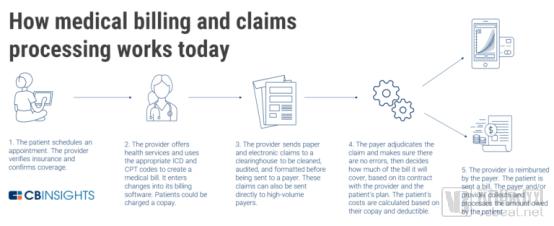
Image source: CB Insights
Many such tasks require accessing complex data from various entities. Payers must know what services the patient received and the patient’s specific rehabilitation plan. Physicians need to know how much to charge the patient. Everyone wants to see claim details throughout their lifecycle.
Change Healthcare has built a system that follows the claims lifecycle, tracking every transaction listed above (data submitted for review, the review itself, approval or rejection, etc.). The company has also improved the speed and scalability of transaction processing, which has long been a bottleneck for many public blockchain projects. The company states that it facilitates nearly 14 billion transactions annually for 2,100 payers, 5,500 hospitals, and 33,000 pharmacies.
Emily Vaughn, Director of Blockchain Product Development at Change Healthcare, stated, “The status of claims is not the innovation; there are already many solutions on the market that can achieve this. The exciting part is that blockchain technology can actually meet the capacity demands of healthcare. In the healthcare sector, the standard requirement for large-scale network solutions is approximately 30 million transactions per day. On its largest transaction day to date, Ethereum processed around 1.4 million transactions. The solution we have designed is capable of handling 50 million transactions daily.”
Pre-screening new participants before they join a permissioned blockchain can help the system scale.
One approach is to establish rule-based smart contracts that automatically execute when predefined conditions are met. This is precisely what PokitDok aims to achieve with its DokChain product to accelerate claims approval.
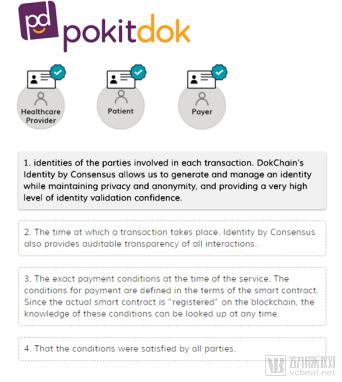
Image source: CBinsights
In this system, the network can authenticate suppliers based on rules embedded in smart contracts, which automatically authorize payments when predefined criteria are met.
Theoretically, this can also be achieved through prior approval of the drug.
Currently, insurance companies require prior authorization to ensure that all other options have been explored before approving expensive medications.
This costly process, which is primarily rule- and checklist-based, currently takes 1–15 days.
Smart contracts can accelerate part of this process by encoding drug-related rules to verify whether every therapeutic approach has been explored and to assess whether prior medications or tests have caused adverse reactions. However, this requires convenient access to patients’ medical records, which may pose a significant barrier.
In an ideal scenario, the backend of healthcare systems would be able to track patients through continuous care and access necessary information when needed. This would require a unique patient identifier that tracks patients across systems and records transactions in which the patient is involved.
Blockchain systems can successfully track patients’ locations and the procedures/tests they have undergone, thereby avoiding many redundant processes and ensuring that all stakeholders are informed about their status.
Companies like PatientPing have established comprehensive businesses that provide real-time admission and discharge notifications to healthcare providers for all patients. Blockchain systems enable known entities to track patient movements and treatment processes (without the need to store information such as test results), which can significantly reduce administrative burdens.
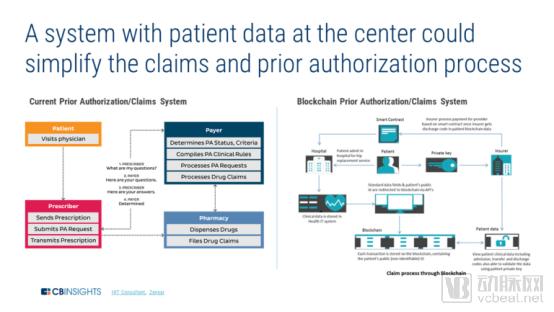
Image source: CB Insights
However, achieving this requires a certain degree of collaboration and access to patient data, which is difficult to realize in the short term.
Data is becoming increasingly valuable. Whether it is for training algorithms, identifying better treatment options, or determining where to establish clinical trials, this means that existing players in the healthcare industry have the opportunity to monetize their datasets.
Currently, data de-identification is a process that requires third-party involvement. However, as these practices become increasingly accepted, we can build blockchain-based systems to facilitate data exchange. Furthermore, new regulations governing how third parties use consumer data—such as the GDPR and Consumer Privacy Acts—will compel enterprises to establish audit trails and consent mechanisms for data development.
HealthVerity is one of the players in this field, combining health data exchange with blockchain products to manage permissions and access rights.
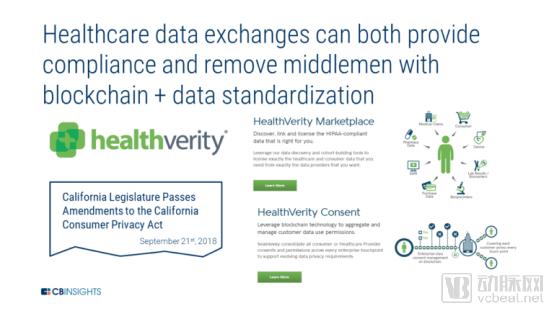
Image source: CB Insights
Some initiatives attempt to completely bypass data exchange by enabling patients to donate their data directly to researchers. This scenario is more likely to occur among populations affected by cancer, incurable conditions, and rare diseases, as well as in regions where individuals are more actively engaged in their healthcare.
For researchers and pharmaceutical companies, patient data is invaluable. Helping these stakeholders better document their data and enabling easier access for researchers will facilitate broader utilization of such data and potentially foster enhanced collaboration among research institutions.
One area we may see first is genomics. In genomics, rare variants are valuable, and there is particular concern about third-party access to such data for profit-driven purposes (e.g., law enforcement, life insurance, etc.).
By placing data access rights in the hands of patients, it becomes possible to establish an incentive system that can be monetized based on data demands.
This monetization model can be expressed in U.S. dollars, and some companies are exploring alternative approaches. Luna DNA is attempting to issue company stock, while Doc.ai is considering providing tokens to participants in exchange for their data. These tokens can be used to pay for services on the network, such as instant notifications.
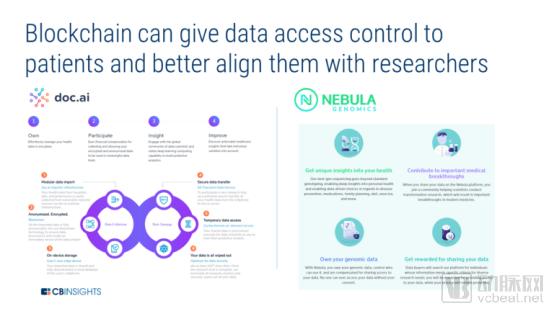
Image source: CB Insights
In the future, such data markets may not require third-party intervention at all. In another model, patients could sell their own data, and entities could be required to pay for access to it.
Other network participants can verify and process transactions, append the transaction block to the end of the chain, and receive tokens as compensation for completing the verification task. This process eliminates the need for a third party to manage data and currency exchanges.
In addition to better data sharing, blockchain also offers an opportunity to improve healthcare before the treatment phase: in research and clinical trials.
Effective research and clinical trials require coordination across multiple sites and stakeholders, as well as the management and review of large volumes of sensitive data from diverse sources.
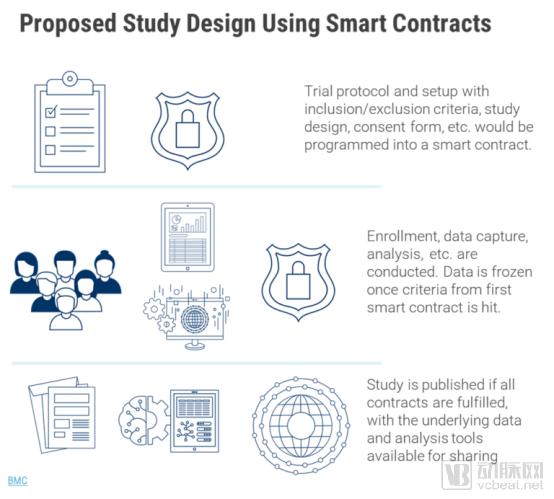
Image source: CBinsights
Blockchain can improve informed consent and structured protocols (documents that clarify objectives, trial design, and how efficacy is evaluated). By determining how to conduct research and analysis early on, third parties can quickly verify whether the original design has been followed.
Timestamps and smart contracts can ensure that researchers adhere to the study design, preventing any changes to criteria or analyses during the trial. This helps eliminate some biases that may arise in research or clinical trials and better ensures the reproducibility and publication of negative results (a scenario that typically does not occur).
Another important function that blockchain can achieve is linking disparate data from research studies, which are often conducted across different research facilities and managed by different researchers. This eliminates the need to coordinate multiple databases to create a traceable record of participant activities.
Patient consent forms can grant access permissions whenever they are used and new data is appended to each examined entity, making such new data available to every participant on the ledger (without the need to reconcile separate data sets). This will ensure that data is not lost or tampered with.
Once a study is completed, an easily accessible audit trail will be available for submission to regulatory authorities, auditors, or other researchers (this task is typically handled by the electronic Trial Master File).
As wearable devices, supply chain tracking, and other sensors capture more granular data, potential failure points in research become easier to identify.
Permissioned blockchains can provide all members of a clinical trial or study with a real-time, timestamped view of participant data and transactions within a given timeframe, as each member holds a copy of the shared database. This simplifies the data reconciliation process and facilitates end-to-end research.
Although these solutions can facilitate research, they do not address one of the critical pain points: recruiting patients who meet the appropriate criteria. Easier access to patient records can help mitigate this challenge.
Long-term Application
In the long run, the true benefit of blockchain-based ledgers is to serve as a platform for decentralized patient records. Empowering patients with convenient access to their health records and granting providers comprehensive access will transform the landscape of healthcare.
To achieve this goal, many obstacles remain to be overcome. Clearer regulations, more methods for creating and capturing data outside existing EHR systems, and finding safer ways to store large volumes of data are all issues that need to be addressed.
The lack of interoperability in healthcare systems is a significant problem, leading to redundant work, poor patient experiences, and, worst of all, suboptimal medical outcomes.
A survey by the Ponemon Institute found that 86% of medical errors are caused by patient misidentification.
Meanwhile, a Black Book survey estimated that the average cost of duplicate care due to duplicate records was $1,950 per inpatient and $800 per emergency department visit.
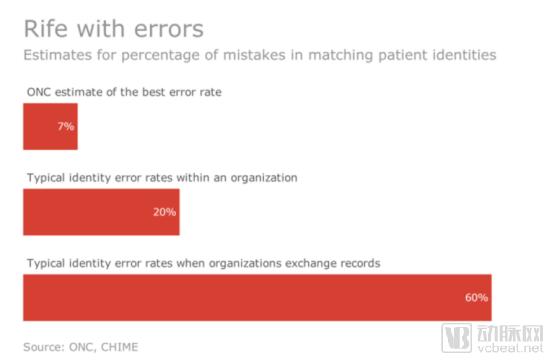
Image source: CB Insights
Given the high costs associated with medical data breaches, cybersecurity is also a major concern.
A report by Verizon Enterprise indicates that the majority of health record breaches occur because individuals send information to incorrect destinations or access records for which they lack proper authorization.
Blockchain ledgers will create an audit trail of who accessed health records, thereby enhancing accountability.
Furthermore, developers have yet to create user-friendly third-party medical platforms that are as advanced as those in many other fields. However, as patients generate increasing amounts of data through technologies such as consumer diagnostics, wearable devices, and genomics, this data can be structured and captured into their own personal health records.
Decentralized patient health record systems can better capture data and provide patients with improved control over data access. Patients can grant data access permissions to anyone they choose to authorize.
This will threaten business models that rely on hoarding data as a moat. It also means that companies must better demonstrate the value they provide to patients in exchange for their data, rather than purchasing data from third parties that collect and identify it.
For example, pharmaceutical companies rely on such data to better inform the target areas of their marketing campaigns and clinical trials.
We have seen announcements of several projects related to patient data, although we have not yet witnessed the actual deployment of these applications.
In January 2017, Du partnered with NMC Healthcare to leverage blockchain technology for managing electronic health records. The Estonian blockchain startup GuardTime was also involved in the initiative. Although the project was scheduled to launch in the first quarter of 2018, the application has yet to be released.
Overall, in countries that still lack unique patient identifiers, decentralized personal health records may be more feasible.
Estonia and India have recently established these identifiers, despite concerns that this could negatively impact citizens’ privacy and potentially expose sensitive information in the event of a data breach.
Once fragmented patient records become widespread, the decentralized application (dApp) layer for various services will become more viable, as data access will be easier. These ecosystems will require some form of token-based incentives to verify every transaction on the network, including exchanges of currency or data for services. This is similar to what we described in the Health Data Exchange section above.
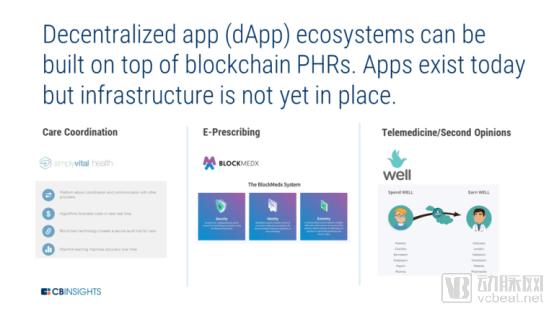
Image source: CB Insights
What Are the Challenges in Applying Blockchain Technology to the Healthcare Industry?
Blockchain Integration in the Healthcare Sector Will Be a Slow Process.
Regulations concerning patient privacy make it difficult for stakeholders to engage and hinder third parties from accessing relevant but de-identified information. The EU’s General Data Protection Regulation (GDPR) may also conflict with blockchain projects, although it could simultaneously serve as a catalyst for improving compliance solutions.
The lack of data standards means that blockchain projects are operating in a challenging environment. For most blockchain projects, scalability remains an issue because storing data on the blockchain is extremely costly. However, solutions to these problems are currently being explored.
In terms of data standards, the establishment and adoption of Fast Healthcare Interoperability Resources (FHIR) have laid the foundation for the thriving ecosystem of third-party development. Shared data standards are essential for many aspects of blockchain technology, such as smart contracts.
New cryptographic technologies—such as zero-knowledge proofs, homomorphic encryption, and secure multi-party computation—enable computations to be performed on encrypted data. This means that sensitive information can remain usable without being actually exposed.
Improved data access models can incentivize patients, hospitals, and other stakeholders to monetize their digital assets, such as patient data.
Finally, to address scalability and sensitivity concerns, blockchain projects are exploring approaches that combine on-chain solutions (records maintained on a distributed ledger) with off-chain solutions (operations conducted outside the ledger). Transactions, urgent data, and similar items can be stored on the blockchain system, while larger data storage needs can be met by private repositories.
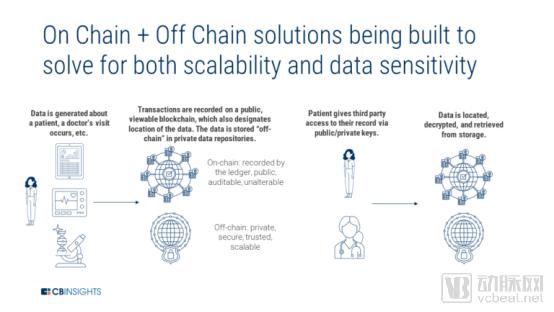
Image source: CB Insights
Blockchain technology and distributed ledgers hold significant potential in healthcare. Blockchain can place patients at the center of the healthcare ecosystem by granting them control over one of their most valuable assets: their data. However, the most critical factor is understanding when and where it is effective.
As the ecosystem takes shape, opportunities for deploying blockchain applications will continue to grow. However, centralization also has its advantages, including speed, privacy, and more. Knowing when to choose centralization over decentralization will be key.
The healthcare industry is expected to see more blockchain entrants attempting to strike a balance between the two. This could fundamentally transform medical processes, business models, and health information technology.