

Cochlear Ltd: The Global Leader in Cochlear Implants with 55% Market Share

Cochlear
Global Leader in Implantable Hearing Solutions
Recently, Cochlear, the world’s largest manufacturer of cochlear implants, released its fiscal 2018 report. The financial statements showed that Cochlear’s revenue for fiscal 2018 was $1.351 billion, with a net profit of $246 million, representing a 10% increase compared to 2017.
Cochlear Implant (CI) is an electronic device that converts sound into encoded electrical signals via an external speech processor. These signals are transmitted through an implanted electrode system to directly stimulate the auditory nerve, thereby restoring, enhancing, and reconstructing hearing function in patients with mild to severe deafness. In recent years, with the advancement of new technologies such as Wi-Fi and Bluetooth, cochlear implant devices have developed rapidly, transitioning from the experimental research phase to clinical application.
It is understood that the cochlear implant is currently the most successfully applied biomedical engineering hearing assistance device, and has become a standard treatment for mild to profound deafness worldwide.
According to the latest report released by Market Research Future (MRFR), a market research and consulting firm, the global cochlear implant industry is projected to reach $3.204 billion by 2023. The rising prevalence of ear infections and prelingual hearing impairment will drive continuous expansion in market demand. From 2017 to 2023, an increase in regulatory approvals and the launch of various hearing aid products are expected to propel the market to grow at a compound annual growth rate (CAGR) of 9.86%.
Currently, in the global cochlear implant market, three major cochlear implant device manufacturers collectively account for more than 90% of the global market share, namely:Cochlear from Australia (55%), Advanced Bionics from the United States (20%), and MED-EL from Austria (20%). (This data is sourced from the Cochlear Implant Help website.)
Among them, Cochlear is the earliest-established and largest cochlear implant device manufacturer by market share. Founded in 1982, Cochlear is headquartered in Sydney, Australia. In April 1999, the company was listed on the Australian Securities Exchange (ASX) under the stock code COH.

Image source: Cochlear official website
As a global leader in the production of cochlear implant devices, Cochlear employs over 3,500 people worldwide and invests more than 12% of its total annual revenue (exceeding AUD 160 million) in product research and development. To date, Cochlear has supplied over 550,000 implantable devices to the global hearing market, helping more than 450,000 individuals with hearing loss across all age groups in over 100 countries regain their hearing.
Cochlear mainly has three major product categories, includingCochlear Implants, Bone Conduction Implants, and Acoustic Implants。
Among these, the Nucleus® 7 Sound Processor is the flagship product of the cochlear implant series and has been the primary revenue driver for the company in recent years. The underlying Nucleus system was developed in the 1970s by Dr. Graeme Clark, a Professor of Otolaryngology at the University of Melbourne in Australia. This system integrates an electronic device surgically implanted behind the patient’s ear, a sound processor that captures acoustic signals, and an electrode array that transmits auditory information to the brain.
The Nucleus sound processor was the first cochlear implant to receive FDA approval. Since its market launch, the company has continuously updated and upgraded the system.
In July 2017, Cochlear launched the latest version of its Nucleus 7 Sound Processor. This product had received approval from the U.S. FDA in June of the same year. It is the world’s first cochlear implant sound processor specifically developed for the iPhone system, and also the smallest and lightest behind-the-ear cochlear implant sound processor on the market, compatible with the Nucleus 24 series implants.
In June 2018, the Nucleus 7 Sound Processor was updated again, enabling the Nucleus system to be compatible with smart devices running the Android operating system. As a result, the Nucleus 7 Sound Processor became the world’s first hearing assistance product to support both iOS and Android systems. According to Cochlear’s 2018 financial report, the launch of the Nucleus 7 Sound Processor drove a 15% increase in the company’s cochlear implant product revenue.
In addition to the Nucleus product series, Cochlear’s other product line—the bone conduction implant series—also commands significant market influence.
The bone conduction implant utilizes the company’s Baha system, a product line that leverages the body’s natural ability to conduct sound through bone. Currently, bone conduction implants are recognized as an established medical option for both adults and children. The Baha-based bone conduction implant captures airborne sound, converts it into vibrational frequencies, and transmits these vibrations to a small implanted device via an abutment or magnetic connection. The implant then directly conducts the vibrational frequencies through the skull bone to the user’s inner ear.
This product series is designed to help patients who are unable to receive sound through hearing aids, or for whom hearing aids provide limited benefit, to more effectively perceive sound and communicate with others.
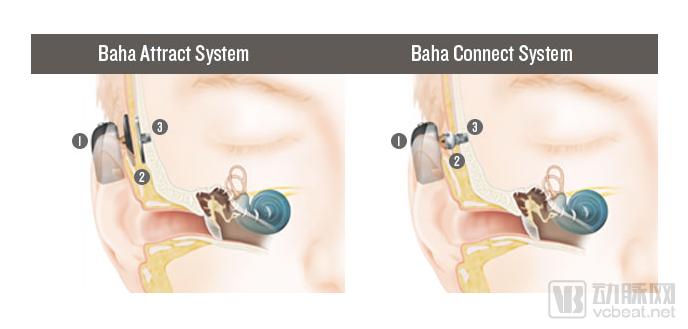
There are two bone conduction implant products, namely Baha® Attract and Baha® Connect (image source: Cochlear official website))
Currently, there are two bone conduction implant products: Baha® Attract and Baha® Connect. However, this product line is not an original Cochlear development; it was initially manufactured by the Swedish biotechnology company Entific Medical Systems.
In March 2005, Cochlear acquired the Swedish company Entific Medical Systems for $195 million, thereby bringing the latter’s Baha product line under Cochlear’s ownership. At that time, Cochlear already held a 65% share of the U.S. cochlear implant market. Through this acquisition, Cochlear not only expanded its product portfolio but also seized an opportunity to enter the Swedish market.
Acoustic implants constitute Cochlear’s third-largest product category. Although this product line has lower market recognition than the company’s first two categories, it plays a significant role in generating corporate revenue. “Sales of acoustic implant cochlear devices remained flat compared with the previous year, which had seen a 26% increase,” stated Dig Howitt, President and CEO of Cochlear, in the 2018 annual report.
The acoustic implant product series adopts the Hybrid system, an electro-acoustic system. This product series combines a cochlear implant with an acoustic hearing aid and is suitable for patients with residual low-frequency hearing. The Hybrid system’s implant is a smaller variant of the Nucleus device; its electrode array delivers only high-frequency sounds, while the Hybrid electro-acoustic component amplifies low-frequency sounds and transmits them to the patient’s brain via the natural neural pathway. Launched in 2008, the Hybrid system received the Australian Engineering Excellence Award and an international design award in 2009.
Cochlear’s other two product series, Middle-ear implants and Cochlear™ True Wireless™, also have their own distinctive features. The flagship product of the middle-ear implant line is the Carina® System, a fully implantable device that, unlike hearing aids or other auditory implants, has no external components. It can be concealed beneath the skin, making it 100% invisible.
The Carina® System was also acquired by Cochlear. In September 2012, Cochlear acquired hearing-related products from the U.S.-based company Otologics LLC, such as the MET Middle Ear Implant and the Carina fully implantable middle ear implant. This acquisition strengthened Cochlear’s capabilities in developing new technologies for hearing restoration and enhancement, and today, these two products remain important components of Cochlear’s product portfolio.
The Cochlear™ True Wireless™ range features no neck loop, no wires, and no cords, making it a fully wireless product line. The range currently comprises four products: the Cochlear™ Wireless Phone Clip, TV Streamer, the next-generation Mini Microphones 2, and the next-generation Mini Microphones 2+.
Cochlear’s True Wireless product series is compatible with Nucleus sound processors as well as Baha 4 and Baha 5 sound processors, enabling direct wireless streaming of audio to the patient’s sound processor to improve hearing ability in various situations, including at a distance.
As mentioned above, several product lines within Cochlear’s extensive portfolio have been acquired. Furthermore, enhancing technical soft power through acquisitions is a key development strategy for Cochlear. In May 2017, Cochlear acquired Sycle, an audiology software company, for $78 million.
Sycle, headquartered in San Francisco, holds a 70% market share in the United States. Chris Smith, then CEO and President of Cochlear, described the acquisition as a “strategic investment.” “Sycle provides market-leading practice management solutions with an expandable and upgradable product suite, enabling its portfolio and technology to deliver solutions for cochlear implant clinics,” Smith said in the acquisition announcement at the time.
However, in Cochlear’s history of financing and investment, the company has not been particularly active. According to incomplete statistics from VCBeat (WeChat ID: vcbeat), since its establishment, the company has acquired three companies (namely, Entific Medical Systems, Otologics LLC, and Sycle, as mentioned earlier) and invested in four companies.
As a publicly listed company with nearly 40 years of history, Cochlear has been remarkably prudent in its strategic investment activities. Nevertheless, each of its investments has served as a significant driver of the company’s growth. The following are key investment milestones in Cochlear’s corporate history:
June 2016 to October 2018:Cochlear has invested three times in EarLens, a medical device company specializing in the production of hearing aids. Headquartered in California, USA, this medical technology company differs from traditional hearing aid manufacturers; its core product, the Contact Hearing Device™, is the world’s first hearing aid that uses light to transmit sound.
This product is essentially a micro-speaker that can simply adjust the volume of air-conducted sound. The EarLens system’s unique direct sound transmission mechanism opens the door to acoustic performance unattained by current hearing aids on the market, and also helps enhance Cochlear’s product performance.
May 2017:Cochlear Partners with Otoconsult. Otoconsult’s flagship product is the AI-powered fitting assistant FOX (Fitting to Outcomes eXpert). The technology provided by Otoconsult is expected to enable faster and more consistent cochlear implant fittings, thereby delivering optimal hearing outcomes for patients.
“The AI assistant FOX will provide clinicians with a platform to accelerate the cochlear implant fitting process while helping them achieve optimal patient outcomes,” said Chris Smith, former CEO of Cochlear.
William H. Shapiro, Associate Clinical Professor at the NYU School of Medicine, stated that this technology will change the way cochlear implants are programmed.
December 2017:Cochlear has entered into a collaboration with the French biotechnology company Sensorion, which is developing SENS-401, a small-molecule clinical candidate for hearing loss. Cochlear invested €1.6 million and acquired an equity stake in Sensorion. The partnership will evaluate the therapeutic efficacy of SENS-401 on hearing outcomes achieved with Cochlear’s implantable devices. Preclinical studies commenced in 2018, with potential clinical trials scheduled to begin in 2019.
June 2018:Cochlear has invested $3.65 million to support the development of Epi-Minder, a company specializing in epilepsy monitoring devices, which was established through a collaboration between St Vincent’s Hospital Melbourne and the University of Melbourne’s Bionics Institute. Epi-Minder is developing a breakthrough monitoring device designed to improve treatment for patients with epilepsy.
Although the products developed by the company are not well aligned with Cochlear’s core areas of focus, Cochlear is interested in the company’s monitoring technology.
As stated by Dig Howitt, current CEO of Cochlear, “Our primary focus remains on the hearing market; therefore, we will make certain investments and monitor all opportunities related to this market. However, we will proceed with great caution, as our ultimate goal continues to be providing solutions for individuals with hearing loss, which indeed represents a significant growth opportunity for our company.”
November 2018:Cochlear Invests $21 Million in European Medtech Startup Nyxoah. Nyxoah Has Developed the World’s First Battery-Free, Leadless Minimally Invasive Neurostimulator, Providing Neurostimulation for Patients with Moderate to Severe Sleep Apnea.
Cochlear Chief Technology Officer Jan Janssen stated, “Nyxoah’s minimally invasive solution offers an attractive alternative for patients who experience adherence issues or intolerance with existing treatments. Furthermore, in the long term, the continuous advancement of new technologies for cochlear implant monitoring and implantable devices will have a positive impact on the company’s core business.”
In terms of strategic market layout, Cochlear focuses on three specific segments: adults and the elderly in developed markets, children in developed markets, and children in emerging markets. The company formulates distinct market strategies for each segment to enhance its competitiveness.
Currently, Cochlear’s products are sold in more than 90 countries and regions worldwide, including the United States, Japan, Germany, France, the United Kingdom, and Canada. In developed markets, Cochlear has captured a 60% share of the target market for children with hearing loss, with its market share reaching 95% in Australia and 80% in most parts of Europe.
However, as Dig Howitt, current CEO of Cochlear, stated, “We have over 30 years of development history, and our products are widely accepted among the pediatric population. However, our penetration rate is only 3% among adults and the elderly in developed countries, as well as among children in emerging markets. There remains significant growth opportunity for us in these markets in the future.”
Since its initial entry into the Chinese market in 1994, Cochlear has been developing in China for over two decades. Currently, China has become one of Cochlear’s top five markets globally and one of its fastest-growing markets.
Several domestic companies have been making significant strides in the field of hearing, with notable enterprises includingNurotron, Aier Timesetc. Among them, Liang Qi, the founder of Aier Times, had worked at Cochlear for eight years. After resigning in 2013, she established Aier Times with the aim of creating an online education platform to train professionals in audiology.
As the first company in China to achieve large-scale commercial sales of cochlear implants, Nurotron is currently a strong competitor to Cochlear in the Chinese market. Founded in 2006, Nurotron has its headquarters and production base in Hangzhou, with its R&D center located in California, USA.
In August 2011, Nurotron obtained the Class III medical device manufacturing license for cochlear implants from the China National Medical Products Administration (NMPA), breaking the monopoly held by companies from the United States, Australia, and Austria in this field. Currently, Nurotron remains one of the few domestic companies holding this certification. The company’s cochlear implant products have captured approximately 17% of the Chinese market share, ranking among the world’s advanced levels in terms of technical specifications, stability, and reliability.
In response to the gradual rise of domestic Chinese enterprises in the hearing sector, Cochlear invested AUD 50 million in 2017 to establish a factory in Chengdu, Sichuan Province. This facility marks Cochlear’s first overseas production and R&D base. The move not only underscores the importance of the Chinese market to the company’s business but also highlights Cochlear’s urgency to further expand its market share in China.
It is expected that Cochlear’s factory in Chengdu, Sichuan will be completed by the end of fiscal year 2020. Once this production base is fully operational in research and development and manufacturing, it is poised to increase Cochlear’s global production capacity by 50%.
(By Cheng Xiaoqin)