

Thorough Insights: World's First AI-Powered Gastric Pathology Diagnostic System Officially Deployed at PLA General Hospital

Thorough Images
AI Pathology Image Diagnosis Service Provider
Following a three-month trial run, Thorough Insights, the gastric pathology computer-aided diagnosis system jointly developed by Thorough Images and the Chinese PLA General Hospital, was officially deployed at the Chinese PLA General Hospital just before the recent Spring Festival. It has become the world’s first large-scale deployed pathology computer-aided diagnosis system, achieving 100% sensitivity and 86% specificity.
Pathology imaging, the “gold standard” in medicine, is also regarded as one of the most challenging frontiers for AI. Compared with other medical imaging modalities such as CT and X-rays, a single pathology image contains approximately 1,000 times more pixels than a CT scan and 10,000 times more than an X-ray. Conventional single-machine, single-GPU systems are far from meeting the computational speed and throughput required for pathology image processing. Consequently, even in the rapidly advancing field of AI-driven medical imaging, pathology imaging remains somewhat “cumbersome” at the forefront of AI implementation.
However, in recent years, with improvements in computing performance and the boost from telemedicine, the field of pathological imaging has also begun to show signs of vitality. Industry insiders predict that the digitalization and AI-driven transformation in pathological imaging will become the next major trend in the healthcare sector within the next one to two years.
Prior to the arrival of the storm, Thorough Images secured a strategic advantage.
Thorough Images is a medical informatics company specializing in AI-assisted pathological diagnosis. Established less than two years ago, it has already forged partnerships with several of China’s top-tier tertiary hospitals, including the Chinese PLA General Hospital, the Cancer Hospital of the Chinese Academy of Medical Sciences, China-Japan Friendship Hospital, and Peking Union Medical College Hospital. Recently, its gastric pathology AI-assisted diagnostic system, jointly developed with the Chinese PLA General Hospital, has officially entered commercial operation.
The current pain points in domestic oncology treatment are mainly twofold: first, the number of pathologists in China is disproportionate to patient demand; second, pathological diagnosis is influenced by subjective factors, leading to inconsistent diagnostic criteria.
According to the recommendations of the National Health and Family Planning Commission, China requires 100,000 pathologists, yet the current number of registered pathologists is only approximately 10,000, representing a ninefold shortfall. Furthermore, the training period for a pathologist qualified to independently issue pathology reports exceeds ten years.
Reviewing 100–200 slides per day at a minimum, and up to 300–400 at a maximum, has become the norm for pathologists in China today. Liu Yanbin, CEO of Thorough Images, once witnessed a former director of the Department of Pathology at the Chinese PLA General Hospital, who retired after years of service, suffer simultaneous retinal detachment in both eyes due to prolonged exposure to the intense light of the microscope; it took three months of post-surgical recovery for him to regain his health.
“AI-based pathological image analysis technology represents a revolution over traditional microscopy and digital pathology,” said Liu Yanbin. He noted that the massive scale of pathological images inevitably drives the field toward an AI-driven transformation.
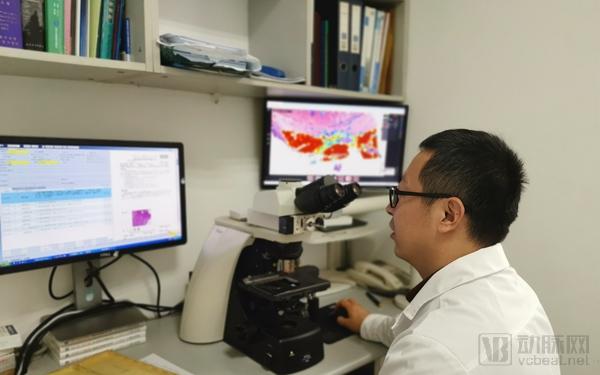
Professor Song Zhigang, Deputy Director of the Department of Pathology at the Chinese PLA General Hospital, uses Thorough Insights for office work (Image provided by the interviewee)
As the former Sales Director for Leica in China, Liu Yanbin recalls that the period of fastest growth in domestic sales of Leica’s digital pathology instruments was from 2013 to 2014. After 2014, with the maturation of product forms and the stabilization of product quality among domestically produced alternatives, their sales grew at a geometric rate, while the growth pace of imported products became relatively slower by comparison.
“The first step in transforming the workflow of pathologists is to digitize glass slides, enabling their storage and viewing on computers; the second step is to analyze them using computer algorithms, such as deep learning algorithms. While slide digitization has been developing in China for several years, truly revolutionary algorithmic analysis is still in its infancy,” said Liu Yanbin. “This is akin to having developed smartphones that require suitable software to be fully functional.”
Returning to the focus of this article, the Thorough Insights AI-assisted pathological diagnosis system is built upon a proprietary deep segmentation model developed by Thorough Images. It achieves 100% sensitivity and a specificity exceeding 86% (with specificity expected to reach 90% in the latest tests), making it currently the most accurate and efficient deep learning-assisted diagnostic system for gastric diseases known in the industry.
The challenge of intelligent analysis of pathological images lies in their massive scale (gigabyte-level), which poses significant challenges to large-scale matrix operations.
Wang Shuhao, CTO of Thorough Images, told VCBeat that all systems developed by Thorough Images adopt a microservices architecture. These are distributed computing systems that support deployment on both standalone machines and large-scale distributed GPU computing clusters, thereby addressing the limitations in storage capacity and computational speed inherent in standalone modes.
AI is inseparable from data training, and deep learning algorithms represent another key technological breakthrough for Thorough Images. “The sheer scale of pathological images poses a challenge for matrix operations, yet offers inherent advantages for data training. A single pathological image can be segmented into thousands of training samples,” said Wang Shuhao. He noted that while a deep learning system typically requires approximately 10 million training samples to achieve near-human performance, Thorough Insights, which has already been deployed in practice, was trained on a dataset of around 27 million samples.
Industry pain points have always persisted. Why is Thorough Images the one to break through? Wang Shuhao attributes this primarily to his team’s strong “technical DNA.” The company’s Chief Scientist, Xu Wei, holds a Ph.D. from the University of California, Berkeley, and has served as an Associate Researcher and Deputy Dean at Tsinghua University’s Institute for Interdisciplinary Information Sciences, as well as a Distributed Systems Researcher at Google. Researcher Sun Zhuo earned his Ph.D. from Leiden University Medical Center and has worked as a Researcher at Erasmus University Rotterdam and as a Researcher at Philips’ Global R&D Center. Wang Shuhao himself holds a Ph.D. from Tsinghua University, where he also completed postdoctoral research and served as an Assistant Researcher at the Institute for Interdisciplinary Information Sciences. He has further worked as a Data Scientist at JD.com, a Researcher in heterogeneous intelligence in Silicon Valley, and a Researcher at Baidu.
Barriers to cross-disciplinary collaboration are one of the key challenges in implementing AI in healthcare. No matter how impressive the technological innovation, if it does not align with physicians’ workflows, it is destined to be sidelined.
Thorough Images, in its R&D philosophy for Thorough Insights, drew inspiration from Steve Jobs’ early approach to developing the iPhone, striving for ultimate simplicity. A dedicated monitor is placed on the physician’s desk; after digital slides are transmitted to the server via high-throughput scanners, physicians can open or close the analysis page for any slide with a single click within their existing Laboratory Information System (LIS). This seamless integration neither disrupts clinical workflows nor requires complex operations.
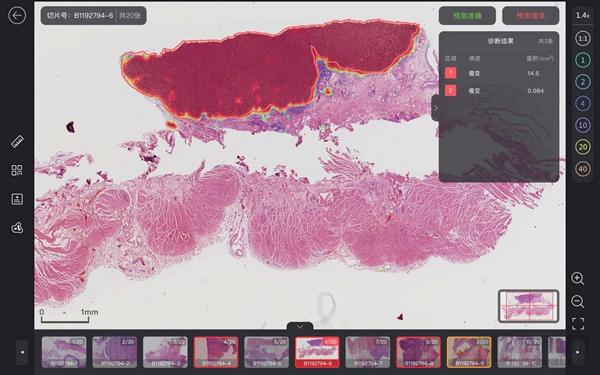
Thorough Insights Analysis Interface (Image provided by the interviewee)
On this system, it takes only 20 seconds to generate an auxiliary diagnostic conclusion for a single whole-slide image averaging 1 GB in size. Furthermore, the system automatically visualizes the likelihood of pathological lesions in the slide using different color channels and ranks them by lesion size.
“A sensitivity of 100% means that the system can detect cancer wherever it is present in the marked slide, thereby preventing major medical errors,” said Liu Yanbin. He noted that previously, physicians had to meticulously analyze every corner of each slide, which involved a substantial workload and carried a risk of missed diagnoses. With the aid of an AI-assisted diagnostic system, however, doctors can focus their review and verification on areas with the largest lesion burden and the highest probability of malignancy. This approach significantly enhances physicians’ efficiency and diagnostic accuracy, while also addressing inconsistencies in pathological diagnostic criteria among different practitioners.
Professor Zhu Minghua, a renowned figure in the field of pathology, once stated that physicians who fail to understand artificial intelligence may eventually be phased out. He further clarified that these physicians would not be displaced by artificial intelligence itself, but rather rendered obsolete due to their lack of understanding of it.
At least two to three days a week, pathology experts can be seen at the offices of Thorough Images; some are specially invited by Thorough Images to deliver lectures on pathology knowledge to the team, while others volunteer their time for regular onsite consultations.
“We hope to understand physicians’ thought processes, and they are equally curious about what we do,” said Liu Yanbin. Currently, most pathologists’ understanding of artificial intelligence still relies largely on imagination. We aim to bridge this gap by gaining insight into clinicians’ reasoning while helping them grasp what artificial intelligence truly is.
“From the very beginning, we integrated this communication into our daily workflow. As a result, the final product features an exceptionally streamlined operation—so simple that it requires only a single button.” Although not trained as a pathologist, Liu Yanbin jokingly claims that, through prolonged interaction and learning, he has become “half a pathologist,” possessing basic slide-reading capabilities.
Currently, Thorough Images has completed a RMB 30 million angel financing round led by Hongdao Capital.