

Axilum Robotics Files IPO Prospectus: Pioneering Robotic Solutions for Precision Transcranial Magnetic Stimulation
In recent years, collaborative robots have garnered significant attention.
The concept of collaborative robots was initially proposed by two professors at Northwestern University in Illinois, USA: J. Edward Colgate and Michael Peshkin. Unlike industrial robots, which operate automatically or are enclosed within safety fencing, collaborative robots can interact closely with humans in a shared workspace.
As collaborative robots meet the demands for precision, flexibility, and safety in delicate tasks, cobot-based solutions are beginning to penetrate specialized medical sectors such as psychiatry.
Axilum Robotics is a typical medical robotics company, with its core business focused on developing collaborative robots to assist in Transcranial Magnetic Stimulation (TMS) therapy.
The company, founded in Strasbourg, France, is led by Dr. Benjamin Maurin and comprises a team of medical robotics experts from the University of Strasbourg.
Eight years after its founding, Axilum Robotics has grown into a representative innovative enterprise leveraging collaborative robot technology to assist in transcranial magnetic stimulation (TMS) therapy. What is the story behind Axilum Robotics?
In 2004, Dr. Jack Foucher, a researcher in transcranial magnetic stimulation (TMS) technology in France, met with Professor Michel de Mathelin, former head of the Medical Robotics Research Group at the University of Strasbourg in France. During their meeting, Dr. Foucher proposed the idea of developing a robot-assisted solution for TMS.
Faced with treatments that sometimes require up to 30 repetitions of the same procedure, and to ensure the accuracy of stimulation, Dr. Jack Foucher has been seeking an automated solution for transcranial magnetic stimulation technology.
Transcranial Magnetic Stimulation (TMS) is a non-invasive neuromodulation technique, first proposed by physician and physicist Jacques-Arsène d'Arsonval at the Collège de France in Paris. In 1985, Professor Anthony Barker of the University of Sheffield in the United Kingdom invented the first modern transcranial magnetic stimulator.
When patients undergo transcranial magnetic stimulation (TMS) therapy, they are required to wear a specialized magnetic therapy cap equipped with coils. Upon activation of the device, an electric current passes through the coils to generate a magnetic field. This cap effectively establishes an external magnetic field around the patient’s brain. The resulting magnetic signals can penetrate the cranial barrier to stimulate the cerebral cortex and modulate neural activity, thereby eliciting relevant physiological responses within the brain and achieving therapeutic effects.
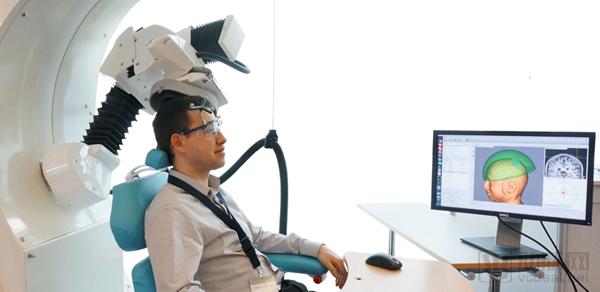
Image source: Axilum Robotics official website
Transcranial magnetic stimulation (TMS) offers the advantages of being non-invasive and painless, and can serve as an adjunct to pharmacotherapy. With the advancement of this technology, TMS has gained increasing recognition in the fields of psychiatry, neurological disorders, and rehabilitation. In 2008, the U.S. Food and Drug Administration (FDA) approved TMS for the treatment of medication-refractory depression.
However, in clinical practice, transcranial magnetic stimulation (TMS) technology has significant limitations. Magnetic modulation of patients’ brain neurons requires prolonged continuous stimulation and demands high precision. Traditional methods rely on physicians manually adjusting the coil position, which is time-consuming and inefficient, making it difficult to simultaneously meet the requirements for position, angle, and coil orientation. Even when experienced operators correctly position the coil under navigation system guidance, patient head movement during the lengthy treatment process makes it nearly impossible to maintain consistent stimulation position and angle throughout the entire session. Dr. Jack Foucher has been seeking an automated solution for transcranial magnetic stimulation technology.
Inspired by Dr. Jack Foucher, Dr. Benjamin Maurin demonstrated that using collaborative robots to assist clinical professionals in administering transcranial magnetic stimulation (TMS) is a viable practice. However, as no company had yet successfully translated this technology from research and development into clinical application, Dr. Benjamin Maurin decided to be the first to venture into this uncharted territory.
On April 7, 2011, Dr. Benjamin Maurin led a team of leading medical robotics experts to establish Axilum Robotics in Strasbourg, France, focusing on providing robotic solutions for researchers and healthcare professionals to automate Transcranial Magnetic Stimulation (TMS) technology, thereby simplifying medical technical procedures and improving the management of medical resources.
Two years later, Benjamin Maurin’s team at the ICube Laboratory in Strasbourg, France, successfully developed the first TMS-Robot, the world’s first collaborative robot designed to assist with the positioning of transcranial magnetic stimulation coils.
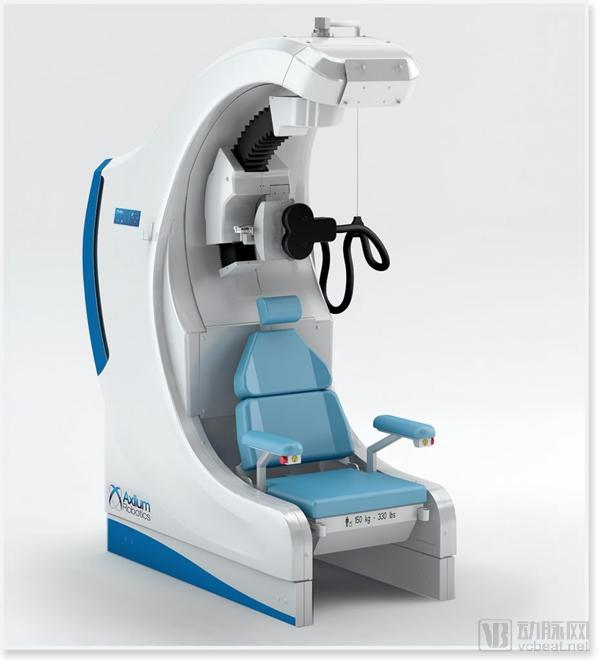
TMS Robot, image sourced from the official website of Axilum Robotics
The TMS-Robot is compatible with Magstim and Rapid2 magnetic stimulators and the Brainsight2 neuronavigation system, comprising a 7-degree-of-freedom robotic arm and a 2-degree-of-freedom computer-controlled patient chair.
The TMS-Robot, integrated with a neuronavigation system, enables the automated execution of pre-planned, image-guided transcranial magnetic stimulation (TMS). Once the stimulation target and coil rotation are defined within the neuronavigation system, the TMS-Robot automatically positions the coil at the target site, ensures contact between the coil and the head, and compensates for any patient head movement during treatment, thereby maintaining the coil’s position and orientation relative to the brain. The TMS-Robot boasts a positioning accuracy error of less than 1 mm and a repeatability error of less than 0.1 mm, significantly enhancing the precision, reliability, and reproducibility of the TMS treatment process.
The TMS-Robot received ISO 13485 quality management system certification in 2013. Currently, the TMS-Robot is deployed in more than 20 centers across nine countries. Last July, Hangzhou Normal University in China procured a batch of fully automated transcranial magnetic stimulation (TMS) positioning robot systems, which were the TMS-Robot developed by Axilum Robotics.
Following the TMS Robot, Dr. Benjamin Maurin and his team did not stop there.
In 2018, the company launched its second new fully automated transcranial magnetic stimulation (TMS) positioning robot, the TMS-Cobot, primarily targeting the U.S. market.
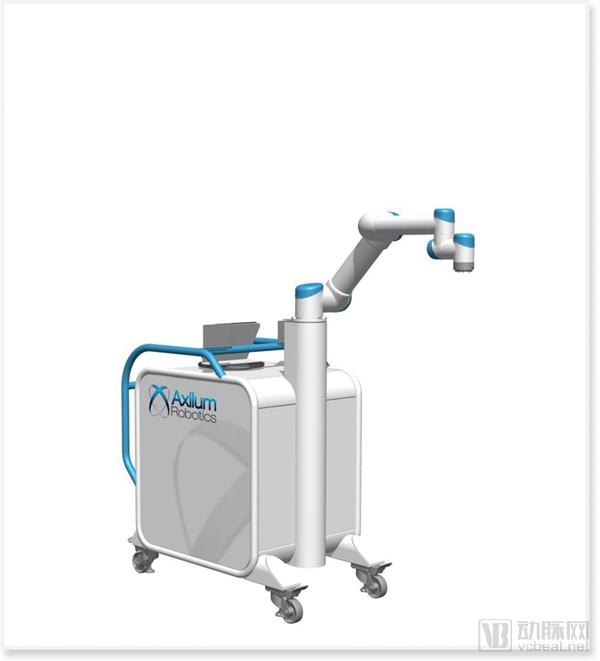
TMS-Cobot, image sourced from the official website of Axilum Robotics
Entering the U.S. market marks a strong start for Axilum Robotics’ international expansion. In Benjamin Maurin’s view, the key to Axilum Robotics’ progress from “0” to “1” lies in its core technology. The critical support behind this technology is a small yet complementary team.
After eight years in operation, Axilum Robotics has a team of fewer than 10 members, yet its core technical team is primarily composed of alumni from the University of Strasbourg. The University of Strasbourg is ranked among the top 100 academic institutions worldwide, with 17 Nobel laureates and one Fields Medalist among its students and faculty. Moncef Marzouki, who was elected President of Tunisia in December 2011, is also an alumnus of the university.
Dr. Benjamin Maurin, Co-Founder and Director of R&D, earned his Ph.D. in Medical Robotics from the University of Strasbourg. Prior to founding Axilum Robotics, he served as an engineering consultant specializing in robotic system control at high-tech companies including Lohr Group, Adept Technology, and Cerebellum Automation, accumulating over a decade of experience in robotics, computer vision, and software development.
Dr. Michel Berg, Co-founder, President, and Chief Executive Officer, oversees the company’s operational management. He graduated from HEC Paris (HEC School of Management), which The Economist ranked as the No. 1 business school in France and No. 22 worldwide. Dr. Berg previously served as Business Director and held international marketing roles at Eli Lilly and Boehringer Ingelheim, the world’s largest privately held pharmaceutical company, accumulating extensive experience in the pharmaceutical and medical device industries.
Dr. Romuald Ginhoux, Product Director, brings expertise in software engineering and project management to Axilum Robotics. Dr. Ginhoux previously served as an R&D Engineer in image processing and computer vision at the Institution of Electrical Engineers (IEE) in the UK, and later worked as a Systems Analyst at MEDIAN Technologies, a company specializing in medical imaging software and services. He also holds a Ph.D. in Robotics from the University of Strasbourg.
Axilum Robotics’ second new fully automated transcranial magnetic stimulation positioning robot, the TMS-Cobot, has seen a steady stream of good news this year…
In early February, TMS-Cobot obtained CE certification in Europe; two weeks later, the U.S. Food and Drug Administration (FDA) also granted 510(k) clearance for TMS-Cobot.
The approval of the 510(k) clearance means that the TMS-Cobot robot can be marketed in the United States, laying the foundation for Axilum Robotics to commercialize its TMS-Cobot robot.
According to BIS Research data, the market share of collaborative robots is projected to reach approximately $2 billion, totaling 150,000 units, by 2021. Axilum Robotics is well aware that while collaborative robot technology is advancing rapidly, the market has not yet fully matured. Therefore, it is crucial for companies to seize the time window and gain a first-mover advantage.
In late February, Axilum Robotics secured a key strategic advantage by authorizing U.S.-based MagVenture to bundle its TMS-Cobot robot with the MagVenture TMS transcranial magnetic stimulation therapy device for joint sales.
At present, it is premature to conclude whether Axilum Robotics will become a monopolist in the field of neuroscience. However, it is evident that the company’s ambitions extend far beyond its TMS-Cobot system. We shall wait and see.
(Editor: Tan Xin)