

Yixintang Releases 2018 Annual Report: Revenue of RMB 9.176 Billion and 5,758 Stores Nationwide
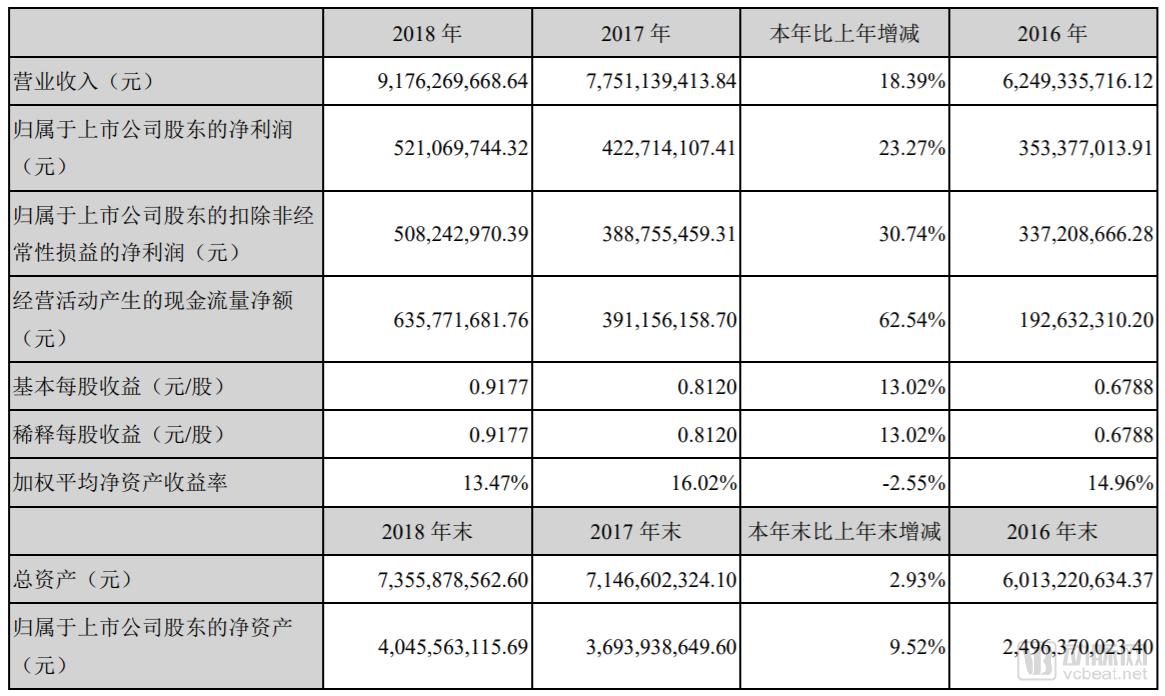
VCBeat (WeChat: vcbeat) has learned that on February 25, Yixintang released its annual report for the 2018 fiscal year. The financial report showed that Yixintang achieved rapid growth in sales revenue in 2018. During the reporting period, Yixintang's total operating revenue reached RMB 9.176 billion, a year-on-year increase of 18.39%; operating profit was RMB 684 million, up 34.86% from the previous year; and total profit amounted to RMB 692 million, representing a 26.48% increase compared to the prior year.
Table 1: Yixintang’s Financial Data for the Past Three Years
Source: Yixintang 2018 Annual Report
Store Count Increases to Approximately 6,000
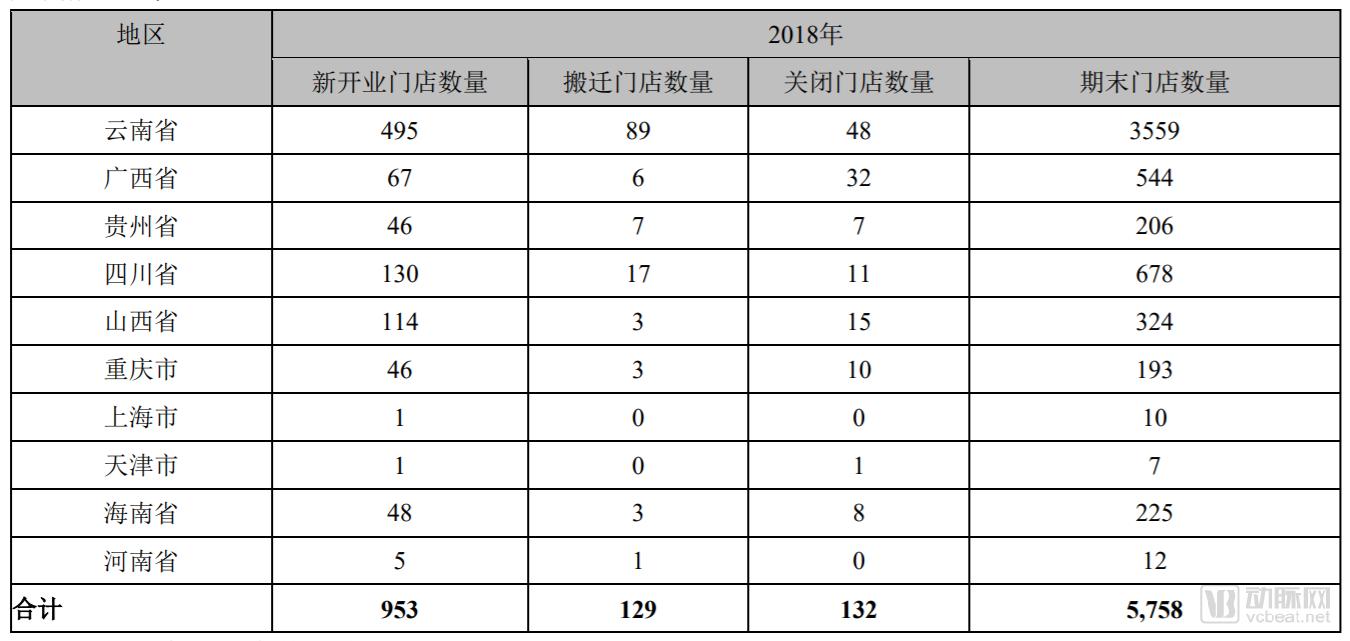
As of December 31, 2018, Hongxiang Yixintang and its wholly-owned subsidiary, Yixintang, collectively operated 5,758 directly-owned chain stores. Yixintang’s direct sales network covered 10 provinces and municipalities, entering more than 260 cities at the county level or above. It has initially formed a business pattern with Southwest China as its core operating region, South China as its strategic depth region, and North China as its supplementary operating region, exerting significant brand and service influence in many markets outside Yunnan Province. During the reporting period, 132 stores were closed, primarily due to factors such as urban redevelopment and strategic location adjustments. Yixintang prioritizes development in Southwest and South China, while also attending to store expansion in North China. The company’s strategy will gradually focus on the national market, while maintaining a high-density store layout in core regions to progressively form an integrated urban-rural store distribution structure. According to Yixintang’s strategy, the company planned to open 1,200 new stores in 2019, including 650 outside Yunnan Province and 550 within Yunnan Province. As of January 31, 2019, Yixintang operated 5,872 directly-owned stores, with a net increase of 114 stores for the month.
Table 2: Changes in the Number of Yixintang Stores
Source: Yixintang 2018 Annual Report
Coverage Across Provincial, Municipal, County, and Township Levels
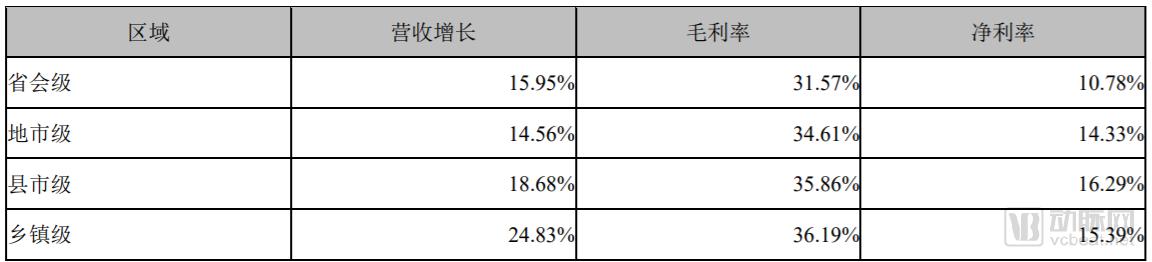
In its store layout strategy, the company adopts a multi-tiered expansion approach by establishing stores across four administrative levels: provincial capitals, prefecture-level cities, counties, and townships. This creates a relatively comprehensive, three-dimensional store network within each province. Following the establishment of logistics center warehouses in provincial capital cities, the company proceeds to open stores across various regions within the province. As the number of county- and township-level stores gradually increases, their contribution to sales revenue and growth rate becomes more pronounced. Meanwhile, due to the company’s advantages in supply chain management—such as product procurement, distribution, and assortment structure—compared to small and medium-sized chain competitors, it demonstrates stronger competitiveness in county and township markets. Consequently, the company does not need to invest heavily in marketing resources or engage in aggressive price competition. Although the per-store output at the county and township levels is lower than the company’s average, both the point-of-sale gross profit margin and net profit margin for these stores exceed the company’s overall averages. In terms of operational performance by provincial region, the Yunnan region achieved a revenue growth of 19.41%. Regions outside the home province have experienced rapid development through intensive expansion over the past two years. In 2018, the year-on-year revenue growth rates for Sichuan, Guangxi, and Guizhou were 27.71%, 20.29%, and 20.47%, respectively, all exceeding the consolidated year-on-year revenue growth rate of 18.39% for the entire company. (The gross profit margins shown in the table below refer to point-of-sale gross profit margins.)
Table 3: Yixintang's Regional Revenue Performance
Source: Yixintang 2018 Annual Report
Approximately 80% of stores are enrolled in the national medical insurance program.
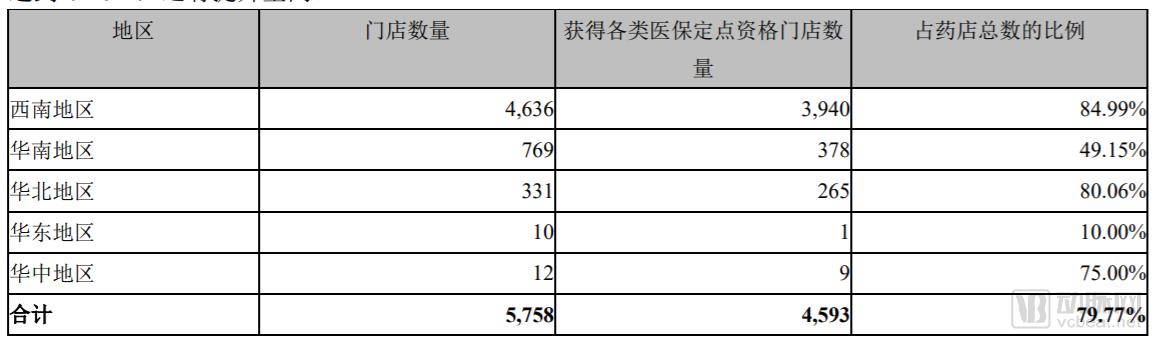
Yixintang has obtained the qualification of "designated retail pharmacies for medical insurance" for 4,593 pharmacies, accounting for 79.77% of the total number of its pharmacies. Among them, due to favorable policy adjustments, the proportion of medical insurance pharmacies in South China has increased rapidly, reaching 49.15% by the end of the period, with room for further growth.
Table 4: Status of Yixintang Stores Obtaining Medical Insurance Qualifications
Source: Yixintang 2018 Annual Report
DTP Products Boost Average Transaction Value and Purchase Frequency
The company sells 103 DTP (Direct-to-Patient) products, accounting for 0.82% of total sales with a gross margin at the point of sale of 8.63%. However, for this category of incremental products, sales growth directly translates into profit increases. Meanwhile, due to stronger customer stickiness associated with these products, increased sales also contribute to stable foot traffic, thereby helping to boost both average transaction value and purchase frequency. (The gross margin figures in the table below refer to front-end point-of-sale gross margins.)
Table 5: Yixintang's DTP Product Portfolio Performance

Rapid Growth of “Internet+” Business
In the first half of 2016, Yixintang successively launched cross-border B2C businesses, including the Yixintang APP, group-buying services, cross-border e-commerce, and same-city delivery services. Leveraging its strong brand influence and regional service advantages, the company also introduced its “Yixintang to Home” B2C service. In 2018, the total transaction volume of its e-commerce business reached RMB 62.3086 million, of which RMB 17.0152 million was generated through third-party sales platforms.
2019 Business Plan
Deepening Penetration in Key Markets of Sichuan and Chongqing. The Sichuan-Chongqing region was the company’s primary focus market in 2019. First, we will continue to implement a dense and rational layout of retail stores within the regional market. Second, we will consistently introduce standardized management and promotional management systems, strengthen store development, and establish strong brand credibility. Meanwhile, by enhancing professional services and standardized operations at stores, optimizing product portfolios, and leveraging mature membership management, we aim to achieve sustained growth in both customer transaction volume and sales revenue. We will place particular emphasis on improving store quality, thereby further bolstering confidence and providing greater assurance for the rapid development of the Sichuan-Chongqing region.
Actively keep pace with the advancement of healthcare reform. As public hospital reforms are fully rolled out and supporting policies such as medical insurance cost containment are sequentially introduced, the trend toward "separation of prescribing and dispensing" is becoming increasingly evident. Pilot programs for tripartite information sharing among medical institutions, medical insurance agencies, and retail pharmacies, along with trial implementations of classified and tiered management for retail pharmacies, will provide significant opportunities for the development of the pharmaceutical retail industry. As the separation of prescribing and dispensing gradually takes shape, the Company will seize the substantial incremental market generated by the outflow of hospital prescriptions by accelerating the establishment and acquisition of stores near hospitals through collaborations with government bodies, medical institutions, medical insurance agencies, and suppliers. Furthermore, the Company will actively explore initiatives in medical insurance payment mechanisms, assumption of community healthcare functions, and sharing of hospital prescription information.
Continuously Strengthen Standardized ManagementManagement improvement has always been one of the company’s key priorities. Building on the promotion of “refined” management, the company will strengthen standardized management in 2019, putting forward new requirements for management enhancement efforts. First, “refinement” requires enterprises to aim high, ensuring that their development and management objectives are both targeted and leading, as well as clear and explicit. Second, “meticulousness” demands that we maintain control over every link in each task. Therefore, to achieve refined and standardized management, it is essential to first clarify objectives: industry-leading companies should establish benchmarks, while follower companies should align with these benchmarks. Subsequently, through comprehensive analysis and systematic review of all operational links, deficiencies and weak points should be identified, and corresponding improvement measures proposed.
In the coming years, retail pharmacies will continuously transform into innovative models such as DTP (Direct-to-Patient) specialty pharmacies, distribution-focused specialty pharmacies, chronic disease management pharmacies, and smart pharmacies. Driven by internet technologies, new applications such as unmanned medication dispensing cabinets, facial recognition, and AI robots will gradually be integrated into retail pharmacies. It is expected that retail pharmacies will leverage innovative technologies—including the internet, the Internet of Things (IoT), big data, and cloud computing—to provide consumers with more professional and convenient services.