

2019 Guide to 5G Technical Talent (Including Healthcare Applications)
5G Has Taken Off, and So Has the Demand for 5G Talent. As the curtain gradually rises on the 5G era, demand for professionals in 5G communications is surging.
On February 19, BOSS Zhipin released insights into the supply and demand dynamics of the job market during the first week after the 2019 Spring Festival (February 9–15). The data showed that job demand in the first week after the 2019 Spring Festival increased by 52% year-on-year compared to 2018. Notably, demand for talent in 5G communications surged significantly, with year-on-year growth exceeding 80% for both optical transmission engineers and wireless RF engineers.
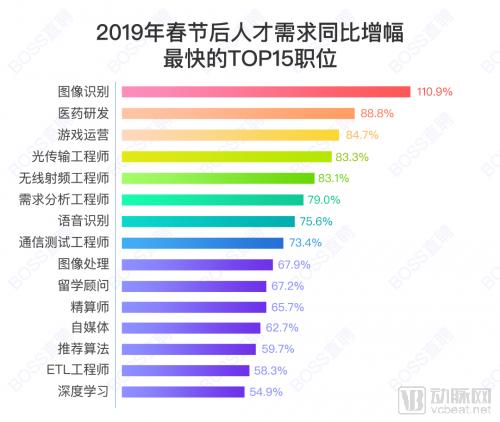
Data Source: BOSS Zhipin
To gain a clearer understanding of the current recruitment landscape for technical talent in the 5G industry, VCBeat analyzed partial data from BOSS Zhipin for January and February and compiled the following table:
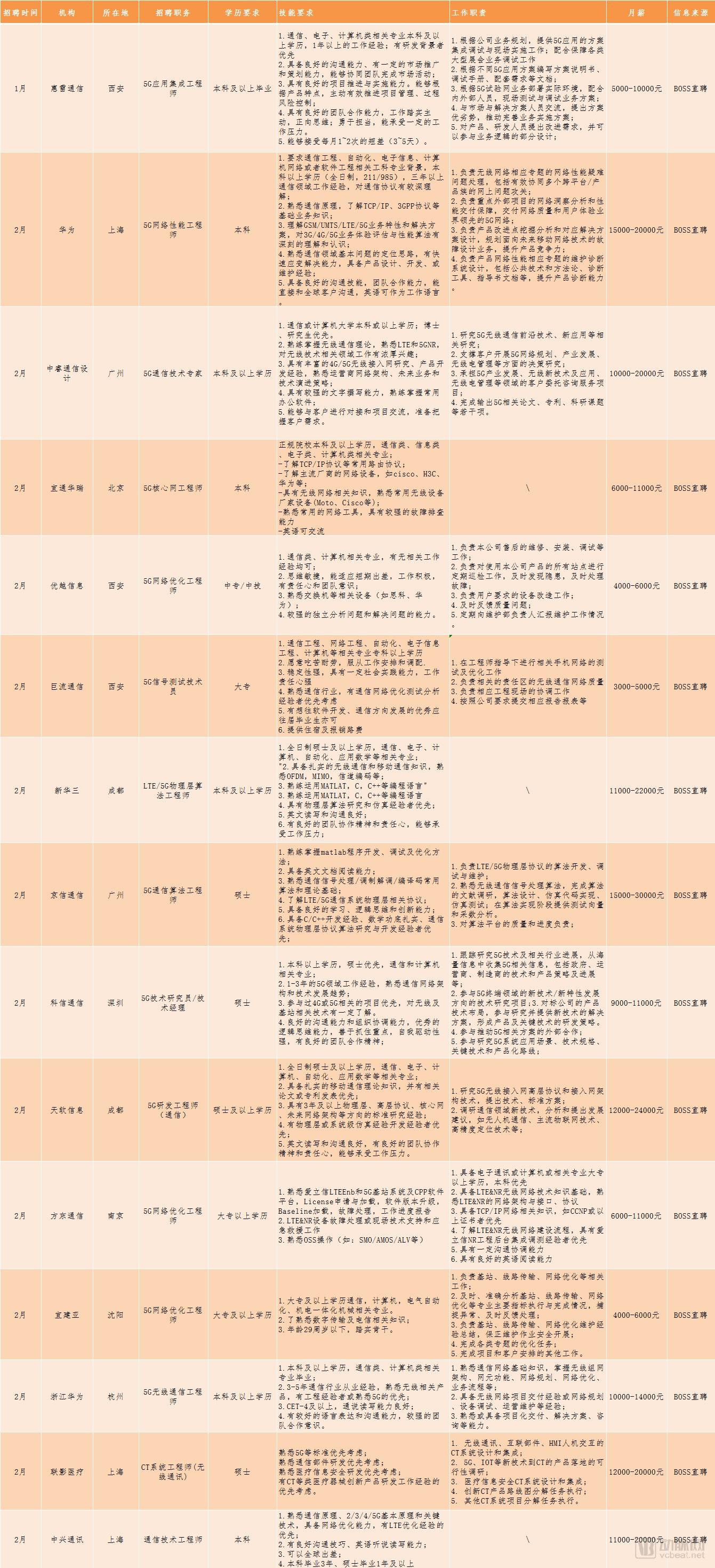
Data Source: BOSS Zhipin
Following our analysis, we found that:
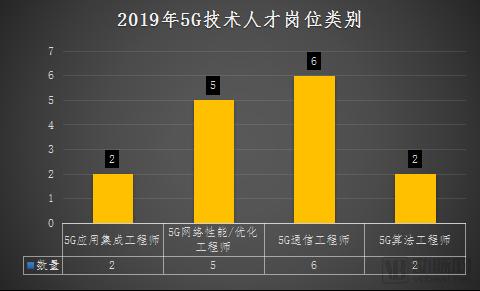
1. Among 5G technology professionals, communications engineers and network performance/optimization engineers are the most frequently recruited roles.
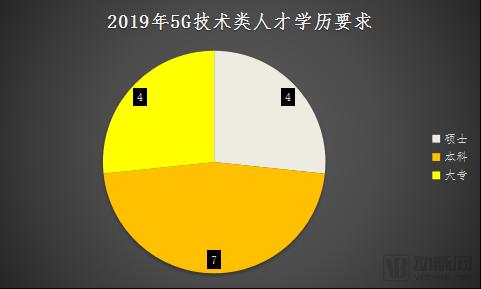
2. Educational requirements for 5G technology professionals are predominantly at the bachelor’s degree level. Among these, communication algorithm and R&D engineers have the highest educational requirements, with most holding a master’s degree or higher. In contrast, network performance/optimization engineers have the lowest educational requirements, for which an associate degree is sufficient.
3. Among the cities with the highest recruitment volumes, Shanghai’s prominence is unsurprising, as it was one of the first 5G pilot cities for the three major telecom operators—China Mobile, China Telecom, and China Unicom (as will be detailed later). However, Xi’an, which was not included in the initial batch of pilot cities, has also joined the fierce competition for 5G talent.
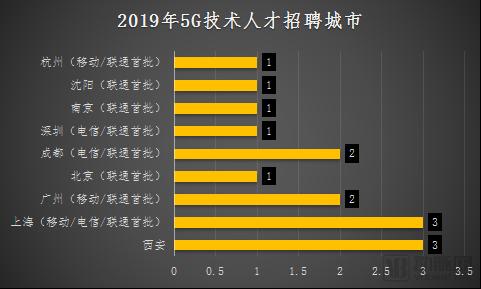
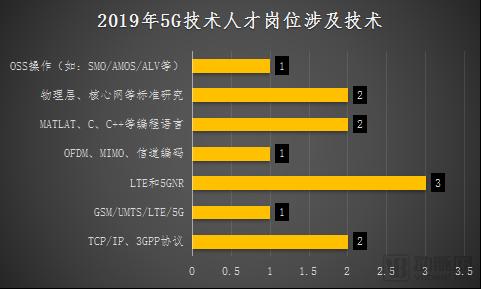
4. LTE and 5G NR are the most frequently mentioned technologies in recruitment for 5G technical talent. Among them, 5G NR is a global 5G standard based on an entirely new OFDM-based air interface design, and it serves as a crucial foundation for next-generation cellular mobile technology. In October 2016, Qualcomm launched its sub-6 GHz 5G NR prototype system and test platform, marking a significant step toward the commercialization of 5G. The sub-6 GHz frequency band is key to achieving high-quality coverage with 5G, and Qualcomm has extensively applied its technologies in this prototype system. On June 14, 2018, companies such as Huawei and Samsung issued press releases announcing that the plenary session of the international standards organization “3rd Generation Partnership Project” (3GPP) had approved the standalone (SA) networking standard for the fifth-generation mobile communication technology, 5G NR.
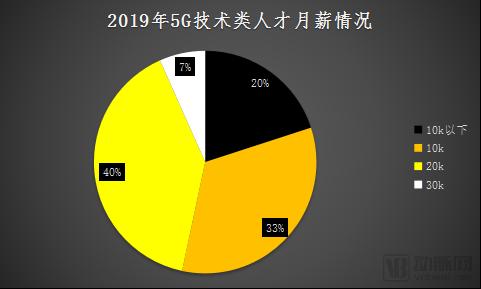
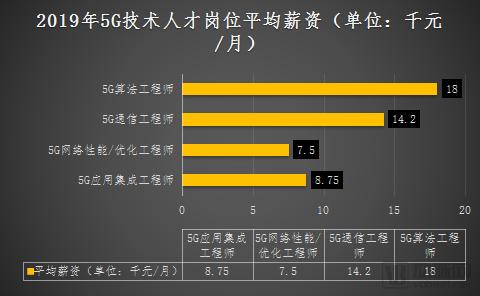
5. In 2019, the vast majority of monthly salaries for 5G-related professionals fell between RMB 10,000 and RMB 20,000, with few reaching RMB 30,000. Among these roles, 5G algorithm engineers commanded the highest average monthly salary at RMB 18,000, followed by communications engineers at RMB 14,200 per month. Network performance/optimization engineers had the lowest average monthly salary, at just RMB 7,500.
6. It is worth noting that in the vertical sector, such as when searching for job postings in the 5G medical healthcare field on BOSS Zhipin, only one company appears: United Imaging Healthcare.
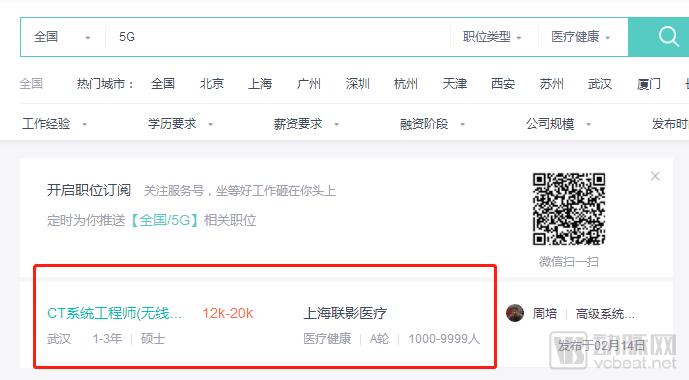
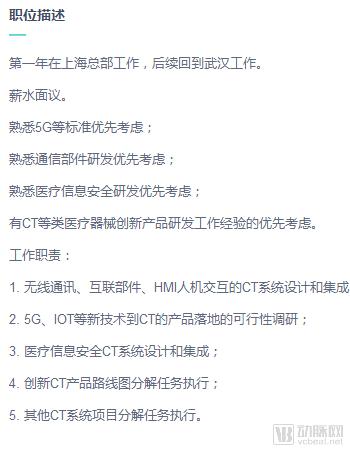
The job description suggests that United Imaging Healthcare is seeking a CT system engineer who is proficient in both CT system design and integration, as well as 5G communication technology. However, according to listings on BOSS Zhipin, such interdisciplinary talent remains scarce in the market.
Where Do 5G Talents Come From?
The surge in popularity of 5G has made telecommunications engineering, a long-established major, one of the most sought-after disciplines among college applicants.
Communication Engineering is a major branch of electronic engineering, a sub-discipline within the field of electronic and information engineering, and one of its foundational disciplines. This field focuses on the principles and applications of information transmission and signal processing during communication processes. Communication Engineering is a broad discipline that intersects with many other fields and serves as a typical example of a subject that closely integrates theory with practice.
Its core curriculum typically includes: Communication Systems, Mobile Communications, Optical Networks, Principles of Network Protocols, Fundamentals of Digital Signal Processing, Communication Networks, Digital Signal Processing for Software-Defined Radio, Communication Network Security, Advanced Communication Technologies, Communication Channels, Telecommunications Projects, and Data Center Networks.
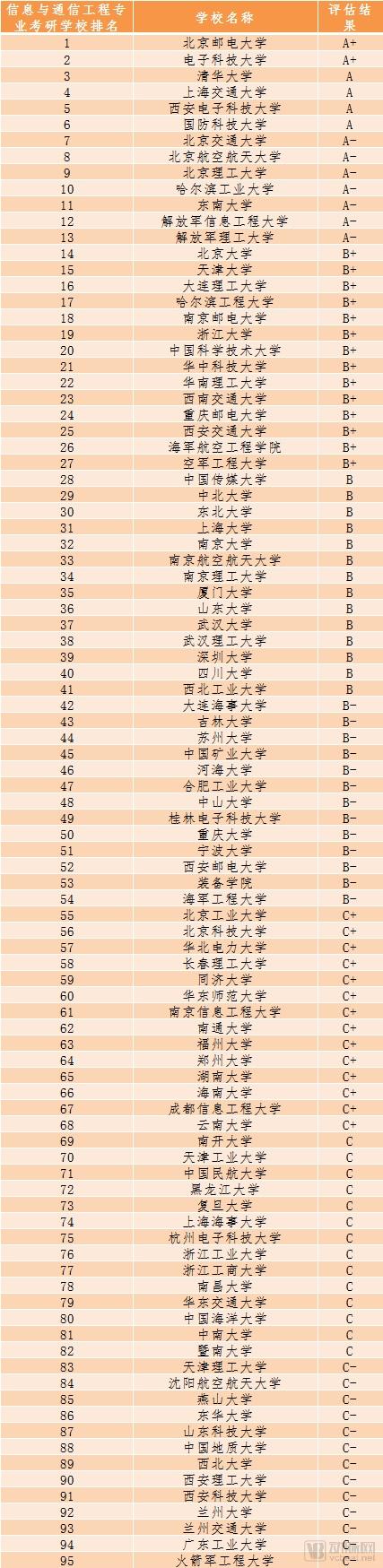
According to the latest results of the fourth round of discipline evaluation for Information and Communication Engineering released by the China Academic Degrees and Graduate Education Development Center under the Ministry of Education, a total of 95 universities in China offering majors in Information and Communication Engineering participated in the ranking. The top three universities were Beijing University of Posts and Telecommunications, University of Electronic Science and Technology of China, and Tsinghua University. These institutions have also become the primary sources for companies to recruit high-quality fresh graduates with 5G expertise.
Communication Engineering boasts extremely broad development prospects and is one of the fields in China facing a severe shortage of talent. Students in this major acquire knowledge in communication technologies, communication systems, and communication networks. Upon graduation, they can engage in research in areas such as wireless communications, large-scale integrated circuits, intelligent instruments, and applied electronic technology. Furthermore, graduates are well-equipped to undertake roles in research, design, and technical development within the emerging field of 5G communication engineering, offering excellent employment prospects.
How Can 5G Talent Upgrade Their Skills?
University graduates must undergo skills upgrade training to meet corporate demands. In particular, as cloud computing and AI technologies converge with 5G, and given their applications in specialized sectors such as healthcare, 5G professionals require more robust industry-specific knowledge reserves.
Therefore, the industry has defined the future capabilities of 5G talent as follows:
1. Fundamental Competencies: Possession of foundational skills in mobile communications, including principles of wireless communication and signaling protocols.
2. Network Planning and Design Capabilities. Responsible for site planning and design, including network architecture planning and design as well as parameter planning and design.
3. Network cloudification capabilities, including NFV technology for the core network, SDN technology for transmission, and wireless CloudRAN technology.
4. Big data and AI technologies reduce operational and maintenance (O&M) costs for telecom operators, necessitating that network engineers possess capabilities in intelligent and automated O&M. They must master data cleaning and mining, data analysis and modeling, machine learning, deep learning, and even programming.
5. Industry Solution Capabilities – One of the Most Critical Competencies. In the long run, 5G networks will increasingly serve vertical sectors, such as healthcare. Different vertical industries have distinct requirements and needs. Professionals in the 5G field must be well-versed in the entire requirements-gathering process, conduct tailored requirement analyses for each industry, design comprehensive solution architectures based on client needs, and ultimately develop and deliver solutions that fully meet those requirements.
Against this backdrop, in October 2018, the China Mobile Communications Federation (CMCF), as a national first-tier industry association in the field of mobile communications, proposed the advancement of the “5G+ Talent Development Initiative.” Leveraging the robust technical capabilities of its member companies—including China Mobile, China Unicom, China Telecom, and Huawei—the CMCF will foster strong collaborations with universities and 5G-related research institutions to drive the development of Digital China.
Professor Chen Xiaohua, Director of the Education and Examination Center of the China Mobile Communications Federation, stated in an interview: “The ‘5G+ Talent Development Initiative’ will address the challenges of difficult employment for graduates in relevant majors and the difficulty enterprises face in recruiting talent. The program targets recent or impending university graduates, postgraduate students, and current employees seeking professional upskilling. Its distinguishing feature is the emphasis on practical training to strengthen the integration of theory and practice, enhance participants’ hands-on capabilities, and meet the workforce needs of enterprises.”
It is understood that the training modalities of the “5G+ Talent Development Program” include offline training, online training, practical skills training, corporate internships, mentorship by renowned experts, and proficiency assessments. By establishing a systematic framework for the “5G+ Talent Development Program,” the initiative aims to build a high-caliber workforce adaptable to the development of the 5G+ industry, thereby promoting its sustained, healthy, and rapid growth. Students who complete the program and pass the certification examinations administered by the Education and Examination Center of the China Mobile Communications Federation will be awarded a Certificate of Completion for the “5G+ Talent Development Program” issued by the Center, and will receive priority recommendation to relevant enterprises affiliated with the Association.
Where Are 5G Talents Heading?
Policy support from provinces and municipalities across China often determines the flow of 5G talent, much like how Guiyang and Wuxi have become industrial hubs for big data and IoT professionals, respectively. With the first version of the 5G standard finalized in 2018, global telecom operators have accelerated their 5G deployments, while local governments have rolled out new policies to seize the benefits of the 5G boom.
On August 1, 2018, Hainan Province released the "Three-Year Special Action Plan for Consolidating and Enhancing Information Infrastructure Levels in Hainan Province (2018–2020)"; on August 7, Zhejiang Province issued the "Guiding Opinions on Promoting Large-Scale Trials and Application Demonstrations of 5G Networks"; Guangdong Province printed and distributed the "Three-Year Action Plan for Information Infrastructure in Guangdong Province (2018–2020)"; and on August 24, Jilin Province printed and distributed the "Implementation Opinions on Promoting the Construction of Fifth-Generation Mobile Communication Networks."
Meanwhile, the Yangtze River Delta region has opted for a collaborative approach to jointly advance 5G network construction, with multiple local governments having signed the “Strategic Cooperation Framework Agreement on Promoting the Pioneer Development of the Digital Economy in the Yangtze River Delta through Early Trial and Use of 5G” with telecom operators...
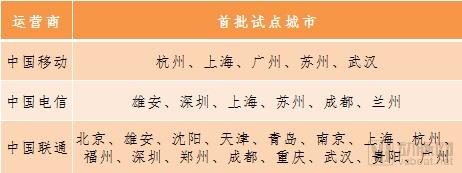
China Unicom has selected 16 cities to conduct 5G trials, implement business applications, and establish typical demonstration projects. It achieved pre-commercial 5G deployment in 2019 and launched formal commercial services in 2020. Among these, Beijing has been designated as a key city for this year’s 5G trials. The other 15 cities are Xiong’an, Tianjin, Shenyang, Qingdao, Nanjing, Shanghai, Hangzhou, Fuzhou, Shenzhen, Guangzhou, Zhengzhou, Chengdu, Chongqing, Wuhan, and Guiyang.
China Mobile has adopted a “5+12” pilot program, with Hangzhou, Shanghai, Guangzhou, Suzhou, and Wuhan serving as the first batch of 5G pilot cities, while 5G service application demonstrations will be conducted in 12 other cities, including Beijing and Chongqing.
China Telecom’s 5G pilot cities follow a “6+6” model. The initial six locations are Xiong’an, Shenzhen, Shanghai, Suzhou, Chengdu, and Lanzhou, with an additional six cities to be added. In total, 18 cities have been confirmed as 5G pilot sites. These 18 cities currently represent the most attractive job markets for 5G professionals.
Healthcare IndustryWhere Is the 5G Talent Depression??
In the agreements signed in these cities, 5G applications typically span industries such as manufacturing, agriculture, education, public welfare, transportation, healthcare, and energy. Among these, the integration of 5G with the healthcare sector is largely driven by specific use cases; therefore, pilot programs are generally implemented at leading local hospitals.
Taking Henan Province as an example, in May 2018, the Henan Provincial Development and Reform Commission and China Mobile Henan Branch officially signed the “Strategic Cooperation Agreement on Promoting Large-Scale 5G Network Deployment and Application Demonstration in Henan” to jointly advance industry-specific 5G application demonstrations, support the construction of infrastructure for 5G pilot projects, and accelerate large-scale 5G network deployment. With the support of the Provincial Development and Reform Commission, China Mobile Henan Branch deployed 30 5G base stations in Zhengzhou’s business application demonstration area in 2018, achieving end-to-end application demonstrations in typical scenarios. Meanwhile, leveraging fields such as smart healthcare as breakthrough areas, it pioneered trials to accelerate the integrated development of 5G technology with various related industries.
It is understood that Zhengzhou is one of the 18 national 5G application demonstration cities designated by the state. Among these, the smart healthcare applications jointly promoted by the First Affiliated Hospital of Zhengzhou University and China Mobile constitute not only a part of the national demonstration initiative but also a key development area outlined in the “Action Plan for the Development of Henan Province’s 5G Industry,” issued by the People’s Government of Henan Province in January 2019.
In 2018, the Henan Provincial Telemedicine Center of the First Affiliated Hospital of Zhengzhou University signed a national cooperation agreement on co-developing 5G smart healthcare with China Mobile’s Henan Branch and was invited to participate in the 2018 Digital Economy Summit and the China Mobile 5G Joint Innovation Center. Recently, China Mobile has deployed a 1 Gbps VPN private network and 5G base stations among three locations: the First Affiliated Hospital of Zhengzhou University (Zhengdong Campus), the National Engineering Laboratory for Internet Systems and Applications (He’nan Campus), and Longzihu Smart Island, the core area of the National Big Data Comprehensive Pilot Zone. This has achieved small-scale 5G networking in key areas, initially establishing a test environment for the “One Network, Three Zones” demonstration of intra- and inter-hospital 5G medical remote applications, and conducted experiments in fields such as remote consultation, remote ultrasound, remote physiological signal transmission, and remote emergency care.
In the future, the hospital will collaborate on 5G technology and conduct applied research in areas such as the Internet of Medical Things (IoMT), remote emergency rescue, VR-assisted surgery, telemedicine, wireless infusion, patient positioning, and cybersecurity.
At the High-Level Forum on the Integrated Development of Wireless Networks and the Healthcare Industry, co-hosted by the China Academy of Information and Communications Technology (CAICT) and the IMT-2020 (5G) Promotion Group, Zhai Yunkai, Director of the Telemedicine Center at the First Affiliated Hospital of Zhengzhou University, categorized the application scenarios of wireless technology in the healthcare sector into three major types: medical monitoring and nursing, medical diagnosis and guidance, and remote control applications. He further described remote surgery as the “crown jewel” of 5G applications in healthcare services.
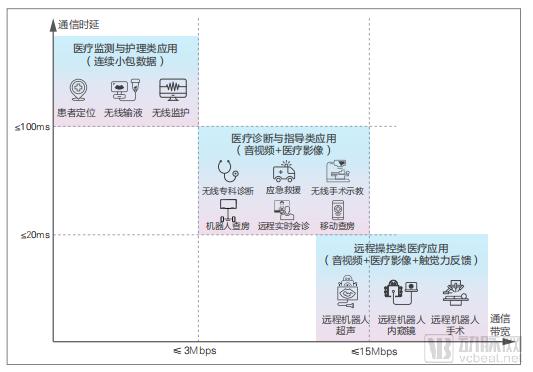
Image source: National Engineering Laboratory for Internet Healthcare Systems and Applications, White Paper on Wireless Healthcare
Director Zhai stated that wireless technology can significantly reduce the time required for routine medical examinations within hospitals, lower the costs of constructing in-hospital and out-of-hospital monitoring systems as well as healthcare services, and thus holds great promise in the medical field. Since remote surgery spans multiple disciplines—including computer science, mechanics, communications, and video technology—it addresses nearly all the bottlenecks associated with the application of wireless networks in healthcare, making it the most challenging aspect of wireless medicine to implement. Currently, from both ethical and technical perspectives, it is predicted that medical service applications characterized by no life-safety risks, low real-time requirements, and modest demands for medical information will emerge as the leading solutions.
Following Director Zhai’s recommendation, 5G professionals specializing in healthcare scenarios should currently focus on application scenarios such as remote consultations, remote ultrasound examinations, remote transmission of physiological signals, and remote emergency care. In the future, as conditions become more favorable, remote surgery is expected to emerge as a key breakthrough area for 5G technology.
References:
Hualian International Business School: The 5G Era Has Arrived! Huawei Unveils Another Major Move; This Field Will Face a Talent Shortage Next Year!
Local Governments Intensively Roll Out New Policies to Advance Large-Scale 5G Network Deployment and Application Demonstration Projects!
Sensor Technology——What are the comprehensive competency requirements for future 5G talent?