

Rock Health Report: Digital Health Use Cases Evolve, Yet Consumers Remain Cautious About Sharing Health Data
Since Rock Health first launched its survey on consumer acceptance and attitudes toward digital health in 2015, the adoption rate of digital health services and technologies among U.S. adults has been on a steady rise. With the emergence of wearable devices, mobile applications, telemedicine, and other technology-enabled services, consumers have gradually become more aware of the impact of “digitalization” on their health.
Annual survey results from Rock Health’s first three years indicated that fitness and wellness tools served as a common (and low-risk) entry point, allowing consumers to try products that seamlessly integrated with their tech-enabled lifestyles. In this report, Rock Health analyzed 2018 data and identified a shift: while consumers continue to embrace digital health solutions, they are no longer driven merely by curiosity or general fitness goals, but rather by the need to address specific health concerns.
An increasing number of Americans are using digital health tools for health diagnostics, connecting with healthcare providers, and making critical medical decisions. While Rock Health is optimistic about this growth and shift, findings from 2018 demonstrate that these digital health tools often fail to reach the populations that stand to benefit the most.
2018 marked the fourth consecutive year that Rock Health conducted its annual Digital Health Consumer Adoption Survey. The report surveyed 4,000 U.S. adults aged 18 and older. Years of longitudinal data provide deep insights into consumers’ use and perceptions of digital health, aiming to support those who develop, invest in, and implement digital health solutions, with the goal of transforming individuals’ healthcare experiences.
VCBeat (WeChat ID: vcbeat) has compiled and translated this report. The main contents are as follows:
I. The use of wearable devices is shifting from fitness to health management;
II. The penetration rate of telemedicine is on the rise, with urban consumers using it at more than twice the rate of their rural counterparts;
III. Consumers are placing greater emphasis on data privacy and are becoming more cautious about sharing their data.
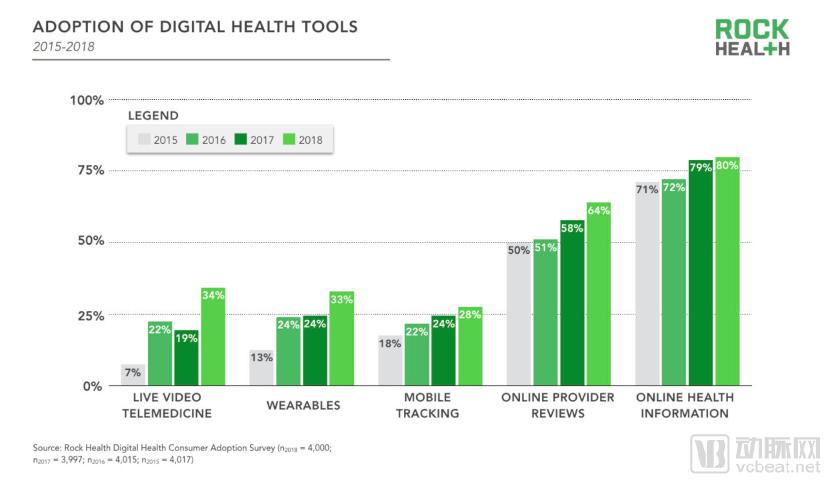
Usage of Digital Health Tools (Image Source: Rock Health Official Website)
In 2018, the proportion of respondents using digital health tools was higher than in previous years. Eighty-nine percent of respondents reported using at least one digital health tool, up from 80% in 2015. The adoption rates of real-time video telemedicine and wearable devices surged after slowing down in 2017. Meanwhile, respondents placed increasing importance on the privacy of their health data; compared with 2017, they were less willing to share such data with trusted entities such as healthcare providers and insurance companies.
I. The Use of Wearable Devices Is Shifting from Fitness to Health Management
In 2018, there was a significant shift in the usage trends of wearable devices—respondents reported that wearables were primarily used for diagnostic purposes, rather than to promote active lifestyles.
Only 44% of wearable device owners reported that monitoring physical activity remains their primary reason for using wearables, down from 54% in 2017. Corresponding to this 10-percentage-point decline, the proportion of respondents using wearables for diagnostic purposes increased by 10%. Wearable devices are evolving from their initial fitness and wellness labeling into clinical tracking tools that hold significance for patients and even for wearable device vendors.
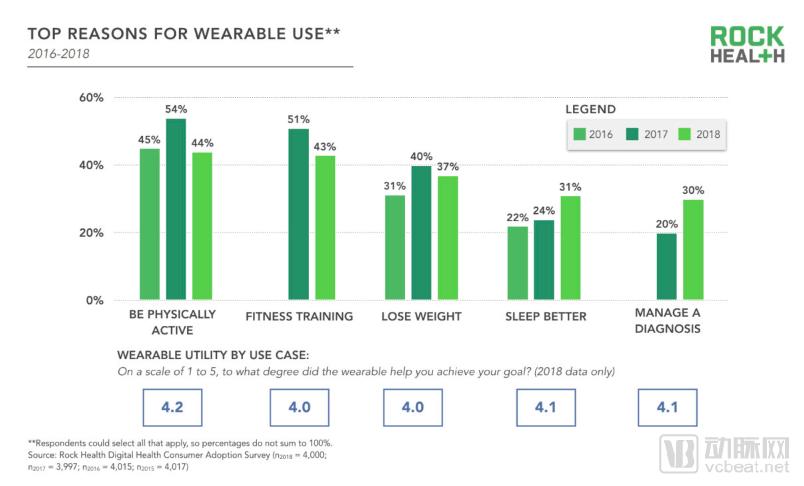 Analysis of Reasons for Using Wearable Devices (Image Source: Rock Health Official Website)
The transition of wearable devices from fitness to healthcare has not been smooth. After failing to shift its business core from consumers to clinical services, Jawbone fell from its former unicorn status into decline. Fitbit is currently undergoing its own clinical transformation and faces intense competition from companies such as Apple and Samsung.
It is therefore worth noting that insufficient user stickiness with wearable devices continues to plague the industry—many step-tracking devices are set aside by consumers after a period of use. In 2018, 39% of respondents discontinued use of their wearable devices, representing a significant increase from 27% in 2017. Notably, the number of respondents who stopped using wearable devices in 2018 exceeded the number of new users.
Nevertheless, as wearables transition from fitness to clinical use, users will become more engaged, since vendors will derive more valuable insights from monitoring user data, while consumers will be incentivized by continued use.
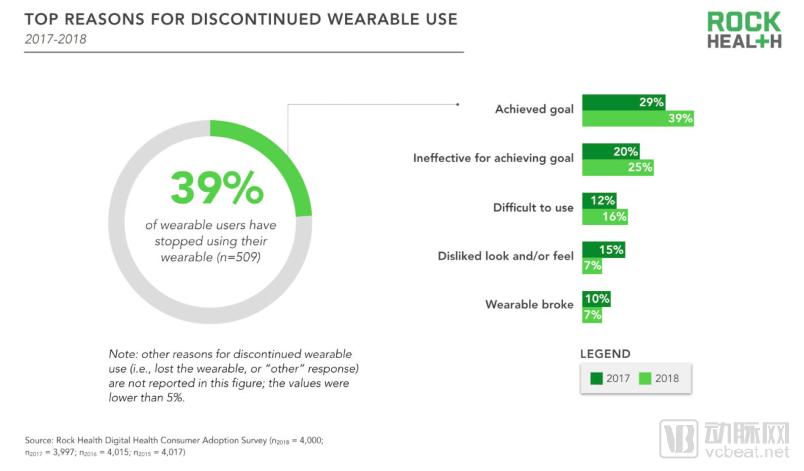 Reasons for Discontinuing Use of Wearable Devices (Image Source: Rock Health Official Website)
For example, entities assuming financial risk have begun to explore ways to empower patients to monitor their own health metrics. Recently, Aetna, a global health insurance giant, partnered with Apple to allow its members to purchase Apple Watches and effectively “earn back” the cost through healthy behaviors. This partnership brings to life two major forces in today’s healthcare landscape: value-based care and consumer-driven healthcare. Some consumers and businesses hope that investments in wearable devices and wellness programs will yield returns by improving patient outcomes.
Investors are also optimistic about digital health companies that operate wearable devices. Since 2011, these companies have secured $3.4 billion in investment, accounting for 11% of the total venture capital invested in digital health during the same period. This trend has remained stable in recent years, with 30 to 40 financing deals completed annually since 2014.
II. Telemedicine adoption rate rises, with urban consumers using it more than twice as much as rural ones
The adoption rate of telemedicine surged in 2018, with 75% of consumers using at least one channel to access remote care, up from 68% in 2017. Although telemedicine can expand healthcare access for consumers in rural areas, rural respondents utilized these services far less frequently than their urban counterparts. The proportion of rural residents who adopted at least one form of telemedicine was 67%, compared to 80% among urban residents.
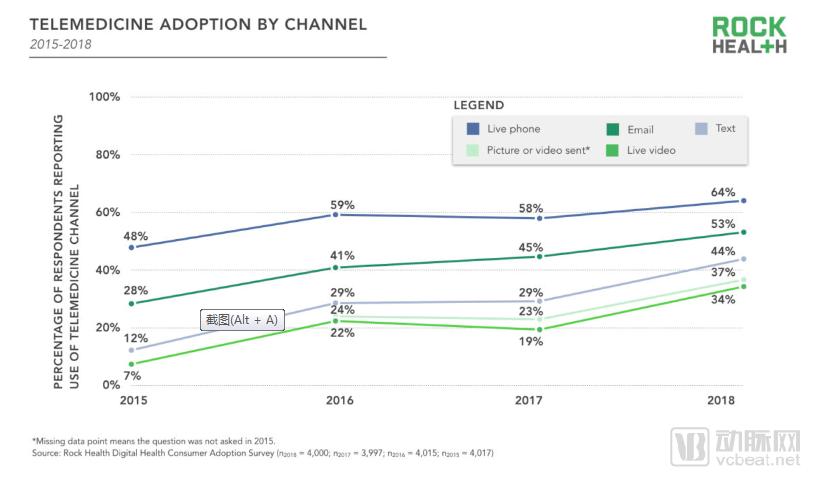 Using Telemedicine as a Medium (Image Source: Rock Health Official Website)
Real-time video telemedicine has seen particularly robust growth, increasing sixfold in just three years. However, the overall adoption rate of 34% for real-time video telemedicine masks significant disparities: only 22% of rural consumers access remote care via real-time video, compared to 51% of urban consumers. Elderly consumers in rural areas are being left behind. In 2018, only 17% of rural respondents aged 35 and older used video telemedicine, which was 19 percentage points lower than that of rural respondents aged 18–34, and 29 percentage points lower than urban residents aged 35 and older.
Perhaps this outcome is hardly surprising. A glance at the marketing strategies of well-funded telehealth startups makes it clear that they are targeting tech-savvy millennials—young people who expect healthcare to be as convenient as food delivery.
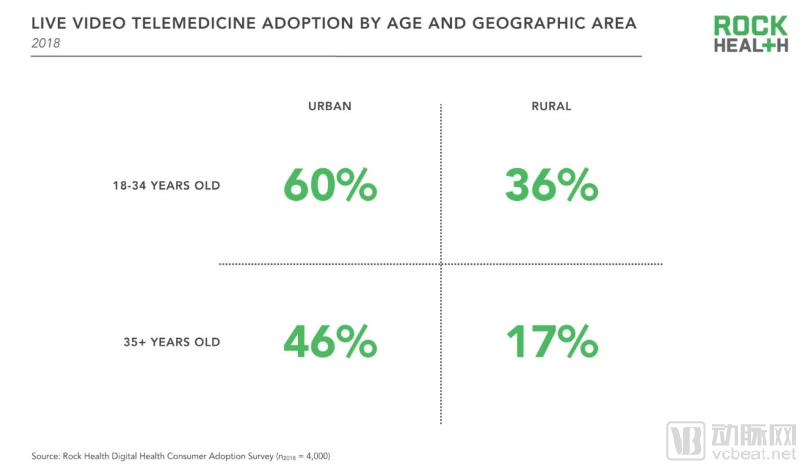 Age and Geographic Distribution of Real-Time Video Telemedicine Users (Image Source: Rock Health Official Website)
Despite uneven adoption rates, this year remains a pivotal one for telemedicine in the United States. Telemedicine utilization began to rise following the enactment of the CHRONIC Care Act in February 2018. This legislation expanded telemedicine coverage to beneficiaries of Medicare Advantage plans and patients treated by Accountable Care Organizations (ACOs).
As reimbursement pathways have become increasingly clear, investors have also opened up financing channels. In 2018, investors poured $1.3 billion into telehealth startups, a threefold surge from the $450 million invested in 2017. Beyond broad-based funding, American Well raised $291 million and Doctor on Demand secured $74 million, as both companies strive to expand their market footprint.
We are witnessing a trend toward consolidation: American Well acquired Avizia, InTouch acquired Reach Health, and Teladoc acquired Advance Medical. Next-generation healthcare providers, such as Oscar and CareMore Health—referred to as “Next-Generation Payers and Providers (NGPPs)”—are making telemedicine a core component of the new patient-centered care model.
III. Consumers Place Greater Emphasis on Data Privacy, Becoming More Cautious About Data Sharing
As in previous years, doctors, health insurers, pharmacies, and research institutions remained the entities most trusted by respondents in 2018 to share their personal medical data. Some respondents indicated that they had the greatest confidence in these entities’ data security management. However, this trend has begun to shift overall. These four most-trusted entities lost an average of 8.8% of respondent support between 2017 and 2018.
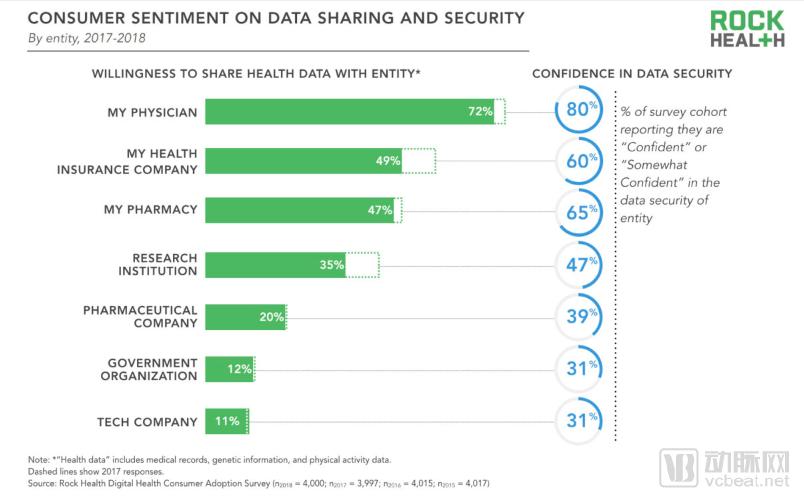 Consumer Attitudes Toward Data Sharing and Security (Image Source: Rock Health Official Website)
One explanation is that public perceptions of data privacy and security are continually evolving in the wake of scandals involving Cambridge Analytica and other technology companies. This growing distrust in technology could have implications for the healthcare industry.
For example, Anne Wojcicki, CEO of the direct-to-consumer genetic testing company 23andMe, attributed the company’s sluggish growth in 2018 to industry-wide concerns over privacy issues. Furthermore, Anthem, the second-largest health insurer in the United States—which paid a $16 million fine to the U.S. federal government following a data breach in 2015—has also failed to reassure consumers that their digitized health information is secure.
Consumers remain cautious about sharing health data with tech companies, with only 11% of respondents willing to do so. In a Rock Health survey, Google emerged as the most trusted company; 60% of respondents expressed willingness to share health data with tech firms partnering with the search giant (note: this implies that only 7% of respondents are willing to share their data directly with Google).
As expected, given the negative impact of news coverage, Facebook ranked near the bottom, with only 40% of respondents willing to share their health data with the social network. It remains unclear how this trend will hinder the development of numerous tech companies in the healthcare sector.
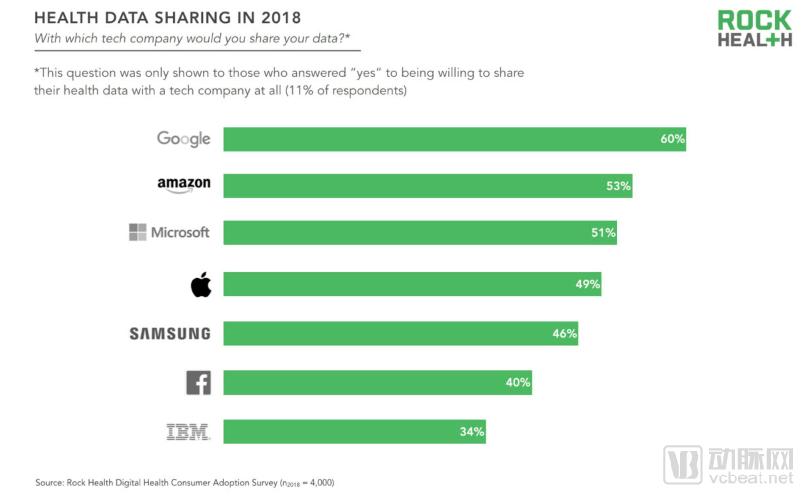 2018 Healthcare Data Sharing Status (Image Source: Rock Health Official Website)
If big tech companies are viewed as leading indicators, then new regulatory policies are imminent; however, it remains uncertain whether and how these will impact the healthcare industry. Consumer behavior does not fully reflect their sentiments. Even though Facebook was mired in scandal and faced government penalties in 2018, its profits still hit a record high in the fourth quarter of that year, and its user base continued to grow throughout 2018.
Do consumers understand where their shared health data is stored and what it contains? How does consumers’ willingness to share health data compare with their willingness to share other types of personal data? Do consumers trust medical decisions made by data-driven algorithms? Rock Health will continue to track consumer attitudes and trends in the adoption of digital health services in its 2019 survey.
(Compiled by Xu Shengnan)