

Milestone Achieved: China's First Biosimilar Drug Rituximab (HLX01) Officially Approved

Henlius
Innovative Biopharmaceutical Company
Unlike chemical generic drugs, biosimilars require more extensive pharmaceutical, non-clinical, and clinical comparative studies with the reference innovator drug during development to assess differences in pharmacokinetics, pharmacodynamics, immunogenicity, and other aspects. Consequently, they entail higher costs in terms of capital, time, and human resources.
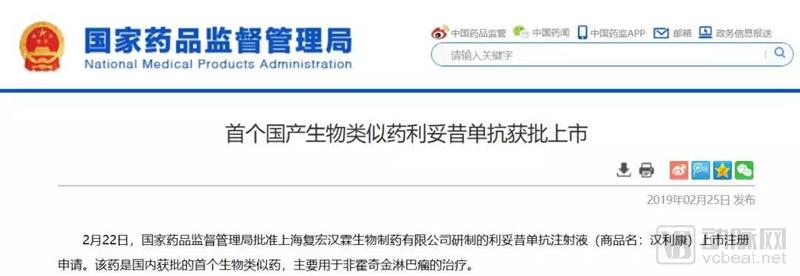
Taking HLX01 as an example, it took eight years from its initial clinical trial application in 2011 to its official approval today. According to information publicly disclosed by Henlius, the New Drug Application (NDA) for HLX01 was accepted in October 2017. From research and development to small-scale production, the product underwent meticulous refinement involving dozens of personnel who contributed over 600,000 hours of work. More than 20 batches were produced during pilot-scale manufacturing, and quality testing involved over 10,000 validation tests. In summary, HLX01 is a product that has been rigorously tested and refined. Furthermore, according to announcements by Fosun Pharma, the R&D costs for this product amounted to RMB 300 million.
As the saying goes, “bitterness ends and sweetness begins.” Henlius’s rituximab injection, now officially approved as China’s first biosimilar, also represents a significant milestone.
Rituximab (Chinese brand name: MabThera) is a chimeric anti-CD20 monoclonal antibody developed by Roche (Genentech). It was first approved in the United States in 1997 and subsequently in Europe the following year. Its indications are primarily focused on hematologic malignancies, such as non-Hodgkin lymphoma and chronic lymphocytic leukemia, as well as rheumatic and autoimmune diseases, including rheumatoid arthritis.
Rituximab is one of the most effective drugs for non-Hodgkin lymphoma (NHL). Its combination with chemotherapy (i.e., the R-CHOP regimen) has been approved as first-line treatment and has been proven to significantly improve patient survival rates. Clinical trial results indicate that the combined use of rituximab and CHOP chemotherapy can increase the overall response rate in patients with aggressive NHL to 83% and the complete response rate to 76%. However, due to its high cost, rituximab remains largely inaccessible as a preferred first-line option for the majority of lymphoma patients in real-world settings.
In 2017, global sales of Roche’s rituximab reached CHF 7.388 billion, with approximately CHF 4.133 billion generated in the United States. Patent protection for rituximab expired in Europe at the end of 2014 and in the United States in 2018.
To date, the European Union has approved two rituximab biosimilars: Celltrion’s Truxima (marketed under different names for various indications, including Blitzima, Rituzena, and Ritemvia) and Sandoz’s (a Novartis subsidiary) Rixathon/Riximyo.
On November 28, 2018, the FDA also approved the first rituximab biosimilar to be marketed in the United States, CT-P10 (Truxima), jointly developed by Celltrion and Teva, for the treatment of B-cell non-Hodgkin’s lymphoma (NHL) as monotherapy, as part of combination therapy, or as maintenance therapy.
On April 21, 2000, rituximab was officially launched in the Chinese market. Meanwhile, a cohort of Chinese biopharmaceutical companies accelerated their efforts to develop biosimilars. In addition to Henlius, which received the first approval, two products from Innovent Biologics and SinoCellTech are currently in Phase III clinical trials, while dozens of other enterprises remain in the early stages of clinical development.
MabThera was included in the National Reimbursement Drug List through price negotiations in 2017. The price for the 500 mg/50 mL per vial specification dropped from RMB 16,041 to RMB 8,298, while the smaller 100 mg/10 mL per vial specification was reduced to RMB 2,418. According to patient disclosures, a typical regimen involves a combination of either 500 mg + 100 mg (totaling RMB 10,716) or 500 mg + 200 mg (totaling RMB 13,134). With four administrations per treatment cycle and a total of 6–8 cycles, the overall cost ranges from RMB 257,200 to RMB 420,300.
Meanwhile, medical insurance reimbursement is subject to strict indications, covering only relapsed or refractory B-cell non-Hodgkin lymphoma (NHL), CD20-positive stage III–IV follicular NHL, and CD20-positive diffuse large B-cell NHL. Although the theoretical reimbursement rate is 70%, the actual rate rarely exceeds 50%. Furthermore, under China’s Class B medical insurance scheme, coverage is capped at eight treatment cycles, leaving patients with a substantial financial burden.
With the official approval of domestically produced rituximab, the monopoly held by the originator drug MabThera in the field of non-Hodgkin lymphoma is undoubtedly set to be broken, thereby reducing the medication burden on patients. It is reported that as early as December 2017, the Chinese Pharmacopoeia Commission approved the common name for HLX01, permitting its generic name to be listed as “rituximab.” This means that HLX01 is expected to share the same name as the originator product and thus gain direct access to national medical insurance coverage. However, Henlius has not yet disclosed the specific pricing for HLX01. Previously, in an interview with the media, Liu Shigao, CEO of Henlius, stated that the price of this product would certainly be noticeably lower compared to the originator drug.
As Rituximab has not yet been approved in China for indications in the field of rheumatic and immune diseases, and given that immune-mediated diseases and tumors involve different mechanisms of action, HLX01 cannot currently gain direct approval for use in rheumatic and immune diseases through indication extrapolation. However, Henlius has already initiated Phase III clinical trials for rheumatoid arthritis in China, demonstrating its commitment to expanding the indications for HLX01 and holding promise for enabling more Chinese patients to access high-quality domestically produced biologics.
From the perspective of the development progress of biosimilars in China, Henlius was not initially at the forefront. However, HLX01 has now become the first biosimilar in the strict sense to be approved in China, a process that has also witnessed the continuous improvement of regulatory frameworks for biological product registration.
According to the Measures for the Administration of Drug Registration issued by the former China Food and Drug Administration (CFDA) in 2007, monoclonal antibodies were required to be filed as Class 2 new therapeutic biological products, necessitating Phase I, II, and III clinical trials. In 2010, biosimilars, as a special type of “generic” biological product distinct from generic chemical drugs, had unclear registration classifications and application pathways. At that time, companies could either apply under the pathway for Class 1 new drugs (biological products not yet marketed domestically or internationally) or under the pathway for Class 2 new drugs (monoclonal antibodies).
Frankly speaking, to avoid the costs and hassles of purchasing "reference drugs" (originator drugs), most monoclonal antibody drugs already approved or under development in China before 2015 were submitted for registration under the Class 1 new drug pathway. Compared with originator drugs, these agents have structures that are not entirely similar, and their clinical trials did not include head-to-head studies; their R&D costs amounted to approximately RMB 30–50 million.
Until 2015, the former China Food and Drug Administration (CFDA) issued the Technical Guidelines for the Development and Evaluation of Biosimilars (Trial), which explicitly stated that the amino acid sequence of a biosimilar candidate should, in principle, be identical to that of the reference product. If host cells, expression systems, or other components different from those used for the reference product are employed during development, comprehensive studies must be conducted. These studies shall be carried out in accordance with the principles of comparison, stepwise progression, consistency, and similarity assessment, to demonstrate similarity to the reference product while supporting its safety, efficacy, and quality controllability.
This means that head-to-head pharmaceutical, non-clinical, and clinical studies are indispensable if biosimilars are to achieve parity with originator products in terms of quality, safety, and efficacy. Consequently, standardized requirements for the development and evaluation of biosimilars have directly raised the R&D cost threshold to RMB 200–400 million, while significantly elevating quality standards.
Taking HLX01 as an example, during its early research and development phase, China had not yet issued relevant regulations and guidelines for biosimilars. Henlius therefore designed its various study and evaluation protocols by referencing the European Medicines Agency’s (EMA) “Guideline on Similar Biological Medicinal Products” and the U.S. Food and Drug Administration’s (FDA) “Guidance for Industry: Scientific Considerations in Demonstrating Biosimilarity to a Reference Product.”
After obtaining the clinical trial approval for the NHL indication issued by the former China Food and Drug Administration (CFDA), Henlius strictly adhered to the requirements of the “Technical Guidelines for the Development and Evaluation of Biosimilars (Trial)” in China. The company evaluated the similarity between HLX01 and the reference drug, MabThera/Rituxan, through head-to-head comparative studies and a stepwise approach across three aspects: pharmaceutical quality, non-clinical studies, and clinical studies.
These comparative studies included analyses of primary structure, higher-order structure, purity, glycoforms, and more than ten biological activities and immunological properties. The results demonstrated that HLX01 is similar to the reference product, MabThera, in terms of quality, safety, and efficacy, establishing it as a biosimilar to MabThera. This marks the first biosimilar developed, evaluated, and approved for marketing in accordance with the requirements set forth in China’s newly clarified technical guidelines, as well as the first domestic biosimilar of rituximab.
Today, the formal approval of this drug also demonstrates that China’s regulatory review and approval pathway for biosimilars is becoming increasingly clear, thereby paving a “clear path” for future entrants.
Monoclonal antibody originator drugs are expensive, while biosimilars can significantly reduce the financial burden on patients and improve drug accessibility, making them a key focus of encouragement in China’s drug regulatory policies. In particular, the expiration of patents for high-cost drugs urgently needed by patients in developing countries led by China, such as rituximab, undoubtedly facilitates the time- and cost-efficient development of antibody drug copies by the industry, while also expanding the accessibility of these medications and making them affordable for more ordinary patients.
We also look forward to this first biosimilar, developed with substantial time and financial investment, helping to build trust in China’s domestically produced biopharmaceutical industry. We hope that subsequent entrants will continue to strive, breaking monopolies and fostering robust competition, ultimately benefiting patients through pricing that offers greater perceived value than that of the originator products.
Reprinted from: PharmaCube