

Yixintang's 2018 Annual Report Highlights the 'Three Highs' of Prescription Outflow: High Customer Retention, High Average Transaction Value, and High Purchase Frequency
On the evening of February 25, Yixintang disclosed its 2018 annual report, revealing full-year revenue of RMB 9.176 billion, a year-on-year increase of 18.39%, and net profit of RMB 521 million, a year-on-year increase of 23.27%.
Behind Yixintang’s Rapid Revenue Growth: Prescription Outflow Plays a Pivotal RoleThe annual report indicates that, driven by prescription outflow, the introduction of DTP (Direct-to-Patient) products, the expansion of pharmacy channels for volume-based procurement (VBP) drugs, and the opening of special chronic disease account payments, the company’s stores are poised to achieve new revenue growth points in the future.
Yixintang’s Annual Report Mentions Prescription Outflow Five Times: What Is the Actual Impact on Pharmacy Performance? The Answer May Lie in the Data.
With the advancement of public hospital reforms, healthcare insurance payment system reforms, and tiered diagnosis and treatment, China’s healthcare investment will steadily increase, and the level of medical security will gradually improve. This will significantly expand the development space for the pharmaceutical distribution industry, leading to the outflow of hospital prescriptions and the gradual formation of a separation between medicine and medical services.
Yixintang began strategically positioning itself in the prescription outflow business at an early stage. In its 2017 annual report, the company stated that it was exploring the transformation of traditional hospital pharmaceutical distribution by engaging in deep logistics and supply chain collaborations with medical institutions and large-scale distributors to extensively promote pharmaceutical care services within medical institutions. By further expanding professional pharmaceutical care services and leveraging support for specialized services for hospital patients with chronic and special diseases as well as internet platforms, Yixintang has actively explored models for prescription outflow from medical institutions and piloted new delivery methods such as “online order, in-store pickup” and “online order, store-based delivery.”
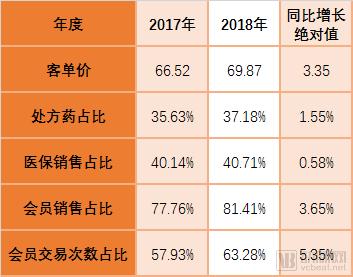
Under this proactive strategic layout, the results have been significant. The table below highlights Yixintang’s 2018 performance in prescription outflow, DTP (Direct-to-Patient), and other related businesses.
Table 1: Changes in Yixintang's Key Sales Indicators
Data Source: Yixintang 2018 Annual Report
As can be seen, the outflow of prescriptions has yielded positive results. In 2018, Yixintang’s average transaction value per customer increased by an absolute year-on-year amount of RMB 3.35, the proportion of prescription drug sales rose by 1.55 percentage points, and the share of sales covered by medical insurance increased by 0.58 percentage points. Notably, performance was even more robust in two key member-related metrics: the proportion of sales attributed to members grew by 3.65 percentage points year-on-year, while the number of transactions surged by 5.35%.
Yixintang stated that it sold 103 DTP (Direct-to-Patient) products, accounting for 0.82% of total sales, with a gross profit margin of 8.63%. For this category of incremental products, growth in sales volume directly translates into increased profits. Meanwhile, due to the stronger customer stickiness associated with these products, their increased sales also help stabilize foot traffic, contributing to higher average transaction values and purchase frequency.
In other words, the value of prescription outflow lies in its “three highs”: high stickiness, high unit price, and high frequency.
Why Does Prescription Outflow Have This Effect? Because the initial categories of prescriptions flowing out are primarily those for chronic diseases, common conditions, and new specialty drugs. Chronic disease medications, in particular, represent the primary category driving prescription outflow. Patients with chronic diseases are predominantly elderly individuals who face challenges in accessing medical care. Community pharmacies located near patients provide a convenient medication pickup environment, making them better suited for maintaining access to long-term therapies.
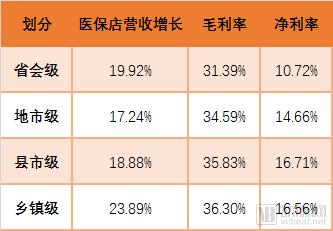
Furthermore, Yixintang’s annual report reveals that prescription outflow and the DTP (Direct-to-Patient) business rely on follow-up support from medical insurance programs. As such support expands, operational metrics for individual stores are improving at an accelerated pace. Payments from personal medical insurance accounts constitute a significant portion of the company’s sales revenue. Driven by factors such as prescription outflow and the expansion of DTP product offerings, the average revenue growth of medical insurance-designated stores in provincial capitals and prefecture-level cities has outpaced the average revenue growth of stores in these same two tiers of regions.
Table 2: Operational Performance of Yixintang’s Medical Insurance-Designated Stores
Data Source: Yixintang 2018 Annual Report
Yixintang currently has 341 stores enabled for special and chronic disease medical insurance payments. The average revenue per store in this segment is 51.93% higher than the company’s overall average store revenue, and 25.60% higher than the average revenue of its medical insurance-designated stores. In short, the sales ratio among ordinary stores, medical insurance-designated pharmacies, and special/chronic disease medical insurance payment-enabled stores stands at 1:1.2:1.5. This clearly explains why Yixintang is vigorously expanding its network of medical insurance-designated pharmacies and special/chronic disease pharmacies.
The annual report indicates that over the next three years, the Sichuan-Chongqing region will be Yixintang’s primary area for expansion, while Guangxi and Hainan will serve as secondary expansion zones. In addition to opening new stores organically, Yixintang will further engage in industry asset consolidation by acquiring high-quality regional pharmaceutical retail assets to expand its market presence, increase market share, and accelerate growth in the Sichuan region, with the aim of establishing Sichuan-Chongqing as its largest sales region. This strategy will create a tripartite stronghold spanning Sichuan-Chongqing, Yunnan-Guizhou, and Guangxi-Hainan, complemented by a strategic presence in North China, specifically in Shanxi, Henan, and Tianjin.
Furthermore, Yixintang will actively establish an “Internet Plus” business model, upgrade and improve the “Internet Plus” infrastructure across all its stores, and achieve integration between online channels and offline sales. This will enable Yixintang to build an innovative marketing platform supporting multi-channel and multi-sales models, thereby further enhancing its customer service capabilities and expanding the market share of its products and services.
Specifically, Yixintang had three key priorities in 2019, with a focus on deepening its presence in the core Sichuan-Chongqing market. The Sichuan-Chongqing region was Yixintang’s primary target market in 2019. First, the company continued to implement intensive and rational store placement within the regional market. Second, it consistently introduced standardized management and promotional management systems, strengthened store development, and built strong brand credibility. Meanwhile, by enhancing professional services and standardized operations at stores, optimizing product portfolios, and leveraging mature membership management, Yixintang achieved continuous growth in both customer transaction volume and sales revenue. Particular emphasis was placed on improving store quality, which further bolstered confidence and provided greater assurance for the rapid development of the Sichuan-Chongqing region.
Actively keep pace with the advancement of healthcare reform. As public hospital reforms are fully rolled out and supporting policies such as health insurance cost containment measures are sequentially introduced, the trend toward “separation of prescribing and dispensing” is becoming increasingly evident. Pilot programs for information sharing among medical institutions, health insurance agencies, and retail pharmacies, along with trial implementations of classified and graded management for retail pharmacies, will provide significant opportunities for the development of the pharmaceutical retail industry. With the gradual formation of a landscape where prescribing and dispensing are separated, Yixintang will seize the substantial incremental market generated by the outflow of hospital prescriptions by accelerating the establishment and acquisition of stores near hospitals through collaborations with government bodies, medical institutions, health insurance agencies, and suppliers. The company will also actively explore initiatives in health insurance payment mechanisms, assumption of community healthcare functions, and sharing of hospital prescription information.
Continuously Strengthen Standardized ManagementManagement improvement has always been one of Yixintang’s key priorities. Building on the promotion of “refined” management, the company will strengthen standardized management in 2019, putting forward new requirements for management enhancement efforts. First, “refinement” requires the enterprise to aspire to high standards, with development and management goals that are both targeted and leading, clear and well-defined. Second, “meticulousness” demands precise control over every link of each task. Therefore, to achieve refined and standardized management, it is essential first to clarify objectives: industry-leading companies should establish benchmarks, while follower companies should align themselves with these benchmarks. Subsequently, through comprehensive analysis and systematic review of all operational processes, deficiencies and weak points should be identified, and corresponding improvement measures proposed.
VCBeat has previously published numerous articles discussing the outflow of prescriptions, a hot topic in the pharmaceutical industry in recent years. This trend refers to the shift from the traditional model—where patients received diagnosis, prescriptions, and medications all within hospitals—to one where restrictions on the free flow of prescriptions are lifted, medications are dispensed by retail pharmacies, and medical services are separated from drug dispensing. The driving force behind prescription outflow is the dismantling of the “drug-revenue-dependent healthcare” mechanism, aiming to refocus hospitals on their core medical functions and reduce their “monopoly” over prescriptions. Policies such as medical insurance cost containment, zero markups on drugs, and controls on the proportion of drug revenue have provided hospitals with strong incentives to release certain prescriptions. Thus, prescription outflow serves both as a “political mandate” and a process guided by “market forces.”
A series of policies are facilitating the gradual realization of prescription outflow. For instance, hospitals are prohibited from restricting prescription outflow, allowing patients to freely choose between purchasing medications at hospital outpatient pharmacies or at retail pharmacies with a valid prescription. Pilot programs for tiered management of retail pharmacies have been implemented to encourage the development of chain pharmacies, while exploring the interconnectivity and real-time sharing of data among medical institutions’ prescription information, health insurance settlement records, and pharmaceutical retail consumption data. In terms of electronic prescription pilots, regions such as Xi’an, Guangdong, and Chongqing have successively issued pilot policies to trial the sale of prescription drugs at retail pharmacies based on electronic prescriptions.
The separation of medical services from pharmaceutical sales and the outflow of prescriptions are regarded as significant growth opportunities for the retail pharmacy industry. Currently, companies such as Baiyang Yifuzhen, WeChat, Ali Health, Jointown Pharmaceutical Group, and Yaoshiquan are deploying prescription circulation platforms. Although local policies are supportive, a nationwide, large-scale system for the external circulation of hospital prescriptions has not yet taken shape. Prescription sharing platforms will become a critical hub connecting hospitals and pharmacies. As the use of electronic prescriptions becomes commonplace, the smart pharmacy model will emerge as a key strategic approach for pharmacies to accommodate the inflow of outsourced prescriptions.
“Internet + Healthcare” serves as a crucial channel for accommodating the outflow of prescriptions. For instance, in the first half of 2016, Yixintang sequentially launched cross-sector B2C initiatives, including the Yixintang APP, group-buying services, cross-border e-commerce, and same-city delivery services. Leveraging its strong brand influence and regional service advantages, the company also introduced its “Yixintang to Home” B2C service. In 2018, the total transaction volume of its e-commerce business reached RMB 62.3086 million, of which RMB 17.0152 million was generated through third-party sales platforms.
Nanjing Pharmaceutical has recently launched an “Internet + Healthcare” initiative aimed at capturing outbound prescription flows. The company plans to enter into a strategic cooperation with the People’s Government of Gulou District, Xuzhou City, and relevant technology firms, and will invest RMB 44.4 million to cover venue leasing costs for smart retail operations as well as expenses for self-service medication dispensing and pickup terminals (including equipment operation, maintenance, and repair costs), thereby implementing its “Internet + Pharmaceutical Consortium” smart retail project.
As noted in Yixintang’s annual report, retail pharmacies will continue to transform over the coming years into innovative models such as DTP (Direct-to-Patient) specialty pharmacies, distribution-focused specialty pharmacies, chronic disease management pharmacies, and smart pharmacies. Driven by internet technologies, new applications—including unmanned medication dispensing cabinets, facial recognition, and AI-powered robots—will gradually be integrated into retail pharmacy operations. It is anticipated that retail pharmacies will leverage innovative technologies such as the internet, the Internet of Things (IoT), big data, and cloud computing to deliver more professional and convenient services to consumers.
These technology companies or platforms that “empower” pharmacies will share in the trillion-yuan market pie created by the outflow of prescription drugs.