

Draft Regulations on Clinical Application of Biomedical New Technologies Released: Six Key Highlights
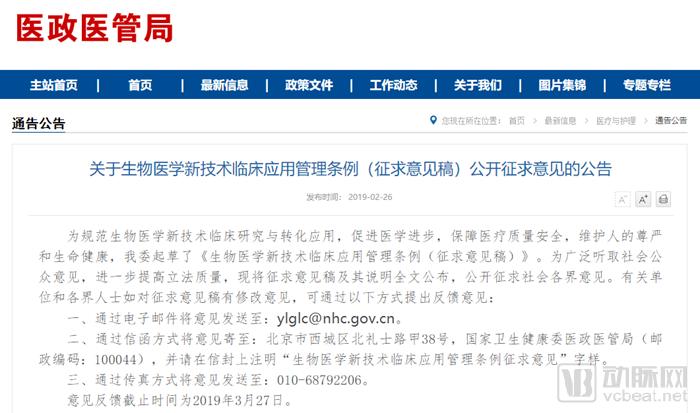
VCBeat (WeChat ID: biobeat1) has learned that on February 26, the Medical Administration and Hospital Administration Bureau of the National Health Commission issued a public notice to solicit comments from the general public on the revisions to the “Regulations on the Clinical Application Management of New Biomedical Technologies (Draft for Comment)” (hereinafter referred to as the “Management Regulations”). The deadline for submitting feedback is March 27, 2019.
Currently, biomedical technologies have become among the fastest-growing areas in the life sciences, providing new tools for disease diagnosis and treatment as well as for improving human health. Over the past two to three years, substantial capital has flowed into the pharmaceutical industry, with a surge of domestic startups emerging across China. According to Deloitte, there were 1,008 financing deals in the biotechnology and healthcare sectors in 2017 alone, totaling RMB 77.1 billion. Meanwhile, overseas capital—primarily from multinational pharmaceutical companies—has shown strong interest in China’s pharmaceutical sector, with 210 pharmaceutical projects receiving foreign investment between 2012 and 2016.
On the other hand, biomedical technology is also among the most challenging fields. New drug development companies are constrained by factors such as shortages of clinical trial resources and insufficient capacity for ethical review. Improper conduct of clinical research and applications can also give rise to issues concerning privacy protection, biosafety, public safety, and social ethics.
Therefore, to prevent a recurrence of incidents similar to the gene-edited babies case, the National Health Commission’s Bureau of Medical Administration and Hospital Management promptly issued the Administrative Regulations, further improving the regulatory framework for clinical research and translational application of new biomedical technologies, promoting standardized and orderly conduct in these areas, and advancing medical progress.
The Administrative Regulations comprise 7 chapters and 63 articles, providing clear stipulations from the perspectives of application and review for clinical research projects, management of the research process, management of translational applications, supervision and administration, and legal liabilities. The following six key highlights of the Administrative Regulations warrant attention:
The “Administrative Regulations” standardize the clinical-stage research and translational application of biotechnology, defining new biomedical technologies as: medical professional methods and measures that have completed preclinical research, are intended to act at the cellular and molecular levels, and aim to diagnose diseases, prevent diseases, eliminate diseases, alleviate disease conditions, relieve pain, improve functions, prolong life, and facilitate recovery of health.
First, it mandates that clinical research and translational application of new biomedical technologies by medical institutions must be approved by administrative authorities. Second, it specifies the qualifications for medical institutions conducting clinical research on new biomedical technologies, as well as for the primary investigators of such projects. Third, it clarifies that approvals by health administrative departments are based on academic and ethical reviews. Fourth, it implements a two-tier management system for clinical research on new biomedical technologies according to risk levels: projects with low-to-moderate risks are approved by provincial-level health authorities, while high-risk projects are reviewed by provincial-level health authorities and subsequently approved by the national health authority under the State Council; the translational application of research outcomes is uniformly overseen by the national health authority under the State Council.
Drawing on relevant international guidelines and the World Health Organization’s provisions on ethical review, the Regulations specify the key components of academic and ethical reviews conducted by health authorities, thereby enhancing the rigor and standardization of such reviews. Meanwhile, detailed review standards—including the composition of ethics committees and academic committees, specific technical specifications for the review process, and review conclusions—shall be formulated separately.
Medical institutions conducting clinical research (including as lead or participating entities) shall assume primary responsibility. Such institutions must meet specified eligibility criteria, which will be formulated separately. The principal head of a medical institution is the primary person responsible for the management of clinical research at that institution. Where a medical institution provides technical support, research facilities, human biological samples (such as cells, tissues, or organs), or assistance in volunteer recruitment to other institutions, both the institution and its involved personnel shall bear corresponding liabilities.
To address the issue of weak penalties under existing regulations, which fail to serve as an effective deterrent, the Regulations have strengthened punitive measures for violations. Specific penalties are prescribed for scenarios such as medical institutions conducting clinical research and translational applications in violation of regulations, failing to conduct research as required, physicians violating regulatory provisions, other medical personnel violating regulatory provisions, and non-medical institutions conducting clinical research in violation of regulations. These penalties include warnings, orders to rectify within a specified time limit, fines, revocation of approved diagnostic and treatment specialties, revocation of the Medical Institution Practice License, dismissal or termination of employment, and a lifetime ban on engaging in clinical research involving new biomedical technologies. In serious cases, criminal liability shall also be pursued.
The expected outcomes of clinical research on certain new biomedical technologies are pharmaceutical drugs or medical devices, which shall be regulated in accordance with the Drug Administration Law and the Regulations on the Supervision and Administration of Medical Devices.
Appendix: Full Text of the "Regulations on the Clinical Application and Management of New Biomedical Technologies (Draft for Comments)"
Regulations on the Clinical Application Management of New Biomedical Technologies
(Draft for Comment)
Chapter 1 General Provisions
Article 1 These Regulations are formulated to regulate the clinical research and translational application of new biomedical technologies, promote medical progress, ensure the quality and safety of medical care, and safeguard human dignity and life and health.
Article 2 This Regulation shall be observed in the conduct of clinical research, translational application, and supervision and administration of new biomedical technologies within the territory of the People’s Republic of China.
Article 3 The term “new biomedical technologies” as used in these Regulations refers to medical professional methods and measures that have completed preclinical research, are intended to act at the cellular or molecular level, and aim to diagnose diseases, prevent diseases, eliminate diseases, alleviate disease conditions, relieve pain, improve bodily functions, prolong life, or facilitate recovery of health.
Article 4 The term “clinical research on new biomedical technologies” (hereinafter referred to as “clinical research”) as used in these Regulations refers to activities involving human trials conducted prior to the clinical application and translation of new biomedical technologies. The primary purposes of such clinical research are to observe and assess the safety, efficacy, and applicable scope of new biomedical technologies, and to clarify operational procedures and precautions, among other matters.
Human clinical trials include, but are not limited to, the following scenarios:
(1) Directly acting on the human body;
(2) Those that act on isolated tissues, organs, cells, etc., and are subsequently implanted or introduced into the human body;
(3) Those that act on human germ cells, zygotes, or embryos, followed by implantation to enable their development.
Article 5. The translational application of new biomedical technologies (hereinafter referred to as “translational application”) refers to the process whereby new biomedical technologies, verified through clinical research to be safe, effective, and ethically compliant, are approved through established procedures for application within a specified scope or on a widespread basis.
Article 6 The health administrative department of the State Council shall be responsible for the supervision and administration of clinical research and translational application nationwide. Relevant departments of the State Council shall, within their respective scopes of duties, be responsible for the supervision and administration related to clinical research and translational application.
The health authorities of local people’s governments at or above the county level shall be responsible for the supervision and administration of clinical research and translational applications within their respective administrative areas. The relevant departments of local people’s governments at or above the county level shall, within the scope of their respective duties, be responsible for the supervision and administration related to clinical research and translational applications.
Health authorities of people’s governments at all levels may designate or establish specialized departments or institutions to be responsible for the supervision and administration of clinical research and translational applications. People’s governments at all levels shall ensure staffing quotas and operational funding for these entities.
Article 7 Clinical research on new biomedical technologies shall be subject to tiered management. Clinical research on new biomedical technologies with medium or low risks shall be administered by provincial-level health authorities, while clinical research on new biomedical technologies with high risks shall be administered by the health authority under the State Council. High-risk new biomedical technologies include, but are not limited to, the following circumstances:
(1) Those involving alterations to genetic material or the regulation of genetic material expression, such as gene transfer technology, gene editing technology, gene regulation technology, stem cell technology, somatic cell technology, and mitochondrial replacement therapy;
(2) Those involving xenogeneic cells, tissues, or organs, including the use of xenogeneic biomaterials or cultivation in xenogeneic hosts via cloning techniques;
(3) The generation of new organisms or biological products for application in the human body, including synthetically created organisms and microbiota transplantation technologies involving genetically engineered modifications;
(4) Involving assisted reproductive technology;
(5) Other research projects characterized by high technical risk and significant difficulty, which may have a major impact.
The Catalog of Risk Levels for New Biomedical Technologies shall be formulated by the health administrative department of the State Council.
The translational application of new biomedical technologies shall be administered by the health department of the State Council.
Article 8 Clinical research on new biomedical technologies shall be subject to academic review and ethical review, while translational application shall be subject to technical assessment and ethical review.
Article 9 The supervision and administration of preclinical research on new biomedical technologies shall be carried out in accordance with the regulations of the relevant departments of the State Council. Where preclinical research has been completed and clinical research is intended, such research shall be conducted within medical institutions, and procedures performed on human subjects shall be carried out by medical personnel.
Article 10 Where the expected outcomes of clinical research are drugs or medical devices, the provisions of the Drug Administration Law, the Regulations on the Supervision and Administration of Medical Devices, and other relevant laws and administrative regulations shall apply.
Article 11 Clinical research shall not be conducted on new biomedical technologies that are explicitly prohibited by laws, regulations, and relevant national provisions; involve significant ethical issues; or have not been proven safe and effective through preclinical animal studies.
Biomedical new technologies that have not been proven safe and effective through clinical research, or that have not passed the review for translational application, shall not be introduced into clinical practice.
Chapter 2 Application and Review of Clinical Research Projects
Article 12 Institutions intending to engage in clinical research activities shall meet the following conditions:
(1) Tertiary Grade A hospitals or Tertiary Grade A maternal and child health care hospitals;
(2) Possessing the qualifications, research premises, environmental conditions, equipment and facilities, and professional technical personnel commensurate with the conduct of clinical research;
(3) Management systems and capabilities to ensure the quality and safety of clinical research, ethical compliance, and the protection of subjects' health rights and interests.
Article 13 Medical institutions are the entities responsible for conducting clinical research on new biomedical technologies, and the principal heads of medical institutions are the primary persons responsible.
The principal leader of a medical institution shall assume overall responsibility for clinical research, establish and improve quality management systems and mechanisms for clinical research, ensure adequate human and material resources for clinical research, refine internal rules and regulations, and promptly address emergencies arising during the conduct of clinical research.
Article 14 The principal investigator of a clinical study shall hold both a practicing physician qualification and a senior professional title, and maintain a good scientific research reputation. Key researchers shall possess the professional knowledge background, qualifications, and capabilities necessary to undertake the study.
Article 15 The principal investigator of a clinical study shall be fully responsible for the operational management of the study; develop the study protocol, strictly implement the protocol after it has been reviewed and registered, and analyze and prepare the study report; master and adhere to standard operating procedures, and maintain detailed study records; promptly address any issues arising during the study to ensure compliance with requirements at all stages.
Article 16 The application for a clinical research project shall be submitted by the principal investigator to the department designated by their medical institution.
The Academic Review Committee and the Ethics Review Committee established by medical institutions review research projects for their necessity, legality, scientific rigor, feasibility, safety, and ethical appropriateness.
Article 17 For those approved through internal review by a medical institution, the medical institution shall submit an application to the health administrative department of the people’s government at the provincial level where it is located, and provide the following materials:
(1) Project Application Form (including the level and category of the research project);
(II) Qualifications of Medical Institutions (Licensing Status);
(3) Qualifications and Research Work Resume of Key Investigators;
(4) Research Plan;
(5) Research Foundation (including summary of scientific literature, laboratory work foundation, animal experiment results, and preclinical work summary, etc.);
(6) Quality Control Management Plan;
(7) Potential Risks and Response Plans;
(8) The assessment conclusions of this institution (including the results of ethical review and academic review);
(9) Informed Consent Form (Template).
Article 18 For applications to conduct clinical research on biomedical new technologies with low-to-moderate risk, the health administrative department of the people's government at the provincial level shall complete academic review and ethical review within 60 days from the date of receipt of the application. If the application meets the prescribed conditions, it shall be approved for conducting clinical research and registered accordingly.
For applications to conduct clinical research on high-risk biomedical new technologies, the health administrative department of the provincial people's government shall conduct a preliminary review and issue its initial review opinion before submitting the application to the health administrative department of the State Council. The health administrative department of the State Council shall complete the review within 60 days. If the review is approved, the clinical research shall be authorized, and the health administrative department of the provincial people's government shall be notified to register the approval.
The standards for academic review and ethical review of clinical studies shall be formulated and promulgated by the health administrative department of the State Council.
Article 19 For clinical research projects, the academic review conducted by health authorities shall primarily include the following contents:
(I) Necessity of Conducting Clinical Research;
(2) Legality, scientific rigor, rationality, and feasibility of the research protocol;
(3) Whether the conditions and specialty setup of medical institutions meet the requirements;
(4) Whether the researchers possess the competence level appropriate for the research;
(5) Potential risks and risk mitigation measures during the research process;
(6) Potential public health safety risks and control measures during the research process.
Article 20 For clinical research projects, the ethical review by the health authorities shall mainly include the following contents:
(1) Whether the qualifications and experience of the investigators meet the requirements of the trial;
(2) Whether the research protocol meets the requirements of scientific rigor and ethical principles;
(3) Whether the level of risk to which subjects may be exposed is commensurate with the anticipated benefits of the study;
(4) Whether the information provided to the subjects (or their family members, guardians, or legal representatives) during the informed consent process is complete and easy to understand, and whether the method of obtaining informed consent is appropriate;
(5) Whether confidentiality measures have been implemented for subject data;
(6) Whether the inclusion and exclusion criteria for subjects are appropriate and fair;
(7) Whether subjects are clearly informed of their rights, including the right to withdraw from the study at any time without providing a reason and without facing discrimination;
(8) Whether subjects receive reasonable compensation for participating in the study, and whether the treatment and compensation measures are appropriate in case of injury or even death resulting from participation in the study;
(9) Whether there is a designated person among the researchers responsible for handling issues related to informed consent and subject safety;
(10) Whether protective measures have been taken against the risks that subjects may be exposed to in the study;
(11) Whether there are any conflicts of interest between the researchers and the subjects.
Article 21 The review shall not be approved if any of the following circumstances exists:
(I) Violations of the provisions of relevant national laws, regulations, and rules;
(II) Violating the principles of research integrity;
(3) Those that have not passed the ethical review;
(4) Insufficient basis for project approval;
(5) The risks of the research (including potential risks) are excessive and exceed the scope controllable by this institution;
(6) Those that do not meet the requirements for laboratory biosafety conditions;
(7) Infringing upon the intellectual property rights of others;
(8) Where the source of funding is unclear, unlawful, or the budget is insufficient.
Article 22 For clinical research projects on new biomedical technologies conducted collaboratively by multiple medical institutions, the medical institution where the project leader is affiliated shall serve as the lead entity for the project and assume primary responsibility. When applying for administrative review, the lead institution shall be responsible for consolidating materials and internal assessment opinions from all collaborating institutions, and submitting them to the provincial-level health administrative department of the people’s government where the lead institution is located for review.
Where cooperation from the provincial-level health administrative authorities at the location of the cooperating institution is required during the review process, such authorities shall provide the necessary cooperation.
Article 23 Clinical research projects on new biomedical technologies proposed by non-medical institutions, such as educational and research institutions, shall be conducted in collaboration with qualified medical institutions. The medical institution shall submit the project application to the health administrative department of the people's government at the provincial level where it is located.
Article 24 Where a medical institution provides technical support and research facilities to other institutions, supplies samples of human cells, tissues, organs, etc., or assists in volunteer recruitment, such activities shall be managed as collaborative clinical research. The institution and its participating personnel shall be fully informed of the protocol and objectives of the research project involved, as well as the intended use of the provided biological samples, and shall conduct institutional ethical review in accordance with established procedures.
Article 25 No organization or individual may conduct clinical research that has not been reviewed and approved.
Chapter 3 Research Process Management
Article 26 Medical institutions shall conduct clinical research in accordance with the reviewed and approved protocol. If any changes occur during the research process, they shall be subject to re-review by the institution’s ethics committee and filed with the health administrative department that approved the research.
In the event of major changes to the research protocol, the health administrative department that approved the study shall organize a review; implementation may continue only after such review and approval have been obtained.
Article 27 Clinical research shall adhere to the following principles:
(1) Comply with national laws and regulations, departmental rules, and provisions of normative documents;
(II) Compliance with fundamental ethical principles;
(3) Respect the right of subjects to informed consent;
(4) The research methodology is scientific and reasonable;
(5) Adhere to the principles of beneficence, non-maleficence, and justice, safeguard the life and safety of subjects, and ensure that no threat is posed to the health and safety of the general public.
Article 28 Medical institutions shall establish and improve comprehensive management systems for the entire process of clinical research, mechanisms for safeguarding the rights and interests of subjects, and audit systems for research funding, so as to ensure that research projects are safe and controllable, the legitimate rights and interests of subjects are protected, and research funding is lawful, stable, and adequate.
Article 29 Specific diagnostic and therapeutic procedures involved in clinical research projects must be performed by qualified health professionals.
Article 30 Researchers shall timely, accurately, and completely record data and circumstances at each stage of the clinical study. Relevant original materials shall be retained and preserved for 30 years after the completion of the clinical study; those involving offspring shall be preserved permanently.
Article 31 Where clinical research involves human genetic resources and biosafety management, it shall comply with the relevant national regulations.
Article 32 Medical institutions shall not charge subjects any fees related to the research content in any form.
Article 33 Medical institutions shall conduct on-site inspections, random checks, and special examinations, combining regular and irregular schedules, for clinical research projects involving new biomedical technologies carried out by the institution.
Article 34 Medical institutions shall conscientiously rectify the problems identified during self-inspection and submit a rectification report to the health administrative department of the provincial people's government within one month after the inspection.
Article 35 During the course of research, if any of the following circumstances occur, medical institutions and researchers shall suspend or terminate the research project and report to the health administrative department of the people's government at the provincial level:
(1) Failure to obtain informed consent or infringement upon the legitimate rights and interests of subjects;
(II) Where significant issues are identified regarding the safety and efficacy of the technology;
(3) Those with significant adverse social impacts or hidden dangers;
(4) Emergence of new uncontrollable risks during the research process, including health threats to individual subjects and the general public, as well as ethical risks.
Article 36 Upon completion of a clinical study, the medical institution shall conduct follow-up monitoring of the subjects to evaluate the long-term safety and efficacy of the clinical study. For any serious health impairments of the subjects identified during follow-up, the institution shall report to its competent administrative department, provide appropriate medical management to the subjects, organize technical assessments, and report the management and assessment outcomes to the provincial-level health administrative department of the people’s government.
Article 37 During the course of clinical research, if personal injury is caused to a subject beyond that predicted by the study design, compensation shall be provided in accordance with relevant national regulations.
Chapter 4 Management of Translational Application
Article 38 Where clinical studies demonstrate that a relevant biomedical new technology is safe, effective, and compliant with ethical principles, and is intended for clinical application, the medical institution undertaking the research project shall submit an application for translational application to the health administrative department of the people’s government at the provincial level.
Article 39 Medical institutions applying for transformation and application shall provide the following materials:
(I) Research Topic;
(II) List of Researchers and Their Basic Information;
(3) Research Objectives, Expected Outcomes, Methods, and Procedures;
(4) Assessment of clinical research projects within this institution;
(5) Clinical Study Review Status (Including Ethical and Academic Reviews);
(6) Research Report;
(7) Original records of the research process, including information on study subjects and discussions of failed cases;
(8) Research Conclusions;
(9) Application for Translational Use;
(10) Assessment of translational application within institutions;
(11) Scope of application of this technology;
(12) Conditions for medical institutions and health professionals applying this technology;
(13) Clinical technical operation specifications for this technology;
(14) Risk prevention and control measures for potential public health safety risks in applications.
Article 40 The health administrative department of the provincial people’s government shall complete the preliminary review within 60 days after receiving the application and submit the application for review to the health administrative department under the State Council. The health administrative department under the State Council shall complete the review of transformation and application within 60 days after receiving the application, and notify the health administrative department of the provincial people’s government where the medical institution is located of the review results.
The measures and standards for the review of translational applications shall be prescribed by the health administrative department of the State Council.
Article 41 Biomedical new technologies that have passed the review for translational application shall be approved by the health administrative department of the State Council for entry into clinical application, and their clinical application management categories shall be determined based on factors such as the safety, efficacy, and technical operational requirements of the technology.
The clinical application of medical technologies is categorized into prohibited, restricted, and unrestricted classes. A negative list management approach is implemented for prohibited and restricted medical technologies, which are subject to strict regulation by health administrative departments at the provincial level or above; unrestricted medical technologies are managed internally by medical institutions.
Article 42 After a new biomedical technology is translated into clinical application, medical institutions that meet the prescribed conditions may carry out its clinical application. For patent applications involved in the process of clinical research and translational application of new biomedical technologies, the relevant provisions of the Patent Law shall apply.
Article 43 For biomedical new technologies entering clinical application, medical institutions shall strictly adhere to indications, comply with all technical operation specifications, and ensure their reasonable and standardized use.
Article 44 For biomedical new technologies approved for clinical application, the medical pricing authorities of the provincial people's governments shall, in conjunction with the health authorities, include them in the list of medical service price items and determine the charging standards.
Chapter 5 Supervision and Administration
Article 45 Medical institutions shall regularly report the progress of research to the health administrative department of the provincial people's government. In the event of serious adverse reactions or events, errors, or accidents during clinical research or translational application, they shall immediately report to the health administrative department of the provincial people's government.
Article 46 Health authorities of people’s governments at or above the provincial level shall conduct regular supervisory inspections, random spot checks, and cause-based inspections of clinical research projects and their translational applications within their respective jurisdictions. They shall promptly keep abreast of the progress of clinical research and translational application activities in their jurisdictions, provide timely guidance and corrective measures for any issues identified, and handle such matters in accordance with laws and regulations.
Article 47 The health administrative departments of the people's governments at or above the provincial level shall strengthen supervision and guidance over the work of the designated or established departments or institutions responsible for the supervision and management of clinical research and translational application within their respective jurisdictions, and promptly correct any issues identified.
Article 48 The health administrative department of the State Council shall establish a unified information platform for the supervision and administration of clinical research and translational applications. Medical institutions shall promptly register on the platform their applications for clinical research projects involving new biomedical technologies and the status of their internal reviews. Health administrative departments of people’s governments at or above the provincial level shall, through the information platform, timely disclose in accordance with the law routine supervisory and administrative information, such as approvals of clinical research projects and reviews of translational applications.
Article 49 The health administrative departments of the people's governments at the provincial level shall establish credit archives for clinical research and translational application of new biomedical technologies. Medical institutions and researchers that conduct clinical research and translational application of new biomedical technologies in violation of regulations shall be included in a blacklist, and joint disciplinary actions by multiple departments shall be implemented for serious acts of dishonesty.
Chapter VI Legal Liability
Article 50 Where a medical institution conducts clinical research or translational application of new biomedical technologies without the permission of the health administrative department of the people's government at or above the provincial level, the health administrative department of the people's government at or above the county level shall circulate a notice of criticism, issue a warning, and impose a fine of not less than 50,000 yuan but not more than 100,000 yuan; the principal person in charge and other responsible personnel of the institution shall be subject to disciplinary sanctions in accordance with the law. In cases where the circumstances are relatively serious, the relevant diagnosis and treatment specialties shall be cancelled, and the institution shall be barred from applying for such specialties within five years; in cases where the circumstances are serious, its Medical Institution Practice License shall be revoked.
Article 51 Where a medical institution fails to conduct clinical research in accordance with the reviewed and approved research protocol, the health administrative department of the people's government at or above the county level shall order it to make corrections within a specified time limit; if it fails to make corrections within the time limit, the health administrative department of the people's government at the provincial level shall issue a warning and impose a fine of not less than RMB 30,000 but not more than RMB 50,000; where serious consequences are caused, the relevant diagnosis and treatment specialties shall be revoked, and no application for such diagnosis and treatment specialties may be filed within five years. The principal person in charge of the project shall be issued a warning by the health administrative department of the people's government at the provincial level and shall be prohibited from engaging in clinical research on new biomedical technologies within five years.
Article 52 Where any institution or individual, without obtaining a Medical Institution Practicing License, unauthorizedly conducts clinical research and translational applications, the market regulation department of the people's government at or above the county level shall order it to cease such activities, ban the illegal research premises, confiscate relevant equipment, facilities, drugs, medical devices, etc., and may, depending on the circumstances, impose a fine of not less than RMB 50,000 but not more than RMB 100,000; where there are illegal gains from violations of laws and regulations, such illegal gains shall be confiscated, and a fine of not less than 10 times but not more than 20 times the amount of such illegal gains shall be imposed; where a crime is constituted, criminal liability shall be investigated in accordance with the law.
Article 53 Where medical personnel conduct clinical research and translational applications in violation of the provisions of these Regulations, the health administrative departments of people's governments at or above the county level shall issue a warning or order the suspension of their practice activities for not less than six months but not more than one year; in serious circumstances, their practicing certificates shall be revoked, and they shall be permanently barred from engaging in clinical research on new biomedical technologies; any illegal gains shall be confiscated, and a fine of not less than ten times but not more than twenty times the amount of such illegal gains shall be imposed; where a crime is constituted, criminal liability shall be investigated in accordance with the law.
Article 54 Where a medical institution or its medical personnel discloses the privacy of subjects or patients, thereby causing damage, it shall bear tort liability in accordance with the law.
Article 55 Where a medical institution uses non-health professional technical personnel to perform clinical research diagnosis and treatment activities in the course of clinical research and/or translational application, the health administrative department of the people’s government at or above the county level shall order it to make corrections within a specified time limit and may impose a fine of not less than RMB 10,000 but not more than RMB 30,000; where the circumstances are serious, its Medical Institution Practice License shall be revoked.
Article 56 Where a medical institution fails to conduct clinical applications in accordance with the determined technical categories, or fails to conduct clinical applications in compliance with the prescribed conditions, technical specifications, and other requirements, the health administrative department of the people's government at or above the county level shall handle the matter in accordance with the relevant provisions of the Regulations on the Administration of Medical Institutions; if the circumstances are serious, sanctions shall also be imposed in accordance with the law on the principal person in charge of the medical institution and other directly responsible personnel; the relevant medical personnel shall be handled in accordance with the relevant provisions of laws and regulations such as the Law on Licensed Physicians and the Regulations on Nurses; and if a crime is constituted, criminal liability shall be investigated in accordance with the law.
Article 57 In the course of clinical application of new biomedical technologies, where drugs or medical devices that have not been approved by the drug regulatory department are used, such cases shall be handled in accordance with the relevant provisions of the Drug Administration Law and the Regulations on the Supervision and Administration of Medical Devices.
Article 58 Where fees are charged in clinical research, or where unauthorized fees are charged in clinical applications, such matters shall be handled in accordance with the relevant provisions of the Price Law and other applicable regulations.
Article 59 Where personnel engaged in the administration of new biomedical technologies abuse their powers, engage in favoritism and irregularities, neglect their duties, or demand or accept bribes in the course of their work, they shall be investigated for criminal responsibility in accordance with the law if a crime is constituted; if no crime is constituted, they shall be given administrative sanctions in accordance with the law.
Article 60 Where false materials are submitted or other deceptive means are employed to obtain approval for a medical institution, clinical research project, or translational application, the health administrative department of the provincial people's government shall revoke the approved license, impose a fine of not less than 50,000 yuan but not more than 100,000 yuan, and shall not accept any related applications filed by the responsible individuals and entities within five years.
Chapter VII Supplementary Provisions
Article 61 For clinical research on new biomedical technologies already underway prior to the promulgation of these Regulations, applications for and review of the clinical research projects shall be completed within six months in accordance with the provisions of these Regulations. Where a clinical research institution fails to meet the conditions stipulated in Article 12, it may complete the ongoing clinical research as planned, provided that it has passed the academic and ethical reviews conducted by the health administrative department of the people’s government at the provincial level; however, it shall not initiate any new clinical research.
Article 62 The provisions for the supervision and administration of clinical research and translational application of stem cell and somatic cell technologies shall be separately formulated by the health administrative department under the State Council and the drug regulatory department under the State Council.
Article 63 These Regulations shall come into force as of [Month] [Day], [Year].