

Shirley Ryan AbilityLab: Biomedical Engineering Dominates Among 152 Researchers, with Strong University Collaborations Driving Innovation

Image source: Shirley Ryan AbilityLab official website
Yesterday, the article published by VCBeat titled “Ranked No. 1 Among U.S. Rehabilitation Hospitals for 28 Consecutive Years: What Sets Shirley Ryan AbilityLab Apart?》This article provides an overview of Shirley Ryan AbilityLab (formerly the Rehabilitation Institute of Chicago, commonly known as RIC) in terms of brand revitalization, translational research, medical services, hospital design and construction, and talent development. Next, VCBeat (WeChat ID: vcbeat) will analyze the institution from three perspectives: research talent, rehabilitation program research, and a comparison between the top rehabilitation hospitals in China and the United States.
VCBeat analyzed the workforce data of 418 employees released by Shirley Ryan AbilityLab, comprising 152 researchers, 69 clinicians, and 195 other staff members. This article primarily focuses on the researcher cohort.

How Much Do You Know About MD, PhD, and MD/PhD?
Before getting to know the researchers at Shirley Ryan, let’s first familiarize ourselves with their titles, which differ significantly from our usual understanding.
In ChinaMD stands for Doctor of Medicine, while PhD refers to a Doctor of Philosophy degree. In China, students who complete the 5-, 6-, or 8-year clinical medical programs (including three-year junior college programs with extended internships) are awarded the MD degree. These graduates may hold either undergraduate or graduate qualifications, but they are all referred to as MDs when going abroad. If one completes a five-year medical program and then pursues master’s and doctoral studies, they can obtain a PhD. Although holders of an MD also bear the title of “doctor,” their academic credential is considered slightly lower than that of a PhD in terms of educational hierarchy.
In the WestAn MD is a Doctor of Medicine degree, while a PhD is a doctoral degree; there is no difference in this regard. However, graduates of clinical medical programs abroad are awarded the MD degree, whereas the PhD is an academic degree in sciences outside of clinical medicine, such as physiology, biochemistry, and genetics.
In the United States, holding only a PhD does not qualify one to take the medical licensing examinations. The path to becoming a physician typically involves completing a four-year undergraduate degree, followed by admission to medical school for another four years of professional training. After graduation, candidates must pass the three-step United States Medical Licensing Examination (USMLE) to obtain their MD degree. Subsequently, it takes an additional five to six years of residency and fellowship training to become board-certified in a specialty and eligible to open a private practice. This arduous and costly journey explains why physicians’ salaries are significantly higher than those of non-physicians.
in the United States,MD/PhDThey can be regarded as the “chosen ones.” The MD/PhD program is designed to train both physicians and researchers. After completing an undergraduate degree, students undergo eight additional years of training, typically following a 2+4+2 structure: two years studying basic sciences in medical school, four years conducting research in the laboratory, and two years returning to clinical training. Competition is extremely fierce—more so than for the MD-only track—due to the very limited number of available positions. Currently, U.S. medical schools enroll approximately 20,000 MD students annually, whereas only 600 MD/PhD students are admitted nationwide each year. With only 600 spots across the entire United States, each medical school typically receives just over a dozen slots.
Furthermore, the admissions criteria are extremely stringent, requiring a university GPA of 3.84 or higher (top 2% of the class) and a Medical College Admission Test (MCAT) score above 519. The acceptance rate is 8.8%. Although applying to medical school in the United States is already considered highly competitive (with an overall success rate of 46%), gaining admission to MSTP programs is several times more difficult than applying for MD programs alone. Due to this rigorous selection process, the eight-year MD/PhD program typically not only waives tuition but also provides a living stipend.
After graduation, aspiring clinical physicians must undergo an additional 5–6 years of residency or specialty training. Calculating the timeline, successfully training an MD/PhD takes 4 + 8 + 6 = 18 years. Therefore, even among these “elite talents,” not everyone ultimately pursues clinical practice; some become researchers at universities, while others join pharmaceutical companies.
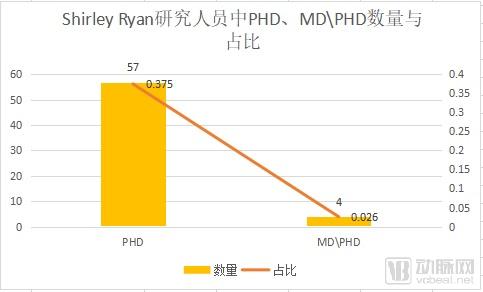
Data source: Shirley Ryan official website; data compiled by VCBeat.
Among the researchers announced by Shirley Ryan AbilityLab, four hold dual MD/PhD degrees. They serve as Director of Neuroscience Research Planning and Engineering, Emeritus Director of the Biomedical Center and Professor of Surgery, and Director of the Brain Stimulation Center, Research Scientist, and Associate Professor, respectively.
They have all made significant contributions in their respective fields, such as Todd Kuiken, Honorary Director of the Center for Bionic Medicine and Professor of Surgery. Dr. Todd Kuiken has dedicated his 30-year career to the treatment and research of amputation. He developed the innovative surgical technique of targeted muscle reinnervation to improve control of powered arm prostheses and reduce neuroma pain. He leads the largest prosthetics and orthotics research laboratory in the United States—the Center for Bionic Medicine (CBM)—which employs more than 60 staff members and is an internationally recognized leader. Dr. Kuiken is also committed to education, having mentored numerous graduate students and postdoctoral fellows.
Biomedical Engineering and Mechanical Engineering Become the Most Popular Majors
To gain an in-depth understanding of the team composition at Shirley Ryan AbilityLab and provide a case study for Chinese rehabilitation research institutions, VCBeat analyzed the professional backgrounds of the hospital’s staff. The analysis covered 23 undergraduate majors, 28 master’s majors, and 14 doctoral majors. The details are as follows:
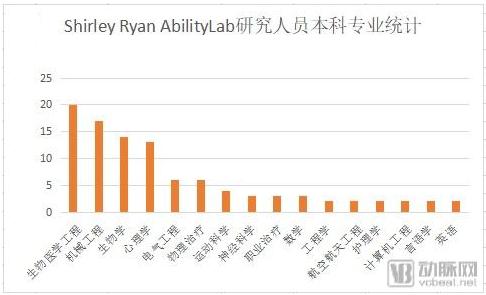
Statistics on Undergraduate Majors of Researchers at Shirley Ryan AbilityLab
Note: Biology, biomechanics, biochemistry, physiology, and bioengineering are collectively referred to as biological sciences. There was only one graduate each in chemical engineering, health and fitness, history, logic, jurisprudence, hospital management, vocal performance, and music-related undergraduate programs; these individuals are not included in the table.
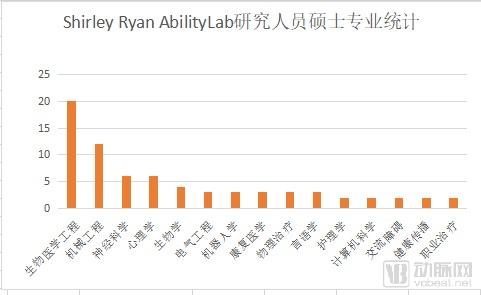
Statistics on Master’s Degree Majors of Researchers at Shirley Ryan AbilityLab
Note: Biology, biomechanics, biochemistry, physiology, and bioengineering are collectively referred to as biology. Materials science, dynamics, engineering, business administration, aerospace engineering, orthopedic and restorative sciences, epidemiology, cognitive science, prosthodontics, medical physics, medical informatics, criminal justice, music, and composition and performance each had only one representative and are therefore not included in the table.
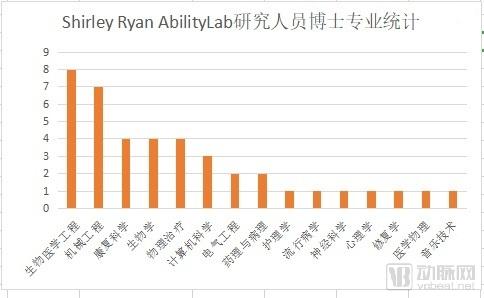
Statistics on the Doctoral Specializations of Researchers at Shirley Ryan AbilityLab
Note: Biology, biomechanics, biochemistry, physiology, and bioengineering are collectively referred to as biology.
As clearly shown in the three figures above, Shirley Ryan strongly favors candidates with backgrounds in biomedical engineering and mechanical engineering. Furthermore, the professional distribution among Shirley Ryan employees is highly diverse, encompassing 29 undergraduate majors, 23 master’s specialties, and 19 doctoral disciplines.
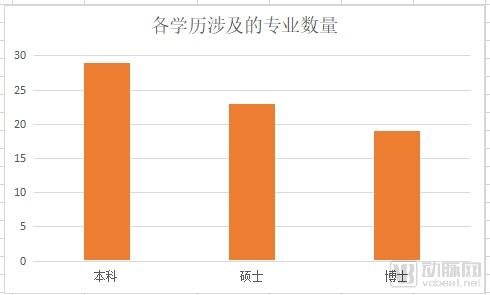
The broad scope of expertise among Shirley Ryan AbilityLab staff is primarily attributable to the institution’s extensive clinical coverage and diverse laboratory infrastructure. According to data from the Shirley Ryan AbilityLab website, the facility comprises five major laboratory categories encompassing 22 specialized sub-laboratories, including the Hand and Arm Laboratory, Lower Extremity Laboratory, Strength and Endurance Laboratory, Speech and Cognition Laboratory, and Pediatric Laboratory. Meanwhile, more than 340 research studies are being conducted concurrently.
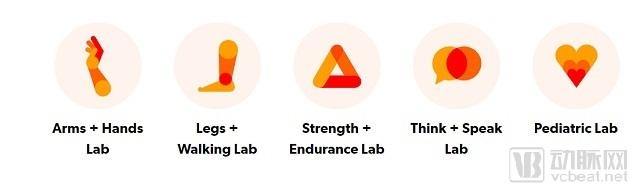
5 Major Laboratory Categories
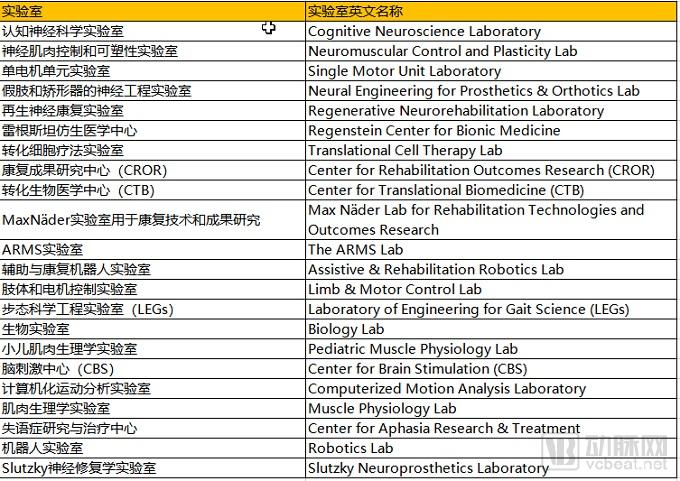
22 Specialized Laboratories
The research and services cover 17 major disease categories, including aphasia, brain injury, pediatric rehabilitation, stroke rehabilitation, cancer rehabilitation, and more.

Source: Shirley Ryan Official Website
Onboarding Dates Are Widely Dispersed

When VCBeat compiled data on the year researchers obtained their master’s degrees, it uncovered an intriguing pattern. There was no clustering of hire dates among the hospital’s researchers; instead, their master’s graduation years spanned nearly every year since 1980. Although certain years—such as 2009, 2010, and 2016—had slightly higher numbers, about half of those individuals went on to pursue doctoral degrees, thereby delaying their entry into the workforce by several years. After accounting for this factor, the analysis revealed that the hospital has been hiring new employees every year, albeit in small numbers of approximately three per year.
This approach not only ensures a steady influx of new researchers but also guarantees the high caliber of incoming staff. Shirley Ryan AbilityLab has ranked No. 1 in rehabilitation in the United States for 27 consecutive years, a achievement closely tied to its consistent recruitment of high-quality talent.
Biomedical Engineering and Mechanical Engineering Are in High Demand
As mentioned above, researchers at Shirley Ryan come most frequently from backgrounds in biomedical engineering and mechanical engineering. The high demand for these two disciplines in rehabilitation hospitals is closely tied to their areas of expertise.
Biomedical engineering majors possess the foundational qualifications to work in the rehabilitation industry.
Biomedical Engineering is an interdisciplinary field closely related to bioengineering. Its primary characteristic lies in applying knowledge and technologies from engineering and applied sciences to address scientific challenges in biology and medicine, conducting comprehensive research on living systems and their behaviors, and developing associated biomedical systems and devices.
Biomedical engineers often collaborate with physicians, therapists, and academic researchers to address clinical challenges. Application examples associated with this profession include biocompatible prostheses, medical devices, diagnostic equipment, implantable devices, physical therapy equipment, and wearable devices.
In terms of curriculum design, the Biomedical Engineering program can branch into multiple fields. According to Tsinghua University’s Biomedical Engineering training scheme, in addition to foundational courses in mathematics, physics, and chemistry, students are required to study modern biology, analog circuits, digital circuits, biomedical electronics, and informatics. Specialized tracks include Neuroengineering, Medical Imaging, and Micro/Nano Medicine and Tissue Engineering.

Selected Courses in the Biomedical Engineering Curriculum at Tsinghua University
From the perspective of curriculum design, students majoring in Biomedical Engineering possess both a medical background and expertise in computer science and electronic engineering. This makes them well-suited for research in physical medicine and, by extension, rehabilitation-related fields, such as the development of rehabilitation robots and assistive devices. As shown in the table below, researchers with a background in Biomedical Engineering primarily work as biomedical engineers, with the majority of their work focused on rehabilitation-related research.

Positions Held by Researchers in the Biomedical Engineering Program at Shirley Ryan AbilityLab
Coincidentally, the author is also a graduate in Biomedical Engineering. During university, I participated in the National College Student Biomedical Electronic Innovation Design Competition with my classmates, where our team developed a wrist-worn blood pressure monitor with a pedometer function. It was during my student years that I identified medical device research as my future career direction.
However, the extensive curriculum makes it difficult to achieve mastery at the undergraduate level. Three-quarters of the 24 students in our class did not pursue graduate studies. Among those who entered the workforce directly after obtaining their bachelor’s degrees, none—except for the author—engaged in healthcare-related roles. The author works merely as a medical editor and is not involved in research. Instead, some classmates have pursued careers in software programming and hardware design.
Regarding compensation and benefits, the U.S. Bureau of Labor Statistics (BLS) states that most biomedical engineering positions require at least a bachelor’s degree in biomedical engineering. Many employers require national certification for professional engineers. A master’s degree is typically required for promotion to managerial roles, and continuous education and training are necessary to keep pace with advancements in technology, testing and monitoring equipment, computer hardware and software, as well as changes in government regulations.
Like many engineering disciplines, biomedical engineers also command high salaries.

Annual Salary of Biomedical Engineers in the United States
Experienced engineers with advanced degrees can earn higher incomes when promoted to management positions. According to data from the U.S. Department of Labor, the top 10% of biomedical engineers earn an annual income of $134,620.
The mechanical engineering curriculum also includes many courses, such as: Mechanical Engineering Drawing, Applications of Electrical and Electronic Technology, Automatic Detection of Electromechanical Equipment, Mechanical Structure Analysis, Application and Maintenance of Hydraulic Systems, Mechanical Manufacturing Technology, Operation and Maintenance of CNC Equipment, Installation and Commissioning of Mechanical Systems, Electrical Control and Repair of Equipment, Modern Equipment Management, and Fault Diagnosis and Maintenance of Electromechanical Equipment.
Most researchers at the Shirley Ryan AbilityLab have academic backgrounds in rehabilitation-related fields, such as rehabilitation engineering within mechanical engineering and applied mechanics.
Collaborating Closely with Northwestern University
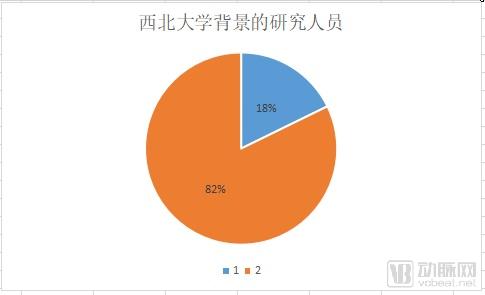
Among the 152 researchers whose information was collected, 27 were affiliated with Northwestern University, accounting for 18%.
Additionally, the Shirley Ryan AbilityLab is located within Northwestern University’s medical campus and serves as the clinical training center for the Feinberg School of Medicine. All fourth-year students at the Feinberg School of Medicine are required to complete a two-week rotation at Shirley Ryan. At the Shirley Ryan AbilityLab, residents can rotate through all inpatient units, including departments specializing in brain injury, spinal cord injury, pediatrics, and oncology. Furthermore, residents will participate in outpatient rotations, ensuring balanced clinical experience and exposure to a diverse range of patients requiring physical therapy services, such as those in sports medicine, pain management, and amputee care.
Northwestern University’s Feinberg School of Medicine ranks among the top 20 medical schools in the United States. It enjoys high national recognition due to its powerful affiliate, Northwestern Memorial Hospital (ranked 6th among U.S. hospitals in 2014), and annual research funding exceeding $350 million ($389.8 million in 2014). It is precisely this strong synergy that has helped Shirley Ryan AbilityLab rapidly attract top-tier talent.
Reflections and Insights
Strengthen Career Guidance for Students in Rehabilitation-Related Majors
Based on the collected data, we have learned that the professional backgrounds involved in rehabilitation research are diverse. In addition to biomedical engineering and mechanical engineering, which are the most prevalent, fields such as music, psychology, and mathematics also play a role. Previously, during my own undergraduate studies, I was unaware that my major in biomedical engineering could lead to a career in rehabilitation research, let alone imagine that individuals with backgrounds in music, psychology, or mechanical engineering would become talents in this field. Therefore, universities should provide education on employment prospects and research directions, enabling students to understand their future options and make informed choices.
Large-Scale Rehabilitation Hospitals Cover a Broader Range of Rehabilitation-Related Research Topics
Shirley Ryan AbilityLab conducts more than 300 research projects, covering not only conventional disease rehabilitation but also diverse areas such as speech-language therapy and psychological support. In China, rehabilitation services were only included in the national medical insurance scheme in 2010, with the number of covered items increasing to just 29 by 2016. Many rehabilitation-related studies in China still lag behind their international counterparts. Therefore, while focusing on conventional rehabilitation, we must also encompass specialized rehabilitation programs.
Strengthen Collaboration with Universities
In 2018, the news that China established the China University of Rehabilitation Sciences and settled it in Qingdao was frequently discussed by industry insiders. Discipline construction is inextricably linked to talent development. If rehabilitation institutions, especially large-scale rehabilitation hospitals, wish to maintain advanced rehabilitation technologies on a sustained basis, they must continuously attract top talent. Collaboration with universities can yield twice the results with half the effort.