

Comper Files IPO Prospectus: Building a Family-Centric Digital Health Ecosystem Through Smart Devices and Data
The cycle of consolidation and fragmentation is a fundamental pattern in business evolution, and the healthcare sector is no exception. In recent years, as modern healthcare has advanced, care delivery has begun to shift from centralized medical institutions toward decentralized household units. The market for personalized home-based health and medical services has emerged as a new blue ocean for commercial investment.
The Tale of Striking Gold in Blue Oceans Remains Ever Alluring. How to Build a Product Line? How to Collect and Track Users’ Health Data? How to Balance User Experience with Corporate Profitability? VCBeat Conducted an Exclusive Interview with Du Han, CEO of Comper, a Silicon Valley Entrepreneur.

Du Han, founder of Comper (photo provided by the interviewee)
Comper (Kangbo) is a technology company providing precise home healthcare services, founded in 2014 and initially established in Silicon Valley, USA. The company is dedicated to the research and development of artificial intelligence applications and devices in healthcare scenarios. By developing and promoting a series of smart products, it enables people to easily and comprehensively monitor their health data from the comfort of their homes.
In January this year, at the Consumer Electronics Show (CES) held in Las Vegas, USA, Comper showcased its self-developed series of smart home products, including beauty devices, fetal heart rate monitors, preconception care devices, smart scales, and forehead thermometers. All of these products can be connected to the Comper Health app via Bluetooth.
All of Comper’s products have obtained U.S. FDA certification, with its smart fetal heart monitor and smart preconception care device also certified by China’s CFDA and the European Union’s CE.
Health Tracking: From Treatment to Prevention
The Smart Fertility Tracker is Comper’s first independently developed product. A previous negative experience with fertility planning led Du Han to identify a gap in China’s fertility market, prompting her to take the first step in launching her startup.
Differences Reveal Business Opportunities. The disparities in health management mindsets between Chinese and American women enabled Du Han, who had previously lived in the United States, to clarify her entrepreneurial direction.
Through personal observation, Du Han has found that the health-oriented mindset was adopted earlier in the United States, with prevention-focused concepts deeply ingrained in public consciousness. In contrast, China remains in a market education phase, transitioning from a disease-oriented mindset to a health-oriented one. Taking preconception care as an example, the U.S. market for preconception products is relatively mature. Nearly all American women preparing to welcome new life clearly know their ovulation dates and whether their ovulation is normal, and they effectively leverage their ovulation cycles for preconception planning. However, among Chinese women, such awareness remains relatively weak; “letting nature take its course” and seeking examinations at medical institutions remain the mainstream choices for most Chinese women trying to conceive.
There are two primary reasons for this phenomenon: first, differences in health management mindsets, with China having a shorter history of promoting preventive care compared to the United States; second, a gap in market offerings.
“China has also been advocating a shift from a disease-oriented mindset to a health-oriented one. Health monitoring is a key component of this health-focused approach, and the most effective way to monitor health is to integrate it into people’s daily lives,” said Du Han. He noted that, driven by efforts from relevant authorities, public health awareness has begun to change. However, there remains a relative lack of products in the market, and Comper aims to fill this gap.
From Du Han’s perspective, the domestic population with demand for family health services can be primarily categorized into three groups: mothers and infants, middle-aged and elderly individuals, and those who have high requirements for personal health management. After comprehensive market analysis, Du Han formulated a development strategy for Comper: focusing on maternal and infant products in the first three years, shifting attention to women’s health in the second three-year period, and providing family health management services in the third three-year phase. She stated that Comper is currently in its second three-year phase, with product R&D transitioning from the maternal and infant sector to the field of women’s health. The newly launched smart beauty device marks their first step into this domain.
Business Logic: The Combined Power of Product and Data
All of Comper’s smart hardware products can be connected via Bluetooth to their companion apps, which leverage algorithms and medical data models to continuously record users’ health status, collect relevant data, and recommend personalized health management plans.
APP monetization channels generally fall into three categories: advertising, e-commerce, and hardware. Comper has opted for the third—hardware sales. When asked whether it had considered expanding profitability through community building or advertising, Du Han stated outright that such options had never been under consideration.
“Our profitability is generated at the hardware sales stage, so whether in product design or app experience, we prioritize user experience above all. Engaging in community building or selling advertisements would deviate from our original intent,” said Du Han. This is why Comper’s products have been rapidly embraced by the market. Notably, within just one year of its launch, Comper’s smart fetal heart rate monitor topped the “fetal heart rate monitor” category on JD.com.
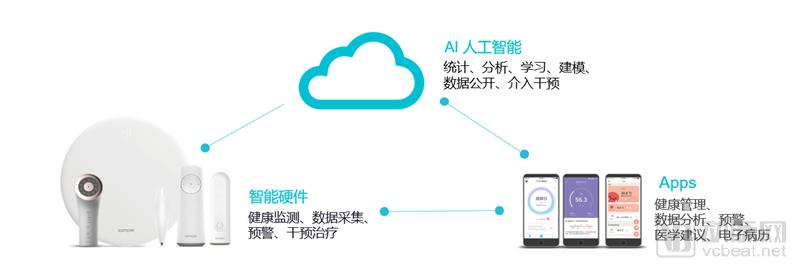
Comper Business Model (Image provided by the interviewee)
Regarding the extension of future business models, Du Han proposed a combined profit strategy of “products + data.” Du Han told VCBeat that Comper is still a very young company, having just entered its second three-year phase, and will continue to focus primarily on product R&D and sales in the early stages. In the future, Comper will add “data value-added services” as another engine, continuously innovating to enrich its hardware offerings and integrating data services to provide people with comprehensive digital health management solutions.
Du Han cited an example, stating that once user data has been accumulated, Comper can share it with healthcare institutions and insurance companies. When users exhibit high-risk data trends, insurers can issue early warnings to encourage them to undergo relevant medical check-ups at an earlier stage, thereby reducing the cost of insurance claims for treatment.
Currently, Comper’s products are primarily targeted at two major healthcare markets: China and the Euro-American region. VCBeat has learned that this year, Comper will launch two iterative products and two new offerings.