

Berry Genomics Leads National Science and Technology Major Project on Early-Stage Liver Cancer Detection, Aims for Clinical Translation by 2020
On March 1, more than 30 of the most influential hospitals, research institutes, universities, and enterprises in the field of oncology treatment in China gathered at the National Center for Liver Cancer Science to hold the kickoff meeting for the National Science and Technology Major Project titled “Research and Development of Warning and Early Diagnosis Kits and Related Equipment for Hepatitis Virus-Associated Liver Cancer Populations.” Among the first batch of 54 major projects under the National Science and Technology Major Project for the Prevention and Control of Major Infectious Diseases announced in 2018, this project is the only one focused on early cancer diagnosis. Led by Berry Genomics as the responsible entity, the project is jointly implemented with 29 other institutions, including the Eastern Hepatobiliary Surgery Hospital of Naval Medical University, Nanfang Hospital of Southern Medical University, and Xiangya Hospital of Central South University.
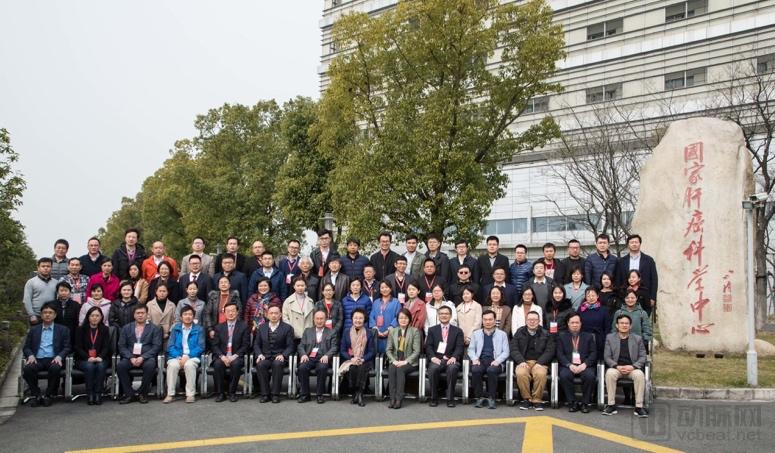
(Group Photo of Collaborating Units and Experts from the Major Special Project)
Building on the preliminary research conducted during the 11th and 12th Five-Year Plan special projects, this project will continue to focus on viral hepatitis, liver cirrhosis, and primary liver cancer. Targeting molecular markers already identified as diagnostic indicators for the progression from chronic hepatitis to liver cancer, the project will leverage core technologies with independent intellectual property rights to develop novel warning and diagnostic kits, as well as point-of-care testing (POCT) devices for early diagnosis. This effort aims to further refine comprehensive solutions for the diagnosis and treatment of liver diseases, filling gaps in this field. Concurrently, the project will facilitate the industrial translation of research findings. Through multi-center, large-sample clinical trials, it will evaluate and validate practical application efficacy, apply for registration certificates from the National Medical Products Administration (NMPA), and promote the clinical adoption of certified kits. These initiatives will jointly enhance and accelerate industrialization in the areas of early warning, diagnosis, treatment, and prognosis of liver diseases, thereby improving the level of early diagnosis of liver cancer, optimizing treatment outcomes and prognosis, extending patient survival, and reducing mortality rates. The expected outcomes will comprehensively advance the research landscape for the prevention, diagnosis, and treatment of liver cancer, provide significant scientific and technological support for achieving the overall objectives of this special project in the field of hepatitis, and further strengthen China’s overall capabilities in the rapid diagnosis of major infectious diseases. The project commenced in 2018 and is scheduled for full completion by the end of 2020.
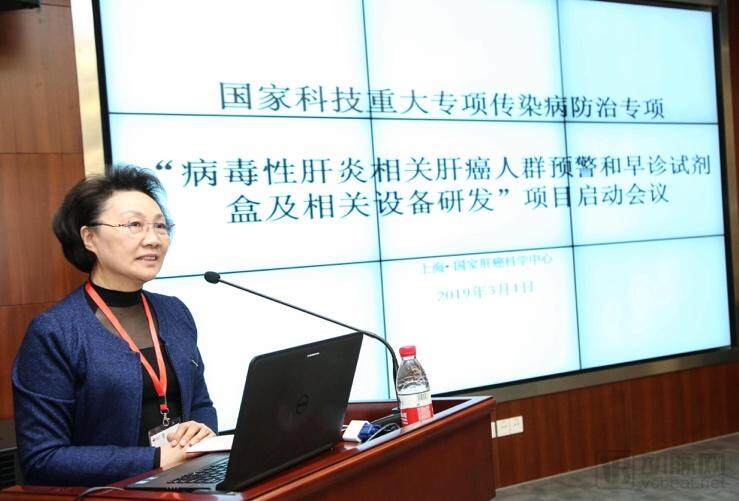
(Speech by Academician Wang Hongyang)
The expert advisory panel includes Academician Wang Hongyang, Director of the National Center for Liver Cancer Science and affiliated with the Eastern Hepatobiliary Surgery Hospital of Naval Medical University; Professor Hou Jinlin from Nanfang Hospital of Southern Medical University; Professor Xia Ningshao from Xiamen University; Professor Yuan Zhenghong from Fudan University; and Researcher Wang Junzhi from the National Institutes for Food and Drug Control.
On February 11, Premier Li Keqiang specifically pointed out at the State Council’s executive meeting that it is essential to accelerate the improvement of the cancer diagnosis and treatment system, adhere to a prevention-first approach, promote cancer screening and early diagnosis and treatment, and strive to reduce mortality rates. Efforts should be strengthened in key scientific and technological research, with support for clinical research and application of new technologies in tumor diagnosis and treatment. Over the years, the government has proactively deployed national-level initiatives for tumor monitoring and screening, investing substantial resources. Significant progress has been made in related fields, yielding a series of innovative discoveries and important achievements.
“This special project places particular emphasis on the parallel advancement of scientific research, technological development, and industrial coordination. This is a significant measure by the government to effectively improve the health of the entire population, and it also constitutes the primary objective of the project,” stated Academician Wang Hongyang. “As you can see, nearly all leading experts and teams in this field have participated. Moreover, a number of industry-leading enterprises, such as Berry Genomics, have served as lead or participating units. This will undoubtedly greatly facilitate the seamless integration of research with the market, accelerate the clinical adoption of research achievements, and enable these advancements to benefit the general public at an earlier stage.”
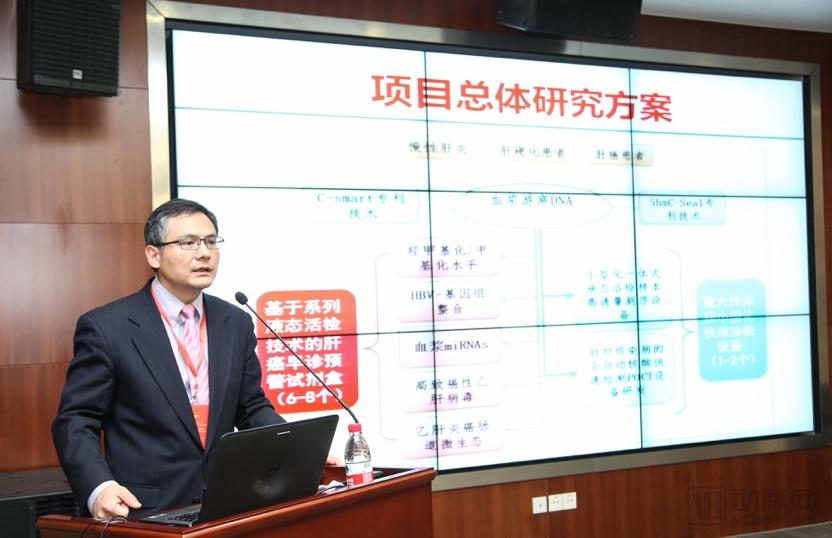
(Dr. Yu Fuli, Principal Investigator of this Major Special Project and Chief Information Officer of Berry Genomics)
National Major Science and Technology Projects cover strategic industries such as information technology and biotechnology, as well as critical and urgent issues related to energy, the environment, and public health. These projects aim to leverage the advantages of the new whole-nation system to achieve leapfrog development in key areas, serving as a crucial instrument for implementing the innovation-driven development strategy. Well-known achievements representative of these projects include the development of the C919 large passenger aircraft, the manned spaceflight and lunar exploration programs, and the BeiDou Navigation Satellite System.
Supported by the National Science and Technology Major Project, and with the participation of national-level expert teams in relevant fields in China as well as industry leaders such as Berry Genomics, the research group is poised to develop new products and methods that can effectively enhance the prevention, diagnosis, and treatment of liver cancer for high-risk populations, including patients with chronic hepatitis B and those with liver fibrosis or cirrhosis. This effort will provide a scientific basis for liver cancer prevention and control, ultimately laying a solid foundation for reducing the incidence and mortality rates of liver cancer.
Technological and Talent Advantages, Leading Position in Early Cancer Screening
According to data from the Chinese Center for Disease Control and Prevention, there are approximately 86 million hepatitis B virus carriers in China, a population that is highly susceptible to liver cancer. Therefore, shifting the focus of prevention and control upstream, with early prediction, diagnosis, and intervention for high-risk groups, constitutes a critical strategy for cancer prevention and control.
From a corporate perspective, products that truly meet market demand often possess substantial market potential. According to a research report by Southwest Securities, the market size for early diagnosis of liver cancer in China could reach as high as RMB 200 billion, excluding considerations of market penetration rates.
As a leading enterprise in China’s genetic testing industry, Berry Genomics has strategically focused on early screening and diagnosis of tumors, maintaining a comprehensive lead in detection technologies. Leveraging its proprietary patented technologies, including cSMART and cSMART 2.0, Berry Genomics can label, circularize, amplify, and perform high-throughput sequencing on cell-free DNA fragments in peripheral blood. This enables qualitative analysis and absolute quantification of single molecules in mutated regions, achieving an accuracy rate exceeding 99% and a sensitivity as high as 3 in 10,000. Building on this foundation, Berry Genomics aims to promptly realize a series of objectives, including early tumor diagnosis, personalized medication, and prognosis monitoring.
At the 2018 CSCO Annual Conference, Berry Genomics’ subsidiary, Geneseeq Technology (HeRui Gene), announced the pilot study results of the PreCar project—a large-scale early screening initiative for liver cancer involving a cohort of 10,000 individuals, jointly led by the National Center for Liver Cancer Science, Shanghai Eastern Hepatobiliary Surgery Hospital, and Guangzhou Nanfang Hospital. The data demonstrated that, with a specificity of 95%, the sensitivity for liver cancer detection exceeded 90%. This performance represents a globally leading standard.
Being appointed as the lead entity for the National Major Project on Early Diagnosis of Liver Cancer further underscores Berry Genomics' talent advantages and first-mover advantage in the field of oncology.
Dr. Zhou Daixing, the Company’s CEO and founder, is one of the international pioneers in the development of high-throughput sequencing instruments and non-invasive prenatal testing (NIPT) technologies, as well as among the first to promote the clinical application of high-throughput genetic testing. Dr. Yu Fuli, the Company’s Chief Information Officer and principal investigator for this major special project, has earned global recognition from peers for his achievements in bioinformatics and genomics. He has previously led major international collaborative initiatives, including the HapMap Project, the 1000 Genomes Project, the CHARGE Consortium, and The Cancer Genome Atlas (TCGA). With his extensive R&D experience and proven ability to manage and organize large-scale projects, Dr. Yu Fuli is the unequivocal choice to serve as the principal investigator for this major special project.
Continuous Investment: Molecular Tumor Diagnostics as a Strategic Development Focus
Gene testing products and services in the field of genetics are Berry Genomics' core business. Leveraging the technological and channel advantages of its NIPT (Non-Invasive Prenatal Testing) and NIPT Plus products, the company has rapidly emerged as a domestic leader in this sector.
The 2018 semi-annual report showed that the company achieved an operating revenue of RMB 645 million, a year-on-year increase of over 23%, with clinical genetic testing services and reagent sales contributing 87% of the total. “NIPT services are Berry Genomics’ core product at this stage. Currently, around 2,000 hospitals across China are using these products and services, including nearly 200 key hospitals,” said Dr. Zhou Daixing. “The market penetration rate of NIPT is less than 25%, leaving substantial room for future growth.”
Meanwhile, to accelerate research and industrialization in the oncology field, particularly to promote advancements in early cancer diagnosis, Berry Genomics’ Oncology Division completed an independent financing round totaling RMB 800 million in 2017. On this basis, He Rui Genetics was established as the successor to Berry Genomics’ oncology business. The aforementioned PreCar project is a prospective cohort study led by He Rui Genetics, leveraging high-throughput genomic sequencing and other technologies to screen, identify, and apply ultra-early warning biomarkers for hepatocellular carcinoma (HCC) in peripheral blood among more than 10,000 individuals at high risk for HCC.
In 2015, J.P. Morgan and Goldman Sachs predicted that the global market potential for liquid biopsy would reach $23 billion within the next five years. According to statistics from the National Cancer Registry Center, there were 4.292 million new cancer cases in China in 2015. Given that the middle-aged and elderly population aged 45 and above in China is approximately 500 million, and assuming a penetration rate of 10%, the market potential for early screening and diagnosis of tumors is enormous.
As Berry Genomics’ oncology business platform, HeRui Gene plans to sequentially launch several research projects focused on early screening and diagnosis of malignant tumors, setting new industry standards and further helping to establish China’s international leadership in the early diagnosis and treatment of cancer. Proactively positioning itself in the trillion-yuan market for early cancer diagnosis is one of Berry Genomics’ development strategies.
With the rapid development of the genomics industry, Berry Genomics is poised for future growth.
In its 2018 semi-annual report, Berry Genomics stated that the company would “continue to deploy across the entire genetic testing industry chain, focusing on the two fastest-growing market segments—medical genetics testing and clinical oncology genetic testing—with clinical medical applications as the main thread, gradually extending into the broader health and wellness sector.”
The company’s future goal is to achieve full controllability of genetic diseases, with gene testing as the primary approach for cancer prevention and control, gradually realizing early diagnosis of cancer and comprehensive monitoring throughout the entire course of cancer treatment. Relevant data show that in the first three quarters of 2018, Berry Genomics’ R&D expenses increased by 111.68% year-on-year. The large-scale and sustained investment in research and development has further consolidated Berry Genomics’ industry advantages.
As recently as February 19, Berry Genomics announced the core management team for its consumer-grade genetic testing platform, Yuan Gene. Yan Jun, former executive at Google China, and Wang Ziyan, a senior expert in China’s consumer genetic testing sector, have officially joined the company.
Tianfeng Securities believes that “the company’s multiple significant investments have solidified the foundation for its development, gradually expanded its product portfolio, safeguarded its sustained growth, and provided essential support for achieving its future development goals.”
Berry Genomics’ investment and focus in the field of genetic testing have already yielded substantial returns. On January 29, Berry Genomics released its 2018 earnings forecast, projecting a net profit of RMB 320–340 million for the full year 2018, representing a year-on-year increase of 30.91%–39.09%. Since the release of this 2018 earnings forecast, the company’s stock price has cumulatively risen by 38%.