

Ericsson Report: The Pivotal Role of 5G in Healthcare Transformation
Recently, Ericsson ConsumerLab released the report “The Shift of Healthcare to Home Care,” which conducted an online survey of 4,500 advanced smartphone/mobile broadband users aged 18–69.
Respondents were from Germany, Japan, South Korea, the United Kingdom, and the United States. Participants generally used fitness trackers, smartwatches, and health applications to monitor their health status. Meanwhile, the report also included an online survey of 900 decision-makers across six industries in the aforementioned countries, encompassing healthcare companies, insurance providers, medical technology firms, telecommunications operators, application developers/integrators, and government regulatory agencies.
The report posits that next-generation networks (5G) will play a pivotal role in healthcare transformation by enabling efficient data transmission within an ecosystem of collaborative feedback, alerts, mobility, and low-latency connectivity. As an enabling tool, 5G will drive the success of a range of applications, including remote monitoring via medical-grade wearable devices, virtual patient-provider interactions, and telesurgery using robotic systems. VCBeat (WeChat ID: vcbeat) will share the key highlights of this report with readers from the following three perspectives:
The prevalence of wearable devices and remote monitoring, coupled with 5G technology, is accelerating the transition from hospital-based care to home-based care models;
Patient data is becoming increasingly centralized, and 5G will address the challenge of securely accessing online central repositories;
5G has become a prerequisite for non-traditional enterprises to enter the healthcare industry.
Wearable Devices and Remote Monitoring Gain Traction, 5G Accelerates the Shift from Hospital-Based to Home Care Models
Where Have All the Doctors Gone? What Will Become of Multi-Story Hospital Buildings? These are questions we may soon face. Consumers are demanding greater control over when, where, how, and by whom their healthcare is delivered—a trend that will become even more pronounced with the advancement of 5G technology and the widespread adoption of smartphone applications and social media.
Growing consumer demand for monitoring is further increasing: using wearable devices to monitor health and medication adherence remotely, with a strong interest in online consultations and receiving telemedicine services at nearby hospitals (such as robotic surgery). Consumers aim to maintain their health through preventive measures, including regular health check-ups, daily exercise, and a healthy diet. Over 60% of respondents are willing to use wearable devices as a preventive tool to detect abnormalities and manage chronic conditions such as heart disease, cancer, and diabetes, believing that wearables will contribute to healthier lifestyles and personalized care.
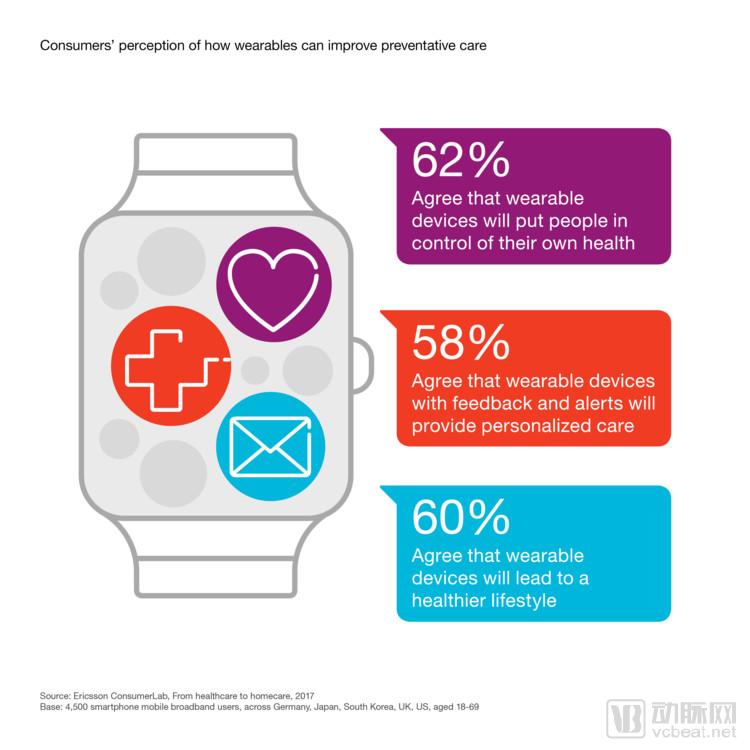
Consumer Perception of Wearable Devices in Improving Preventive Care (Screenshot from the Report “Healthcare’s Shift to Home-Based Care”)
Robotic surgery is no longer unfamiliar to the public; however, such procedures currently require surgeons to stand beside the robotic system rather than operate it remotely. Nearly half (48%) of consumers consider remote robotic surgery acceptable, yet 61% perceive it as risky due to its heavy reliance on internet connectivity. These procedures are conducted using haptic feedback and high-definition video streaming, necessitating low-latency, high-throughput communication.
Advancements in healthcare standards have helped extend life expectancy, but they have also led to a rise in elderly patients requiring intensive care, placing greater strain on medical systems. The resulting resource shortages are driving the healthcare industry to increasingly rely on 5G, automation, telemedicine, and artificial intelligence (AI).
By 2050, the global population aged 60 and above is projected to reach 2 billion, with those aged 80 and older accounting for 21%, making elder care a significant challenge. For instance, over the past decade, the number of established nursing homes in the United States has declined by 9% due to rising costs and resource shortages. Meanwhile, more than 70% of respondents expressed concern that elderly patients are left unsupervised—facing risks such as slips and falls at home and non-adherence to prescribed medication regimens. Wearable devices and remote monitoring have provided tangible benefits to seniors and their families; approximately 48% of people hope that home sensors can monitor the health status of the elderly and summon an ambulance when necessary.
In remote health monitoring, wearable devices (such as cardiac monitors and glucose monitors) require high-frequency updates to central data repositories at low data rates. Conventional networks fail to provide the necessary technical support when connecting a large number of such devices, whereas 5G can address this challenge. By better supporting continuous monitoring and sensory processing devices, 5G enables sustained patient monitoring and accelerates the transition of hospitals toward home-based care models.
In terms of battery life, 42% of cross-industry decision-makers hope that 5G will enable devices to consume less power, which is key to remote monitoring. Currently, consumer-grade wearable devices are widely used as a preventive measure, but at the same time, they are considered insufficient for accurate or reliable diagnosis. Additionally, due to liability concerns, patients' smartphones cannot be relied upon for connectivity. For them, wearable devices need high-frequency updates from a central repository, but with low data rates. 5G connectivity is not limited to wearable devices; it also allows patients to carry medical-grade 5G routers and then use Bluetooth to connect various wearable devices.
Patient Data Is Becoming Increasingly Centralized; 5G Will Resolve the Challenge of Secure Access to Online Central Repositories
The shift of medical care from hospitals to homes will feed back more detailed patient information to hospitals. The widespread adoption of wearable devices, sensors, and other connected devices will generate vast amounts of diagnostic data, which need to be integrated with electronic health records (EHRs) created by clinicians and stored in a secure central location.
To facilitate the transformation of patient-facing applications, healthcare practitioners need to centralize patient data storage, transforming hospitals into data centers and physicians into data scientists. By accessing medical records in the central repository online, patients can easily enhance the quality and efficiency of their care. Artificial intelligence systems can provide physicians and researchers with clinically relevant, real-time information from centralized data repositories.
44% of cross-industry decision-makers believe that insights derived from the analysis of such complex data will accelerate diagnosis. Accessing patients’ health records during routine consultations can improve diagnostic accuracy and reduce medical errors in emergency situations. Although doctors and patients do not have face-to-face contact, data bridges the gap between them.
More than 40% of cross-industry decision-makers stated that fragmented patient data is a serious issue in the current healthcare system. Forty-five percent believed that enabling physicians to access centralized patient data online would have a positive impact on healthcare services, representing a breakthrough in healthcare delivery. Meanwhile, 47% of telecommunications decision-makers considered secure access to be a challenge.
Patients also support this data-centric development. Sixty percent of consumers are willing to share their data with healthcare providers and store it in a centralized repository, as this will improve the healthcare services they receive, facilitate chronic disease monitoring, enhance diagnostic quality, and reduce waiting times. However, 61% of patients with chronic conditions express concern about the unauthorized use of their monitoring data. Approximately 46% of cross-industry decision-makers indicate that data security is a challenge facing online and remote medical services.
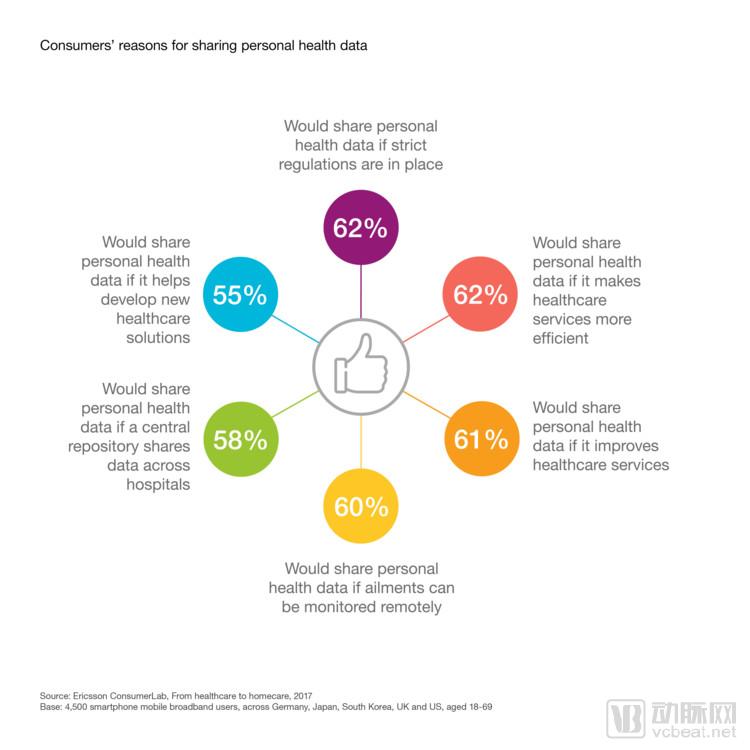
Analysis of Reasons Why Consumers Share Health Data (Screenshot from the Report “The Shift of Healthcare to Home Care”)
Although centralized repositories can help physicians make informed clinical decisions and provide remote care when needed, any sudden disruption (such as connection failures) may cause patients to feel insecure. For instance, human error recently caused a sudden outage of Amazon Web Services (AWS), forcing the suspension of many web services. Such disruptions in healthcare systems could have fatal consequences, which means that as healthcare services move closer to patients and data is increasingly transferred to centralized repositories, high-availability networks and data centers will become critical.
5G networks are sufficiently secure to comply with regulations governing sensitive patient data. Furthermore, 5G is expected to significantly enhance connectivity performance. For instance, 35% of cross-industry decision-makers expect 5G to provide reliable connections with latency below 1 millisecond, enabling haptic feedback that improves surgeons’ ability to perform remote robotic surgeries. Due to the constraints of physical laws, delivering low-latency connectivity over long distances remains a challenge. Although fiber optics can offer low-latency connections, experts indicate that 5G is preferable for reasons of accessibility and usability.
5G Becomes a Prerequisite for Non-Traditional Enterprises to Enter the Healthcare Industry
Shifting consumer expectations, ubiquitous access to patient data, and rising internet usage have all paved the way for non-traditional players to enter the healthcare industry. Medical technology manufacturers, integrators, and application developers have already introduced services that shift healthcare delivery out of hospitals. For instance, devices from Israel’s TytoCare and Las Vegas-based Medwand Solutions enable physicians to remotely examine patients in their homes.
Non-medical sector players, including app development companies and telecommunications firms, have already captured 13% and 9% of their respective total revenues from the healthcare sector. Cross-industry experts predict that these figures will reach 19% and 13%, respectively, by 2020. Furthermore, over the past seven years, venture capital investment in digital health has risen from $1.5 billion to approximately $7 billion.
More sophisticated devices and applications are under development. For instance, Swansea University in the UK is planning to pilot smart 3D-printed bandages. This wearable medical product, equipped with 5G wireless data connectivity and nanoscale sensors, aims to transmit specific health information, thereby assisting physicians in formulating personalized treatment plans based on wound healing progress.
Whether as 5G network providers or as enablers and creators of services, telecommunications operators play an indispensable role in the healthcare transformation. Eighty-six percent of cross-industry decision-makers believe that telecom operators should not merely provide connectivity services but also assume greater responsibility by offering system integration and development support for applications and services.
Ericsson predicts that by 2026, telecom operators driving the 5G healthcare transformation will generate $76 billion in revenue. To achieve a successful transformation, collaboration among various stakeholders is essential. Cross-industry decision-makers identify internet companies (such as Apple, Google, Microsoft, and IBM), telecom operators, and application developers as the top three preferred partners in the healthcare sector. Moreover, healthcare leaders prioritize telecom operators above application developers and internet companies.
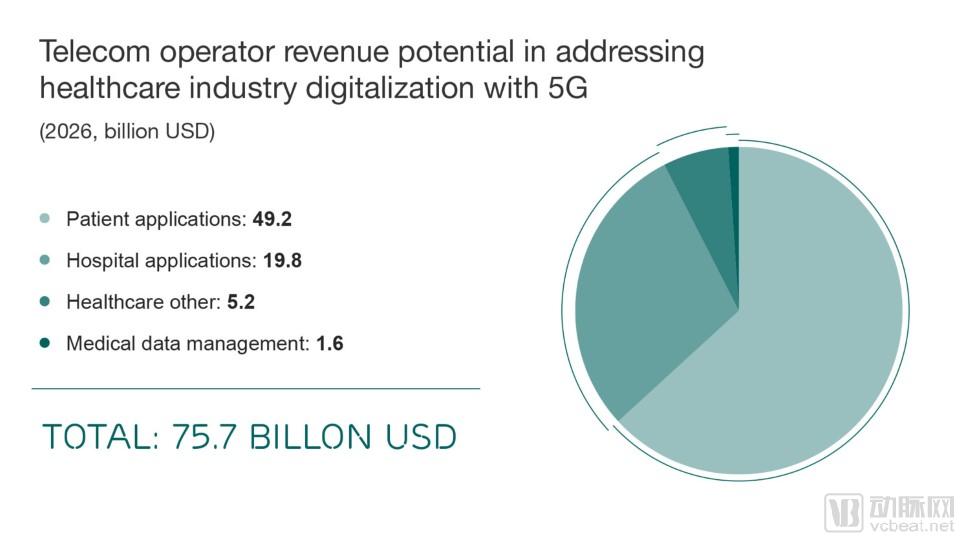
By 2026, the potential revenue for 5G operators in healthcare transformation is projected to reach $76 billion.(Screenshot from the report "Transitioning Healthcare to Home-Based Care")
Telecom carriers’ entry into the healthcare value chain can drive their transformation across multiple domains, including hospital applications (such as virtual reality used in medical training, telemetry, and online booking systems) and real-time healthcare data management. For carriers leveraging 5G to enter this industry, the most promising area lies in patient-facing applications used outside traditional hospital settings. Such use cases include precision medicine, online consultations, remote health monitoring for chronic diseases, and remote medication management.
5G will also benefit many existing applications and help develop new applications that are not possible with current technology, such as remote patient diagnosis and treatment. At the same time, critical healthcare services require reliable connectivity technologies, end-to-end low latency, and ultra-reliable communication. Instant communication of patient conditions (through high-definition images and access to medical records) is also crucial, and it can provide accurate sensory and haptic interaction during remote surgical procedures.
The widespread adoption of wearable devices largely depends on whether physicians recommend them to patients and whether health insurers provide coverage for them. For instance, the UK’s National Health Service (NHS) offers free applications and devices to manage chronic conditions such as diabetes. If telemedicine and remote surgery are to become mainstream, insurers must provide coverage for these medical services.
The regulatory framework governing the healthcare industry is extremely stringent. Non-traditional players must bear in mind that biotechnology companies require an average of 10 years to obtain product certification, whereas the investment cycle for IT startups is merely three years. The high-profile failure of Theranos, a low-cost blood testing provider, underscores the need for technology companies to collaborate with healthcare providers to enhance services. As connectivity becomes increasingly critical, hospitals can no longer cite consumer-grade devices or network coverage limitations as excuses for shirking responsibility. Hospitals must partner with medical technology and telecommunications companies to develop medical-grade wearable devices capable of connecting to the internet independently of smartphones.
Hospitals must also adopt a collaborative approach to help patients set and achieve health goals. Consumers have different needs across various care scenarios—preventive, routine, and postoperative care—and healthcare institutions must employ tailored strategies to meet these diverse requirements. To address the needs of patients with chronic conditions, medical care is shifting toward home-based models, where patients provide data to hospitals; these patients are likely to be the primary beneficiaries of this transformation.
Furthermore, the following emerging technologies will have a critical impact on healthcare reform. For instance, 5G’s new radio frequency interfaces and access mechanisms surpass previous generations of mobile communication, offering massive system capacity, ultra-low latency, ultra-high reliability and availability, and ultra-low device energy consumption. Joint network slicing enables network slices to roam across other networks, thereby providing global services. RAN virtualization and distributed cloud storage ensure ultra-low end-to-end latency. Artificial intelligence and real-time machine learning will become essential elements for enabling self-optimizing networks to ensure that service level agreements are met.
(Compiled by Xu Shengnan)