

From Near Bankruptcy to a $14 Billion Valuation: Abiomed's Remarkable Turnaround with Impella

Abiomed
Cardiac System Medical Device Developer
Recently, Abiomed issued a statement on its clinical research: Over the past five years, Abiomed has invested more than $100 million in clinical studies of the Impella heart pump. (“$100 Million Is Not Enough: Abiomed Continues to Develop the Impella Clinical Portfolio of Miniature ‘Artificial Hearts’”)
Fifteen years ago, the publicly listed medical device company Abiomed was in dire straits. Its first implantable artificial heart, AbioCor, had just failed in clinical trials, causing its stock price to plummet and operating funds to run critically low. The founder resigned taking responsibility for the failure, and the company was on the brink of bankruptcy.
Fifteen years later, no one could have imagined that Abiomed would become one of the global giants in cardiovascular medical technology, as well as one of the fastest-growing and most profitable medical device companies, with a market capitalization reaching $14 billion.
As a publicly listed medical device company specializing in the development and sales of ventricular assist devices, Abiomed has experienced both troughs and highlights over its more than 40-year history—marked by departures in disappointment and turnarounds through decisive leadership. Next, VCBeat (WeChat ID: vcbeat) will outline Abiomed’s journey of resurgence.
Abiomed was founded in 1981 by David M. Lederman and is headquartered in Danvers, Massachusetts, USA. With the corporate mission of “Healing Hearts and Saving Lives,” the company is dedicated to the development of artificial hearts designed to assist or replace the pumping function of failing hearts. In its early years, Abiomed’s research and development funding was primarily supported by federal research grants. In 1987, Abiomed went public on the NASDAQ under the ticker symbol ABMD. At the end of its first year as a public company, Abiomed’s annual revenue stood at just $1.5 million.
Initially, Abiomed’s revenue-generating devices included the AbioCor® Implantable Replacement Heart System, the BVS® 5000 Biventricular Support System, and the AB5000™ Circulatory Support System. These products were primarily used to provide temporary support for patients with heart failure and to facilitate cardiac recovery.
Among these, AbioCor was Abiomed’s first and most significant product. Developed collaboratively by the company’s founder, Lederman, and the Texas Heart Institute, it was the world’s first fully implantable heart replacement device, designed to treat patients with end-stage heart failure. The BVS5000 is a biventricular support system that received U.S. FDA approval in 1992 as the first ventricular assist device used for cardiac bypass. The AB5000 Circulatory Support System obtained U.S. FDA approval in 2004 for temporary support of profound shock in patients with acute heart failure, including cardiogenic shock following myocardial infarction, post-cardiotomy, or myocarditis.
The awkward reality, however, is that AbioCor, the company’s flagship product, underwent more than 20 years of development yet failed to secure U.S. FDA approval for a prolonged period. Moreover, its clinical trial failure in 2000 triggered a sharp decline in the company’s stock price. By the end of 2000, Abiomed’s share price had plummeted from $41 per share at the beginning of the year to approximately $3.
Internal challenges remained unresolved, and the external business environment was equally daunting. At that time, Thoratec and Heartware dominated the ventricular assist device (VAD) market with substantial shares. Abiomed’s product portfolio primarily consisted of biventricular VADs, strategically positioned as a bridge to heart transplantation rather than as destination therapy. Consequently, its competitiveness fell far short of most left ventricular assist devices (LVADs) available on the market. Furthermore, the company’s founder came from a research background and placed limited emphasis on product marketing, leaving Abiomed unable to compete with Thoratec and Heartware for market share.
Under the dual pressures of internal strife and external challenges, Abiomed was forced to lay off more than 20 employees in early 2003. Dr. Lederman, the company’s founder, CEO, and Chief Scientific Officer, resigned taking responsibility for the crisis, leaving Abiomed on the brink of bankruptcy.
At a critical juncture, the emergence of a key figure reversed Abiomed’s decline. This individual is Michael R. Minogue, who currently serves as Chief Executive Officer and President of Abiomed.
Michael R. Minogue is a military veteran who earned a Bachelor of Science in Engineering Management from the United States Military Academy at West Point and served as an infantry officer in the U.S. Army. Prior to joining Abiomed, he spent 11 years at GE Healthcare, where he held various leadership positions and developed expertise in sales, marketing, product development, information technology, and software/services operations for diagnostic imaging in oncology and cardiovascular diseases.
In 2004, Minogue joined Abiomed as its Chief Executive Officer and President. Upon taking office, he implemented two key initiatives: the first secured Abiomed’s survival, while the second enabled the company to stage a remarkable turnaround against the odds.
In his first year at the helm, Minogue leveraged his marketing expertise to boost sales of Abiomed’s existing cardiac assist devices, delivering rapid results. According to the 2005 financial report, Abiomed’s total revenue increased by 48%.
Minogue’s “second move” was to pursue a transformation, leveraging new technologies and products to shift the company’s existing development strategy.
Minogue realized that Abiomed’s product portfolio, due to its different strategic positioning, was unable to penetrate a broader market, and developing new products in-house would certainly be too late. To achieve rapid growth in a short period, leveraging external forces—such as acquiring new technologies or products through mergers and acquisitions—was the prudent course of action.
With a military background, Minogue adopted a decidedly decisive management style. In his second year in office, 2005, he led Abiomed in acquiring Impella CardioSystems AG, a near-bankrupt German startup specializing in ventricular assist devices based in Aachen, for $2 million in cash, over $45 million in Abiomed stock, and $29 million in milestone payments.
Dr. Thorsten Siess, one of the company’s co-founders, developed the Impella heart pump, which is the smallest heart pump in the world. It was this innovative technology that attracted Minogue’s interest. Following the acquisition of Impella CardioSystems AG, Dr. Siess joined Abiomed as Chief Technology Officer.
“The acquisition of Impella is fully aligned with our strategy to provide cardiac support and circulatory assistance to more patients across hospitals. We will be able to offer a comprehensive portfolio of devices, thereby increasing the likelihood of restoring patients’ native heart function,” explained Michael R. Minogue, Chief Executive Officer and President, at the time of the acquisition. “We are delighted to bring Impella’s engineering expertise into Abiomed and integrate it as a core component of our team and strategy. Furthermore, this transaction enables us to expand the company’s commercial footprint across the European market and lays a solid foundation for Abiomed’s market development in Germany.”
Since then, Abiomed has gradually shifted its development focus to the Impella product series, aiming to improve patient blood flow or cardiac pumping function, thereby allowing the hearts of heart failure patients to rest, heal, and recover. Accordingly, Abiomed’s business focus has transitioned from pre-heart transplant supportive interventions to comprehensive perioperative care, spanning the pre-operative, intra-operative, and post-operative phases of cardiac surgery.
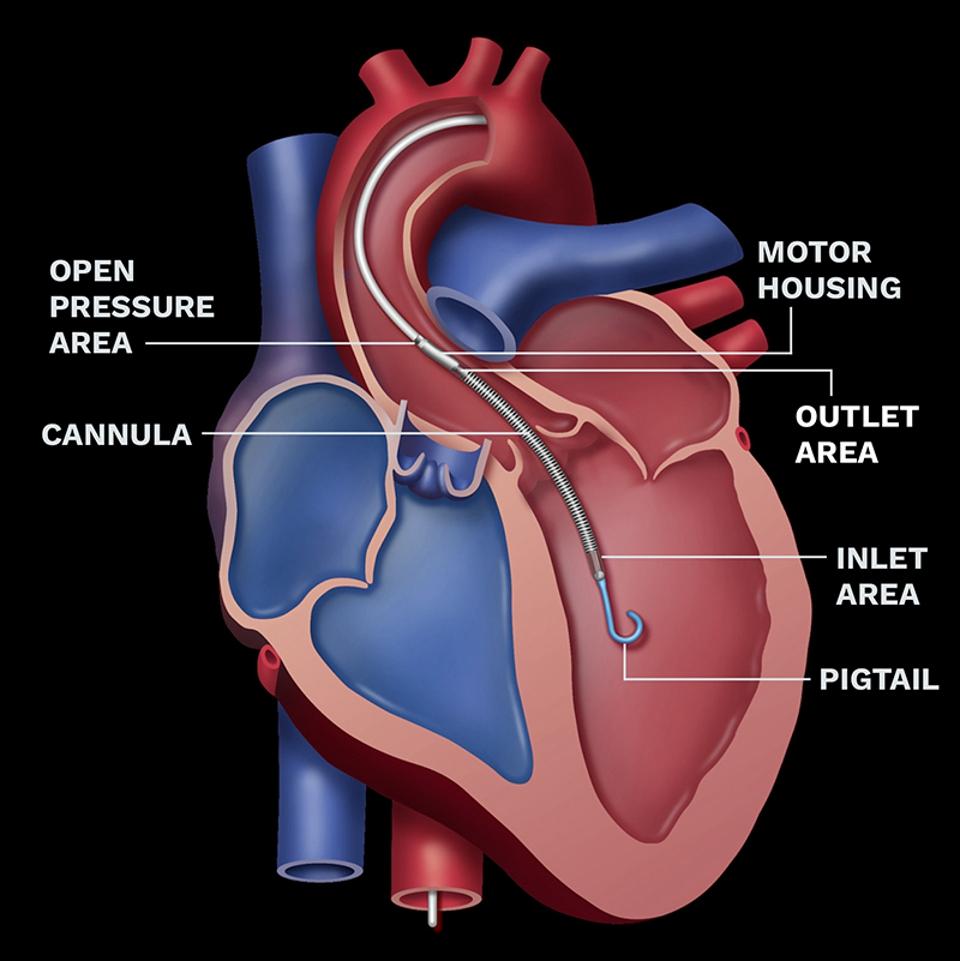
The Impella pump draws oxygenated blood from the left ventricle and ejects it into the aorta for distribution to the rest of the body. (Image source: Abiomed official website)
The Impella heart pump resembles a gray, striped pen with a pigtail catheter at its tip. It is implanted into the patient’s heart via a catheter inserted through the groin and connected to an automated Impella controller positioned at the bedside. The Impella heart pump continuously circulates blood throughout the body. Once the patient’s heart function recovers, the pump is removed. The automated Impella controller regulates the performance of the Impella catheter, monitors alarms, and displays real-time information on circulatory support and catheter position on a 10-inch high-resolution monitor.
Impella Heart Pump: Primarily Addresses Two Key Issues, the First Being High-Risk PCI (Percutaneous Coronary Intervention). For patients with compromised cardiac pump function who require cardiac surgery, the Impella heart pump provides circulatory support, reduces cardiac workload, and facilitates arterial reperfusion.
The second category includes treatments for persistent cardiogenic shock, cardiogenic shock secondary to acute myocardial infarction (AMI), and post-cardiotomy cardiogenic shock (PCCS). Reportedly, the Impella heart pump is the first and only percutaneous temporary ventricular support device approved by the FDA as safe and effective for the indication of cardiogenic shock, accounting for 50% of the company’s business. When a patient’s heart is severely damaged and unable to pump blood effectively, physicians can implant the Impella heart pump using minimally invasive techniques to help sustain the patient’s life.
Due to high research and development costs, the Impella heart pump is relatively expensive, with an average selling price of $23,000 for its five models (including nursing and cardiac support). Different versions of the Impella heart pump can support the left ventricle and right ventricle, respectively. The main products include Impella 2.5, Impella 5.0, Impella CP, Impella RP, and Impella LD. Among them, Impella 2.5 and Impella 5.0 were developed by Dr. Thorsten Siess in Europe and have obtained European CE certification.
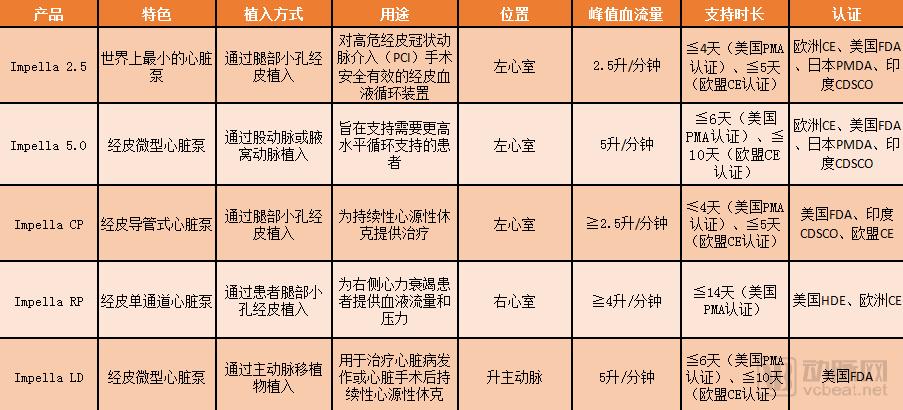
The chart shows Abiomed's Impella product series.
From the world’s first artificial heart to the world’s smallest heart pump, Abiomed has launched a series of ventricular assist devices (VADs) to the market, thereby gaining an increasing share of the market.
Certainly, to remain competitive in an ever-evolving industry, the prudent path lies in the continuous development and commercialization of new products and technologies. Having navigated through its startup phase, initial public offering, and near-bankruptcy, Abiomed—then experiencing a counter-trend upswing—faced at least two strategic options in R&D: one was to acquire companies to further bolster its technological capabilities and product portfolio; the other was to leverage its internal strengths to develop new products based on its Impella series.
Abiomed appears to have a strong preference for its Impella product line. Since acquiring Impella CardioSystems AG in 2005, Abiomed has rarely expanded its portfolio through acquisitions or investments. The few investments and acquisitions it has made were primarily aimed at further solidifying its position as an innovator and leader in the cardiovascular medical technology industry.
Over the past five years, Abiomed has invested more than $200 million in research and development for its Impella product line. Building on improvements to existing products, Abiomed has pursued the development of new technologies and products with the goals of enhancing medical efficiency, device usability, and quality of patient management. These innovations include optical sensor technology, smart device connectivity (Impella Connect), and an expanded product portfolio comprising the Impella 5.5, Impella ECP, and Impella BTR.
Among these, optical sensors have been integrated into the new-generation Impella CP heart pump, which has received FDA and CE clearance. Leveraging advanced software and intelligent sensors, the new-generation Impella CP heart pump enhances the precision of real-time positioning while eliminating the need for imaging equipment, thereby simplifying patient management. By integrating real-time clinical data—including left ventricular pressure (LVP), end-diastolic pressure (EDP), and cardiac power output (CPO)—into the Impella console, the new-generation Impella CP heart pump enables physicians to provide optimal support for patients.
Meanwhile, the new device features a convenient and straightforward setup process, simplifying patient management for physicians, laboratory staff, and ICU personnel. With a 15% reduction in startup time, it provides critical additional treatment time for emergency patients with cardiogenic shock.
In late January 2019, Abiomed’s Impella Connect system received CE marking in the European Union. As the company’s first cloud-based remote patient monitoring system, it represents, to some extent, the cutting edge of innovation in cardiovascular medical technology.
Impella Connect employs real-time monitoring technology that enables physicians and hospital staff to securely view the Impella console remotely and in real time from any internet-connected computer or mobile device, thereby more effectively improving patient outcomes. Additionally, Impella Connect allows personnel at Abiomed’s 24/7 Clinical Support Center to provide expert assessment of Impella data and facilitate real-time collaborative patient management for healthcare professionals.
In addition, three new products currently under development also feature integrated motors and sensors. Among them, the Impella 5.5 is a percutaneous micro heart pump; this compact device can provide hemodynamic support for several months, with an expected blood flow rate exceeding 5 liters per minute. In April 2018, the Impella 5.5 received CE marking in the European Union, and the first patient was treated at the University Heart Center Hamburg in Germany. However, it has not yet been approved for marketing in the United States.
The Impella ECP can deliver a blood flow rate exceeding 3 liters per minute. This product was developed by Abiomed after it acquired the relevant patent rights through the purchase of ECP in 2014. Currently, the Impella ECP has not yet received approval for commercial use or sales. In 2019, the Impella ECP will undergo its first-in-human trials outside the United States.
The Impella BTR is also a percutaneous micro-heart pump with an integrated motor and sensors. The Impella BTR features a compact design and can provide hemodynamic support for up to one year, with an expected blood flow rate exceeding 5 liters per minute. The Impella BTR system also includes a wearable driver specifically designed for discharged patients; this product remains in the development stage and has not yet been approved for commercial use or sale.
Furthermore, Abiomed’s recent clinical research commitments demonstrate that the company is continuously improving patient outcomes through real-time monitoring technologies, including the Impella Quality (IQ) Database, the FDA-reviewed one-year prospective cVAD study, and its industry-leading 24/7 clinical support services.
Among these, the Impella Quality (IQ) Database is the world’s largest database of high-risk PCI and cardiogenic shock patients, developed by Abiomed three years ago at a cost of $85 million. The database contains real-world treatment data from approximately 50,000 U.S. patients, including 15,259 cases of acute myocardial infarction complicated by cardiogenic shock (AMICS).
To improve real-world treatment outcomes for patients undergoing high-risk PCI and those with cardiogenic shock, Abiomed shares the analytical insights derived from this database with hospital clients and other customers free of charge.
In 2019, Abiomed will continue to conduct multiple pivotal randomized controlled trials, committed to providing healthcare providers and patients with high-quality devices, cost-effective solutions, and optimal therapeutic strategies for improved outcomes.
It has proven that Minogue’s strategic vision was precise and distinctive; in the United States, Germany, and Japan, more than 100,000 patients have been treated with the Impella product line. Since 2014, Impella’s sales have maintained double-digit growth.
Today, Abiomed employs more than 1,100 people worldwide and operates manufacturing facilities in Danvers and Massachusetts (USA), Aachen and Berlin (Germany), and Tokyo (Japan). The company’s Impella product series has received approvals from more than 30 regulatory authorities globally, including in the United States, Europe, Japan, Canada, China, and India. As a result, market penetration of its products continues to rise in these regions, and its business footprint is expanding steadily.
According to Abiomed’s official website, during Minogue’s tenure, Abiomed’s market capitalization increased by 4,000%, making it one of the fastest-growing medical technology companies that is GAAP-profitable and debt-free. Currently, Abiomed has a market capitalization of $14 billion, which is 74 times its trailing earnings (data sourced from Forbes).
The 2018 financial report shows that Abiomed’s primary revenue source is its Impella product series, with 90% of its revenue derived from the U.S. domestic market. Although Abiomed has entered markets in Europe, Canada, Japan, China, and India, its penetration rate in these regions remains low, indicating significant untapped potential for future growth in international markets.
Note: All data mentioned in the article are as of the publication date.
(By Cheng Xiaoqin)