

Alzheimer's Breakthrough: Five Novel Genetic Loci Linked to Late-Onset Disease Identified in Landmark Study
Recently, ArteryMed (WeChat ID: biobeat1) learned that a study published inNature GeneticsNew research published in may help develop treatments for Alzheimer’s disease. By conducting a genetic meta-analysis of nearly 95,000 individuals diagnosed with Alzheimer’s disease in the United States and Europe, the study identified five new genomic loci potentially associated with the risk of Alzheimer’s disease and confirmed 20 previously identified risk gene loci.
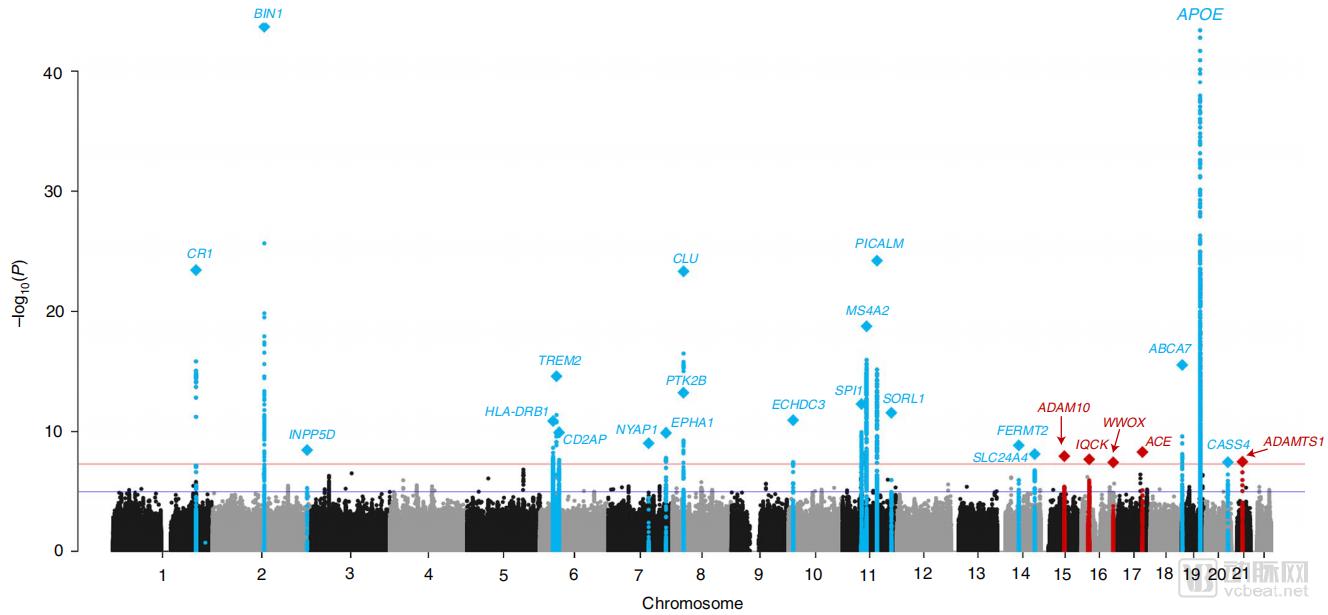
Figure: Distribution of abnormal loci in Alzheimer's disease patients (red indicates the five newly discovered loci, and blue indicates the 20 previously identified loci)
Image source: Genetic meta-analysis of diagnosed Alzheimer's disease identifies new risk loci and implicates Aβ, tau, immunity and lipid processing. Brian W. Kunkle et al.NATURE GENETICS.51,414-430(2019).
Late-onset Alzheimer’s disease (LOAD) is partly caused by genetic factors. Researchers stated that these five newly identified loci work in concert with the 20 previously known risk gene loci. The most critical risk locus identified to date is APOE4. ApoE4 is involved in cholesterol transport and is considered one of the most significant risk factors for Alzheimer’s disease.
Led by researchers at the University of Miami’s Hussman Institute for Human Genomics, this study serves as a follow-up to a 2013 genome-wide association study. It identified 11 novel genetic loci that had not previously been associated with the development of Alzheimer’s disease.
“We confirmed 20 previously identified LOAD risk gene loci and discovered five new risk gene loci (IQCK, ACE, ADAM10, ADAMTS1, and WWOX), two of which (ADAM10 and ACE) were identified in recent genome-wide association studies (GWAS).” The researchers stated inNature GeneticsThe magazine stated that with the identification of these new genome-wide loci, current efforts are focused on exploring their relationship with the development of Alzheimer's disease.
“Enrichment of rare variants in pathways associated with Alzheimer’s disease suggests the presence of additional rare variants yet to be identified. Larger sample sizes and improved imputation panels will facilitate their discovery. Although these rare variants may not substantially contribute to the predictive value of genetic findings, they will enhance our understanding of disease mechanisms and potential drug targets. While genome-wide identification of risk gene loci remains challenging, we demonstrate that aggregated evidence from existing and newly analyzed data can help prioritize risk genes,” the researchers wrote in the conclusion of their paper.
Meanwhile, researchers have also confirmed that the metabolic process of amyloid precursor protein is associated not only with early-onset Alzheimer’s disease but also with late-onset Alzheimer’s disease. This implies that therapies developed for early-onset disease may also be applicable to late-onset disease. Pathway analysis suggests that tau protein is likely an early pathological signal in Alzheimer’s disease and confirms that therapies targeting tau tangle formation or degradation may be effective for late-onset Alzheimer’s disease.
Richard Isaacson, who directs the Alzheimer’s Prevention Clinic at Weill Cornell Medicine, stated that the data presented in the study represent another step forward in understanding Alzheimer’s disease. The discovery of these four new genes will enable clinicians to target them as they continue to explore treatment options. Furthermore, Isaacson noted that the new genetic findings provide researchers with “a deeper perspective on the underlying causes of Alzheimer’s disease.”
Margaret Pericak-Vance, Director of the Hussman Institute, highlighted the complexity of Alzheimer’s disease. In an interview, she noted that Alzheimer’s differs from other genetically related disorders, such as Huntington’s disease or Parkinson’s disease, which are governed by single genes, where a mutation in a single gene can cause the disease.
“Alzheimer’s disease involves the combined effects of multiple genes. We are attempting to identify very rare genetic variants that may contribute to Alzheimer’s disease. Previously, we were unable to do so simply because we lacked a sufficient sample size,” she said.
Rudy Tanzi, a Professor of Neurology at Harvard University and Director of the Alzheimer’s Genome Project, as well as a member of the research team, also stated that this study validates the role of amyloid and immune system genes in the development of Alzheimer’s disease. Although this field has experienced many setbacks in the past, this study may renew interest and attention in the area.
Research and development of treatments for Alzheimer’s disease has proven extremely challenging, with numerous companies reporting failures of drug candidates in clinical trials, particularly those targeting amyloid plaques. In January 2019, Dr. Rudolph Tanzi, Chair of the Cure Alzheimer’s Fund Research Consortium and Kennedy Professor of Neurology at Harvard Medical School and Massachusetts General Hospital, stated that he did not believe the amyloid hypothesis had been invalidated.
“I believe that amyloid and tangles trigger the disease, but they are not sufficient to cause dementia. In short, what we know is that amyloid appears 15 years before symptoms occur. All genetic evidence tells us that this disease begins with amyloid,” said Tanzi.
He added that tangles and amyloid plaques are harbingers of the disease, leading to neuroinflammation, which kills neurons and causes dementia.