

Huawei and China Mobile Enable Zhengzhou University First Affiliated Hospital to Complete 5G-Powered Remote Consultation, Ultrasound, and Emergency Rescue Trials
If you look closely, near the office building of The First Affiliated Hospital of Zhengzhou University (hereinafter referred to as “Zhengzhou University First Affiliated Hospital”), you will notice several black-tech boxes resembling water heaters (as shown in the figure below). These are 5G network base stations currently under construction at the hospital.

Currently, a total of 30 base stations are being installed among the Zhengdong Campus of the First Affiliated Hospital of Zhengzhou University, the National Engineering Laboratory for Internet Systems and Applications (located at the He’nan Campus), and the Longzihu Smart Island, which serves as the core area of the National Big Data Comprehensive Pilot Zone. The installation is expected to be fully completed around March 15, with the system scheduled to become operational by the end of the month.
In October 2018, at the 2018 Digital Economy Summit and Major 5G Technology Exhibition and Exchange Conference, Henan Mobile made a remarkable appearance under the theme “Yu Meets 5G: Within Reach,” showcasing its achievements in remote healthcare within a mobile 5G environment.
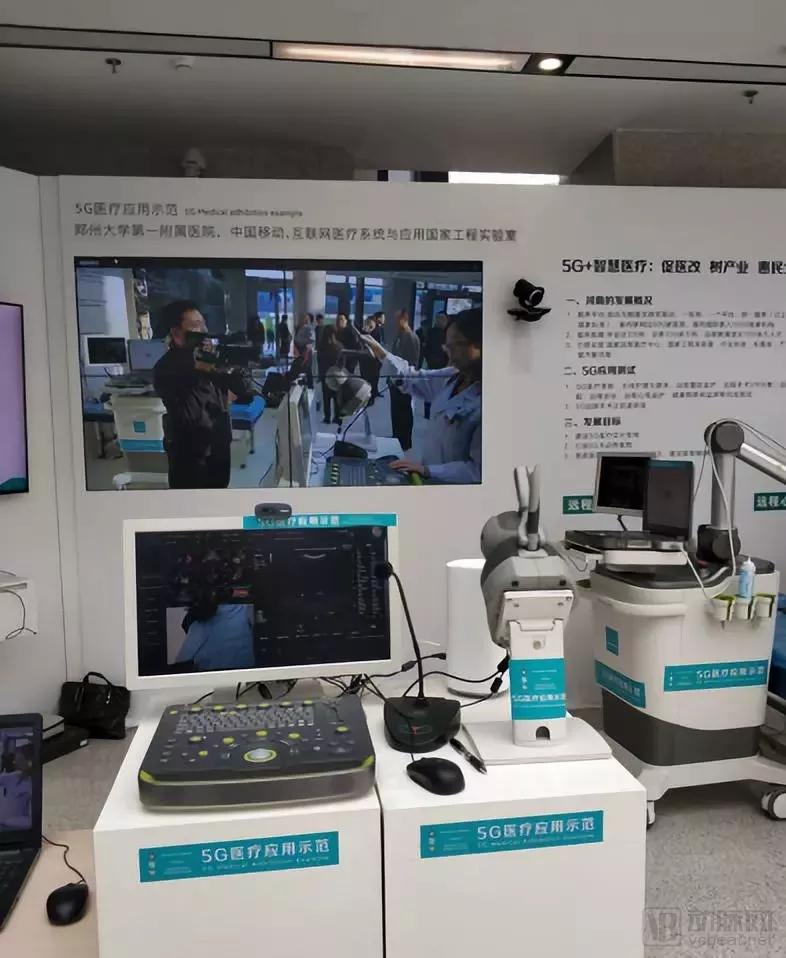
Mobile 5G Telemedicine Booth (Image source: Sanmenxia Mobile)
At the 5G Mobile Medical Application Demonstration Zone, staff from the Telemedicine Center of the First Affiliated Hospital of Zhengzhou University demonstrated cutting-edge telemedicine technologies to attendees, including remote consultations, remote ultrasound examinations, and mobile ward-round robots.
Professor Zhao Jie, Deputy Secretary of the Party Committee of the First Affiliated Hospital of Zhengzhou University and Director of the National Engineering Laboratory for Internet Medical Systems and Applications, stated that in the future, with mobile 5G technology, patients will be able to access diagnostic and treatment services from experts at the First Affiliated Hospital of Zhengzhou University without leaving their homes, as long as there is a mobile 5G signal, even in remote rural areas.
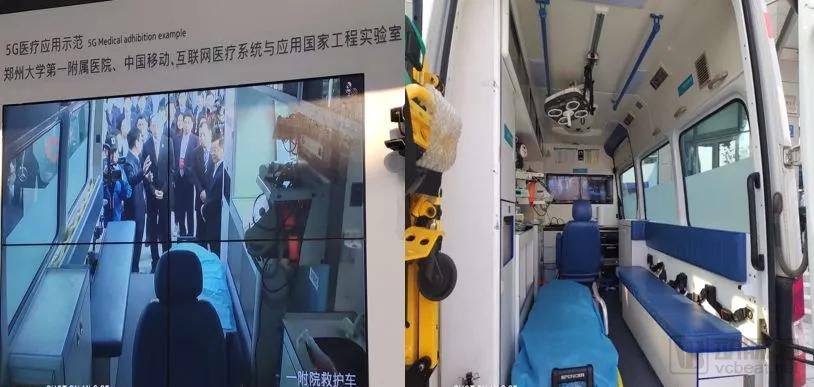
Mobile 5G Ambulance Remote Consultation (Image source: Sanmenxia Mobile)
Once the patient is on board, the ambulance’s legacy 4G connection proves too slow. By leveraging mobile 5G technology, patient examination data and live scene footage can be transmitted rapidly and directly to the hospital. This enables specialists to review the patient’s medical records and issue test orders while en route, allowing immediate execution of relevant examinations upon arrival. Such an approach significantly reduces pre-hospital emergency response time; in essence, boarding the ambulance becomes equivalent to arriving at the emergency center.
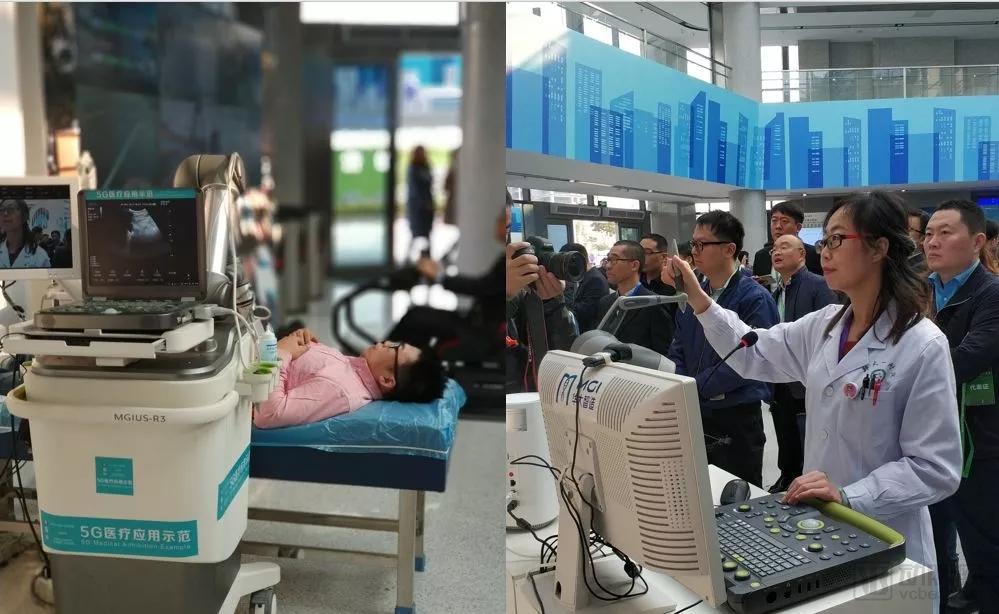
Remote B-mode Ultrasound Based on 5G Networks (Image source: Sanmenxia Mobile)
Leveraging 5G technology, this compact wireless ultrasound probe functions as a control handle; by moving it up, down, left, right, or rotating it, clinicians can flexibly manipulate the robotic arm at the remote end of a telemedicine system. While patients lie on hospital beds in their hometowns, specialist physicians thousands of miles away gain a clear, comprehensive view of their physical condition. As a powerful tool for visualized precision medicine and an effective aid for rapid emergency assessment and preliminary screening, remote ultrasound and telemedicine help improve healthcare professionals’ work efficiency and diagnostic and therapeutic standards, while minimizing diagnostic errors and the resulting doctor-patient disputes to the greatest extent possible.
In addition to remote ultrasound, wireless infusion is another cutting-edge technology in the 5G healthcare era.
Intravenous infusion is one of the most common clinical treatments. During the infusion process, patients often need to keep an eye on the IV bottle and must call a nurse immediately if extravasation occurs or the infusion is nearing completion. In the era of 5G-enabled healthcare, this process will become much simpler.
According to Chen Baozhan, a staff member at the Telemedicine Center of the First Affiliated Hospital of Zhengzhou University, wireless infusion systems can monitor patients’ infusion progress via sensors connected to wireless alarms. The system automatically alerts nurses when the infusion is nearing completion, eliminating the need for patients to constantly watch the IV bottle or manually call for assistance.
In addition, the system can monitor infusion progress, rate, and status in real time, thereby standardizing processes such as infusion rate. Nurses can obtain an at-a-glance overview of infusion activities across an entire ward on a single display screen.
9 Major Application Scenarios of 5G Hospitals
In June 2018, Zhengzhou was officially designated as one of the 18 pilot cities for 5G applications in China. Among these initiatives, the smart healthcare application jointly promoted by the First Affiliated Hospital of Zhengzhou University and China Mobile serves not only as part of the national demonstration project but also as a key development area outlined in the “Action Plan for the Development of the 5G Industry in Henan Province,” issued by the People’s Government of Henan Province in January 2019. In 2018, the Henan Telemedicine Center of the First Affiliated Hospital of Zhengzhou University signed a nationwide cooperation agreement with China Mobile Henan Branch to co-develop 5G-enabled smart healthcare solutions, and was invited to participate in the 2018 Digital Economy Summit and the China Mobile 5G Joint Innovation Center.
Recently, China Mobile deployed a 1 Gbps VPN private network and 5G base stations among the First Affiliated Hospital of Zhengzhou University (Zhengdong Campus), the National Engineering Laboratory for Internet Systems and Applications (He’nan Campus), and Longzihu Smart Island, the core area of the National Big Data Comprehensive Pilot Zone. This has achieved small-scale 5G networking in key areas and initially established a test environment for the “One Network, Three Zones” demonstration of cross-location 5G medical applications both inside and outside the hospital.
Furthermore, the hospital has conducted pilot projects in areas such as remote consultations, remote ultrasound, remote physiological signal transmission, and remote emergency care. In the future, it will collaborate on 5G technology applications and research in fields including the Internet of Medical Things (IoMT), remote emergency rescue, VR-assisted surgery, telemedicine, wireless infusion, patient positioning, and cybersecurity.
These application scenarios correspond precisely to the nine major scenarios outlined in the White Paper on Wireless Healthcare, jointly authored and released on January 13, 2018, by the National Engineering Laboratory for Internet Medical Systems and Applications, Huawei Wireless XLabs, the First Affiliated Hospital of Zhengzhou University, the China Academy of Information and Communications Technology, and China Mobile Communications Group Co., Ltd.
In light of the characteristics of healthcare services, the White Paper on Wireless Healthcare categorizes wireless healthcare application scenarios into three major types:
Category 1: Medical monitoring and nursing applications based on wireless data acquisition from medical devices, such as wireless patient monitoring, wireless infusion, mobile nursing, and real-time patient location tracking and monitoring.
Category 2: Medical diagnosis and guidance applications based on video and image interaction, such as mobile ward rounds with real-time access to patients’ imaging diagnostic information, remote ward rounds using medical service robots, remote real-time consultations, emergency rescue guidance, wireless surgical teaching, and wireless specialty diagnostics.
Category 3: Remote control applications based on video and haptic feedback, such as remote robotic ultrasound examinations, remote robotic endoscopy, and remote robotic surgery.
These three types of wireless application scenarios have different requirements for network bandwidth and latency, as detailed in the figure below:
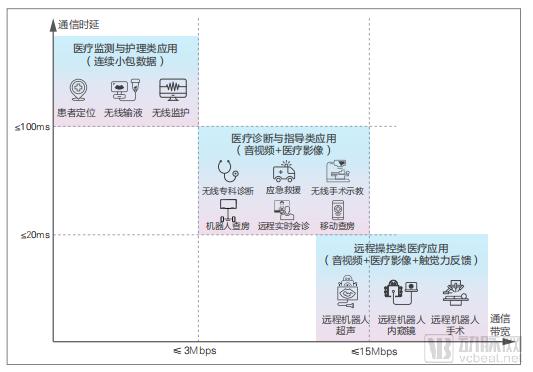
Image source: White Paper on Wireless Healthcare, National Engineering Laboratory for Internet Medical Systems and Applications
Collaboration Among Project Participants
In this 5G smart healthcare project, the First Affiliated Hospital of Zhengzhou University, China Mobile, and Huawei each fulfilled their respective responsibilities through coordinated collaboration.
China Mobile primarily provides end-to-end 5G network solutions, encompassing network planning, construction, slicing, performance optimization, and maintenance, as well as terminal supply, customization of medical devices, and interoperability testing between medical equipment and the network. It is reported that the company has completed site surveys for 30 locations, with supporting engineering tasks—such as power supply and antenna adjustments, and transmission network upgrades—currently underway. Installation of the 30 base stations is in progress, with completion expected by March 15 and operational deployment scheduled for the end of March.
The integration of 5G networks with the construction of an ecosystem for smart healthcare applications will be a gradual and deepening process. As an enabler in the 5G industry, China Mobile is also actively assisting medical device manufacturers in improving their related products.
The head of Huawei Wireless XLabs stated that Huawei has a long-standing partnership with telecom operators, providing them with 5G solutions while jointly advancing the development and implementation of the industry ecosystem.
In the hospital sector, Huawei has long collaborated with the First Affiliated Hospital of Zhengzhou University, providing services and equipment such as storage, data centers, and cloud solutions for telemedicine. At the inception of the National Engineering Laboratory, Huawei participated in discussions on research directions and contributed to its establishment. Xlabs has been more extensively involved in areas such as the Frontier Technology Laboratory, the Wireless Medical Internet of Things (IoMT), intelligent medical terminals, remote ultrasound, and 5G-enabled emergency ambulances.
It is reported that, in its exploration of the future, Xlabs has established Special Interest Groups (SIGs) across multiple business directions, engaging more than 280 partners along the industry chain—including telecom operators, hospitals, and medical device manufacturers—and launching over 40 collaborative research projects. In the field of wireless healthcare connectivity, Xlabs has forged extensive and in-depth collaborations with renowned hospitals both in China and abroad, leading medical device manufacturers, innovative medical terminal companies, and healthcare IT vendors.
Technical Solutions for Different Scenarios
A relevant official from Henan Mobile stated that in the 5G healthcare sector, the greatest challenges facing wireless networks are low latency and high reliability. The technical difficulties vary across different categories of application scenarios. To meet the requirements of various application scenarios, the project has adopted the following technologies:
Monitoring and Diagnostic Applications: Leverage the high bandwidth and low latency of 5G to optimize network architecture and topology. To reduce latency, the 5G physical layer supports diverse subcarrier spacings; larger frequency-domain subcarrier spacing configurations are used to shorten time-domain scheduling latency, while Minislot-based scheduling further reduces scheduling delays. To enhance reliability, the PDCP layer introduces a duplication function that maps the same bearer to different logical channels, with the physical layer transmitting over distinct carriers to ensure transmission reliability.
For remote control applications, to maximize the high bandwidth and low latency performance of 5G networks, the aforementioned technologies are employed. Additionally, for uplink data transmission, User Equipment (UE) adopts configurable scheduling to send data directly on pre-allocated resources, thereby reducing latency. Furthermore, physical-layer dedicated control channels utilize redundancy to ensure transmission reliability. Enhanced MCS mapping technology is used to improve the reliability of the 5G air interface. Moreover, Nokia’s vMEC solution, which recently won the Innovative Mobile Services and Applications Award at MWC, is adopted to bring the service server entry point from the remote core closer to the local access network. This architectural adjustment reduces service latency and enhances service reliability.
The head of Huawei Wireless XLabs added, “Mobile health and telemedicine are developing rapidly, with network infrastructure being one of the key factors enabling this swift growth. In-hospital communications are complex, encompassing both consumer mobile phone usage and medical device connectivity. From a technical perspective, the landscape includes Wi-Fi, wired connections, Bluetooth, and other protocols, creating a fragmented environment akin to ‘seven countries and eight systems,’ which poses significant management challenges.”
Wireless medical applications within hospitals are highly diverse. Three major categories—monitoring, diagnostic, and remote control applications—require simultaneous support for massive connectivity, low-latency high-reliability communications, and high bandwidth. However, current Wi-Fi implementations have proven inadequate in practice. Hospitals seek a unified, secure, reliable, blind-spot-free, high-capacity network that requires no dedicated operational maintenance. To meet these concurrent demands, the Wireless Medical Internet of Things (IoMT), leveraging 4G and 5G technologies, has enabled the creation of virtual private networks for hospitals over carrier networks. This approach resolves issues related to latency, reliability, and interference in the access and data communication of mobile and wireless medical devices, while also eliminating the need for hospitals to maintain specialized IT staff for network operations.
Taking emergency care as an example, modern emergency medical services are not merely a matter of mobilizing personnel and allocating supplies; rather, they constitute a multi-system, comprehensive, and three-dimensional networked framework that integrates the collection, transmission, processing, and feedback of emergency information, along with the unified allocation of medical resources. On-site data collection for casualties primarily involves multi-dimensional data, including basic patient information, location data, physiological parameters, triage categories, medical intervention records, and VR or video communication feeds. This system supports the completion of relevant diagnostic examinations such as blood pressure, pulse, temperature, electrocardiogram (ECG), computed tomography (CT), B-mode ultrasound, and digital radiography (DR). Consequently, mobile emergency care must address three critical challenges: key information acquisition devices, backend data processing, and transmission pathways.
Zhai Yunkai, Director of the Telemedicine Center at the First Affiliated Hospital of Zhengzhou University, stated that in the realm of remote consultations via mobile 5G ambulances, the features of 5G—namely massive connectivity, low latency, and high reliability—have resolved issues prevalent in mobile emergency care, such as network instability, insufficient bandwidth, and insecure data transmission. This technology facilitates the sharing of patient condition data and live on-site video feeds with both the command center and the destination hospital, ensuring the reliable transmission of emergency information. It holds significant importance for achieving the rational allocation of emergency resources and enhancing the level of emergency medical support.
In scenarios with limited 5G network coverage, the National Engineering Laboratory for Internet Healthcare Systems and Applications has established a remote emergency command and treatment platform integrating video conferencing, two-way referral, emergency command, and satellite communication systems. This platform supports remote experts in conducting non-real-time information queries and video consultations regarding patients’ basic information, physiological signals, and medical interventions. It enables timely remote guidance and in-hospital resource allocation for complex and critical cases, thereby improving the efficiency of pre-hospital care.
Director Zhai stated, “5G is not a panacea; it serves merely as a data transmission channel that further enhances the efficiency and quality of data transfer. However, 5G has its limitations, and in medical applications, 5G mobile networks must be used in conjunction with wired networks.”
It is reported that mobile healthcare focuses on addressing the shortage of medical resources in remote and medically underdeveloped regions, which are often areas with lagging network infrastructure. Undoubtedly, only after the completion of communication network construction, including 5G, will there be conditions for the large-scale promotion of so-called 5G medical applications.
How 5G Is Disrupting Traditional Ultrasound, Ward Rounds, and Surgery?
Remote ultrasound and ward-round robots had already been piloted in hospitals before the advent of 5G, but their widespread adoption was hindered by technological limitations.
In response, Director Zhai stated that B-mode ultrasound is an economical, practical, repeatable, and non-invasive medical diagnostic modality, offering the advantages of being non-invasive, harmless to the human body, and widely adaptable. Tele-ultrasound overcomes temporal and spatial constraints by transmitting information such as panoramic examination views, specific anatomical regions, and control instructions via networks. This enables remote acquisition, analysis, and printing of B-mode ultrasound images of specific patient body parts, as well as the issuance of diagnostic reports.
Currently, the implementation of remote ultrasound requires addressing a series of technical challenges, including adaptive sensitivity of robotic arms, real-time transmission of control commands, real-time transmission of ultra-high-definition audio and video, distributed storage of dynamic ultrasound image data from specific patient anatomical regions, and dynamic data processing. Director Zhai stated, “At present, 5G networks primarily support ultrasound data acquisition, transmission, and command feedback. Once the network infrastructure is in place, these issues are not particularly complex. However, further advancements are needed in the mechanical and electronic components of remote ultrasound systems, as well as in backend data processing, particularly intelligent processing.”
Regarding ward-round robots, although existing technologies have enabled “face-to-face” communication between patients and specialists via audio-video calls, and some models have integrated basic examinations such as blood pressure monitoring, temperature measurement, otoscopy, dermoscopy, and electrocardiography (ECG), most are still constrained by factors including the large volume of medical data, unstable transmission networks, insecure data transmission, and the lack of patients’ historical diagnostic and treatment information. Consequently, it remains difficult to achieve real-time dynamic transmission and storage of collected data, as well as real-time querying of historical information.
Existing transmission networks are still unable to meet the dynamic, real-time access requirements for patients’ instantaneous data and historical medical records during expert ward rounds. Therefore, 5G-based medical robots will have broad development prospects in the future, particularly in regions with weak primary healthcare resources, where they will serve as a critical link connecting grassroots medical facilities with senior specialists.
In the realm of remote surgery, while Director Zhai is highly optimistic about its applications, he believes that certain medical challenges still persist. Director Zhai contends that the implementation of remote surgery is not merely a technical issue, but more importantly, a medical one. From a technical perspective, 5G communication technology is only one component. In this field, core technical issues related to remote human surgery still need to be resolved, including the research and development of 5G network chips and equipment, large-scale deployment of 5G base stations, full high-definition video image codec, 5G network slicing, edge computing, and NFV/SDN. These advancements are essential to reduce network transmission latency, ensure dynamic real-time querying of large-capacity medical information such as HIS, LIS, PACS, and EMR, enable distributed storage of full high-definition video images, and guarantee the secure and reliable transmission of real-time control commands for intelligent devices.
Meanwhile, given the substantial variations in preoperative preparations across different surgical procedures, it is necessary to conduct categorized experimental testing and validation of remote surgeries prior to their clinical application on humans. This includes verifying foundational conditions, basic workflows, operational standards, scope of application, and other relevant indicators and parameters. Currently, there is a lack of research and practical experience in areas such as national policies, technical standards, management systems, and clinical guidelines. Consequently, remote surgery on human patients still has a long way to go.
How Does 5G Policy Provide Support?
In addition to the full cooperation of hospitals, policy support is crucial for the development of 5G technology in healthcare.
Currently, the Ministry of Industry and Information Technology (MIIT) is the primary government body responsible for formulating and implementing industry plans, industrial policies, and standards; managing the telecommunications sector; and guiding and promoting informatization development. To adapt to and facilitate the application and development of 5G systems in China, the MIIT has taken the lead globally by releasing a frequency usage plan for 5G systems in the 3000–5000 MHz band (mid-band spectrum), taking into account the actual conditions of frequency utilization in China. Furthermore, it has approved 5G trial frequency licenses for the three major telecom operators, thereby promoting the launch of large-scale 5G trials nationwide. The National Health Commission (NHC) is the department responsible for formulating national health policies; drafting laws, regulations, policies, and plans for the development of healthcare services; and establishing and implementing departmental rules and standards.
The National Health Commission and the Ministry of Industry and Information Technology have established effective coordination mechanisms in areas such as the dedicated network for internet-based healthcare, universal broadband service, poverty alleviation through medical care, big data in healthcare, and artificial intelligence in medicine. They jointly participated in the issuance of documents including the “Opinions of the General Office of the State Council on Promoting the Development of ‘Internet + Healthcare’” (Guo Ban Fa [2018] No. 26) and the “Guiding Opinions of the General Office of the State Council on Promoting and Regulating the Application and Development of Health and Medical Big Data” (Guo Ban Fa [2016] No. 47).
As a new generation of network communication technology, 5G has already demonstrated its localized feasibility in areas such as remote consultations, emergency rescue, remote ultrasound, and remote VR-assisted surgery. Both the National Health Commission and the Ministry of Industry and Information Technology attach great importance to the application of 5G in the healthcare sector, continuously focusing on key projects, demonstration applications, standard development, and platform construction.
It is believed that as the application models, standards, and technologies of 5G in the healthcare sector mature, relevant policies from the two ministries will be rolled out successively to facilitate collaborative medical services within and outside hospitals or across different regions, thereby promoting the high-quality development of China’s healthcare services.