

Hainan to Fully Roll Out 'Internet+' Medical Services Across All Secondary and Above Hospitals by Next Year
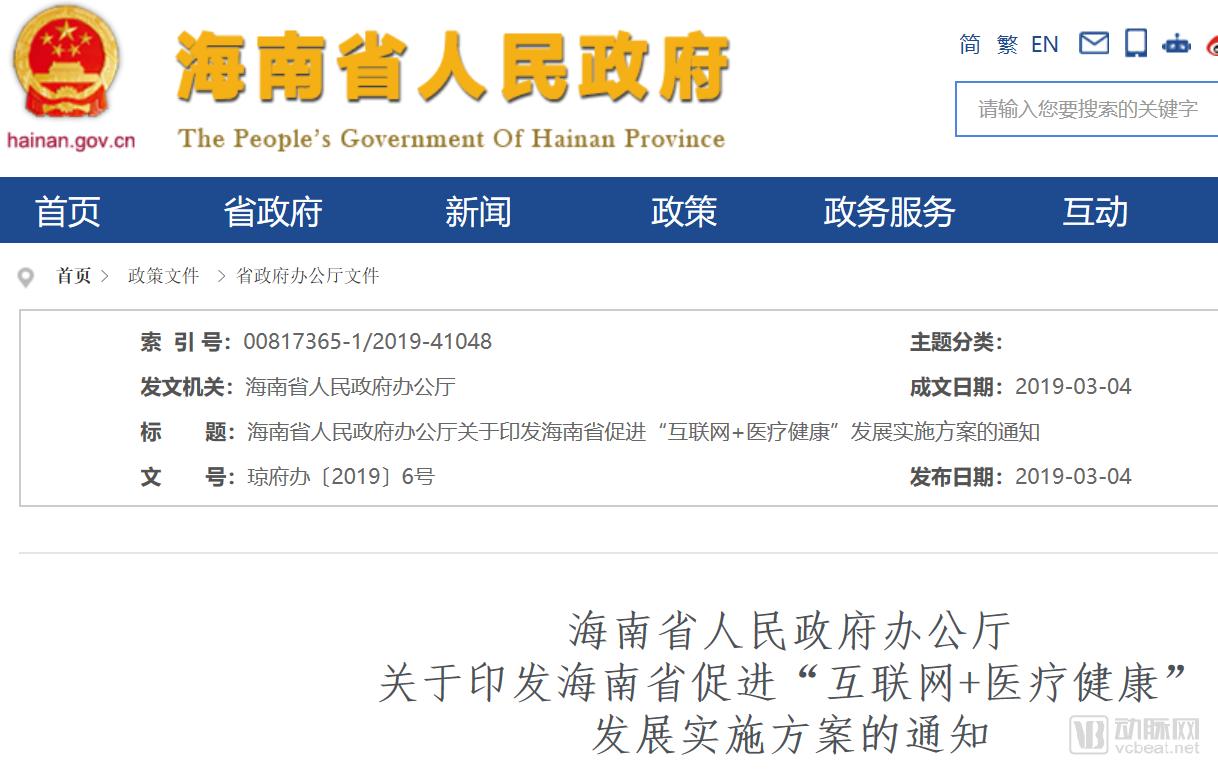
Recently,General Office of the People's Government of Hainan ProvinceNotice on Issuing the Implementation Plan for Promoting the Development of “Internet + Healthcare” in Hainan Province.
This marks another region issuing detailed implementation rules following the National Health Commission’s promulgation of new regulations on internet-based healthcare last year. The aim is to promote the deep integration of internet information technology with healthcare services in our province, innovate healthcare service models, accelerate the development of Healthy Hainan, and enhance the level of healthcare services and modernized management in our province against the backdrop of advancing the construction of the Free Trade Zone (Port). The full text of the policy is attached below:
I. General Requirements
By 2020, Hainan Province had basically established its policy framework for “Internet + Healthcare,” progressively improved its infrastructure support system, and achieved significant development in the medical and health service sector. Basic interconnectivity and shared application of medical and health information among government agencies, healthcare institutions, and urban and rural residents were realized, providing the public with more accessible, intelligent, and precise healthcare services, fostering more harmonious doctor-patient relationships, and positioning Hainan’s “Internet + Healthcare” initiatives among the most advanced in China.
II. Key Tasks
(1) Actively promote the development of “Internet + Healthcare” services.Medical institutions are permitted to use “Internet Hospital” as their secondary name and, building upon their physical hospital infrastructure, leverage internet technologies to provide safe and appropriate medical services. Licensed physicians who are registered or filed are allowed to conduct online follow-up consultations for certain common and chronic diseases; after reviewing patients’ medical records, physicians are permitted to issue online prescriptions for certain common and chronic diseases.
Encourage medical institutions, particularly various types of medical consortia, to leverage information technology to expand the scope and content of medical services, thereby establishing an integrated service model that encompasses pre-diagnosis, diagnosis, and post-diagnosis phases, facilitates synergy between online and offline channels, and ensures interoperability between in-hospital and out-of-hospital care.
Support healthcare institutions and qualified third-party organizations in establishing internet-based information platforms to provide telemedicine, health consultation, and health management services, thereby facilitating effective communication among hospitals, medical professionals, and patients.
By 2020, all hospitals at Level II and above across the province had fully implemented “Internet+” medical services.(Responsible Units: Provincial Health Commission, Provincial Department of Industry and Information Technology, Provincial Government Affairs Service Center)
(II) Improve pricing and medical insurance payment policies for “Internet + Healthcare.” In accordance with the requirements of facilitating convenient access to nearby medical care, promoting the effective utilization of high-quality medical resources, and supporting the sustainable development of “Internet + Healthcare,” we will study and formulate pricing policies for “Internet+” medical services. For medical service items provided via the internet that fall under basic medical services, standardized pricing for basic medical services shall be applied, and such services shall be included in the scope of medical insurance coverage in accordance with relevant regulations. For services characterized by sufficient competition and strong demand for personalization, market-regulated pricing shall be implemented. We will accelerate the integration and docking of medical security information systems, establish a unified settlement system for medical institutions across the province, reduce the difficulty and cost of information interface for medical institutions, and achieve intelligent medical insurance review, real-time monitoring, and “one-stop” settlement under the unified system. Rules concerning clinical pathways, rational drug use, and payment policies will be embedded into the system and hospital information systems to enable pre-service reminders, in-process supervision, and post-service audits, thereby strictly regulating medical practices and costs. Furthermore, data connectivity and sharing between medical security data and relevant departmental data will be achieved through the system, leveraging big medical data to drive reforms in medical insurance payment methods. (Responsible units: Provincial Medical Security Bureau, Provincial Health Commission, Provincial Department of Industry and Information Technology, Provincial Development and Reform Commission)
(3) Promote the optimization and reengineering of “Internet+” medical service processes.Actively promote the reengineering of medical service processes based on emerging information technologies to improve the quality of medical services. Accelerate the deployment and application of “Hainan Smart Hospitals” to comprehensively implement public-benefit and convenient services, including online appointment registration, triage scheduling, mobile payments, point-of-care settlement, pharmaceutical logistics and distribution, push notifications for examination/test reports, and personal health management. Expedite the vertical integration of medical resources within medical consortia, ensuring seamless information sharing and efficient operational coordination. Facilitate convenient services such as appointment-based diagnosis and treatment, two-way referrals, and telemedicine. Promote real-time access, mutual recognition, and sharing of examination and test results among medical institutions within medical consortia. Advance the model of “primary-level examinations with senior-level diagnoses” to foster an orderly tiered diagnosis and treatment system. Leverage big data and other technologies to optimize hospital management processes and enhance hospital management standards. (Responsible entities: Provincial Health Commission, Provincial Department of Industry and Information Technology, Provincial Drug Administration)
(4) Vigorously develop “Internet+” public health services.Strengthen information sharing and promote operational synergy among medical institutions, public health agencies, and related entities. Using the resident (electronic) health card as the primary index, continuously build, integrate, and improve provincial electronic health records (EHRs) for residents, and facilitate their orderly opening and standardized use. Fully leverage data from EHRs, electronic medical records (EMRs), dietary consumption, environmental factors, epidemiological factors, and vector surveillance to conduct big data analytics and mining, thereby enhancing intelligent monitoring and precise prediction of various infectious diseases, chronic diseases, cancers, and cardiovascular and cerebrovascular disorders. Encourage the use of wearable devices to capture vital signs data, strengthen online management of chronic diseases in the elderly, child health management, childhood immunization, maternal health monitoring, and classified interventions for severe mental disorders, and promptly push convenient service information such as vaccination appointment scheduling, child health management service protocols, and health education.
Strengthen the integration of public health service data with the business platforms of relevant departments to provide various electronic certification services. Leverage new media platforms, such as mobile internet, to disseminate information to the public on epidemic warnings for infectious diseases, prevention and control measures, and nutritional health. (Responsible entities: Provincial Health Commission, Provincial Department of Industry and Information Technology, Provincial Department of Ecology and Environment)
(5) Innovate “Internet+” health management services.Further improve residents’ health and medical information systems to establish individualized, continuous, dynamically updated, and shared electronic health records for each resident, thereby developing health and medical information services that cover the entire life cycle. Prioritize conditions such as hypertension and diabetes to strengthen online service management for chronic diseases. Actively promote the application of Internet of Things (IoT) technologies in the healthcare sector to enable real-time health monitoring, disease early warning, chronic disease screening, proactive intervention, and personalized assessment, while supporting residents’ autonomous online access to their health and medical information and self-management of their health. Encourage the development of on-demand nursing, on-demand family doctor, and on-demand home pharmacist services, providing residents with online health consultations, chronic disease follow-up, extended prescriptions, and health management services. (Responsible units: Provincial Health Commission, Provincial Department of Civil Affairs, Provincial Department of Industry and Information Technology)
(6) Develop “Internet+” pharmaceutical supply and assurance services.Explore the establishment of a province-wide unified prescription circulation system, and construct a new model of pharmaceutical care services featuring electronic prescribing by physicians in medical institutions, electronic prescription review by pharmacists, medication dispensing by retail pharmacies, and either home delivery via logistics or convenient nearby pickup by patients. Support and encourage hospitals, pharmacies, and qualified third-party institutions to jointly participate in prescription circulation and pharmaceutical logistics and distribution. Encourage social forces to build and operate pharmaceutical care services, providing socialized pharmaceutical services such as prescription review, rational drug use consultation, and prescription simplification for primary healthcare institutions and residents. Promote smart pharmacies, encourage external fulfillment of hospital prescriptions and information sharing, transform traditional medication supply processes, and provide patients with “one-stop” pharmaceutical care services. Strengthen internet-based multi-source data collection and supply chain coordination for shortage medicines. By 2020, preliminarily establish an information system for prescription circulation. (Responsible entities: Provincial Health Commission, Provincial Drug Administration, Provincial Department of Industry and Information Technology)
(7) Accelerate the development of “Internet + Healthcare” information systems.Leveraging the Hainan Provincial Population Health Information Platform, we will build a province-wide “Internet + Healthcare” information system and vigorously advance the informatization of medical institutions. Through the construction of hospital integration platforms, we will achieve internal information consolidation and standardize data collection. We will strengthen data collection in areas such as medical services, health insurance, drug supply, public health, and comprehensive management, improve the three major databases—population registry, electronic health records (EHR), and electronic medical records (EMR)—and promote the sharing and application of population health information.
Leverage tertiary hospitals to actively provide services such as remote consultation, remote imaging diagnosis, remote ECG diagnosis, remote pathology examination, remote surgical guidance, and remote education. (Responsible units: Provincial Health Commission, Provincial Department of Industry and Information Technology, Provincial Development and Reform Commission)
(8) Vigorously develop artificial intelligence technologies for healthcare.Encourage medical institutions to collaborate with leading domestic and international artificial intelligence (AI) enterprises to jointly establish medical and health big data research centers and AI diagnostic laboratories, thereby promoting the high-standard aggregation, high-quality sharing, advanced mining, and high-level application of medical and health data across the province. Support the clinical application of intelligent auxiliary systems for Traditional Chinese Medicine (TCM) syndrome differentiation and diagnosis, as well as technologies such as speech recognition, image recognition, and pathological classification, to foster deep integration among diagnostic and treatment technologies, AI technologies, and medical equipment. Promote the adoption of AI-assisted diagnostic and treatment technologies and clinical intelligent diagnostic support systems in primary healthcare institutions to enhance their diagnostic and treatment service capabilities. (Responsible units: Provincial Health Commission, Provincial Department of Industry and Information Technology, Provincial Department of Science and Technology, Provincial Department of Finance)
(9) Accelerate the training of professionals in “Internet + Healthcare.”Encourage universities and colleges within the province to establish specialized departments, launch relevant majors, and strengthen related disciplines, so as to cultivate “Internet + Healthcare” talent at multiple levels. Make vigorous efforts to recruit specialized professionals, academic leaders, and pioneering figures in the field of “Internet + Healthcare.”
Integrate educational resources from universities, research institutes, enterprises, medical institutions, and social organizations to establish a cloud-based platform for medical and health education and training, offering diverse teaching materials. Promote university-enterprise, university-hospital, and hospital-enterprise collaborations to conduct on-the-job and job-transfer training, and vigorously cultivate interdisciplinary talents and research teams in fields such as “Internet + Medical Health.” (Responsible entities: Provincial Health Commission, Provincial Department of Industry and Information Technology, Provincial Department of Education, Provincial Party Committee Talent Development Bureau)
(10) Standardize quality supervision of “Internet + Healthcare”.Establish a quality control center for “Internet + Medical Health” to strengthen supervision over the entire process of medical and health services. Accelerate the research and formulation of quality management measures and quality standards for “Internet + Medical Health.” Promote the construction of a network trust system; data generated by “Internet + Medical Health” services must be fully logged, queryable, and traceable to meet industry regulatory requirements. In principle, personal information and important data shall not be transferred out of the country; if such transfer is indeed necessary, it must undergo a security assessment. (Responsible units: Provincial Health Commission, Provincial Department of Industry and Information Technology, Provincial Cyberspace Administration, Provincial Market Supervision Administration)
III. Safeguard Measures
(I) Strengthen policy support.Governments at all levels across the province shall prioritize the development of “Internet + Healthcare” as a key task in deepening healthcare system reforms, strengthen overall coordination, increase investment in information infrastructure, hospital informatization, and talent development, establish and improve supporting policies and administrative measures for “Internet + Healthcare,” formulate relevant standards, and create a long-term guarantee mechanism for its development. Relevant departments shall promptly study and formulate specific support policies and complementary measures, fulfill their respective responsibilities, coordinate closely, and work together to form a synergistic effort.
(2) Strengthening security safeguards.Establish a unified, standardized, open, and transparent safety supervision system for “Internet + Healthcare.” Strictly enforce information security and health/medical data confidentiality regulations, establish and improve systems for protecting personal privacy, and rigorously safeguard patient information, user data, genetic data, and other sensitive information. Strengthen the security protection of “Internet + Healthcare” information systems and critical information infrastructure. Improve the security assessment mechanism, and regularly conduct inspections, supervision, and early warning for information security risks.
(3) Strengthen publicity and promotion.Actively cultivate typical models of “Internet + Healthcare,” vigorously promote policies and measures for the development of “Internet + Healthcare,” promptly summarize and disseminate best practices and achievements in its application, enhance public awareness and participation, and foster a favorable environment and social atmosphere for the development of “Internet + Healthcare.”