

Biogen to Acquire Nightstar Therapeutics for $877 Million to Expand Gene Therapy Pipeline in Inherited Retinal Diseases

Nightstar Therapeutics
Biopharmaceutical Manufacturer
Arterial New Medicine (WeChat ID: biobeat1) has learned that on March 4, 2019, local time, Biogen (Nasdaq stock code: BIIB), a biotechnology company focused on the development of drugs for neurological diseases, autoimmune diseases, and cancer, announced it would acquire at a price of $25.50 per shareNightstar Therapeuticsall shares of PLC (NASDAQ: NITE) (hereinafter referred to as “Nightstar”).
The transaction involves a total amount exceeding $800 million and is expected to be completed in cash by mid-year. Nightstar is a clinical-stage gene therapy company focused on the development of adeno-associated virus (AAV) therapies for inherited retinal diseases. Following the announcement, Nightstar’s stock price surged 66% in early trading from its Friday closing price.
Since 2018, major pharmaceutical companies have frequently made high-profile acquisitions of gene therapy firms: Celgene acquired Juno Therapeutics for $9 billion, Sanofi acquired Bioverativ for $11.6 billion, Novartis acquired AveXis for $8.7 billion, and just last Monday, Roche’s $4.3 billion acquisition of Spark Therapeutics was revealed. According to statistics from VBInsight, 66% of the R&D pipelines of gene therapy companies are focused on genetic diseases, particularly rare diseases—a segment that large pharmaceutical companies had previously overlooked in their intense competition.
After more than two decades of development, gene therapy companies have continuously brought their R&D achievements to the new drug market, with products such as Yescarta, Kymriah, and Luxturna successively receiving FDA approval and reaching the market. On the other hand, large pharmaceutical companies, constrained by factors such as market exclusivity periods and uncertainties in new drug development, need to constantly expand their R&D pipelines. By entering the gene therapy sector at this juncture, these major pharmaceutical firms are leveraging a strategic opportunity to overtake competitors, using their cash reserves to secure entry into future competition in the new drug market.
On September 27, 2018, UK-based Nightstar Therapeutics listed on the NASDAQ in the United States, with an initial offering price of $18 per share. Last Friday (March 1), prior to the announcement of Biogen’s acquisition, Nightstar’s shares closed at $15.16. Similar to previous “big fish eating small fish” scenarios, Biogen’s acquisition of Nightstar at a premium of nearly 70% was driven by the latter’s increasingly mature pipeline of investigational drugs.
As Biogen CEO Michel Vounatsos stated in a press release, ophthalmology is an emerging growth area for Biogen. “The Company is excited about the opportunities Nightstar brings to Biogen. By providing two mid-to-late stage gene therapy assets, Nightstar will accelerate our entry into ophthalmology, potentially creating long-term value for shareholders.”
David Fellows, CEO of Nightstar Therapeutics, also pointed out, “The agreement we have reached with Biogen will provide us with the platform and resources to expand our mission of preserving and restoring vision in patients with inherited retinal diseases. This transaction accelerates Nightstar’s retinal gene therapy programs, which have the potential to alter or halt the progression of blindness.”
Following the acquisition, Biogen will obtain a portfolio of ophthalmic gene therapy candidates from Nightstar, thereby enriching its R&D pipeline. According to an analysis by VCBeat New Medicine, Nightstar focuses on degenerative X-linked inherited retinal diseases, including choroideremia (CHM), X-linked retinitis pigmentosa (XLRP), and Stargardt disease (macular atrophy with retinal yellow spot deposition). A common feature of these conditions is the absence of existing effective treatments in the market.
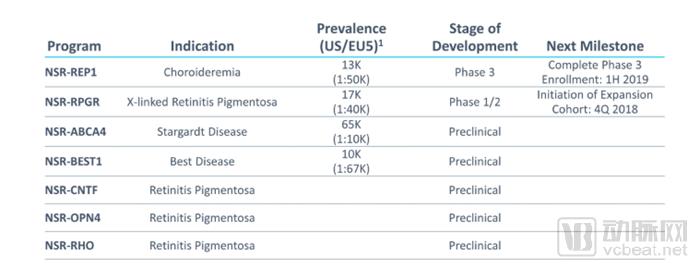
Nightstar’s R&D Pipeline (Image from Nightstar’s official website)
NSR-REP1: Patient recruitment for the Phase III clinical trial is expected to be completed in H1 2019
Nightstar’s primary asset is the investigational drug NSR-REP1, indicated for the treatment of choroideremia (CHM). CHM predominantly affects males and can lead to severe vision loss or blindness, representing an unmet medical need.
Choroideremia (CHM) is caused by loss-of-function mutations in the CHM gene, which encodes Rab escort protein-1 (REP-1). The REP-1 protein plays a role in intracellular protein trafficking; therefore, loss of CHM gene function leads to aberrant intracellular protein transport and impairs the clearance of metabolic waste from retinal pigment epithelial cells and photoreceptors. Initially, patients with CHM experience impaired night vision, which progresses over time to gradual vision loss, ultimately resulting in complete blindness.
NSR-REP1 is a gene therapy for the treatment of choroideremia (CHM), consisting of an AAV2 vector containing recombinant human complementary DNA (cDNA) designed to produce REP1 within the eye. During treatment, NSR-REP1 is injected into the subretinal space between the outer layers of the retina. The introduction of a functional CHM gene aims to enhance the expression of the REP1 protein, thereby reducing waste accumulation in retinal cells and slowing or halting vision loss.
NSR-REF1 is administered via a three-step surgical procedure. In the first step, the surgeon removes a portion of the vitreous humor located between the lens and the retina to obtain a clear surgical field. In the second step, the surgeon creates a bleb-like space filled with balanced salt solution in the subretinal space. In the third step, NSR-REF1 is injected into the bleb-like balanced salt solution space.
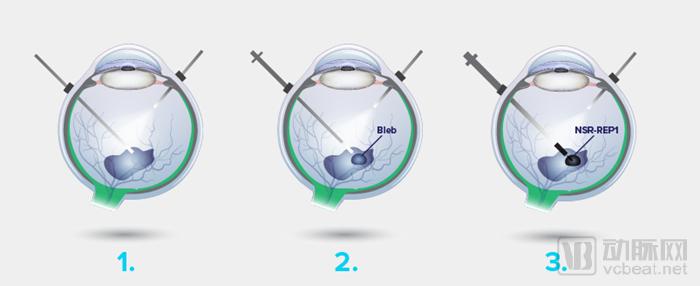
NSR-REF1 Three-Step Surgical Procedure Schematic Diagram. Image source: Nightstar official website
Phase I/II clinical trial data for NSR-REP1 from Nightstar showed that, compared with the control group, the decline in visual acuity was significantly slowed in patients in the treatment arm, with some patients experiencing improvements in vision. Currently, NSR-REP1 is undergoing Phase III clinical trials, with patient enrollment expected to be completed in the first half of 2019 and trial results anticipated to be released in the second half of 2020.
Furthermore, Nightstar researchers observed significant improvements in vision in certain patients following treatment with NSR-REP1, leading them to hypothesize that enhanced REP1 expression may also slow or reverse the early stages of cell death in already compromised retinal cells.
NSR-RPGR: Phase II/III dose expansion ongoing
Nightstar’s second clinical-stage program is NSR-RPGR, indicated for X-linked retinitis pigmentosa (XLRP). XLRP is a rare inherited retinal disease that predominantly affects males.
XLRP is characterized by mutations in the retinitis pigmentosa GTPase regulator (RPGR) gene, leading to impaired active protein transport in photoreceptors. This abnormality results in photoreceptor loss, causing retinal dysfunction during adolescence and early adulthood, with progression to blindness by the age of 40.
NSR-RPGR consists of an AAV vector administered via subretinal injection, which delivers a functional RPGR gene and thereby enables the expression of the RPGR protein, which is critical for protein transport in photoreceptors. The restoration of photoreceptor function aims to slow, halt, or potentially reverse vision loss. Data from the Phase I/II dose-escalation portion of the XIRIUS trial for NSR-RPGR demonstrated an increase in central retinal sensitivity. NightstaRx is currently conducting the Phase II/III dose-expansion portion of the XIRIUS trial.
Meanwhile, Nightstar has a robust preclinical pipeline, including NSR-ABCA4 for Stargardt disease and potential therapeutics for Best vitelliform macular dystrophy (Best disease) and other hereditary forms of retinitis pigmentosa. Through this acquisition, Biogen will bring the aforementioned pipeline under its umbrella.
Previously, Artery New Medicine compiled a list of acquisitions or collaborations in the gene therapy sector involving major pharmaceutical companies in recent years, and will now soon add Biogen’s acquisition of Nightstar to this list. (See details in “Rare Disease Day | A Review of How 99 Companies Are Tackling Rare Diseases with Gene Therapy》) This article excerpts the section on “Big Pharma’s Strategic Layout in Gene Therapy.”
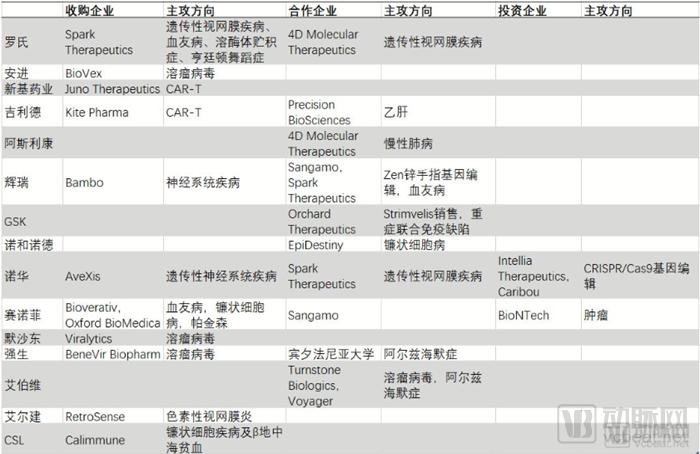
List of Major Pharmaceutical Companies’ Acquisitions of Gene Therapy Firms | Data Source: VCBeat New Medicine, compiled from public information
Roche: $4.3 Billion Acquisition of Spark
In February 2019, Roche acquired Spark Therapeutics for $4.3 billion, gaining access to its gene therapy drug Luxturna, which was approved in 2017, as well as its pipeline of investigational therapies for inherited retinal diseases (IRDs), liver-mediated disorders, hemophilia, lysosomal storage disorders, Huntington’s disease, and other conditions. Notably, the FDA had hailed Luxturna as a landmark drug.
Celgene: $9 Billion Acquisition of Juno Therapeutics
In January 2018, Celgene acquired Juno Therapeutics for $9 billion. At the time, Juno Therapeutics’ lead product candidate, JCAR17—a CD19-targeted CAR-T cell therapy—was undergoing Phase II clinical trials for the treatment of acute myeloid leukemia (AML). On January 4, 2019, Celgene was acquired by Bristol Myers Squibb (BMS) for $74 billion.
Novartis: $8.7 Billion Acquisition of AveXis
In April 2018, Novartis acquired the U.S. gene therapy company AveXis for $8.7 billion in cash. AveXis’s novel drug, AVXS-101, has the potential to become the first one-time gene replacement therapy for spinal muscular atrophy (SMA). Novartis noted that SMA is a hereditary neurodegenerative disease caused by a single-gene defect, affecting approximately 1 in every 6,000 to 10,000 newborns.
Sanofi: $11.6 Billion Acquisition of Bioverativ
In January 2018, Sanofi announced the acquisition of Bioverativ for $11.6 billion. Interestingly, Bioverativ was a hemophilia drug manufacturer spun off from Biogen in early 2017, known for its extended half-life therapy—Eloctate®and Alprolix®Used to treat hemophilia A and B, respectively, they represent the first major advances in the hemophilia market in nearly two decades. In 2016, Bioverativ generated $847 million in sales and $41 million in royalties.
Following an analysis by VCBeat, it has been observed that large pharmaceutical companies are often willing to offer high premiums for targeted acquisition candidates. This generous spending is underpinned by their strong desire for high-quality assets. Building on our previous review of 99 global biotechnology companies engaged in gene therapy research, we have identified the nine most promising acquisition targets for the future.
4D Molecular Therapeutics(4DMT)
Status: Series B
Total Funding: $100 Million
Disease Areas and Most Advanced Pipeline: Inherited Retinal Degenerations (IND), Age-Related Macular Degeneration (AMD), Choroideremia
4DMT is a gene therapy company with a transformative discovery platform for therapeutic vector evolution, capable of inventing optimized and proprietary AAV vectors, each specifically designed to treat rare diseases with high unmet medical needs.
In 2018, entered into an extensive long-term partnership with 4D Molecular Therapeutics to develop and promote a range of ophthalmic products.
In July 2018, MedImmune, AstraZeneca’s global biologics research and development arm, and 4D Molecular Therapeutics (4DMT) announced a collaboration to jointly leverage 4DMT’s novel discovery platform to generate optimized AAV vectors, with the aim of delivering gene therapies for patients with chronic lung diseases.
MeiraGTx
Status: IPO
Current Share Price: $17.54
Disease Area and Fastest-Advancing Pipeline: Inherited Retinal Diseases – Cone Dystrophy (Phase I/II Clinical Trials)
MeiraGTx is dedicated to the development and commercialization of innovative gene therapy products to transform the lives of patients with acquired and genetic diseases. MeiraGTx is a vertically integrated, clinical-stage gene therapy company with five ongoing clinical programs and an extensive pipeline of preclinical and research initiatives.
MeiraGTx possesses core capabilities in viral vector design and optimization, gene therapy manufacturing, and potentially transformative gene regulation technologies. Led by an experienced management team, MeiraGTx employs a portfolio approach that leverages licensing, acquisition, and development of technologies to deepen our understanding of candidate products and indications. While initially focused on the eyes, salivary glands, and central nervous system, MeiraGTx intends to expand its R&D focus in the future to develop additional gene therapy treatments for patients suffering from a range of serious diseases.
Voyager
Status: IPO
Current Stock Price: $18.19
Disease Areas and Fastest-Advancing Pipelines: Amyotrophic Lateral Sclerosis, Parkinson’s Disease (Phase II Clinical Trials), Chronic Pain, Huntington’s Disease
Voyager is a gene therapy company dedicated to developing treatments for debilitating diseases of the central nervous system (CNS). Founded in 2013 and headquartered in Massachusetts, USA, Voyager advances AAV gene therapy through innovation and investment in vector optimization and engineering, delivery technologies, as well as process development and manufacturing. The company’s initial R&D focus is on novel therapies for CNS disorders, including Parkinson’s disease and Friedreich’s ataxia.
BlueBird Bio
Status: IPO
Current Share Price: $152.83
Disease Areas and Fastest-Advancing Pipeline: Multiple Myeloma (Phase II/III Clinical Trials), Sickle Cell Disease, Leukodystrophy, Thalassemia (Phase III Clinical Trials)
bluebird bio, formerly known as Genetix Pharmaceuticals, specializes in gene therapy and seeks breakthrough treatments for severe genetic disorders. The company’s platform treats genetic diseases by inserting healthy genes into bone marrow stem cells extracted from patients and then transplanting these corrected stem cells back into the patients.
Bluebird Bio’s primary clinical product is LentiGlobin for adrenoleukodystrophy (ALD).®, currently in the clinical development stage. The ongoing ALD trial is based on work completed by the French National Institute of Health and Medical Research (INSERM), the results of which were named a “2009 Breakthrough of the Year” by Science magazine. In addition to patients with adrenoleukodystrophy, bluebird bio is conducting LentiGlobin®The product is undergoing Phase I/II clinical trials for thalassemia, the most common human genetic disorder. To date, all patients who have received the full treatment regimen have been cured and are in good health. Furthermore, bluebird bio’s proprietary technologies in stem cell processing, GMP manufacturing, and gene therapy vectors are also applicable to the treatment of other genetic diseases.
Sarepta Therapeutics
Status: IPO
Current Stock Price: $145.48
For the most rapidly advancing pipelines by indication: Duchenne Muscular Dystrophy, Pompe Disease
Sarepta Therapeutics, Inc. is a biopharmaceutical company dedicated to the discovery and development of precision gene therapies for rare neuromuscular diseases. Sarepta’s unique technology has yielded multiple RNA-based therapeutics, including its lead clinical candidate, eteplirsen, for the treatment of Duchenne muscular dystrophy.
Mustang Bio
Status: IPO
Current Share Price: $3.77
Disease Area and Fastest-Advancing Pipeline: X-Linked Severe Immunodeficiency (Phase II Clinical Trial)
Mustang Bio is a biopharmaceutical company focused on developing novel immunotherapies based on breakthrough chimeric antigen receptor (CAR) research. It specializes in the development and commercialization of a broad portfolio of patented chimeric antigen receptor-engineered T cell (CAR-T) immunotherapies and gene therapies. Mustang Bio collaborates with leading medical institutions to advance CAR-T and CRISPR/Cas9-enhanced CAR-T therapies for various cancers, as well as lentiviral gene therapy for X-linked severe combined immunodeficiency (XSCID).
Intellia Therapeutics
Status: IPO
Current Share Price: $16.59
Disease Areas and Fastest-Advancing Pipeline: Transthyretin Amyloidosis (Early-Stage Development), Primary Hyperoxaluria, Alpha-1 Antitrypsin Deficiency, Leukemia, Sickle Cell Disease, Beta-Thalassemia
Intellia Therapeutics is a biotechnology company primarily dedicated to advancing its unique CRISPR/Cas9 gene-editing technology for medical applications, such as the treatment of leukemia and cancer. One of the co-founders of Intellia Therapeutics is Professor Jennifer Doudna of the University of California, Berkeley, a pioneer in CRISPR research.
CRISPR Therapeutics
Status: IPO
Current Stock Price: $39.92
Disease Areas and Fastest-Advancing Pipelines: Sickle Cell Disease, Oncology, Glycogen Storage Diseases, Cystic Fibrosis
CRISPR Therapeutics is a gene-editing company that develops genetic medicines for various diseases through its CRISPR/Cas9 gene-editing platform, researching treatments for conditions such as cystic fibrosis, blindness, blood disorders, and congenital heart disease. CRISPR/Cas9 is a revolutionary technology that enables direct and precise gene editing.
Editas
Status: IPO
Current Share Price: $23.82
Disease Areas and Fastest-Advancing Pipeline: Leber Congenital Amaurosis, Inherited Retinal Diseases
Editas Medicine is a leading genome editing company dedicated to treating patients with genetic diseases. CRISPR is currently the company’s primary area of research. Its founding team includes Feng Zhang, a pioneer in the field of CRISPR, and George Church, a dual member of the U.S. National Academy of Sciences and the National Academy of Engineering, as well as a Professor of Genetics at Harvard Medical School.