

China's First Diabetes Knowledge Graph Debuts: Tianchi Competition Outcomes Empower 'Ruining Assist-Sugar' for Optimized Medication Recommendations

AliHealth
Medical and Health Services Network Service Provider
Recently, the final results of the new round of the Tianchi Competition—the “Ruijin Hospital MMC AI-Assisted Knowledge Graph Construction Competition,” jointly organized by Alibaba Cloud, Shanghai Ruijin Hospital, and AliHealth—were announced. Young scholar teams from Harbin Institute of Technology, Peking University, and Jiangnan University stood out among nearly 2,000 developers, securing the top three spots respectively.
In cutting-edge fields such as artificial intelligence, what outcomes has the Tianchi platform, with its community of 250,000 developers, produced by harnessing collective intelligence? Furthermore, how can the results of technology-driven competitions be integrated with enterprises and hospitals for practical application? We found the answers in the competition’s outcome translation product unveiled at this event: China’s first “Machine Intelligence-Based Knowledge Graph for Diabetes.”
Endocrinologist Shortage Is Significant; Machines Can Replace Repetitive Tasks
“My father is a diabetic patient. I initially entered the competition because of him, hoping to leverage my technical expertise to help more diabetes patients like him. Technology should not exist merely for show; it should contribute to the well-being of all humanity,” said a participating developer when discussing his original motivation for joining the competition.
According to the 8th edition of the IDF Diabetes Atlas, China had 114.4 million people with diabetes in 2017, ranking first globally. Even based on the ratio of one physician managing 1,000 patients, this would require 100,000 physicians. However, the current number of endocrinologists in China falls far short of 100,000, leaving many patients unable to access high-quality chronic disease management services. Furthermore, the varying levels of diagnostic and therapeutic expertise for diabetes across healthcare institutions at different tiers adversely affect patients’ treatment experiences.
To achieve optimal diabetes management outcomes with maximum efficiency, the National Standardized Metabolic Disease Management Center (MMC), initiated by Ning Guang—an academician of the Chinese Academy of Engineering, Vice President of Ruijin Hospital affiliated with Shanghai Jiao Tong University School of Medicine, and Director of the National Clinical Research Center for Metabolic Diseases—adopts an integrated diagnosis and treatment workflow to standardize diabetes care.
MMC adopts a “1+X” model, in which one MMC central hospital is linked with multiple surrounding community hospitals, forming a two-way referral system for patients that flows from the national-level MMC center to MMC central hospitals and then to multiple community health centers. Consequently, issues such as an insufficient number of physicians—particularly primary care providers—and uneven professional competency have become major constraints affecting the treatment and rehabilitation of patients with diabetes.
Academician Ning Guang stated, “Primary care physicians, especially general practitioners, need to manage a wide variety of diseases and often cannot achieve the level of ‘specialized expertise.’ How to enable primary care physicians to manage these conditions with the same proficiency as specialists is a critical issue that MMC needs to address.”
Moreover, physicians are heavily burdened with repetitive tasks, and chronic fatigue can easily lead to missed or incorrect diagnoses. “Shifting more of these established repetitive tasks to machines, thereby allowing physicians to focus more on the irregular aspects of diseases, is a crucial component of disease treatment.”
First Diabetes Knowledge Graph Released, Empowering Ruining Zhutang to Optimize Medication Regimens
In September 2018, the Alibaba Cloud Tianchi Competition launched a challenge to leverage artificial intelligence in constructing a diabetes knowledge graph. Over the past six months, it has attracted 1,629 teams and 1,817 developers from eight countries and regions, including China, the United States, Japan, Denmark, and Singapore.
Among the teams attracted were not only renowned domestic and international universities such as Peking University, Zhejiang University, Harbin Institute of Technology, and the National University of Singapore, but also numerous Chinese enterprises, drawing significant attention within the industry.
The competition organizer, Ruijin Hospital, provides academic papers and clinical guidelines related to diabetes. The topic for the first season is “Construction of Annotations Based on Diabetes Clinical Guidelines and Research Papers,” requiring participants to perform entity annotation based on academic papers and clinical guidelines. The topic for the second season is “Construction of Inter-entity Relationships Based on Diabetes Clinical Guidelines and Research Papers,” where participants will extract relationships between entities. The champion will be determined through preliminary rounds, semi-finals, and final defenses, combining scores from online submissions and offline defenses.
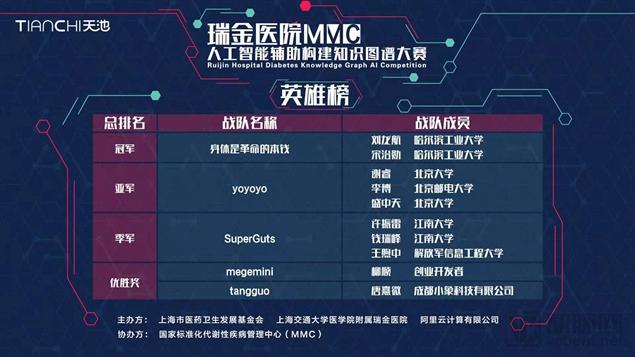
Through annotation efforts, the competition team created China’s first text-annotated dataset in the field of diabetes, labeling nearly 190,000 Chinese entities. Ultimately, developers leveraged efficient algorithms to mine literature from diabetes-related textbooks and research papers, constructed a knowledge graph, and deeply integrated it with Ruining Zhutang to accelerate product iteration.
Rewinding to 2016, Ning Guang’s team collaborated with Alibaba to launch “Rui Ning Zhu Tang” for the first time. This AI assistant for diabetes physicians is a software system built on two machine learning components: an experience model and a knowledge model. Leveraging deep learning techniques, the system constructs its experience model using over 1,000 real-world diabetes cases combined with the clinical expertise of 300 diabetes specialists. Simultaneously, it establishes a knowledge base by integrating various diabetes guidelines and domestic and international literature databases. By incorporating the pathogenic mechanisms and standardized clinical data for more than 100 potential complications associated with diabetes—such as dyslipidemia, hypertension, and obesity—the system provides diagnostic recommendations to physicians.
After undergoing several iterations, “Rui Ning Zhu Tang,” which leverages the knowledge graph construction outcomes from the Tianchi Competition, has ushered in a significant transformation and upgrade three years later.
Gu Fei, an algorithm expert at Alibaba Cloud, stated while presenting the results that the role of knowledge graphs lies in the following three aspects: First, they can transform unstructured data, such as electronic medical records and scientific research papers, into structured formats, which is “a crucial step for subsequent artificial intelligence research.” Second, knowledge graphs can integrate various literature materials and extract entity relationships. Third, the process of constructing knowledge graphs provides a solid foundation for subsequent AI-assisted diagnosis and intelligent medication recommendations.
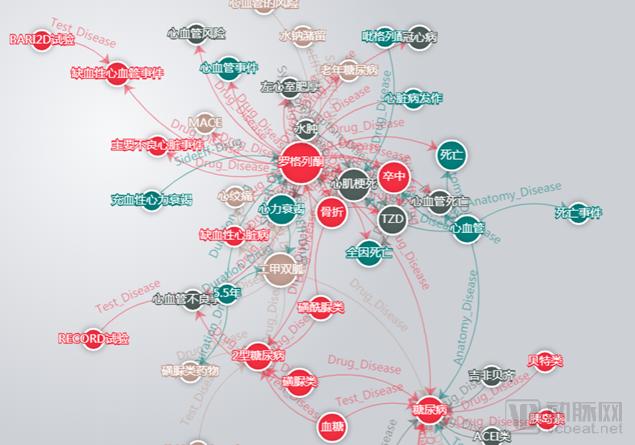
Knowledge Graph Example, Image Provided by the Company
Taking practical operation as an example, first input patient-related information and symptoms on the "Rui Ning Zhu Tang" interface to make a diagnosis of diabetes and its complications based on test results such as blood glucose and blood lipids; secondly, provide treatment recommendations for doctors' reference, offering standardized medication advice for diabetes based on extensive medical guidelines and academic papers; finally, clicking on specific recommended drugs will link to a knowledge graph centered on that drug, including entity relationships such as drug names with diseases and drug names with side effects. Additionally, the right side of the interface will display the latest research literature related to the drug, which updates in real-time as the database is updated.
For instance, after entering a specific medical record, if medication recommendations for Type 2 diabetes are generated—including metformin or acarbose—clicking on “acarbose” will display a knowledge graph centered on “acarbose.” Within the entity relationships, adverse effects such as “diarrhea” are included, while relevant literature associated with “acarbose” is simultaneously displayed on the right-hand side to provide reference for physicians.
Simulating Expert Reasoning to Assist Primary Care Physicians in Making Scientific Decisions
A knowledge graph is essentially a semantic network. Its nodes represent entities or concepts, while edges denote various semantic relationships between these entities/concepts.
Xie Xuansong, Head of Healthcare at Alibaba DAMO Academy, stated: “Human understanding of knowledge is often linear, whereas a knowledge graph is an ‘interconnected web.’ It involves inherently complex relationships and high levels of specialization. Each piece of text is closely tied to human life and health and encompasses massive amounts of data. Therefore, every stage in the construction of a medical knowledge graph presents its own unique challenges.”
Challenges in Constructing a Medical Knowledge Graph, Particularly for DiabetesThe difficulties in building a medical knowledge graph, especially one focused on diabetes, lie in the following aspects: 1. In clinical practice, a vast amount of medical documentation exists in textual form, which is not only massive in volume but also unstructured, thereby increasing the complexity of text processing; 2. Diabetes is a chronic disease with a prolonged course, where the relevant knowledge points corresponding to symptoms may vary across different stages. Furthermore, diabetes is among the chronic conditions associated with the highest number of complications, each of which corresponds to a distinct knowledge system. This results in the content and scale of the knowledge graph being significantly larger than those for typical diseases.
By annotating nearly 190,000 data entries, the construction of a diabetes knowledge graph has enabled Ruining Zhutang to upgrade its structured capabilities, effectively assisting physicians in correcting and optimizing medication regimens for patients.
Furthermore, in physician training, in addition to summarizing knowledge from existing literature, RuiNing ZhuTang can leverage algorithms to mine new knowledge and establish novel associations. When new clinical studies emerge, the application of artificial intelligence for annotation and contributions from knowledge graphs may uncover latent relationships, thereby enabling physicians to update their medical knowledge in real time.
Fan Yi, head of AliHealth’s Medical Brain, stated that computers can assist in the processes of knowledge acquisition and determination. This is akin to creating a more user-friendly “medical dictionary,” with the computer serving as its medium. The computer then presents its determinations in textual form, much like how a physician applies their expertise to diagnose diseases and presents their findings in a similar manner.
Academician Ning Guang stated that constructing a comprehensive knowledge graph for diabetes facilitates closed-loop management encompassing prediction, intervention, monitoring, and education. This approach can closely replicate the medication reasoning of experts in diabetes treatment, assist primary care clinicians in making more scientific decisions, enhance their prescribing skills, and further improve consultation efficiency while lowering barriers to healthcare access. Meanwhile, it holds significant importance for medical research on diabetes.
“It is crucial to effectively utilize medical history data; however, our previous efforts in this regard have been inadequate. Leveraging existing data holds significant importance for supporting physician development and enhancing clinical diagnosis and treatment.”
It is reported that the upgraded “RuiNing ZhuTang” is expected to be first used at Ruijin Hospital in March, officially launched in May, and further promoted across China to serve more doctors and patients.

—“Could the data from Ruijin Hospital be made publicly available for academic research as soon as possible? Eagerly awaited. Thank you!”
Three months before the final results were announced, a user posted the aforementioned thread on the competition’s forum, demonstrating that there had long been a demand for open datasets. The nearly 190,000 Chinese entities annotated in this Tianchi Competition constitute the most fundamental and critical dataset for artificial intelligence applications in the medical field, holding significant scientific and practical value, and are poised to become the standard for AI in diabetes care.
“Our mission begins with competitions and culminates in ecosystem building. We hope to leverage our platform to foster an ecosystem that connects medical professionals with AI developers,” said Gu Fei.
In addition, he revealed that multiple Tianchi competitions related to healthcare will be held in the near future. As a developer community and crowdsourcing intelligence platform for global AI experts and technology enthusiasts, the Tianchi platform currently hosts over 190,000 active tech enthusiasts worldwide and more than 200 innovative startups and teams in the big data sector. By 2020, the platform is expected to cultivate 300,000 AI engineers. “We aim to develop in a more vertical direction, including supporting startups that are gradually embarking on research or entrepreneurial ventures at the intersection of healthcare and artificial intelligence.” At that time, more competition outcomes will be translated into practical applications, assisting physicians in improving the efficiency of clinical diagnosis and treatment, thereby serving as better medical tools.