

AI + Pharma: Six Key Application Scenarios and Strategic Moves by Novartis, GSK, and Sanofi to Capture the Digital Transformation Wave
In recent years, continuous technological innovation has helped transform the pharmaceutical industry, reduce costs, and create greater value. From personalized therapy to prevention, technological advancements are challenging the traditional business models of pharmaceutical companies.
Among the many emerging technologies, artificial intelligence and advanced analytics are garnering increasing attention from the pharmaceutical industry. The value of these technologies lies in their ability to rapidly process large volumes of complex structured and unstructured data, providing actionable recommendations for stakeholders, thereby reducing costs, shortening drug time-to-market, and securing a competitive advantage in the marketplace.
VCBeat (WeChat ID: vcbeat) compiled the report “Applications of Artificial Intelligence and Advanced Analytics in the Pharmaceutical Industry” released by FICCI.
FICCI is the acronym for the Federation of Indian Chambers of Commerce & Industry. Established in 1927, it is India’s oldest national chamber of commerce. The federation comprises more than 500 regional and industry-specific chamber members, spanning all sectors of Indian industry and commerce. It represents 250,000 companies, which collectively employ approximately 20 million people. FICCI also maintains extensive ties with the global business community, having established Joint Business Councils (JBCs) with 74 countries and regions. This report offers readers a perspective on the landscape of AI in pharmaceuticals and healthcare as seen by FICCI.
Currently, the global pharmaceutical industry is undergoing two major transformations. First, the entire healthcare value chain is shifting, with governments and insurance companies acting as central forces that pressure pharmaceutical companies to lower prices and enhance drug value. Second, the healthcare model is gradually transitioning from a treatment-focused approach to one centered on prevention, diagnosis, and cure, attracting a large number of competitors from both within and outside the industry. This transformation is driven by three developmental trends: breakthrough innovative therapies, technological advancements, and healthcare consumerism enabled by the acquisition and analysis of patient data.
While most current applications remain focused on drug discovery, the practical use of artificial intelligence (AI) is being further explored in other areas, including drug dosing and medication safety, manufacturing and supply chain management, and commercialization. In terms of AI and advanced analytics, pharmaceutical companies need to strategically select their business focus areas and partners. It is evident that pharmaceutical firms are increasingly emphasizing collaborative partnerships, with the most frequent collaborations being those with technology startups.
Looking ahead, the “technology + pharmaceuticals” market holds immense growth potential. This is because market leaders have reaped high returns, which, while exerting considerable pressure on other competitors, also encourages more players to enter the competitive landscape. Furthermore, driven by startups, the applications of these technologies are extensive. Meanwhile, regulatory agencies need to transform their traditional approaches to medical device approval and equip themselves with relevant technical expertise and specialized personnel to accelerate the evaluation and approval of these emerging technologies.
Technological advancements are enabling possibilities for many complex issues in diverse ways. Digital technologies, including mobile communications, cloud computing, advanced analytics, and the Internet of Things (IoT), are disrupting traditional industries such as industrial manufacturing, retail, telecommunications, banking, and pharmaceutical manufacturing. Various drivers are accelerating digital transformation in the pharmaceutical sector:
· Improve efficiency and reduce the cost of pharmaceutical R&D;
· Optimize product quality to ensure the production process is more compliant with specifications;
· Increase patient engagement to boost repurchase rates;
· Enhance the level of disease diagnosis and treatment;
· Identify patient needs to reduce the gap between supply and demand;
· Broaden product variety and service scope.
In the realm of emerging technologies, artificial intelligence and advanced analytics are challenging the traditional business models of pharmaceutical companies. Consequently, some technology firms may propose new business models distinct from those of traditional pharmaceutical companies, striving to gain their acceptance. As the volume of data generated by the pharmaceutical industry grows exponentially, the top priority for pharmaceutical enterprises is to leverage this data to drive value. The ultimate goal is to streamline the pharmaceutical value chain, enhance drug production efficiency and approval rates, and reduce costs.
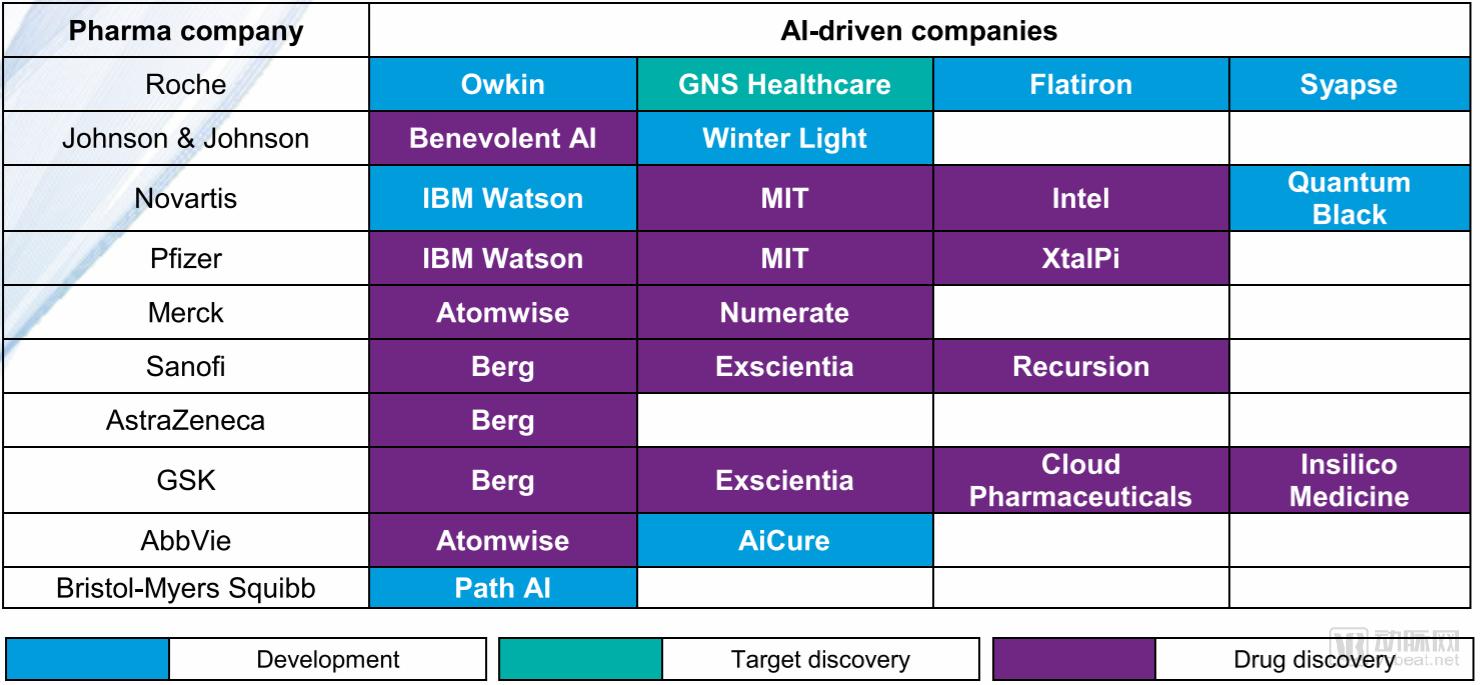
To better develop emerging technologies, top pharmaceutical companies have made substantial investments in this field and formed strategic alliances with artificial intelligence firms to integrate AI technology into their value chains.
Figure 1: Strategic Layouts of Leading Global Pharmaceutical Companies in AI-Driven Drug Development
 Source: FICCI
Most of these companies have chosen to form strategic alliances with artificial intelligence (AI) firms to leverage AI for drug research and development. As these collaborations lie at the core of pharmaceutical companies’ operations, some pharmaceutical firms also believe they need to develop relevant technologies in-house, such as those related to drug dosing and medication safety.
Artificial intelligence in the pharmaceutical industry is gradually shifting from its initial R&D phase to post-consumption stages.
Some development trends in this industry include:
Drug R&D:Large pharmaceutical companies are choosing to develop their own AI technologies or collaborate with AI startups to accelerate the drug development process and achieve personalized medicine;
Medication Dosage and Medication Safety:Artificial intelligence can customize medication dosages for each patient based on their condition and characteristics. AI is applied across all stages of the safety value chain to enhance overall quality and medication adherence;
Pharmaceutical Production and Supply Chain:Artificial intelligence is being used to optimize drug verification and counterfeit drug identification throughout the entire production process;
Commercialization:Artificial intelligence is increasingly being used for patient triage to enhance drug efficacy and reduce adverse reactions;
Regulatory Approval:Simplify the approval process for clinical drugs to make it faster and more transparent.
In India, pharmaceutical companies have only recently begun applying artificial intelligence to drug research and development and product supply chains. Drug discovery remains a key focus of the pharmaceutical industry’s digital transformation, as AI can identify specific drug molecules by scanning databases.
1. AI + Drug R&D
The drug discovery process typically involves the identification of a vast number of compounds. Artificial intelligence can streamline this process by using algorithms to examine the chemical properties of molecules to determine their potential for drug development. Pharmaceutical companies such as GlaxoSmithKline (GSK), Sanofi, Takeda Pharma, and Merck have established various partnerships with AI startups:
GSK has partnered with the UK-based AI startup Exscientia, investing $43 million in drug R&D to identify small molecules for 10 selected targeted drugs in undisclosed therapeutic areas. Sanofi has signed a strategic collaboration agreement worth $283 million with Exscientia to develop new therapies for diabetes and other metabolic diseases.
Drug repurposing is another common use case—finding new applications for existing drugs. Different algorithms can identify new potential indications for existing drugs or candidate drugs in late-stage development.
Repurposing drugs in late-stage development for new therapeutic indications is a preferred strategy for many biopharmaceutical companies. For instance, Sanofi has partnered with the AI startup Recursion Pharmaceuticals to jointly conduct drug R&D, aiming to leverage Sanofi’s clinical-stage small molecules for the treatment of various genetic diseases. Astellas Pharma has collaborated with the big data bioinformatics company NuMedii to utilize machine learning technologies for drug repurposing.
Biomarker development is a critical phase in drug R&D, with artificial intelligence (AI) seeing increasing application in this field. Sanofi Pasteur, the global leader in influenza vaccines, leverages Berg Health’s platform and AI tools to identify molecular signatures and develop potential biomarkers for assessing immune responses to influenza vaccines.
Furthermore, pharmaceutical companies are increasingly focusing on digital biomarkers, which facilitate the acquisition of clinically meaningful objective data and enhance cost-effectiveness.
2. AI + Medication Safety
Drug Dosage: The National University of Singapore has developed an artificial intelligence platform named “CURATE.AI.” It leverages patients’ clinical data, such as medical history, to rapidly identify optimal drug dosages and adjust them based on tumor size or tumor biomarker levels. These data can also be used to tailor treatment regimens to individual patient needs.
Clinical Safety: Agios Pharmaceuticals leverages natural language processing (NLP) to enable its systems to make rapid and comprehensive decisions. This technology can also identify safety signals through exploratory research for use in preclinical drug development. Furthermore, NLP can be applied to analyze patient symptom patterns to help determine whether patients are at high risk.
Non-Clinical Safety: Merck leverages NLP technology to automate workflows, integrating unstructured and structured data for analysis, and creating visual business intelligence dashboards for the safety assessment team. This process enables the company to identify anomalies that would only be detectable through long-term testing.
Pharmacovigilance: GSK’s clinical safety team continuously identifies relevant safety signals by reviewing medical literature. With a portfolio of nearly 200 products, GSK leverages natural language processing (NLP) to enhance research efficiency and language processing speed, standardize the search process, and accelerate the identification of associations between drugs and adverse events.
3. AI + Drug Manufacturing and Supply Chain
Veripad leverages machine learning technologies to identify counterfeit drugs in the supply chain. The organization has designed a chemical test card for the rapid detection of ingredients in common medications. By using this test card in conjunction with its corresponding mobile application, counterfeit drugs can be identified. Furthermore, Veripad employs data analytics techniques to aggregate the results of each test, thereby gaining better insights into the distribution patterns of counterfeit and substandard medicines. Regarding drug classification, Veripad’s first-generation application has achieved an accuracy rate of 80%. A research team at New York University has also utilized machine learning technologies to develop a new mechanism for distinguishing between genuine and counterfeit versions of the same product.
4. AI+ Market Expansion and Commercialization
A global pharmaceutical company has partnered with artificial intelligence and analytics firm Aktana to streamline its multichannel marketing (MCM) processes. The company believes that physicians are more likely to open and respond to emails sent by pharmaceutical sales representatives than to automated messages. Based on this insight, the company decided to simplify its patient engagement channels with Aktana’s assistance.
Given the complexity and time-consuming nature of these processes, Aktana assists pharmaceutical companies in pre-synthesizing data, sending scheduled emails, and tracking interactions within Customer Relationship Management (CRM) systems. After adopting Aktana’s recommendations, the company experienced a 23-fold increase in customer email volume and a two-fold improvement in email engagement.
5. AI-Driven Personalized Diagnosis and Treatment for Patients
Oncology has long been one of the primary research areas in the pharmaceutical industry, with a focus on identifying optimal treatments for tumors and cancer. To achieve this goal, clinicians must first determine the appropriate therapeutic approach based on the specific etiology of each patient.
IBM Watson leverages its advanced technologies in data analytics and machine learning to analyze data from electronic health records (EHR) and related information, thereby facilitating further research into optimal treatment plans tailored to individual patients.
Furthermore, artificial intelligence is being used to help match patients with clinical trials, which helps improve the outcomes of cancer clinical trials. Novartis has partnered with IBM Watson to apply such solutions in the field of advanced breast cancer and plans to expand into broader oncology areas. The two companies aim to improve patient treatment outcomes by analyzing real-time patient data.
Hungarian startup Turbine has partnered with German pharmaceutical giant Bayer to integrate artificial intelligence into cancer treatment. Turbine aims to create digital simulations of cancer cells using gene sequencing, with software capable of running millions of simulations to identify optimal therapeutic combinations. By significantly shortening trial cycles, this approach can help pharmaceutical companies achieve high returns on investment. Furthermore, in the absence of a clear treatment plan, Turbine’s AI platform can test millions of therapeutic combinations to determine the most suitable regimen.
6. AI+ Enables Patient Connectivity Through Telemedicine and Mobile Health
London-based AI health app developer Ada Health has launched a telemedicine application. Leveraging artificial intelligence and natural language processing (NLP), the app generates relevant questions and recommendations based on patients’ symptoms. Its design was inspired by the company’s recognition that the pharmaceutical and healthcare industries are adopting patient-centric models. The application enables physicians to collaborate with AI assistants in providing patient care. Furthermore, Ada Health has partnered with the pharmacy Karepack to deliver prescription medications directly to patients’ homes.
For pharmaceutical companies, merely recognizing these two shifts—lowering prices while enhancing the value of their therapies, and transitioning from a treatment-focused model to one centered on prevention, diagnosis, and cure—is insufficient. The greatest challenge facing pharmaceutical enterprises lies in how to adapt swiftly and decisively, in a comprehensive manner, to the implications these changes have for their business and operational models.
Meanwhile, pharmaceutical companies are increasingly adopting technologies such as artificial intelligence and advanced analytics. This not only helps improve efficiency and reduce costs but also enables them to adapt to patient-centric business models. Key factors such as automation, efficiency, and collaboration will play a significant role in reshaping the patient-centric landscape of the pharmaceutical industry.
The integrated application of these technologies will become a future trend, reshaping the overall landscape of the pharmaceutical value chain. Whether through collaborations with AI startups or the development of in-house capabilities, pharmaceutical companies are undergoing digital transformation and investing in artificial intelligence. Although only a small fraction of the pharmaceutical value chain has fully adopted these technologies to date, AI and advanced analytics are poised to transform this traditional industry in the coming years.
[Original Article Link]
http://ficci.in/spdocument/23066/Knowledge-Paper-India-Pharma-2019.pdf