

How Humana Pivoted to Innovation After Aetna's $34 Billion Acquisition Bid Was Blocked
Humana
Health Insurance Service Provider
In recent years, the pace of consolidation and restructuring among companies in the U.S. health insurance market has continued to accelerate, with frequent announcements of major acquisitions.
In early July 2015, U.S. insurance giant Aetna announced its intention to acquire peer company Humana for $34 billion. Despite Aetna’s persistent efforts to facilitate the deal since its announcement, the large-scale merger was ultimately blocked in January 2017 by a U.S. federal judge, who ruled that it violated antitrust laws.
Nevertheless, this incident has also sparked public curiosity about Humana: What kind of company is it, and what unique attributes made Aetna willing to acquire it at a premium? How has Humana positioned itself in the highly competitive U.S. health insurance market? VCBeat (WeChat Official Account: vcbeat) has reviewed the company’s development history and industry dynamics.
“Y2K” and the “Tigers”
Humana was founded in 1961 under the original name Heritage House, primarily focusing on nursing home operations, and was renamed Humana in 1974.
In the 1980s, Humana began developing its own insurance plans. In the 1990s, the company divested its hospital assets, enabling it to focus on developing insurance and healthcare service products. By the late 1990s, Humana had grown into the largest hospital company in the world.
In 1999, the company welcomed its new Chief Information Officer, Bruce Goodman. At that time, Humana was facing the global “Y2K” problem.
“The Millennium Bug,” also known as the “Year 2000 (Y2K) Problem,” refers to an issue in which various systems and devices—including computer software, hardware, and digital control chips—used two-digit codes to record years, with the first two digits implicitly assumed to be “19.” For example, “95” represented 1995. However, when the calendar rolled over to the year 2000, computers misinterpreted “00” as 1900, thereby causing date-related processing errors.
The impact of this systemic disruption on the insurance industry is:
First, damage to computer systems and machinery prevents insurance company staff from working normally, resulting in business interruption;
Second, computer systems may miscalculate the duration of each insurance policy, preventing physicians from obtaining patients’ medical records in a timely manner, or certain medical control systems may cease functioning, resulting in delayed treatment for patients and causing property damage or personal injury;
Third, this may lead to medical malpractice incidents, where policyholders file claims against insurance companies, resulting in substantial payout liabilities for the insurers, among other consequences.
After Bruce Goodman assumed office, Humana established an emergency team named the “Tiger Team” to address the “Y2K bug.” Humana chose this name to underscore the critical and urgent nature of the task, as well as the team’s determination to succeed. This group later evolved into the company’s Project Management Office (PMO), responsible for analyzing business issues requiring resolution, identifying solutions and assigning implementation personnel, and monitoring the entire project lifecycle. In early 2001, Humana reactivated the “Tiger Team” to prepare for compliance with the Health Insurance Portability and Accountability Act (HIPAA), the strictest U.S. federal legislation governing the exchange and confidentiality of health insurance information.
In 1996, the Clinton administration signed the Health Insurance Portability and Accountability Act (HIPAA), which had been passed by the Senate and the House of Representatives. The act aimed to streamline administrative processes, curb rising healthcare costs, and ensure that Americans retained health insurance coverage when changing jobs or becoming unemployed.
More importantly, it also establishes standards for the insurance industry in areas such as patient health, data exchange, and data confidentiality.
To meet data standard requirements, Humana established three emergency task forces building on the foundation of the “Tiger Team”: one responsible for electronic data interchange (EDI), one for privacy policies and practices, and one to address data security issues. The company directed these three groups to collaborate with staff from Internal Audit, Privacy, Security, Electronic Data Interchange (EDI), Legal, and Service Delivery departments to jointly respond to this urgent matter.
Following the Y2K and HIPAA incidents, the “Tiger Team” formally laid the foundation for Humana’s emergency response mechanisms, and Humana also established its core corporate strategy—leveraging information technology as the backbone of its business operations.
In its subsequent development, Humana has kept pace with technological changes, increasingly adopting emerging technologies such as robotic process automation, machine learning, cloud-native application platforms, and open innovation architectures. Its technological scope is comprehensive, ranging from big data processing and IoT-enabled device interactions to electronic health records, digital, mobile, and cloud-based systems, as well as traditional IT-related technologies.
Clearly Construct a Business Model for Sustainable and Stable Revenue Generation
Supported by technology, Humana has grown into one of the largest health insurance providers in the United States, offering a wide range of products and services to customers across multiple market segments. To cater to different customer groups, the company divides its business into three segments: Retail, Group, and Healthcare Services:
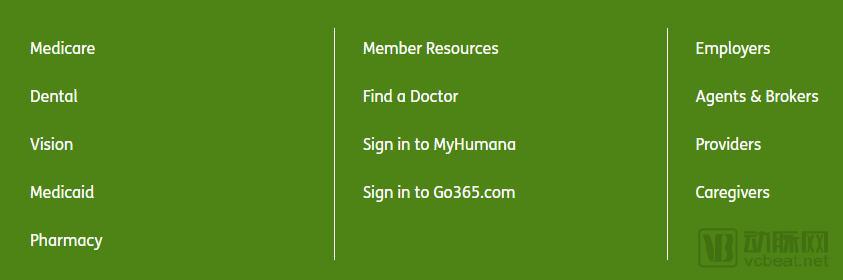
Humana’s Business Segments (Image source: Company website)
First is the retail business targeting individuals, including individual consumers under health welfare plans, particularly Medicaid, as well as individual commercial fully-insured medical and specialized health insurance benefits. The company primarily sells dental, vision, and other supplemental health and financial protection products to this customer segment.
Next is group business targeting employer groups, including employers and employer groups across various industries, commercial entities, government and public institutions, and other organizations such as non-profit organizations. The group business segment consists of fully insured commercial medical and specialized health insurance benefits for employer groups, including dental, vision, other supplemental health and voluntary insurance benefits, as well as administrative-services-only products.
Finally, healthcare services for healthcare service customers include certain corporate businesses, external health plan members, external health plans, and other employers or individuals. This segment comprises services provided to health plan members and third parties, such as pharmacy solutions, enterprise services, home-based services, and clinical programs.
In addition, Humana has entered into a contract with the U.S. Department of Defense to provide administrative services and arrange medical care for active-duty military personnel’s families, veterans, and their families.
In addition to providing the aforementioned diverse health and medical services, Humana also offers preventive care programs to assist individuals seeking to improve their health status. By leveraging intelligent analytics technologies and collaborating with clinicians, the company focuses on the social determinants of health, providing members with online resources and digital services to help them understand the latest health benefit plans.
Despite the rise of self-service models driven by technological advancements, Humana Inc. has adhered to a strategy of not employing such approaches for selling its products and services to customers. Given the current landscape, the company’s professional sales representatives are better positioned to accurately identify customer needs, deliver tailored solutions for each individual, and help their client base achieve their health goals.
Although it does not offer self-service options, the company provides a suite of tools and resources through its online customer portal to enhance customer autonomy. This enables customers to manage their coverage plans and payments without direct interaction with sales and service team members. By combining human expertise with technology, the company delivers more efficient and accurate services, thereby enhancing customer satisfaction.
This business model has also brought stable revenue to Humana. According to the company’s third-quarter 2018 earnings report, Humana posted a profit of $901 million in that quarter, exceeding the combined total of the previous two quarters. For fiscal year 2018, its revenue reached $56.9 billion, ranking it 183rd on the 2018 Fortune Global 500 list and fourth among all U.S.-based companies in the same category.
Summary of Humana’s Revenue Sources: The company primarily generates revenue through regular premiums paid by its customers for health insurance and other related services, as well as service fees charged on a case-by-case basis.
M&A + External Partnerships: Consolidating Industry Leadership
Last July, Humana, together with two other companies, completed the acquisition of Kindred Healthcare for $4.1 billion. This acquisition continues the trend of insurers acquiring healthcare providers and extends Humana’s reach into the post-acute care sector. This is the company’s most recent acquisition; according to Crunchbase, Humana has completed a total of 13 mergers and acquisitions since its inception:
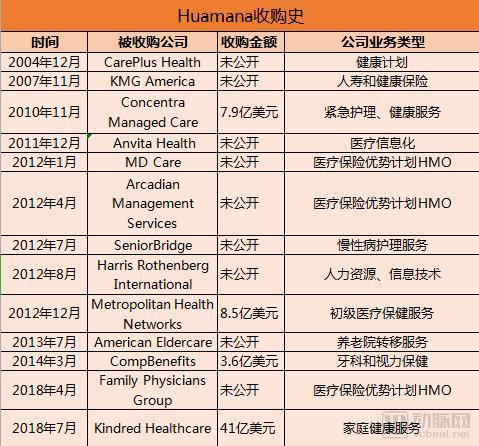
As can be seen from the table, the types of companies acquired by Humana are closely related to its business operations. Each acquisition has served to strengthen and expand Humana’s capabilities and scope in specific areas.
In addition to mergers and acquisitions, Humana is also continuously collaborating with external enterprises of various sizes, including the following:
Starting in October 2010, Humana partnered with Walmart to provide services for Medicare Part D (prescription drug coverage). In 2012, Walmart and Humana reached an agreement to offer a co-branded prescription drug plan, providing exclusive discounts on health-focused food products to select Humana members at Walmart stores. This collaboration facilitated cross-industry customer acquisition, directing Humana members to Walmart’s pharmacies.
By March of last year, as the partnership between the two parties was underway, media reports emerged that Walmart was considering acquiring Humana.
Following reports of a potential merger, foreign media stated that initial negotiations between the two parties took place after Cigna announced its plan to acquire Express Scripts, the largest pharmacy benefit manager in the United States, for $67 billion. The news sparked significant controversy within the industry. At the time, Humana was acquiring long-term care provider Kindred Healthcare. In late 2017, CVS Health announced its acquisition of Aetna.
“The CVS-Aetna merger was a watershed moment in healthcare, but the Walmart-Humana deal marks the beginning of an avalanche that will lead to the convergence of the entire healthcare system,” said David Friend, Chief Transformation Officer at BDO’s Center for Healthcare Excellence and Innovation, when news of the Walmart-Humana transaction first emerged. “By next year, the traditional PBM model may become extinct. Every player will retreat to its core business, as traditional healthcare, retail, and technology companies unite behind the single goal of ‘survival.’”
More than two months after rumors emerged that Walmart was planning to acquire Humana, Humana announced in June 2018 a partnership with Walgreens, the leading U.S. pharmacy retail chain. Under this collaboration, Humana would operate on-site clinics for seniors at two Walgreens stores in Kansas City, providing patients with information about Medicare. This cooperative model mirrored Humana’s earlier arrangement with Walmart, leading outside observers to speculate whether Humana’s move was intended to circumvent Walmart’s acquisition attempt.
In November, the company and Walgreens planned to expand their existing partnership and take cross-equity stakes. Foreign media reported that the formal partnership between Humana and Walgreens would eliminate any chance of Walmart acquiring Humana and enable Humana Inc. to keep pace with vertical integration in the industry.
In September 2018, Humana announced an expanded partnership with Fitbit, a leading global brand in wearable health devices, to help Humana members adopt and implement healthy behaviors for the prevention and management of chronic diseases.
Humana has selected Fitbit Care as the preferred health coaching solution for its employer clients. Fitbit Care is a connected health platform that integrates wellness programs, wearable devices, employers, healthcare systems, and health coaches. By driving behavioral change and enhancing care team collaboration, it maximizes health outcomes across the entire spectrum of care—from health and prevention to disease management and complex care.
Fitbit Care will be delivered through its B2B division, Fitbit Health Solutions. Humana will leverage Fitbit Care for its corporate clients, providing Fitbit wearable devices to employees to help them adopt healthier lifestyles and better manage chronic and complex conditions, while fostering stronger connections between members and their entire care teams.
On March 15, Humana announced a partnership with its peer, Accolade. The two companies will integrate their respective capabilities to create differentiated healthcare and benefits experiences for consumers. Together, they will provide employers and their health plan members with access to Humana’s provider network, innovative medical, dental, and pharmacy services, employee assistance programs, work-life services, the Go365 wellness rewards program, and comprehensive health and benefits partnership programs.
Humana adopts an innovative and open approach to healthcare, integrating rich data into the Accolade platform. Leveraging machine learning technologies, the Accolade platform delivers highly personalized and targeted services to its entire member base, with the aim of reducing the complexity of healthcare delivery and minimizing waste of medical resources. This partnership will provide employers with personalized services tailored to the specific healthcare and benefits needs of their employees and family members.
The partnership with Accolade represents Humana’s introduction of external technological resources, which has further refined the accuracy of services provided to its customers and enhanced user stickiness.
Industry Giants Spark Acquisition Frenzy as Humana Continues to Expand Its Digital Health Footprint
Currently, Humana’s main competitors among publicly listed companies are UnitedHealth, the largest health insurance company in the United States; Anthem, one of the top five health insurers in the U.S.; Aetna, a major global provider of insurance and financial services; and Cigna.
Including Humana, five companies have formed a tripartite balance of power in the United States. While maintaining their respective business territories relatively fixed, these giants are also engaged in subtle competition.
Last year, UnitedHealth Group embarked on an acquisition spree. Since April 2018, the company has acquired three healthcare entities, with the most recent transaction occurring on October 16 of last year, when it purchased U.S. specialty pharmacy Avella for $325 million.
Since 2007, Anthem has also been continuously acquiring healthcare companies. In 2015, the company attempted to acquire Cigna for $48 billion, but the deal fell through. Last October, Udi Manber, former Vice President of Engineering for Google’s search product suite, joined Anthem to lead its AI team. Like other traditional insurers, Anthem hopes this move will accelerate its modernization efforts.
Cigna, one of the largest commercial insurers in the United States, acquired a total of seven companies from 2005 to 2018. Last December, Cigna officially completed its acquisition of Express Scripts, the largest pharmacy benefit manager in the U.S., for $67 billion.
In December 2017, CVS Health, a retail pharmacy oligopoly in the U.S. market, announced its acquisition of Aetna. The announcement sparked intense industry debate, with concerns that the merger would further intensify oligopolistic dominance in both the U.S. pharmaceutical retail and health insurance sectors. Despite considerable controversy, the deal ultimately closed in late November 2018 after undergoing rigorous regulatory review, at a valuation of $70 billion.
Competitors are making frequent moves, and Humana is also continuously seeking change and implementing new strategic initiatives.
The company is developing new tools and software that integrate healthcare with technology. Bruce Broussard, who has been promoted to CEO of Humana, stated in a media interview that the company’s analytics division pioneered medication management initiatives, leveraging technology to identify medication discrepancies, thereby reducing adverse drug reactions in patients and lowering hospital readmission rates.
For example, the company has designed an AI-powered smart voice terminal device to help elderly individuals better manage their medication use. This voice-based solution allows seniors to ask questions about their medications and receive immediate answers and recommendations.
Last August, Humana Inc. announced plans to open Studio H., a digital health analytics center in Boston. The center aims to leverage digital analytics technologies to design products, tools, and services for use across the company and by its customers. Bruce Broussard stated that at Studio H., “we are developing a critical capability that can help Humana make a leap forward, creating a simplified, connected, and personalized healthcare experience for our members.”
Source:
https://www.humana.com/
https://craft.co/humana
https://www.crunchbase.com/organization/humana
https://www.cleverism.com/company/humana/
https://workingnation.com/c-suite-solutions-humana-ceo-bruce-broussard/
https://press.humana.com/press-release/current-releases/humana-accelerates-digital-health-and-analytics-capabilities