

Tech Giants Enter the Arena as Over 35 3D-Printed Implants Gain Approval; Bio-Printing Industry Shows Strong Growth Potential [Medical 3D Printing Part I]
“3D printing will bring revolutionary changes to the manufacturing methods of almost all products.” Former U.S. President Barack Hussein Obama once said this, but even now, two years after Obama left office, the innovation of 3D printing is still on its way.
The development of the 3D printing industry has not been as promising as expected. Particularly in the medical sector, characterized by long cycles and high barriers to entry, application concepts may be packaged as all-encompassing, but clinical implementation requires a meticulous, step-by-step approach over a protracted period.So, what stage has 3D printing reached in the healthcare industry? VCBeat has assessed the development landscape overseas and interviewed domestic industry insiders to gain a comprehensive understanding of the sector’s current status.
In 2017, the world-renowned research firm Gartner outlined the technology maturity curve for 3D printing. By analyzing this curve alongside Gartner’s original data, one can assess the pace of development of 3D printing technology in medical applications.

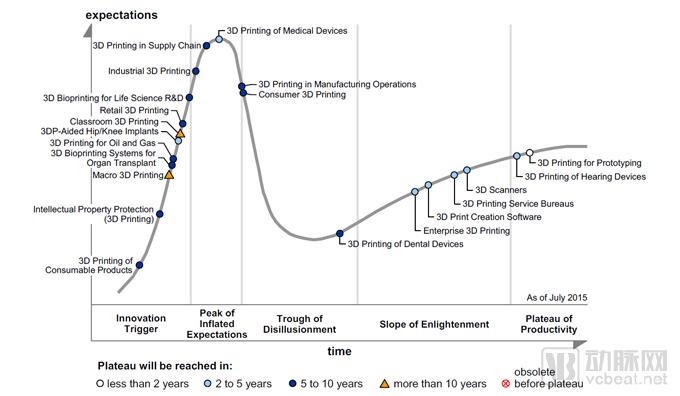
According to the technology curve analysis:
In 2017, 3D-printed medical devices in the peak of inflated expectations were expected to reach the plateau of productivity within two to five years;
In 2017, 3D bioprinting, then in its nascent stage for life sciences research, was projected to reach maturity within 5 to 10 years;
3D-printed hip and knee implants were still in their infancy in 2017, and are expected to reach maturity within two to five years;
3D-printed dental products are in a period of steady recovery and growth.
Based on the overall situation both domestically and internationally, this curve is relatively advanced. Currently, enterprises engaged in 3D printing medical applications across the entire market are small and fragmented.Fewer than 100 companies are engaged in 3D printing for medical applications, and the sector is still far from reaching maturity., neither the FDA nor the CFDA has issued standard documents for medical devices.
An examination of specific figures also reveals that the development of 3D printing in medical applications has fallen short of expectations. Gartner previously released a report titled “2016–2019: 3D Printing Disrupts Healthcare and Manufacturing.” As more than two months have passed since 2019, this period serves as an appropriate milestone to evaluate the progress of 3D printing technology.
The report predicts that by 2019, 3D printing will become a key tool in over 35% of surgical procedures involving the placement of prosthetics and implantable devices (including synthetic organs) within or around the body, and that 30% of medical implants and devices will be 3D-printed. By 2019, technological and material innovations will lead to 10% of pharmaceuticals being manufactured using 3D printers. The report also forecasts that in 2016, the cost of enterprise-grade 3D printers will fall below $2,000. By 2019, 10% of the population in developed countries will use medical devices produced via 3D printing.
Obviously, these ideas were somewhat ahead of their time for 2019.
In 2019, GE’s ATLAS 3D printer could not be purchased for less than $2,000, while customized titanium alloy implants were also very expensive, with costs ranging from $5,000 to $7,000.
In the realm of bioprinting, reports predict that 3D bioprinting technology (the medical application of 3D printing techniques to produce living tissues and organs) is advancing so rapidly that it will spark a major ethical debate over the use of 3D printing by 2016.
The replacement of biological tissues has not yet been achieved, but there have been advances such as 3D-printed corneas. However, 3D-printed corneas are currently still undergoing safety testing and have not yet been applied to human transplantation.
Although many predictions have fallen short of expectations, this does not signify the failure of 3D printing. On one hand, forecasting the future inherently involves deviations; on the other, the broader trends predicted have remained on course. Indeed, the most mature application of 3D printing in healthcare lies in dentistry, while multiple hip and knee implant products have received FDA approval. How is 3D printing actually being applied in clinical settings abroad? VCBeat has provided a summary.
3The applications of 3D printing in the medical field can be broadly categorized into several major areas, including 3D-printed pharmaceuticals, 3D-printed implants, and 3D-printed biological tissues. This article will primarily provide a summary through these perspectives.
3D-printed drugs are a promising field, but progress in this area has been slower compared to 3D printing applications in other sectors.
3D printing is regarded as a promising technology poised to completely disrupt the entire pharmaceutical industry by enabling personalized medicine. For instance, it has the potential to create unique dosage forms with features unattainable by conventional formulations, such as instantaneous disintegration of active ingredients and other complex drug release profiles.
Of course, personalized medications can also be provided. For example, children may require special or lower doses beyond those conventionally available; older adults may present with various physiological or metabolic conditions due to certain diseases or polypharmacy, which may necessitate continuous adjustments in dosage or dosage form. Furthermore, combining multiple drugs into a single “polypill” allows for easier control of drug product performance by modifying 3D digital designs rather than altering physical equipment or manufacturing processes.
3D-printed drugs can also be used to manufacture orphan drugs with limited production volumes. In December 2017, Aprecia Pharmaceuticals and Cycle Pharmaceuticals announced a partnership to leverage ZipDose technology for the development and commercialization of tablets targeting orphan (rare) diseases.
Over the past decade, 3D printing technology has been utilized in the production of medical devices, with approximately 200 FDA-approved 3D-printed devices available for customized manufacturing based on patients’ anatomical structures. However, to date, only one 3D-printed drug has received FDA approval.
Currently, the only FDA-approved 3D-printed drug is Spritam.Spritam® is indicated for the treatment of epilepsy. Its design enables a high dose of the active ingredient (1000 mg levetiracetam) to disintegrate within seconds after taking a small sip of water.
However, FDA spokesperson Jeremy Kahn also stated that currently, more than 12 pharmaceutical manufacturers have engaged with the FDA’s Center for Drug Evaluation and Research (CDER), either formally or informally, regarding the use of 3D printing in drug manufacturing.
Currently, the companies primarily engaged in 3D-printed pharmaceuticals abroad include Aprecia Pharmaceuticals, which was founded in 2003. Aprecia Pharmaceuticals’ core business remains pharmaceutical manufacturing, offering a variety of drugs, including Spritam, an anti-epileptic medication produced using 3D printing technology. The company has raised a total of $158 million in funding.
Aprecia Pharmaceuticals’ proprietary ZipDose® technology platform leverages exclusive 3D printing technology to bind multiple layers of powder using a liquid binder, addressing various challenges. By delivering high-dose medications in a rapidly disintegrating form, ZipDose enhances patient adherence and alleviates difficulties associated with swallowing.
ZipDose technology is a platform; in this sense, the formulation approach is applicable to a wide range of compounds, including small molecules and macromolecules. Aprecia’s ZipDose technology platform combines materials science with the unique capabilities of powder-liquid 3D printing to formulate, develop, and manufacture high-dose, fast-melt pharmaceutical products. Through careful preliminary assessments, ZipDose formulators have identified more than 150 compounds that are potentially compatible with the platform.
Once 3D bioprinting technology matures, it will offer vast application potential. It can be utilized in clinical trials to reduce the need for animal testing, help identify drug side effects, and facilitate the translation of verified safe dosages to human use. Furthermore, it can be applied to organ transplantation and repair, providing patients with personalized biological tissues.
Compared with other tissue fabrication techniques, the advantages of 3D bioprinting include: fabricating anatomically accurate shapes, creating porous structures, utilizing multiple cell types, and controlling the delivery of growth factors and genes. One of the greatest challenges to be overcome is reducing the resolution of printing technology to enable vascularization of tissues and organs.
Of course, in addition to overcoming technical challenges, ethical and moral issues also pose significant hurdles to the application of 3D bioprinting of tissues. In the field of 3D bioprinting, companies such as Ultimaker, Organovo, and Cellink are primarily engaged in this work.
Organovo is dedicated to the development of 3D bioprinted liver technology. As a pioneer in 3D bioprinted tissues, Organovo aims to treat a range of severe adult and pediatric liver diseases, with an initial focus on hepatic disorders.
Among current products, Organovo’s ExVive™ 3D bioprinted human liver tissue model is created using proprietary 3D bioprinting technology. The resulting tissue features precise and reproducible structures, maintaining full functionality and stability for up to 28 days.
ExVive™ Human Kidney Tissue is a fully human 3D bioprinted tissue composed of an apical layer of polarized primary renal proximal tubule epithelial cells (RPTECs), supported by a stromal interface of primary renal fibroblasts and endothelial cells rich in type IV collagen.
ExVive™ is intended for use in clinical trials. Through Organovo’s preclinical in vitro testing services, the ExVive™ 3D bioprinted liver model can be obtained to complement in vitro and preclinical (non-GLP) animal studies, providing predictive assessment of liver tissue-specific toxicity markers.
It addresses the critical challenge that, as nephrotoxicity garners increasing attention in the drug development pipeline, the proximal tubule is recognized as the primary site of renal toxicity. Conventional preclinical renal assays, such as in vitro cell cultures and animal models, often fail to accurately replicate the complexity of organ toxicity observed in drug responses due to limited functionality or species-specific variations.
Cellink is dedicated to developing “inks” for bioprinting tissues. Cellink has developed the first universal bio-ink, compatible with any cell type in any 3D bioprinting system. Founded in January 2016, Cellink completed its IPO in just 10 months.
When Gatenholm founded CELLINK in 2016, he attempted to collaborate with 3D printing or bioprinting companies, but none were willing to partner with such an early-stage venture.
Therefore, Cellink decided to develop its own series of cost-effective mobile printers. Cellink now provides customers with complete 3D bioprinting package solutions, primarily serving academic institutions and pharmaceutical companies. The company’s products are used by at least 500 laboratories worldwide.
Cellink’s business model is similar to that of traditional printer manufacturers: it promotes the sale of its bioinks by selling printing technology. Other Swedish additive manufacturing companies have also adopted the same strategy.
Major players have also entered this field, such as GE. GE Healthcare supports the development of novel bioink materials and bioprinting instruments. However, according to William Whitford, Head of Bioprocess Strategic Solutions at GE Healthcare Life Sciences, GE is particularly interested in peripheral technologies aimed at improving and simplifying the 3D bioprinting process, including imaging analysis and data management tools.
William Whitford said, “Imagine you have printed a series of organic compounds and want to see how they respond to certain chemical or biological challenges. We support the development of high-power microscopes that allow you to track these reactions in detail.”
Furthermore, GE Healthcare has long been interested in storing, processing, and transmitting medical images in digital formats. Whitford pointed out, “Many 3D bioprinted objects are very basic, but they are becoming increasingly complex as we move into multi-material, multi-modal bioprinting, which requires sophisticated model construction and printer control. GE Healthcare is supporting the development of digital modeling and data management tools in the field of 3D bioprinting.”
GE also acquired a stake in Arcam AB in 2016, further solidifying its position in the 3D printing sector. This acquisition extended beyond medical applications to encompass other fields such as aerospace, electronics, and power generation.
In the orthopedic implant market, the FDA has approved more than 35 types of 3D-printed implants. In January 2018, the FDA released a draft guidance on 3D-printed medical devices to solicit public feedback, with a primary focus on implants. VCBeat has compiled an overview of the major products.
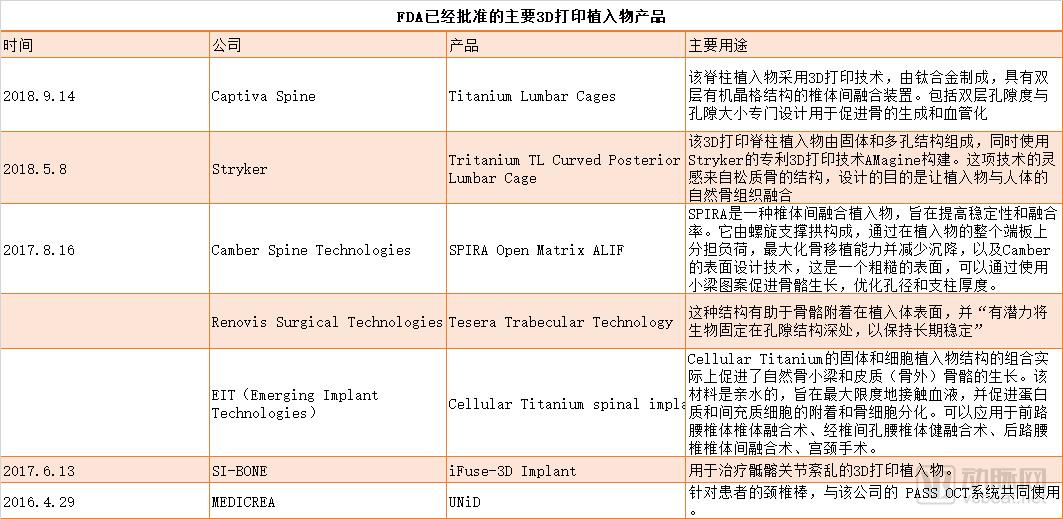
The potential of 3D printing in orthopedics stems from the fact that traditional manufacturing methods remain more cost-effective for mass production, whereas 3D printing is cost-competitive for small-batch production.
Moreover, with the advancement of precision medicine, orthopedic implants are becoming increasingly personalized. This is particularly true for small-sized standard implants or prostheses, especially those used for spinal, dental, or craniofacial conditions. The cost of custom 3D-printed objects is low, which is particularly advantageous for companies with low production volumes or those manufacturing highly complex parts or products that require frequent modifications.
Although 3D-printed titanium alloy implants are not yet inexpensive, 3D printing has played a significant role in assisting patients with spinal disorders. Stryker is one of the most prominent companies in the 3D-printed spinal implant sector. The medical device company first launched its 3D-printed Tritanium posterior lumbar interbody fusion cage in 2016, utilizing Stryker’s proprietary Tritanium technology. The company has now announced that another of its 3D-printed devices, the Tritanium TL Curved Posterior Lumbar Stabilizer, has received FDA clearance via the 510(k) pathway.
3D-printed spinal implants are composed of a combination of solid and porous structures, simultaneously fabricated using Stryker’s proprietary 3D printing technology, AMagine. Inspired by the structure of trabecular bone, this technology is designed to facilitate the integration of the implant with the body’s native bone tissue.
Tritanium Technology is also specifically designed for bone ingrowth and biological fixation, utilizing porous titanium material to create a favorable environment for cell attachment. This technology has demonstrated the infiltration, attachment, and proliferation of osteocytes or osteoblasts on the titanium surface. Furthermore, compared with traditional titanium materials, this material can absorb body fluids.
Simply put, Stryker’s 3D-printed products can mimic the structure of human trabecular bone, allowing for host bone ingrowth after implantation.
A standout startup in this field is SI-BONE, which is now publicly listed. The company’s product, iFuse-3D, is the first 3D-printed titanium implant for the sacroiliac joint and received FDA market approval in 2017.
SI-BONE has developed proprietary 3D printing technology to create implants with an enhanced porous surface that mimics the trabecular structure of cancellous bone and features a unique perforated design. These two characteristics combine to create an environment that promotes bone ingrowth and intra-articular fusion through biological integration. The system also leverages the triangular design of the iFuse Implant System, which has been clinically validated in over 26,000 procedures and supported by more than 50 peer-reviewed publications.
In summary, although the development of the 3D printing industry abroad has not advanced as rapidly as Ganter predicted, it is evident that 3D printing has made remarkable progress in its medical applications over the past two years.
So, what is the situation in China? VCBeat will provide a detailed introduction in the next article on 3D printing. Stay tuned!