

VC/PE Battle in China's Innovative Drug Sector: $7 Billion Raised in Six Years
Editor’s Note: This article is sourced from Investment Circle (WeChat Official Account ID: PEdaily2012), authored by RICA. Republished with authorization by VCBeat.
Over the past five years, enthusiasm among venture capital (VC) and private equity (PE) firms for investing in innovative drugs has remained strong. Data from Zero2IPO Research Center shows that from 2013 to the first half of 2018, the cumulative disclosed investment amount in the innovative drug sector reached RMB 48.6 billion, with 297 investment deals involving 646 institutions. Among these, 578 were VC/PE firms, accounting for 90% of the total participating institutions.
Undoubtedly, innovative drugs are ushering in a "Golden Age."
The National Medical Products Administration revealed that China approved 48 new drugs for market launch in 2018. Compared with other years, the approval timeline for new drugs in 2018 was nearly the shortest on record.
Meanwhile, the STAR Market has also been actively courting biopharmaceutical companies. According to the “Guidelines for Recommending Enterprises for Listing on the Shanghai Stock Exchange STAR Market” released on March 3, biopharmaceutical technology innovation enterprises will be a key focus of recommendation. Biopharmaceutical companies that are not yet profitable may pursue initial public offerings (IPOs) on the STAR Market.
In fact, venture capital (VC) and private equity (PE) firms have maintained strong enthusiasm for investing in innovative drugs. Data from Zero2IPO Research Center shows that from 2013 to the first half of 2018, the cumulative disclosed investment amount in the innovative drug sector reached RMB 48.6 billion, with 297 investment deals involving 646 institutions. Among these, 578 were VC/PE firms, accounting for 90% of the total participating institutions.
“A partner at a VC firm with years of focus on healthcare remarked, ‘Investment in innovative drugs has entered its best phase in history.’”
From the perspective of China’s pharmaceutical development in recent years, the “golden age” of generic drugs is gone for good. With growing market demand for innovative drugs in China, coupled with national policy guidance and an increasing influx of high-level overseas biomedical talent returning home, domestic innovative pharmaceutical companies have made rapid progress in new drug research and development.
Under China’s current regulations, there is no clear definition of “innovative drugs.” In the *2018 Investment Research Report on China’s Innovative Drug Industry* recently released by Zero2IPO Research, innovative drugs are defined as pharmaceutical products with independent intellectual property rights, novel pharmacological mechanisms or therapeutic indications, and clinical value, which have never been introduced anywhere in the world.
Innovative drugs can be categorized into three types: chemical drugs, biologics, and traditional Chinese medicine. Among these, biologics have become the fastest-growing sector in recent years due to their superior efficacy and rapid onset of action, coupled with favorable policy support and capital investment preferences.
Biopharmaceuticals are further subdivided into multiple subfields, including monoclonal antibodies and recombinant proteins. Monoclonal antibody drugs, primarily used for the treatment of cancer and autoimmune diseases, account for nearly half of the biopharmaceutical market. In particular, PD-1/PD-L1 monoclonal antibodies for the treatment of various cancers have become a breakthrough point in new drug development and a focal point for venture capital (VC) and private equity (PE) firms.
According to the report, from 2013 to the first half of 2018, the cumulative disclosed investment amount in the innovative drug sector reached RMB 48.6 billion, with 297 investment transactions and 646 participating institutions.
In the first half of 2018 alone, disclosed investment amounts reached RMB 17.2 billion across 59 deals, surpassing the total investment volume for the entire year of 2017, thereby emerging as a capital hotspot and star sector in the previous year.
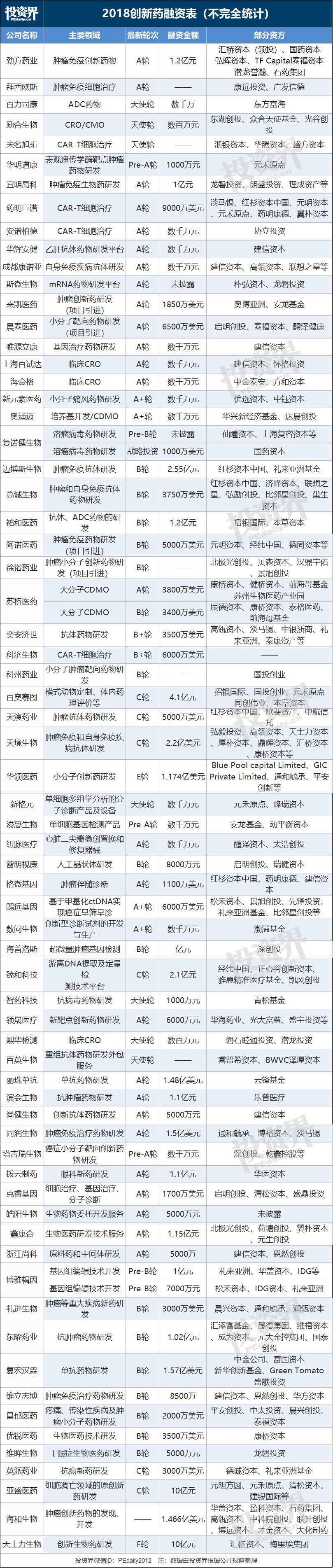
From the perspective of financing round distribution, from 2013 to the first half of 2018, the financing of innovative drug companies was mainly in Series A and B rounds, accounting for more than 50% of the total number. Institutions invested more in innovative drug companies in the expansion and mature stages.
From the perspective of institutional types, venture capital (VC) and private equity (PE) firms dominate, accounting for 90% of all institutions. Among them, VC firms are the most numerous, with a total of 334, followed by PE firms, with 244. In the innovative drug investment market, CITIC Private Equity Fund, Huakong Fund, Hillhouse Capital, Yuanhe Holdings, Sequoia China, Yunfeng Capital, and CCB Trust are among the more active investors in the innovative drug sector.
Reviewing the development of the biopharmaceutical industry in 2018, investors found that the market was relatively hot in the first half of the year, but began to decline in the second half, forming an inverted V-shaped structure.
Currently, the total investment volume in the biopharmaceutical industry remains insufficient, with investments in innovative drugs and innovative enterprises still in their nascent stages. Moreover, a pronounced crowding-out effect has emerged in the industry over the past two years: the number of high-quality companies securing financing has declined, while the funding amount per project has increased.
In 2019, the STAR Market was undoubtedly the highlight, with biopharmaceuticals emerging as the most sought-after sector on this new board.
According to the “Guidelines for Recommending Enterprises for Listing on the STAR Market of the Shanghai Stock Exchange” released on March 3, biopharmaceutical technology innovation enterprises will be a key focus of recommendation, primarily including biological products, high-end chemical drugs, high-end medical equipment and devices, and related technical services.
Innovative companies, investment banks, and VC/PE firms have responded swiftly to these developments. Over the past five years, biomedicine has remained a key focus of the venture capital and private equity industry. The establishment of the STAR Market and the reforms to the registration-based IPO system will further channel investment attention toward this sector, while increased capital inflow will, in turn, fuel entrepreneurs’ enthusiasm for entering the field.
Before the Hong Kong Stock Exchange gave its green light, Nasdaq had long been the IPO mecca for pre-profit biotechnology companies. Currently, there are 2,643 listed companies on Nasdaq, with 737 in the pharmaceutical and healthcare sectors, making it a core segment of the exchange.
Yet a single document from the Hong Kong Stock Exchange (HKEX) stole much of the spotlight from Nasdaq. Since late April 2018, when the HKEX announced it would accept listing applications on its Main Board from pre-revenue biotechnology companies, numerous biotech firms—including Ascletis Pharma, BeiGene, Innovent Biologics, Hua Medicine, Ascentage Pharma, MicuRx Pharmaceuticals, Henlius Biotech, CanSino Biologics, Junshi Biosciences, Mabwell Therapeutics, CStone Pharmaceuticals, AOBiome Therapeutics, and Stealth BioTherapeutics—have listed in Hong Kong.
The fervor in the Hong Kong stock market also spurred the A-share market and accelerated the launch of the Shanghai Stock Exchange’s STAR Market along with its pilot registration-based IPO system.
As policy, market, and capital all send positive and optimistic signals, biopharmaceutical companies have more options to choose from. Faced with one olive branch after another, should drug companies planning an IPO join the rush to list in Hong Kong, be among the first to taste the “initial offerings” on the STAR Market, or head to the distant NASDAQ?
“We invested in Chipscreen Biosciences, an innovative drug company based in Shenzhen. Its Class 1 new drug, Chidamide, was launched in 2015 and later included in the National Reimbursement Drug List. The company strongly meets the IPO requirements for the STAR Market, and the approval results will be announced soon.” CCB Capital and CMB International, the investors behind Chipscreen Biosciences, revealed to the investment community that the company is expected to be among the first batch of listings.
Zeng Zhiqiang, Managing Partner of Huagai Capital’s Healthcare Fund, also revealed to the investment community that biopharmaceutical companies backed by Huagai—including Henlius, Haihe Biopharma, and Antengene—currently meet the basic listing requirements for the STAR Market. “We have already collaborated with leading sponsoring institutions on these projects, aiming to have several Huagai-backed enterprises listed among the first batches on the STAR Market.”
“Of course, alongside the optimism, some investors are adopting a wait-and-see approach. ‘Many companies that raised funds on the New Third Board back then are still facing dilemmas. The high investor thresholds, lack of liquidity, and unclear positioning mean that the STAR Market today will encounter similar challenges,’ an anonymous investor told VCBeat.”
On February 18, the Outline Development Plan for the Guangdong-Hong Kong-Macao Greater Bay Area was officially released. As a prominent buzzword in recent years, biomedicine has been incorporated into the plan as one of the key industries to be fostered, with specific mention of cultivating a batch of major industrial projects in key areas such as protein-based biopharmaceuticals and genetic testing.
The Greater Bay Area offers robust policy support, Guangdong entrepreneurs are enterprising, and an increasing number of startups are establishing their presence here, with a well-developed industrial chain taking shape. “Deep waters, abundant fish”—this is how Yuan Quanhong describes the current state of the Greater Bay Area.
CCB Capital has currently invested in four companies in the Greater Bay Area: Hengnuokang, Chipscreen Biosciences, Akeso, and Basecare Medical. Yuan Quanhong noted that even without the development plan for the Guangdong-Hong Kong-Macao Greater Bay Area city cluster, CCB Capital would still prioritize this region for biomedical investments. “The fact that we consistently find outstanding entrepreneurs and scientists here, along with high-potential startups, demonstrates the strength of this ecosystem.”
However, it is also important to recognize the shortcomings in the development of the Greater Bay Area. Compared with Shanghai and the Jiangsu-Zhejiang region, Guangdong’s economy is predominantly manufacturing-based. Although this trend is shifting and investment intensity is increasing, its industrial chain remains less comprehensive than that of the Yangtze River Delta.
“For example, companies conducting clinical trials, firms providing preclinical outsourcing services, and R&D centers of multinational corporations in China—these are indeed weak links in the Guangdong-Hong Kong-Macao Greater Bay Area,” said Yuan Quanhong. In Shanghai, by contrast, multinational pharmaceutical companies such as Johnson & Johnson, Novartis, and AstraZeneca have all established R&D centers, alongside CRO firms like WuXi AppTec.
CMB International has completed its investments in Burning Rock Biotech and Chipscreen Biosciences in the Greater Bay Area. Burning Rock Biotech has demonstrated strong capabilities in tumor gene sequencing, while Chipscreen Biosciences is already preparing for its initial listing on the STAR Market.
Over the past two decades, IDG Capital has invested nearly RMB 20 billion in Guangdong Province, covering all sectors including biopharmaceuticals and TMT, with approximately RMB 5 billion allocated to Guangzhou. Currently, IDG Capital is working to strengthen its presence in the Greater Bay Area (GBA) and deepen cooperation with the Guangzhou Municipal Government, gradually shifting its investment hub to South China or the GBA. Zhang Jianbin, Partner at IDG Capital, believes that the GBA presents a historic opportunity, offering excellent prospects for investment and entrepreneurship in China, particularly in the South China region.
GTJA Investment Group has also invested in numerous enterprises in the Guangdong-Hong Kong-Macao Greater Bay Area, including Mindray Medical, Akeso Biopharma, and Huayin Health. According to the Administrative Committee of Zhongshan Torch Hi-Tech Industrial Development Zone, since 2018, 18 projects have reached cooperation agreements at the Zhongshan National Health Base, involving companies such as Thermo Fisher Scientific, Akeso’s industrialization base for novel antibody drugs, and Xunuo Pharmaceutical, with a total investment exceeding RMB 3 billion.
Teng Yuhang, Executive Partner at GTJA Investment, believes that the pharmaceutical industry in the Greater Bay Area has historically been dominated by relatively mature enterprises, primarily concentrated in traditional sectors such as Traditional Chinese Medicine (TCM), proprietary Chinese medicines, and active pharmaceutical ingredients (APIs). Although the innovative drug sector has demonstrated strong momentum and rapid growth, its scale and volume remain in the early stages. Contrary to the views of many investors, Teng Yuhang stated, “The bubble in the biopharmaceutical sector that existed in the past still persists today. We are currently in a process of returning to rationality, and the previous model of continuous cash burn will undergo constant change in the future.”
As a comprehensive investment institution, Shenzhen Capital Group (SCGC) has also made frequent moves in the biopharmaceutical industry, establishing a dedicated biopharmaceutical fund in 2018. It has invested in Chipscreen Biosciences, Mindray, and Akeso in the Greater Bay Area. Cao Xuguang, Executive General Manager of SCGC, admitted that truly high-quality enterprises in the Greater Bay Area have no difficulty securing financing.
Over the past three years, the pharmaceutical industry has also become a key investment focus for Yunfeng Capital. In the last 12 months, Yunfeng Capital’s largest investments were not in IT, finance, or TMT, but in the pharmaceutical sector.
Sun Xuan, Managing Director of Healthcare at Yunfeng Capital, candidly stated that while pharmaceutical innovation enterprises in the Greater Bay Area have historically enjoyed certain advantages, they still lag behind the Yangtze River Delta region in terms of technology—a situation that presents both opportunities and challenges. From an investment perspective, the Greater Bay Area represents precisely the “next wave” they are seeking.