

How Centene Corporation Achieved Over $60 Billion in Annual Revenue and a Spot Among America's Top 100 Companies

Centene
Health Insurance Company
In mid-January 2019, U.S. health insurer Centene Corporation released its 2018 financial report. According to the report, Centene Corporation delivered impressive performance in 2018, with total annual revenue reaching $60.1 billion and total assets amounting to $309.01 billion. Just a few months earlier, Centene Corporation had been ranked No. 61 on Fortune magazine’s “2018 Fortune 500” list, recognized for its outstanding comprehensive profitability.
Such impressive performance has sparked widespread curiosity about Centene Corporation. As a company primarily engaged in health insurance services, we cannot help but wonder: What sets Centene Corporation apart, enabling it to achieve steady growth and outstanding results over its 35-year history? These insights offer valuable lessons for startups seeking long-term strategic positioning, as well as for large health insurance enterprises undergoing transformation and upgrading.
Of course, before exploring why Centene Corporation has achieved such remarkable success, we must first gain a basic understanding of the U.S. health insurance system.
According to Zhaoyu Wealth’s summary of the U.S. health insurance system, the fundamental characteristic of the American health insurance framework is that it provides a range of tiered health insurance products and services to the public through highly marketized health insurance plans and healthcare networks, under the guidance, regulation, or direct participation of federal and state governments. The entire system rests on three pillars: exceptional national economic and technological strength, federal and state government service provision and regulation, and a well-developed healthcare industry and market.
Therefore, for Centene Corporation, how to strategically position its business operations within the highly market-driven U.S. economic environment amid evolving policy orientations is a matter that requires careful consideration.
Centene Corporation, founded in 1984 and headquartered in Wisconsin, is currently a large publicly traded company and a multi-line managed care enterprise, serving as a key intermediary in government-sponsored private healthcare programs. Centene Corporation’s main product lines include Medicare, health management, the Health Insurance Marketplace system (ACA-certified), military healthcare systems, and traditional commercial insurance.
In its multi-line business operations, Centene Corporation also contracts with other healthcare companies and commercial organizations to provide specialized services, including behavioral health care, case management software maintenance, commercial insurance services, home health services, pharmacy benefit management, and telehealth services.
Clayton Christensen, author of The Innovator’s Prescription, stated that the cyclical shift between consolidation and fragmentation is a fundamental law of business evolution. Centene Corporation and the health insurance sector in which it has deeply specialized continue to adhere to this principle.
From a company with a small commercial health insurance plan to the second-largest publicly listed company in Missouri, why has Centene Corporation maintained steady growth over its 35-year development history? The answer lies in its strong leadership and strategic alignment with technological milestones.
The development of Centene Corporation can be divided into two stages.
The first phase, from 1984 to 1997, was a period of slow growth for the company. During this stage, Centene Corporation primarily served as an administrator for government health insurance programs, resulting in a relatively narrow business scope. This not only kept Centene Corporation’s revenue largely stagnant but also limited its ability to expand into other business areas.
The turning point came in 1996, when Michael F. Neidorff, the current Chairman, President, and Chief Executive Officer, joined Centene Corporation. To break the deadlock and seek new opportunities, Mr. Neidorff adjusted the human resources system by implementing more generous incentive measures under stricter performance evaluation criteria. This greatly stimulated employee enthusiasm, enabling relevant teams to continuously optimize marketing strategies and actively explore new business opportunities, thereby driving rapid growth for Centene Corporation.
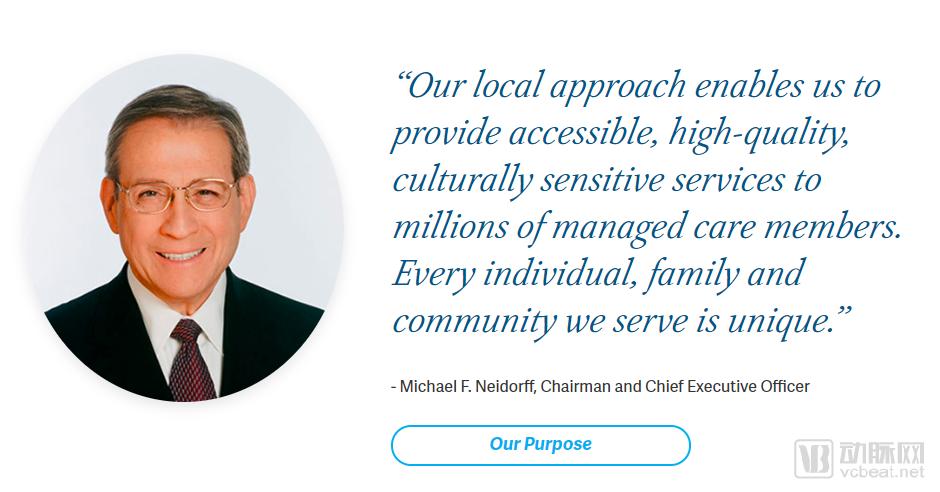
Centene Corporation Chairman and CEO Michael F. Neidorff (Image source: Centene Corporation official website)
The second phase, from 2001 to the present, has seen Centene Corporation achieve rapid growth, benefiting from the Affordable Care Act and a strategic shift in its overall business direction.
During the second phase, Centene Corporation encountered several development bottlenecks. However, viewing challenges as opportunities, the company did not adopt a passive approach; instead, it embraced new technologies. From leveraging the internet to later implementing big data-driven precision medical insurance services, Centene Corporation actively explored these innovations and achieved notable results.
On the internet, Centene Corporation established a systematic health insurance service platform during the first decade of the 21st century through partnerships with technology software companies. Users can purchase insurance policies directly online or engage in real-time, one-on-one consultations with customer service representatives and professional insurance advisors to address complex inquiries. Unlike other health insurers, Centene Corporation’s proprietary technology reduces communication costs among users, health insurance companies, and community healthcare providers, thereby enhancing operational efficiency.
As big data began to permeate various industries, Centene Corporation actively adopted this technology. Through precise medical big data analytics, Centene Corporation can identify potential health risks in patients. The team collects users’ medical histories from their past health insurance claims data and matches them with models established in its database to identify high-risk populations and help them improve their health outcomes. Intervening in users’ health conditions before disease onset can reduce the company’s payout costs for health insurance programs.
Centene Corporation officially stated that the adoption of big data-driven precision analytics can deliver sustained value growth for customers, primarily manifested in two aspects:
1. Transitioning from passive diagnosis and treatment to proactive prevention. Leveraging big data technology, high-risk populations are monitored in real time to implement preventive measures before disease onset, thereby avoiding the physical suffering and substantial medical costs associated with major illnesses and achieving the goal of "preventive healthcare."
2. More Precise User Targeting. Centene Corporation’s user base primarily consists of residents in low-to-middle-income communities, who often struggle to afford the high costs associated with treating complex and severe conditions. Through precise identification and prevention enabled by big data analytics, the company not only provides greater peace of mind to its members but also boosts Centene Corporation’s net revenue.

Centene Corporation-Served Lacy Clay Children’s Health Center (Image source: Centene Corporation official website)
As Amazon founder Jeff Bezos once said, “Embrace trends, and you will ride the wave.” During the implementation of the Affordable Care Act under the Obama administration’s healthcare reform, Centene Corporation extensively promoted its new suite of health insurance solutions to low- and middle-income populations, offering its professional services regardless of individuals’ insurance status. This initiative garnered widespread support and recognition from numerous communities. Coupled with Centene Corporation’s high service standards, the company achieved rapid growth.
“The Affordable Care Act,” implemented since 2010, primarily aims to increase health insurance coverage and control healthcare expenditures. Measures include providing insurance subsidies for low-income individuals, mandating employers to purchase insurance for their employees, prohibiting insurers from denying coverage or charging higher premiums due to pre-existing conditions, and offering more comprehensive insurance plans covering services such as screenings, medications, and surgeries.
However, to date, the Affordable Care Act has drawn considerable criticism, with opponents questioning its effectiveness in curbing the growth of healthcare expenditures. According to statistics from the Kaiser Family Foundation, U.S. health insurance costs have risen dramatically over the past 60 years. In 1960, U.S. healthcare spending stood at $27.2 billion; by 2016, it had surged to $3.3 trillion, amounting to $10,348 per capita. These costs are shared among the government, employers, insurers, and individuals.
Since taking office, the Trump administration has been attempting to modify the Affordable Care Act (Obamacare), and in October 2017, it terminated government subsidies to health insurance companies known as Cost-Sharing Reduction (CSR) payments. These subsidies were designed to help low-income Americans share the cost of individual health insurance premiums under the Affordable Care Act.
To this end, Centene Corporation has stated that it will not abandon its individual health insurance business under the Affordable Care Act. On the contrary, the company is continuously expanding this line of business. In 2018, Centene Corporation expanded its individual health insurance market in Kansas, Missouri, and Nevada, and intensified its promotion efforts in six other states where it already had a presence.
Centene Corporation CEO Michael Neidorff stated during the company’s quarterly earnings conference call, “Centene Corporation will continue to collaborate with members of both political parties to stabilize the individual health insurance market and improve the healthcare delivery system. Meanwhile, we believe that significant systemic changes require bipartisan efforts. From both a commercial and a social welfare perspective, Centene Corporation is committed to delivering the highest-quality, cost-effective services to more members.”
Over the past 35 years, Centene Corporation has grown into one of the “most tradable” members on the New York Stock Exchange. The company currently employs more than 30,000 people, serves 12.3 million members across 29 U.S. states and two international markets, and provides health insurance solutions to other healthcare companies and commercial organizations.
Centene Corporation’s outstanding performance can be attributed not only to the factors mentioned above but also to its continuous mergers and acquisitions.
In 2006, Centene Corporation acquired OptiCare Health Systems, a developer of health management systems, and Cardium Health Services, a healthcare services company, for $7.5 million and $12 million, respectively.
In 2008, Centene Corporation acquired the health insurance company Celtic Group for $80 million.
In March 2016, Centene Corporation announced the completion of its $6.8 billion acquisition of competitor Health Net Inc., with the merged company serving over 11 million members nationwide.
On September 12, 2017, Centene Corporation announced the acquisition of the non-profit insurer Fidelis Care for $3.75 billion.
……
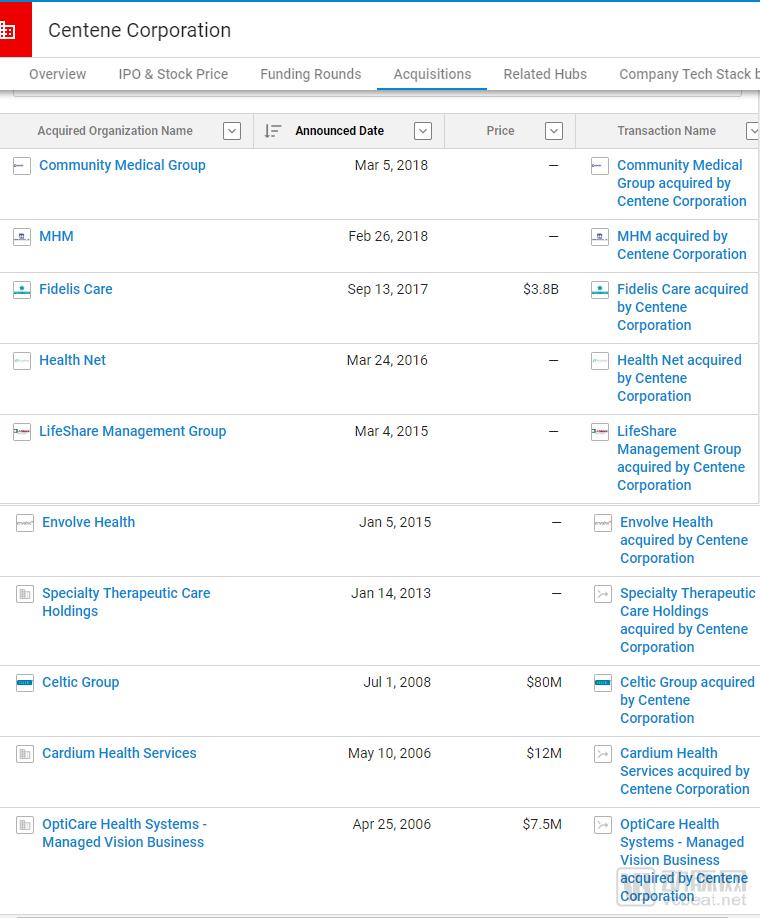
Centene Corporation’s M&A History (Image Source: Crunchbase)
To date, Centene Corporation has completed 12 mergers and acquisitions. Through strategic capital operations, the company has continuously strengthened its business lines and enhanced its bargaining power in the market.
But as the saying goes, “an elephant finds it hard to turn around”; the larger the scale, the more challenges Centene Corporation faces. This has also brought numerous problems to Centene Corporation.
In 2017, Centene Corporation faced widespread class-action complaints from users and uniform media criticism due to mismanagement that caused issues with its Medicaid services in multiple states. The company failed to effectively address the crisis. To date, the controversy remains unresolved.
Centene Corporation still has a long way to go. After all, becoming a great enterprise requires not only embracing trends through managerial and technological changes, but also ensuring rigorous quality control to adapt to those trends.
This is both a challenge facing Centene Corporation and a significant opportunity for the company.