

GeneCast and AstraZeneca Partner to Advance Precision Oncology with BRCA Testing Collaboration
On the afternoon of March 7, 2019, at the AstraZeneca Wuxi Innovation Center, Berry Oncology (hereinafter referred to as “Berry Oncology”) and AstraZeneca China signed a strategic cooperation agreement on BRCA testing. By leveraging their respective strengths, the two parties will join forces to enter the field of precision oncology in China and jointly promote the research and development of precision medicine in the country. This collaboration provides a broader platform for patients with BRCA gene mutations to access more scientific and personalized precision treatments. It is hoped that this partnership will bring new breakthroughs in the treatment of cancer patients in China, particularly those with BRCA mutations.

Win-Win Cooperation—Strategic Cooperation Agreement on BRCA Testing
At the signing ceremony, Ms. Yin Min, General Manager of AstraZeneca’s Oncology Business Unit, welcomed Berry Oncology’s participation, noting that Berry Oncology places strong emphasis on the standardization and quality of genetic testing and achieved outstanding results in the 2018 “NGS BRCA Calibration Program.” She expressed hope that this strategic collaboration would leverage the complementary strengths of both parties to achieve win-win outcomes. As a strategic partner, AstraZeneca aims to establish a long-term community of shared interests with Berry Oncology, fostering mutual support, equality, mutual benefit, and trust to develop a lasting cooperative relationship.
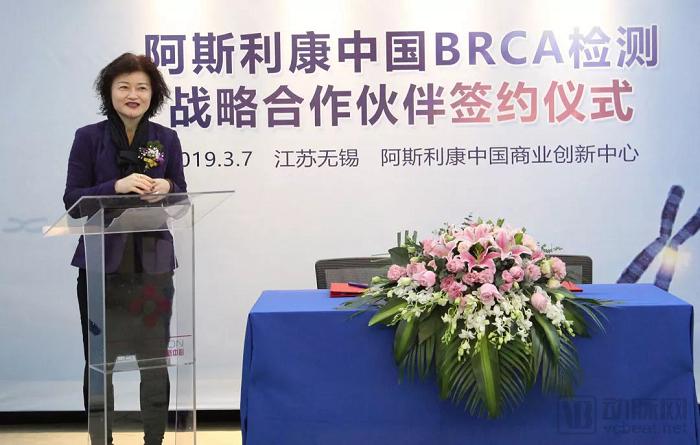
Mr. Zhou Jun, CEO of Berry Oncology, expressed his gratitude for the invitation from AstraZeneca and stated that the company would strictly control testing quality, prioritizing patient benefits. Berry Oncology’s BRCA testing platform is committed to providing more precise genetic diagnostic technologies for AstraZeneca’s PARP inhibitors, contributing to the advancement of precision medicine.

“NGS BRCA Calibration Program” and Berry Oncology
BRCA (Breast Cancer Susceptibility Gene) is a critical tumor suppressor gene that primarily participates in DNA damage repair and transcriptional regulation. It serves as one of the key biomarkers for assessing the risk of developing breast cancer, ovarian cancer, and other related malignancies, and also influences the selection of personalized treatment regimens for patients.
In 2018, the China Association of Medical Device Industry (CAMDI), in collaboration with multiple stakeholders, launched the “NGS BRCA Calibration Program” to standardize BRCA testing workflows based on next-generation sequencing (NGS) platforms in China, thereby better guiding clinical practice. Berry Oncology successfully passed the six-month assessment of the “NGS BRCA Calibration Program.”
Berry Oncology has fully inherited Berry Genomics’ oncology business, bringing a decade of expertise in the field. In the area of hereditary breast cancer screening, Berry Oncology collaborated with Professor Xie Yuntao from Peking University Cancer Hospital on a BRCA gene testing project involving 8,085 breast cancer cases, the results of which were published in the prestigious journal Clinical Cancer Research. Berry Oncology possesses an ultra-large database comprising baseline data from one million Chinese individuals, along with two patented bioinformatics analysis software platforms, both of which facilitate the interpretation of BRCA gene testing results in the Chinese population.
PARP Inhibitors and AstraZeneca
On August 22, 2018, the National Medical Products Administration approved the market launch of AstraZeneca’s olaparib tablets (brand name: Lynparza), marking the first PARP inhibitor to be marketed in China and filling a nearly 30-year gap in targeted therapy for ovarian cancer in the country. AstraZeneca is an innovation-driven global biopharmaceutical company with leading positions in the fields of gastrointestinal, cardiovascular, central nervous system, respiratory, oncology, anesthesia, and anti-infective therapies.
The signing of this strategic cooperation agreement will have a profound and significant impact on China’s BRCA genetic testing market. The strong alliance between the two parties will jointly advance the research and development of precision medicine in China, facilitating earlier treatment for patients with BRCA gene mutations and bringing hope to cancer patients carrying these mutations.