

18 Leading Scientists Call for Global Moratorium on Heritable Human Genome Editing
This article is reprinted from Sequencing China, authored by iseqer. VCBeat has been authorized to republish it.
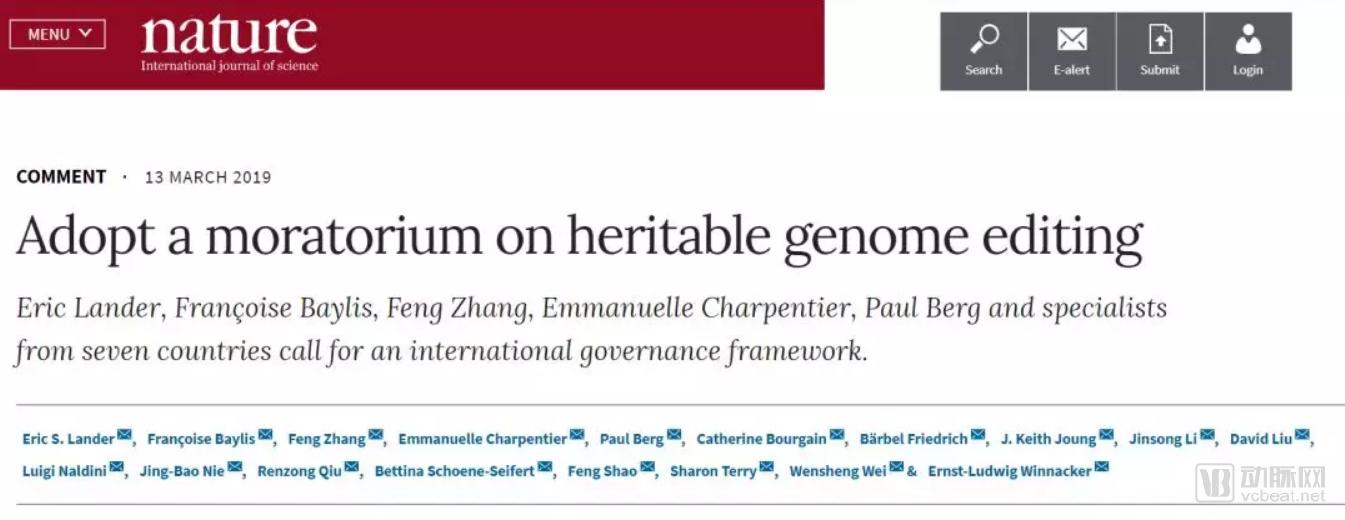
On March 13, local time, in a commentary article published in Nature,Eighteen renowned scientists and ethicists in the field of gene editing from seven countries have jointly called for a global moratorium on the clinical application of germline gene editing and for the establishment of an international regulatory framework.. The 18 scientists are Eric S. Lander, Françoise Baylis, Feng Zhang, Emmanuelle Charpentier, Paul Berg, Catherine Bourgain, Bärbel Friedrich, J. Keith Joung, Jinsong Li, David Liu, Luigi Naldini, Jing-Bao Nie, Renzong Qiu, Bettina Schoene-Seifert, Feng Shao, Sharon Terry, Wensheng Wei, and Ernst-Ludwig Winnacker.
Below is an excerpt from the appeal article.
We call for a global moratorium on all clinical applications of human germline gene editing, namely, halting the alteration of heritable DNA (from sperm, eggs, or embryos) to create genetically modified children.
A global moratorium does not imply a permanent ban. Rather, we call for the establishment of an international framework in which countries, while retaining their right to make independent decisions, voluntarily commit to not approving any clinical use of germline gene editing unless certain conditions are met.
First, there should be a fixed moratorium during which any form of germline gene editing is prohibited in clinical practice. Before permitting germline gene editing, comprehensive discussions addressing technical, scientific, medical, social, ethical, and moral issues must take place; this period will provide the necessary time to establish an international framework.
Thereafter, countries may choose to follow different paths. Currently, approximately 30 countries have legislation that directly or indirectly prohibits all clinical applications of germline gene editing; these nations may opt to continue an indefinite moratorium or implement a permanent ban. However, any country may also choose to permit specific clinical applications of germline gene editing, provided that it first publicly discloses its intention to consider such applications, engages in international consultations within a specified timeframe to assess the prudence of proceeding, determines the rationale of the application through a transparent evaluation framework, and ensures that broad domestic social consensus is reached regarding the appropriateness of the application. While countries are likely to adopt different approaches, they will agree to conduct these processes openly and with due respect for public opinion on issues that ultimately affect the entire human species.
It should be clarified that the proposed moratorium does not apply to germline gene editing for research purposes, provided that such research does not involve the implantation of embryos into a human uterus. Nor does it apply to gene editing of human somatic cells (non-germline cells) for the treatment of diseases, where patients can provide informed consent and the DNA modifications are not heritable.
The 18 signatories of this appeal include scientists and ethicists from seven countries. Many of us have engaged in the field of gene editing through developing and applying technologies, organizing and speaking at international summits, serving on national advisory committees, and researching and raising ethical issues.
Here, we outline why we believe a pause is justified at this time and explain how the international framework operates.
······
This appeal is considered a response to the He Jiankui gene-edited babies incident.In November 2018, He Jiankui’s research team performed gene editing on two embryos to prevent future infection with the human immunodeficiency virus (HIV). The announcement sparked an uproar in the field of gene editing and ignited widespread public debate. As scientists pointed out in their commentaries, such modifications could lead to other consequences, such as increasing the risk of complications or death from infections like West Nile virus, influenza, and other viral pathogens. More concerningly, the scientific community generally agrees that the risk of failing to achieve the intended changes or introducing unintended mutations (off-target effects) remains unacceptably high for clinical germline gene editing. Therefore, it remains unclear exactly how germline gene editing will affect humans.
Institutions such as the U.S. National Academy of Medicine, the U.S. National Academy of Sciences, the U.S. National Institutes of Health, and the Royal Society have all expressed support for calls to ban the clinical application of germline gene editing., Nature also published an editorial. Eric Lander, a co-author of the article and a professor with joint appointments at Harvard University and MIT, stated: “We all agree that germline gene editing should not currently advance toward clinical application, and a moratorium would help clarify the situation.”
Carrie Wolinetz, Deputy Director for Science Policy at the National Institutes of Health (NIH), and Francis Collins, Director of the NIH, expressed support for this call., they argued: “This is a pivotal moment in the history of science: a new technology offers us the potential to rewrite the ‘script of human life.’ Human gene editing for reproductive purposes would entail profound consequences, spanning social, ethical, philosophical, and theological domains. These far-reaching implications demand deep reflection.”
In fact, the scientific community has been continuously establishing regulatory frameworks and mechanisms for the clinical application of germline gene editing. In December 2015, at the First International Summit on Human Gene Editing, the organizing committee issued a statement on embryo editing technologies, asserting that any gene editing of human germline cells would be irresponsible unless (i) safety and efficacy concerns related to embryo editing are resolved, and (ii) broad social consensus is reached regarding its clinical applicability. This statement implies that germline gene editing should not be applied in clinical settings anywhere in the world.
In 2017, the U.S. National Academies of Sciences, Engineering, and Medicine stated in a report that germline gene editing should not be used in clinical settings, including clinical trials, until preclinical studies have elucidated all potential risks and effects; this approach should only be considered when no other reasonable alternatives exist. In 2018, the Nuffield Council on Bioethics recommended conducting further research, fully incorporating broad societal engagement, and establishing guidelines for the clinical application of this technology.
However, subsequent events have demonstrated that these constraints are clearly insufficient.
*Nature* Call for Papers article points out that for the clinical application of germline gene editing, we need to consider multiple aspects.1. Technical Issues, including whether there is sufficient safety and efficacy, medical needs, risks, potential benefits, and alternative methods.Second, Scientific Questions, the clinical application of germline gene editing should not be considered unless there is a thorough understanding of its long-term biological consequences for individuals and the human species.Third, Medical Issues, clinical application should only be considered when there are sufficiently compelling reasons.Fourth, Society、Ethical and Moral Issues, regardless of the aforementioned circumstances, clinical germline gene editing should not be applied in any form without broad societal consensus.
Currently, relevant authorities in certain countries are discussing the scientific and ethical nuances of germline gene editing to establish criteria for determining whether clinical trials involving such technologies may proceed. On February 26, 2019, China’s National Health Commission released the Administrative Regulations on the Clinical Application of New Biomedical Technologies (Draft for Comment), which explicitly stipulates that clinical research on high-risk new biomedical technologies—including germline gene editing—shall be regulated by the health administrative department of the State Council. This marks China’s formal introduction of a review mechanism for human gene editing research, along with strengthened oversight and penalties.
A global suspension of relevant clinical trials and the establishment of an international regulatory framework to build broader social consensus will help promote more scientific and rational applications of gene-editing technologies.The implications of germline gene editing are global; regulating this technology is not solely the responsibility of scientific, medical, and governmental entities, but a shared responsibility of society as a whole.It is hoped that more regulatory agencies, health and scientific organizations, and the public will engage in collaborative discussions and research on the benefits and risks of the clinical application of this technology, thereby upholding the utmost respect for human life.
References:
1. Adopt a moratorium on heritable genome editing
2. Scientists Push for a Moratorium on Human Germline Editing
3. NIH Expresses Support for Germline Editing Moratorium
4. Official Website of the National Health Commission