TGF-β + PD-(L)1 Dual-Targeting Combination Therapy: Pioneering the Future of Multi-Target Cancer Treatment
In February 2019, GlaxoSmithKline and Merck KGaA announced a collaboration to jointly develop and commercialize M7824. This agent is a dual-targeting drug against TGF-β and PD-L1, and represents the most advanced therapeutic candidate in clinical development targeting TGF-β.
TGF-β plays a non-negligible role in the initiation and progression of advanced malignant tumors. In recent years, with the surge in popularity of PD-1/PD-L1 targeted therapies, TGF-β has once again garnered significant attention as a crucial anticancer target. Many pharmaceutical companies have begun to strategize their development pipelines around TGF-β antibody drugs. Among them, Merck KGaA’s M7824 is the most advanced, having already entered Phase II clinical trials. Recognizing this commercial opportunity, GlaxoSmithKline (GSK) has invested substantial funds to jointly develop this drug with Merck KGaA. In the realm of TGF-β antibody drug development, most companies have opted for combination therapies targeting both TGF-β and PD-1/PD-L1. Such multi-target combination treatments are highly likely to become the primary direction for future targeted drug research and development.
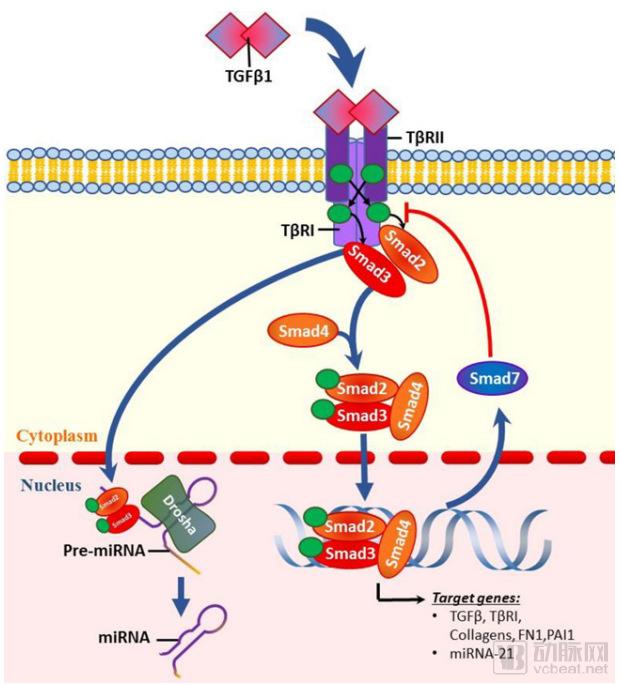
Image source: Pacific Huynh, Zhonglin Chai. Transforming growth factor β (TGFβ) and related molecules in chronic kidney disease (CKD).CLINICAL SCIENCE 133(2),287-313(2019).
Figure: Structure of the TGF-β Signaling Pathway
The TGF-β signaling pathway plays a crucial role in the growth and development of embryos and the human body. Scientists have conducted extensive research on the composition of the TGF-β signaling pathway for many years. TGF-β is a signaling protein, and its gene expression is influenced by various extracellular signals, such as glucose concentration, oxidative stress, and certain cytokines. In the canonical TGF-β signaling pathway, after TGF-β is expressed within cells, it is released into the extracellular environment, where it binds to the membrane receptor TGFβRII (abbreviated as TβRII). This binding activates TβRII, enabling it to associate with TGFβRI (abbreviated as TβRI) to form a receptor complex.
The activated TβRI/TβRII complex phosphorylates the downstream Smad2 and Smad3. The phosphorylated Smad2 and Smad3 then bind to another Smad family protein, Smad4, forming a phosphorylated Smad2/3/4 complex. This phosphorylated Smad2/3/4 complex subsequently translocates into the nucleus to regulate the expression of downstream target genes.
TGF-β regulates a series of proteins associated with cell adhesion. In the tumor microenvironment, elevated levels of TGF-β reduce cell adhesion, thereby promoting the epithelial-mesenchymal transition (EMT) process, which marks the onset of tumor metastasis. Consequently, high expression of TGF-β signaling is often associated with immune evasion, therapeutic resistance, and poor prognosis. Upregulation of factors related to the TGF-β signaling pathway has been observed in various malignant tumor samples, and their expression levels are closely linked to cancer metastasis and patient prognosis.
However, on the other hand, another subset of TGF-β downstream targets functions to arrest the cell cycle and inhibit cell proliferation. Consequently, TGF-β plays a dual role in tumor progression, both promoting metastasis and suppressing tumor growth. This dichotomy has long fueled debate within the academic community regarding whether TGF-β should be pursued as a therapeutic target for cancer treatment. In clinical applications of TGF-β-targeted therapies to date, inhibition of the TGF-β signaling pathway has demonstrated beneficial effects on disease progression and patient prognosis. Thus, concerns about potential adverse effects resulting from TGF-β inhibition have been effectively alleviated.
The combination of TGF-β-targeted therapies with PD-1/PD-L1 inhibitors represents the primary focus of current clinical trials for TGF-β agents. While PD-1/PD-L1 inhibitors are currently the most prominent targeted therapies, the issue of drug resistance remains a significant challenge that is difficult to overcome. This has become the most scrutinized aspect of research on PD-1/PD-L1 inhibitors. Numerous studies have confirmed that the TGF-β signaling pathway plays a critical role in tumor resistance to PD-1/PD-L1 inhibitors, likely by disrupting the balance of the tumor microenvironment through the induction of regulatory T cells (Tregs) and the suppression of effector T cells.
In a 2016 article published in Cell, researchers identified significant upregulation of factors associated with the TGF-β signaling pathway in patient samples exhibiting resistance to PD-1 inhibitors. In 2018, two related papers were published in Nature, demonstrating in mouse models of metastatic colorectal cancer and metastatic urothelial carcinoma, respectively, that concurrent inhibition of TGF-β/TβR and PD-L1 effectively suppressed tumor metastasis and improved survival rates. These findings collectively suggest that inhibiting the TGF-β signaling pathway may enhance the therapeutic efficacy of PD-1/PD-L1 targeted agents.
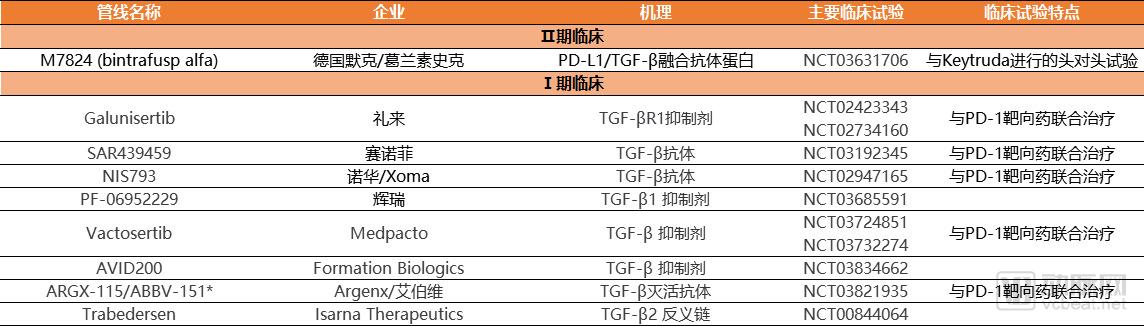
Figure: TGF-β-targeted drugs that have entered clinical trials
Many pharmaceutical companies are currently strategizing around TGF-β-targeted therapies. According to VCBeat New Medicine, there are nine drugs in clinical development, with Merck KGaA’s M7824 being the most advanced, having entered Phase II clinical trials. Among these nine candidates, six adopt a dual-targeting approach against PD-1/PD-L1 and TGF-β/TβR, underscoring the significance of combination antibody therapies in the future development of biopharmaceuticals.
In the clinical trials of these drugs, different trial designs were selected. Merck KGaA’s M7824 directly opted for a head-to-head trial against MSD’s PD-1-targeting Keytruda in its Phase II clinical study to fully demonstrate its efficacy. Sanofi’s SAR439459 and AbbVie’s ABBV-151 both adopted combination therapies with PD-1 inhibitors and specifically enrolled patients who had failed prior anti-PD-1/PD-L1 treatments in their clinical trials. In contrast, Pfizer’s PF-06952229 and Isarna’s Trabedersen chose monotherapy targeting patients with high TGF-β expression.
M7824 (bintrafusp alfa) is an investigational new drug from Merck KGaA, Germany. It is a bifunctional fusion protein targeting both PD-L1 and TGF-β, thereby simultaneously blocking these two pathways. As such, it has been referred to by some as an “upgraded” anti-PD-(L)1 antibody therapy.
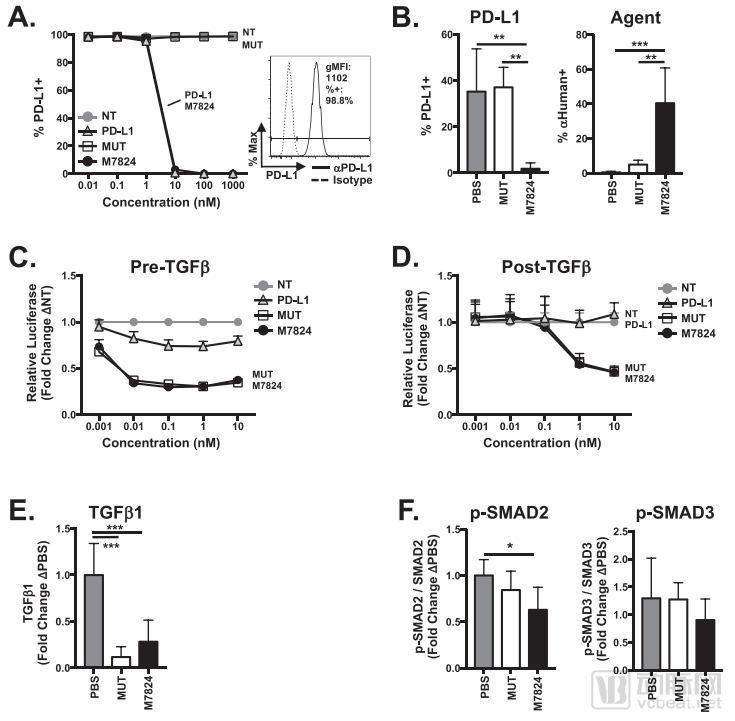
Image source: Karin M. Knudson, Kristin C. Hicks, et al. M7824, a novel bifunctional anti-PD-L1/TGFβ Trap fusion protein, promotes anti-tumor efficacy as monotherapy and in combination with vaccine.OncoImmunology 7,e1426519(2018).
Figure: Mechanism of Action Study of M7824
M7824 underwent comprehensive pharmacological studies prior to clinical trials, confirming its dual inhibitory effects on PD-L1 and TGF-β from a mechanistic perspective. As anticipated, M7824 exhibited nearly identical PD-L1 binding efficiency compared to avelumab (a PD-L1 antibody drug jointly developed by Pfizer and Merck KGaA). Furthermore, in murine experiments, M7824 demonstrated equally robust specific binding to PD-L1. In contrast, M7824 and avelumab showed significant differences in their ability to modulate TGF-β. Under the influence of M7824, TGF-β1 levels in the extracellular matrix were markedly reduced. Meanwhile, M7824 effectively decreased luciferase signaling downstream of TGF-β via Smad2 and significantly inhibited the phosphorylation levels of SMAD2 and SMAD3.

, Phase I Trial of M7824 (MSB0011359C), a Bifunctional Fusion Protein Targeting PD-L1 and TGFβ, in Advanced Solid Tumors.Clinical Cancer Research 24,1287-1295(2018).
Figure: Phase I Clinical Study of M7824
In early June 2018, M7824 announced two key sets of clinical data at the American Society of Clinical Oncology (ASCO) Annual Meeting. One clinical trial evaluated M7824 administered at a dose of 1200 mg every two weeks in patients with advanced non-small cell lung cancer (NSCLC). In this study, the objective response rate (ORR) for M7824 was significantly higher than historical data for PD-1 inhibitors, reaching an ORR of 71.4% among patients with high PD-L1 expression. In another clinical trial involving 17 patients with HPV-associated cancers treated with varying doses of M7824, the overall ORR reached 41.7%, whereas PD-1 inhibitors typically yield response rates of only 15% to 20% in this patient population.
The excellent results from the Phase I clinical trial greatly boosted the researchers’ confidence. In September 2018, M7824 initiated further Phase II clinical trials, directly opting for a head-to-head comparison with Keytruda. This international, multicenter trial is expected to enroll 1,500 participants, including 30 patients to be recruited from four hospitals in Beijing, Shanghai, and Guangzhou, China.
The development progress of this drug has also drawn the attention of the U.S. Food and Drug Administration (FDA). In December 2018, the FDA granted orphan drug designation to M7824 for the treatment of cholangiocarcinoma, indicating that its future research and development activities in the United States will proceed smoothly. Meanwhile, two clinical trial applications for M7824 have been submitted in China, one of which was approved in December 2018.
In February 2019, GlaxoSmithKline (GSK), recognizing the potential of M7824, announced a collaboration with Merck KGaA to jointly develop and commercialize M7824. The valuation of this project could reach up to €3.7 billion. Under the agreement, Merck KGaA will receive an upfront payment of €300 million ($340 million) and is eligible for milestones of up to €500 million ($566 million) related to the M7824 lung cancer program. Additionally, Merck KGaA can receive up to €2.9 billion ($3.3 billion) in funding support from GSK. The two companies will jointly undertake the development and commercialization of new technologies, with profits and costs from the collaborative projects shared equally.
The rapid development of targeted therapies in recent years has made them highly attractive to investors. Among the top ten best-selling drugs in 2018, nine were targeted therapies, with the remaining one being a vaccine. However, in clinical practice, single-target agents are increasingly failing to meet the therapeutic needs of many patients, due to issues such as primary insensitivity or acquired drug resistance. Introducing a second target to act concurrently at this stage could significantly improve patient outcomes. Bispecific antibodies and combination therapies involving multiple targeted agents are both designed to enhance the current treatment paradigm based on this rationale, and several such regimens have already received FDA approval for market entry. It is foreseeable that, in the future development of the biopharmaceutical industry, multi-target combination therapy will become one of the major directions in targeted drug research, alongside the continued expansion of the number of available targets.