

Sempre Health Files for IPO: Revolutionizing U.S. Prescription Drug Affordability Through Behavioral Incentives and Nationwide Pharmacy Integration

Sempre Health
Medical Pricing Solutions Provider
On May 14, 2018, Trump unveiled the “American Patients First” blueprint at the White House, vowing to significantly reduce prescription drug prices through “the most thorough reforms.” In response, U.S. pharmaceutical companies, represented by Pfizer, sharply raised the prices of certain drugs as a form of protest by “striking a discordant note.” In retaliation, President Trump launched a fierce tirade against them on Twitter.
Nevertheless, some companies are quietly aligning with policy directives to lower prescription drug prices and alleviate the financial burden on patients. On August 29 of the same year, Sempre Health, a leading healthcare software company, announced the completion of an $8 million Series A financing round led by Rethink Impact, with participation from Social Capital and other investors. The proceeds from this round will be used by Sempre Health to further build a two-sided network comprising payers and pharmaceutical manufacturers, aimed at reducing prescription drug prices.
Unlike the coupon and voucher systems used by traditional pharmacies, Sempre Health partners with multiple healthcare stakeholders and even strives to cover pharmacy networks nationwide. The Sempre Health platform can dynamically adjust payment methods based on individual adherence and behavior, ensuring that medication plans align with users’ financial and clinical circumstances.
Sempre Health, a company born amidst the surge of skyrocketing drug prices in the United States, has been in existence for less than four years. It strives to fundamentally enhance medication affordability for American patients and transform access to prescription drugs.
A study has shown that the use of economic incentives can sometimes help patients adhere to established care plans; however, such incentives are not always effective, as patient compliance with relatively less stringent care plans remains poor.
It was precisely by keenly recognizing this that Anurati Mathur and Swaraj Banerjee, the founders of Sempre Health who possess extensive experience in the big data industry, conceived the idea of addressing patient “compliance” with care plans, thereby building a prescription drug discount payment platform designed to enhance patient adherence to those plans.
They view this as a plan to gamify healthcare, incentivizing compliant behavior in a manner akin to the “good driver discount”—where responsible drivers enjoy reduced insurance premiums. How might this approach translate to the pharmaceutical or health insurance industries? If patients adhere to medical advice and health plans by purchasing and taking their medications on schedule, such positive behavioral records could help lower their medication costs, allowing them to receive discounts on prescription drugs. Otherwise, these patients might forgo purchasing the prescribed medications altogether. After all, Anurati Mathur had a similar experience: upon realizing that filling her prescription would cost $150, she decisively chose not to buy it.
“Patients must follow the process of consultation, undergo mammography or colonoscopy, and take medications as prescribed. Achieving this is not easy, but what if patients could use such behaviors as currency? What if their actions could save money for the healthcare system?” Anurati Mathur stated that through technology, Sempre Health can create a world where behavior subsidizes consumption—a network of manufacturers and payers leveraging big data technology to replace drug coupons. As for conventional coupon-based vouchers, Anurati Mathur believes they should be avoided as much as possible because “payers strongly dislike them.”
However, Anurati Mathur also believes that once patients take responsibility for their own health, and such responsible behavior can be used as “currency” to offset medical expenses, they can reduce their healthcare costs over time. Ultimately, patients can personally control their payment amounts.
Consequently, Anurati Mathur and Swaraj Banerjee promptly implemented this approach to reduce out-of-pocket costs for prescription medications, aiming to provide patients with partial discounts on their purchases and enhance their adherence to the payment platform through incentive-based mechanisms.
As a former data scientist at Propeller Health and the designer of epidemiological data products at Practice Fusion, Anurati Mathur possesses unique insights into healthcare big data and insurance discount schemes, while also having deep personal experience with the inconveniences of the prescription drug purchasing system. She found immediate synergy with Swaraj Banerjee, who previously served as Engineering Director at Zynga and MindMeld. Consequently, in 2015, with financial support from the renowned U.S. corporate incubator Alchemist Accelerator, the healthcare payment platform Sempre Health was established in San Francisco, California.
In 2016, Sempre Health raised $2.5 million in seed funding from Social Capital, a Silicon Valley-based consumer healthcare investment firm, and began to gradually build its medical payment network.
In July 2017, two years after its founding, the San Francisco-based startup Sempre Health partnered with health plans and pharmaceutical companies in Pennsylvania to evaluate the effectiveness of the Sempre Health platform. Reportedly, this pilot program began with heart disease patients enrolled in local health plans (Sempre Health declined to disclose patient names due to privacy concerns).
The Sempre Health platform operates on a registered membership model. First, patients complete personal registration on the official Sempre Health website to become members, a step that typically requires linking a mobile phone number or a commonly used email address. Sempre Health then generates a personalized health plan record for the patient and sends an exclusive invitation code via SMS or email (according to the official Sempre Health website, this process takes only five seconds). Consequently, when patients use the invitation code to purchase prescription medications at pharmacies, their health plan records are promptly updated to reflect the transaction.
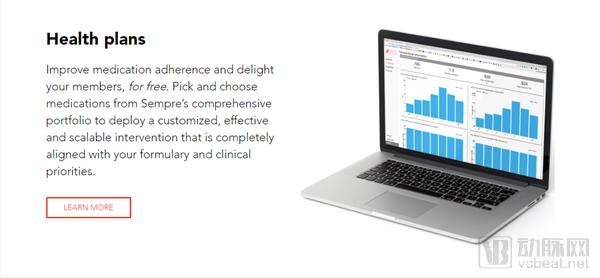
Sempre Health Official Platform Page (Image Source: Sempre Health Official Website)
Meanwhile, to ensure patients promptly fill their prescriptions and purchase medications on schedule according to their dosing dates, Sempre Health has established a dedicated discount program for its members. Additionally, to facilitate timely medication access at nearby pharmacies, the Sempre Health platform strives to integrate with pharmacy networks across the United States, thereby maximizing convenience.
When patients who have become Sempre Health members complete their first payment, it not only triggers an update to their health plan but also generates another message encouraging them to quickly schedule their next medication refill and calculating the corresponding discount based on the timeframe. For example, Sempre Health might send a message to the member stating: “If you pick up your prescription on Sunday (the date specified by the platform’s calculations), you will pay only $20; otherwise, you will pay $40.” The implication is that patients who fail to purchase and take their medications on time will incur higher out-of-pocket costs.
“Given that patients never pay more for their medications than their budget allows, Sempre Health’s discount model can enhance member adherence, with some members saving as much as $100 in a single transaction,” said Anurati Mathur. “We share these data with partners through a web-based dashboard that updates in real time. Additionally, we have built a sophisticated SMS management product that tags, parses, and learns the optimal ways to communicate with each patient, including the best times to send text messages and the most effective language to use.”
The U.S. Centers for Disease Control and Prevention states that nearly one in ten American adults do not take their medications as prescribed in order to save money, while according to Sempre Health, this approach can not only help patients cut costs but also encourage them to adhere to their medication schedules.
However, Sempre Health employs a reward mechanism that offers discounts to patients who adhere to their treatment regimens, while other companies in the market are comprehensively reducing drug prices.
Companies like GoodRx and Blink Health also aim to reduce the cost of prescription drugs, but they do so by enabling consumers to compare prices across pharmacies (as with GoodRx) or to locate the lowest-priced medications online for pickup at local pharmacies (as with Blink Health). In addition, OnMed, a startup, has developed telehealth kiosks that integrate diagnosis, prescription issuance, and payment into a single platform, and is currently expanding its operations nationwide.
Despite the distinctiveness of Sempre Health’s approach, which founder Anurati Mathur also considers more appealing, the company continues to seek stronger external partnerships and adjust its business operations in response to shifts in medical market segments.
On April 18, 2018, Sempre Health announced a pilot program in partnership with the renowned pharmaceutical giant Novo Nordisk (NYSE: NVO) to integrate diabetes medications into Sempre Health’s affordability and engagement solutions. Members enrolled in health plans on the Sempre Health platform who are prescribed Novo Nordisk’s diabetes medications will automatically receive discounts at the point of sale.
Sempre Health’s decision to focus on the niche segment of diabetes medications is well-founded. Taking insulin as an example, it is prohibitively expensive in the United States. According to statistics from the American Diabetes Association, prices for diabetes treatment drugs have risen by 25.6% over the past three years. A 10 mL vial of insulin at a concentration of 100 U/mL costs $285, whereas in China, a 10 mL vial of injectable insulin at 40 U/mL costs only RMB 20. Diabetic patients typically consume two to four vials of injectable insulin per month. However, high deductibles imposed by insurance companies place substantial financial burdens on these patients. Some diabetic patients have resorted to crowdfunding platforms to cover their insulin costs, while others have even turned to the black market to purchase insulin.
“Sempre Health’s appeal to Novo Nordisk lies not only in its current achievements and corporate objectives, but also in its direct collaboration with payers within existing technology systems,” said Rich DeNunzio, Vice President of Market Access Strategy and Innovation at Novo Nordisk. “From our perspective, the platform developed by Sempre is dynamic because it transforms traditional benefit design models, reducing patients’ out-of-pocket costs while lowering total care costs and improving patient adherence.”
Not limited to the field of diabetes, Bloomberg’s survey data on 40 commonly used drugs across six major categories reveals that over the three years since Donald Trump announced his candidacy for U.S. President in 2016, prices for five major categories of commonly used medications have continued to rise without effective control. Among these, autoimmune disease treatments saw the largest price increase at 40.1%; cancer therapies followed with a 30.9% rise; multiple sclerosis treatments increased by 30.6%; asthma and chronic obstructive pulmonary disease (COPD) medications rose by 27.7%; and HIV/AIDS treatments increased by 24.7%. In comparison, the U.S. Consumer Price Index (CPI) rose by only 5.6%, indicating that the price growth rates for these five major drug categories far exceeded those of general consumer goods.
In fact, the United States faces a series of problems that exist globally, such as pharmaceutical company monopolies, conflicts of interest, ineffective price controls, and middlemen profiting from price differentials. Rising drug prices are also one of the persistent social issues. According to a report released by the U.S. Congress in March 2018, between 2012 and 2017, the prices of the most popular brand-name drugs in the U.S. increased nearly tenfold compared to inflation. In the prescription drug sector, the annual per capita expenditure on prescription drugs in the U.S. reached $1,000, with total annual consumption amounting to $370 billion. Thousands of Americans spend over $100,000 annually on prescription drugs.
Amidst the severe pharmaceutical market pricing, Sempre Health continues to exert its efforts.
On December 18, 2018, Sempre Health announced an expansion of its partnership with UPMC Health Plan to improve patient affordability of critical medications. UPMC Health Plan is part of the University of Pittsburgh Medical Center (UPMC), the second-largest integrated health system in the United States.
This collaboration aims to enroll more cardiac patients from UPMC Health Plan as members of Sempre Health. The urgency and necessity of this partnership are driven by the fact that nearly one-third of cardiac patients skip or delay filling prescriptions or taking their medications due to high costs, leading to serious medical events.
From diabetes to heart disease, Sempre Health has successfully crossed over, inspiring its two founders, Anurati Mathur and Swaraj Banerjee. As long as the sharp rise in drug prices remains in stark contrast with consumers’ ability to pay, healthcare payment software companies like Sempre Health, which aim to reduce patients’ medication costs, will continue to have value in expanding. Entering 2019, Sempre Health is also poised to venture into other therapeutic areas, seek new partners, and deliver financial benefits to patients across the United States.
Reference Link:
Gamifying healthcare to reduce costs Sempre Health launches from the Alchemist Accelerator
https://techcrunch.com/2016/05/19/gamifying-healthcare-to-reduce-costs-sempre-health-launches-from-the-alchemist-accelerator/
Sempre Health and Novo Nordisk Partner to Improve Medication Costs for Patients With Diabetes
https://www.prnewswire.com/news-releases/sempre-health-and-novo-nordisk-partner-to-improve-medication-costs-for-patients-with-diabetes-300631826.html
Sempre Health and UPMC Health Plan Expand Program that Improves Affordability and Adherence for Critical Medications
https://www.prnewswire.com/news-releases/sempre-health-and-upmc-health-plan-expand-program-that-improves-affordability-and-adherence-for-critical-medications-300768200.html
Drug Prices
https://www.bloomberg.com/quicktake/drug-prices
(Compiled by Ning Chen)