

Yitu Healthcare and Huawei Pioneer the Era of Intelligent Medical Cloud
VCBeat (WeChat ID: vcbeat) has learned that on March 21, at the 2019 Huawei China Ecosystem Partner Conference held in Fuzhou, Yitu Healthcare and Huawei jointly unveiled a major strategic collaboration achievement—the Intelligent Medical Cloud. This represents a deep integration of world-class medical artificial intelligence technology with Huawei’s robust cloud platform and big data capabilities. Across the entire AI healthcare sector, this launch marks the first time an AI healthcare company has deeply integrated multiple discrete disease-specific applications to form patient-centered, scenario-based solutions. It also signifies the first migration of AI to the cloud, formally ushering AI-powered medical solutions into the cloud era.
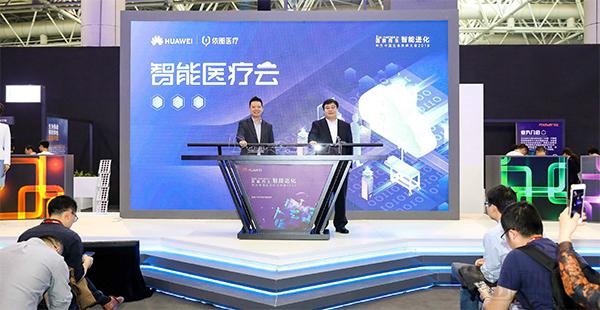
Left: He Ji, General Manager of R&D for Huawei Digital Government; Right: Su Xiaoming, General Manager of the Healthcare Industry Division at Yitu Technology
Huawei and Yitu have maintained a long-standing partnership. This renewed collaboration underscores Yitu Medical’s continued commitment to deepening its presence across the full spectrum of healthcare scenarios. “We aim to lay a solid foundation for the advancement of medical AI with cutting-edge artificial intelligence technologies, and leverage cloud platforms to make intelligent healthcare applications widely accessible to the public,” said Su Xiaoming, General Manager of Yitu Medical’s Healthcare Industry Division.
“Yitu is one of the few AI companies worldwide that has achieved world-class capabilities in all three core AI domains: computer vision, natural language processing, and automatic speech recognition. By leveraging Huawei’s full-scenario AI infrastructure solutions spanning devices, edge, and cloud, we can jointly deliver flexible and efficient smart healthcare solutions to enterprise customers,” said He Ji, General Manager of R&D for Huawei’s Digital Government Business.
The Intelligent Medical Cloud represents a deep integration of “one foundation and three core technologies.” The “foundation” refers to Huawei’s full-stack cloud and big data infrastructure, while the “three core technologies” are Yitu Healthcare’s three globally recognized AI pillars: image recognition, natural language processing, and speech processing. Through the deep convergence of “big data, AI, and cloud,” this Intelligent Medical Cloud harnesses the power of “aggregation,” “sharing,” and “empowerment,” truly transforming heterogeneous medical data repositories into structured, analyzable data assets. Leveraging the sharing capabilities and accessibility enabled by cloud technology, it accelerates the deployment of Yitu Healthcare’s AI product portfolio covering the entire clinical workflow, thereby achieving extensive empowerment of primary healthcare institutions across China.
Yitu Healthcare has always adhered to the view that artificial intelligence is the foundation of medical big data. In his keynote address at the conference, Su Xiaoming stated, “Leveraging artificial intelligence technologies to govern big data can transform vast amounts of dormant data into medical big data with genuine utility, thereby further converting such data into data assets. These assets become valuable resources for healthcare institutions and governments, creating value for society.”
The newly released Intelligent Medical Cloud boasts powerful medical data analytics capabilities, enabling the analysis of comprehensive healthcare industry data and patient full-lifecycle data, thereby forming a full-stack decision support engine.
Huawei’s big data platform provides an enterprise-grade big data environment for medical data processing. In October 2017, Huawei’s FusionInsight big data platform ranked first in the Leaders quadrant of the “IDC MarketScape: China Big Data Management Platform Vendor Assessment, 2017” report published by IDC. The deepened collaboration between the two parties will further advance their progress in the field of medical data processing.
There is a gap between the demand for and supply of medical services in China. The essence of medical AI lies in instrumentalizing human capabilities, transforming healthcare providers from “physicians” to “AI-assisted physicians,” thereby enabling advanced diagnostic and treatment capabilities to reach primary care settings through medical AI and empowering grassroots healthcare.
Yitu Healthcare is currently the only medical AI company in the industry with full-stack data and algorithm capabilities. Its care.ai™ series of AI products have been deployed in more than 200 Grade A tertiary hospitals across China, breaking beyond single medical scenarios to expand into early screening and health management. “With the support of Huawei Cloud, Yitu Healthcare’s leading AI product portfolio will further deepen its penetration into grassroots healthcare, enhancing the level of intelligence in primary medical institutions across multiple domains, including imaging diagnosis, tumor multidisciplinary team (MDT) diagnosis and treatment, intelligent research, and smart hospital management,” said Su Xiaoming.
“The ultimate outcome of AI in the healthcare sector is to leverage artificial intelligence to restructure the diagnosis and treatment pathway for diseases, empowering hospitals and outpatient clinics by providing physicians with efficiency-optimization tools and decision-support services. Taking intelligent imaging diagnosis within an intelligent medical cloud platform as an example, this platform can provide primary healthcare institutions with robust imaging diagnostic capabilities while improving diagnostic efficiency, significantly enhancing both the medical service delivery capacity of healthcare institutions and patient satisfaction. A single AI solution can save a county or city tens of millions of yuan annually in costs related to film, equipment, software, and personnel training, generating nearly 100 million yuan in economic benefits,” said Su Xiaoming.
Huawei also has high hopes for this collaboration. He Ji stated, “Both parties firmly believe that the future of AI lies in healthcare. We are committed to seamlessly integrating algorithms with physicians’ clinical decision-making capabilities, ensuring that everyone has equitable access to medical services.”