

AnHan Technology, a Capsule Endoscopy Company, Included in the First Batch of Sci-Tech Innovation Board IPO Applicants
On the afternoon of March 22, the Shanghai Stock Exchange announced the first batch of accepted applicants for the STAR Market. Anhan Technology and Wuhan Keqian Biology, as representatives in the biopharmaceutical sector, were successfully included. (Note: As Wuhan Keqian Biology’s primary business is veterinary drugs, this article will not provide extensive coverage.) The detailed list is as follows:
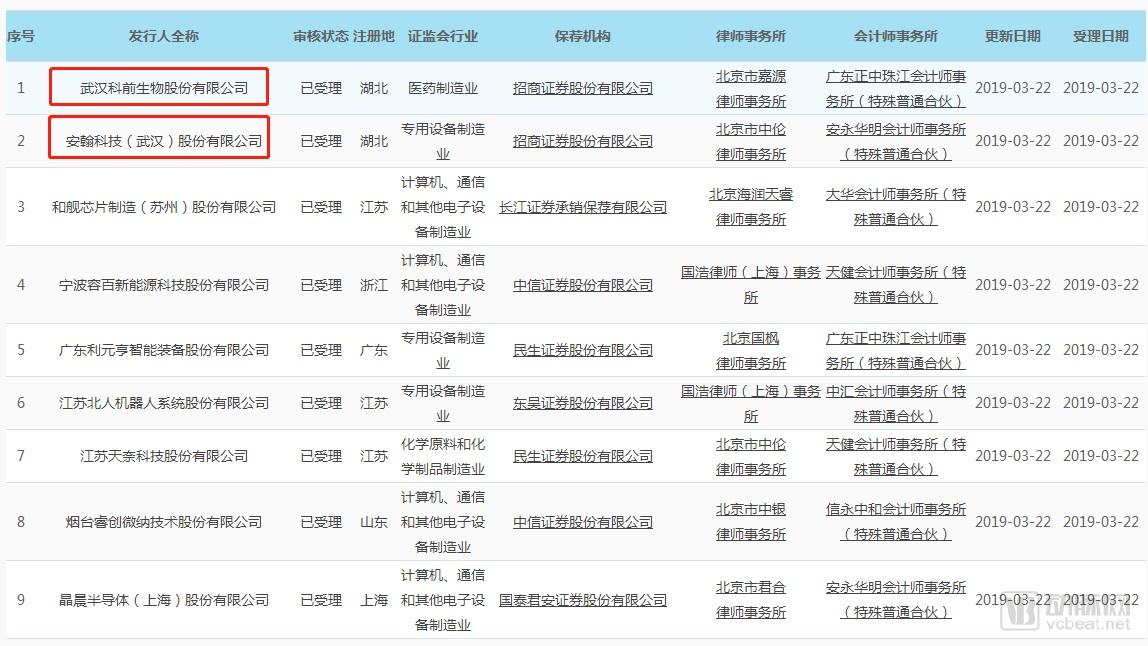
According to VCBeat (WeChat official account: vcbeat), the basic profiles of the nine companies in the first batch accepted for review are as follows: In terms of industrial and sector classification, three companies belong to next-generation information technology, two each to high-end equipment manufacturing and biopharmaceuticals, and one each to new materials and new energy. Regarding the chosen listing standards, six companies opted for Standard I (“market capitalization + net profit/revenue”), while three selected Standard IV (“market capitalization + revenue”), including one pre-profit company. The average projected market capitalization of the nine companies is RMB 7.276 billion; after excluding the company with the highest projected market capitalization (RMB 18 billion), the average projected market capitalization stands at RMB 5.935 billion.
From a financial perspective, excluding one loss-making enterprise (Hejian Chip, with total assets of RMB 24.194 billion, operating revenue of RMB 3.694 billion, and net profit of -RMB 2.602 billion in the most recent year), the average total assets at year-end for the other eight enterprises amounted to RMB 1.532 billion. Their average operating revenue for the most recent fiscal year was RMB 1.034 billion, and the average net profit attributable to shareholders after deducting non-recurring gains and losses was RMB 164 million. The average revenue growth rate across these companies in the most recent fiscal year was 61.43%, with R&D expenditure accounting for 5–20% of operating revenue.
Overall, the aforementioned companies operate in diverse industries and vary in terms of company size, operational performance, and development stages. Collectively, they possess certain scientific and technological innovation attributes, reflecting the inclusiveness of the listing requirements on the STAR Market.
In accordance with relevant regulations, the issuance and listing process for stocks on the STAR Market includes the following stages: application, acceptance, review, deliberation by the Listing Committee, submission to the China Securities Regulatory Commission (CSRC), CSRC registration, and issuance and listing. In other words, the acceptance of a company’s application by the Shanghai Stock Exchange merely represents the first step in the issuance and listing process.
Analysis of the First Batch of Accepted Medical Enterprises
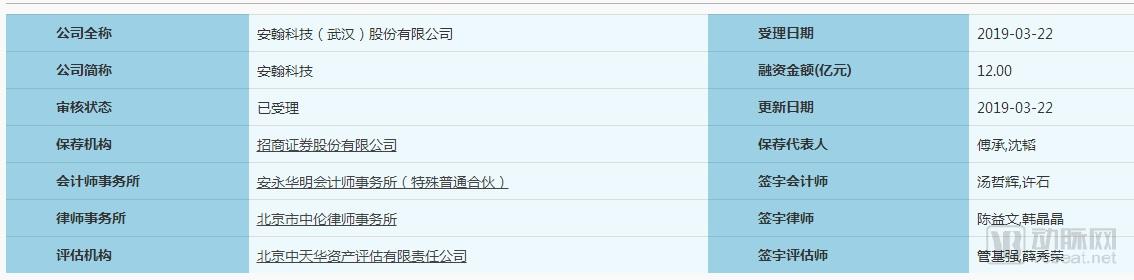
Anhan Technology focuses on the health of the digestive system. Leveraging a new-generation capsule technology platform that encompasses multiple technical fields, including precise magnetic control, dedicated chips, artificial intelligence, intelligent manufacturing, micro-optical imaging, image processing, and wireless transmission, the company is primarily engaged in the independent research and development, production, sales, and service of its "Magnetic-Controlled Capsule Gastroscopy System" robot. It is the first company globally to obtain a Class III medical device registration certificate for the "Magnetic-Controlled Capsule Gastroscopy System" issued by the China Food and Drug Administration (CFDA).
The “Magnet-Controlled Capsule Gastroscopy System” robot developed by the company is currently the world’s first magnet-controlled capsule gastroscopy product to have obtained a Class III medical device registration certificate approved by the China Food and Drug Administration (CFDA) and achieved mass production and market launch, representing significant technological innovation and breakthroughs. The company holds a series of independent intellectual property rights for its “Magnet-Controlled Capsule Gastroscopy System” robot products, with technologies spanning multiple fields, including precise magnetic control, specialized chips, artificial intelligence, intelligent manufacturing, micro-optical imaging, image processing, and wireless transmission. The company has been granted a total of 51 patents, covering areas such as magnetic control algorithms, magnetic control equipment, controllable endoscopic capsules (e.g., capsule activation technology), magnetic-controlled capsule image processing and AI recognition, magnetic positioning technology, and wireless receiving devices for magnetically controlled capsules, thereby ensuring comprehensive protection for both the equipment and the capsules.
The aforementioned patents have provided a certain level of protection for the improvement and optimization of the Company’s products. In addition to patent applications filed in China, the Company has also submitted patent applications in the United States, Europe, Japan, and other regions to achieve multi-jurisdictional patent protection. Other technical patents held by the Company cover products under development, including vibrating capsules, gastrointestinal motility marker capsules, portable endoscopes, and sampling capsules, which represent one of the key directions for the Company’s future expansion. The technical patents related to these products under development will help perfect the Company’s technological ecosystem and enhance its risk resilience.
The Company’s robotic product, the “Magnetic-Controlled Capsule Gastroscopy System,” has been deployed in hundreds of medical institutions (including hospitals and health examination centers) across China. It has generated sales revenue in China, France, Hungary, and the United Arab Emirates, and clinical studies and validations are underway in the United Kingdom and other regions.
The company’s most recent round of financing took place in 2017, after which Anhan Technology was valued at RMB 5.96 billion. During the reporting period, the company’s primary customer base consisted of private health checkup centers and public hospitals, among others. The composition of the company’s main business revenue is as follows:
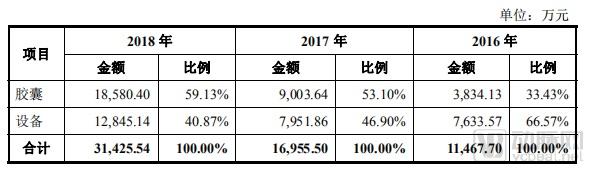
Data source: Anhan Technology's prospectus
During the reporting period, the production capacity, output, and sales volume of the Company’s main products were as follows:
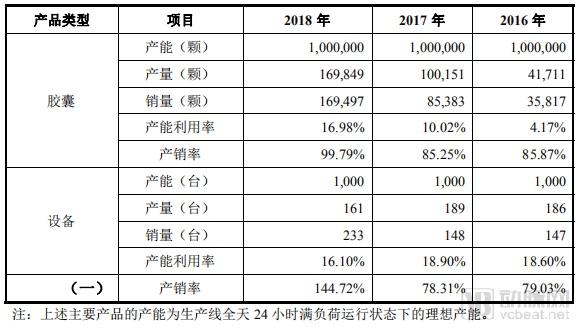
Data source: Prospectus of Anhan Technology
During the reporting period, except for sales to Meinian Onehealth Healthcare Industry (Group) Co., Ltd. and its franchisees, which accounted for more than 50% of total sales, the Company did not have any situation where sales to any other single customer exceeded 50% of the total amount. The Company’s sales to the top five customers in each period are as follows:
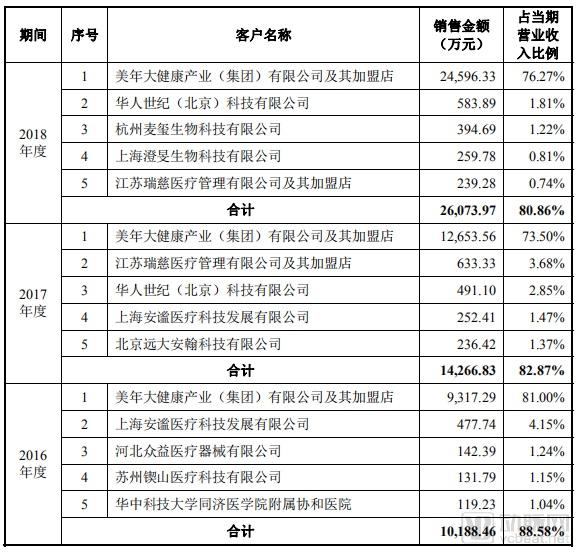
Source: Anhan Technology Prospectus
The background and reasons why Meinian Onehealth Healthcare Industry (Group) Co., Ltd. and its franchisees became the Company’s largest customer during the reporting period are as follows: One of the Company’s key channels for market promotion is the health checkup market, which in China is primarily composed of private health checkup providers and public hospital-affiliated checkup centers. Unlike public hospital checkup departments, where each entity conducts independent evaluations and procurement, private health checkup providers typically centralize evaluation and procurement at their group headquarters, thereby achieving higher marketing effectiveness.
The comparison of the Company’s comprehensive gross profit margin with that of listed companies in the same industry is shown in the table below:
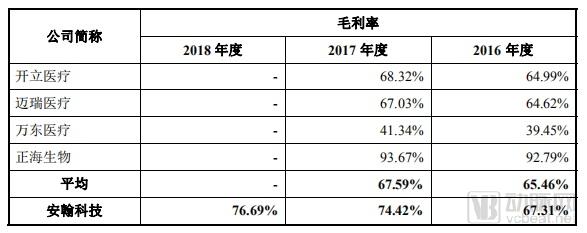
Data source: Anhan Technology's prospectus
Targeting the gastric disease screening market as its primary focus, the company currently adopts a sales model that combines direct sales and distribution, with direct sales as the main channel and distribution as supplementary. The details are as follows:
Direct Sales Model
For private health checkup institutions, primarily referring to clients such as Meinian Onehealth Healthcare Industry (Group) Co., Ltd. and its franchisees, the Company generally adopts a direct sales model for the sale of capsules and equipment. This is mainly because the cooperation between the Company and private health checkup institutions constitutes commercial partnerships, where cooperation intentions and specific details can typically be determined through negotiations and consultations.
Under the direct sales model, the company’s Business Management Center must first review the customer’s business license and Medical Institution Practice License before signing a buyout sales contract with the customer.
When selling equipment to private health checkup institutions, the Company allows these customers to make payments either in accordance with the terms stipulated in the contract or through financial leasing arrangements. For sales to a small number of public medical institutions, the Company also adopts a direct sales model.
Business Model
Given that public medical institutions typically have established procurement processes and maintain relatively fixed supplier relationships, new medical devices generally enter the public healthcare system through these existing suppliers via bidding procedures. Consequently, the Company primarily adopts a distribution model for selling capsules and equipment to public medical institutions.
Under the distribution model, prior to signing a contract with a distributor, the Company’s Business Management Center must first review the distributor’s business license and Medical Device Operation Permit. Upon completion of verification, the Company shall then enter into a buyout sales agreement with the distributor. After acquiring ownership of the equipment and capsules, the distributor typically will further
Sell the equipment and capsules to public medical institutions, which procure the equipment and capsules from distributors.
Ownership of the Cyst.
The Company also adopts a distribution model for its sales to a small number of private health checkup institutions.