DeYi Sunshine Pursues the Next Wave in China's Orphan Drug Market
In 1999, after completing his doctoral and postdoctoral research in the United States, Liu Hongyu returned to his homeland, eager to make a significant impact. However, after exploring various opportunities, he became convinced that China was not yet fertile ground for biopharmaceuticals at that time. “Having just completed my studies, I had only a superficial, textbook understanding of pharmaceuticals. I needed an established pharmaceutical company to mentor me and help me grow into a true pharmaceutical professional.”
Six months later, Liu Hongyu signed a contract with ZymoGenetics, a pharmaceutical company based in Seattle. “But I never intended to stay in the United States permanently.” His aspiration to return to China and start his own business was as tranquil yet profound as Lake Union beside the company’s offices. What Liu did not anticipate was that this biopharmaceutical company, ZymoGenetics, would forge a lifelong bond with him. Fifteen years later, he decisively chose the shores of Lake Union as the site for Deyi Sunshine’s U.S. clinical center—but that is a story for another time.
Deyi Sunshine Biotechnology is a company dedicated to innovative orphan drugs. At its inception in 2013, the founding team decided to focus on orphan drugs as their core business, based on their assessment of domestic and global pharmaceutical trends. “Our early judgment has been proven correct by recent policy and market trends,” said Dr. Liu Hongyu, Chairman and President of Deyi Sunshine Biotechnology, in an interview with VCBeat New Medicine.
The development of China’s macroeconomy and policy incentives have created an ideal external environment for orphan drugs. Regions with more mature orphan drug markets, such as the United States, South Korea, and Taiwan, all entered their golden age following substantial government encouragement after their per capita GDP exceeded US$10,000. Since 2010, China’s per capita GDP has risen rapidly, approaching US$10,000 by the end of 2018. From a payment perspective, Chinese patients have generally begun to demonstrate the ability to afford orphan drugs.
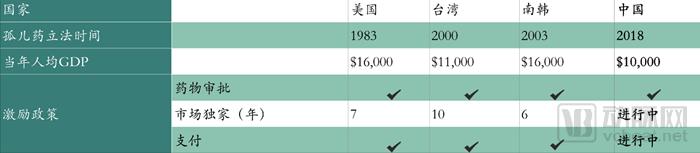
Orphan Drug Legislation in the United States, Taiwan, South Korea, and China (Compiled by Zero2IPO Healthcare Team)
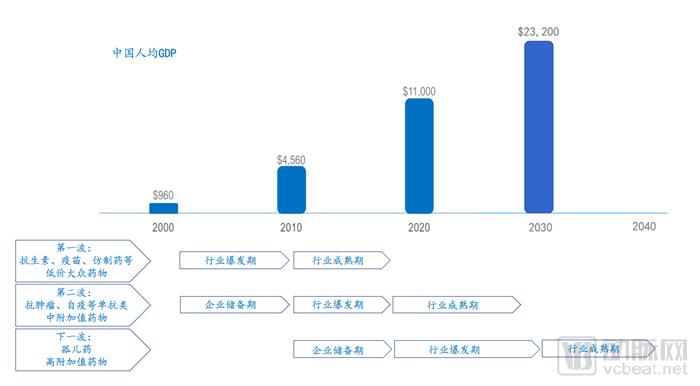
Per Capita GDP and Mainstream Drugs (Compiled by the Zero2IPO Healthcare Team)
On the other hand, as a crucial support for early-stage R&D, capital attention toward orphan drugs has gradually increased. In 2013, when Liu Hongyu first began fundraising, rare diseases and orphan drugs had not yet entered public awareness in China, and professional investment institutions rarely invested in this sector. Due to the high prices and narrow patient populations associated with orphan drugs, investors often kept their distance from Deyi Sunshine Biotechnology (Beijing) Co., Ltd.’s projects, despite the allure of terms like “global novelty” and “exclusivity.” “I barely had the chance to finish presenting our pipeline.” Looking back nearly six years later, a reporter from VCBeat New Medicine could still clearly sense Liu Hongyu’s helplessness at that time.
The turning point came when Liu Hongyu first walked into Jinfu Investment, located in Pudong, Shanghai. The investment managers not only listened to Liu Hongyu’s project presentation with great interest but also repeatedly sought him out for further discussions and exchanges. Dr. Wang Xiaoyan, a partner at Jinfu Health Fund who is responsible for the Deyi Sunshine project, told VCBeat New Medicine that prior to engaging with Deyi Sunshine’s project, her team had been closely monitoring the rare disease novel drug sector and planning to make forward-looking investments. Dr. Wang’s assessment of Deyi Sunshine was, “The team members are all low-key, but they possess a solid and excellent technological foundation.”
In 2016, Deyi Sunshine successfully secured RMB 20 million in Series A financing from Jinpu Health Fund. In 2017, it further attracted investment from Xuan Shi Capital. “Xuan Shi has invested in multiple drug development companies in Europe and the United States, including those focused on orphan drugs. However, Deyi Sunshine is the first Chinese pharmaceutical company we have invested in. One of the primary reasons is their focus on orphan drugs,” introduced Dr. Dai Xiaochang, former President of Kunming Pharmaceutical Group and current Partner at Xuan Shi Fund. “Our collaboration with Deyi Sunshine is long-term, and we will continue to provide financial support. We are considering participating in their next funding round.”
Yu Jurong, Partner at Qingke Medical, also stated, “As a long-term capital partner of Deyi Sunshine, we are highly optimistic about the tangible value of orphan drugs and the market opportunities both domestically and internationally. Dr. Liu Hongyu combines the rigor of a scientist with the pragmatic flexibility of an entrepreneur, and he is very candid when addressing capital-related issues. With a comprehensive research team, a rich product pipeline, and a suitable business model, we believe that Deyi Sunshine will become a leading enterprise in the field of orphan drugs.”
Furthermore, the “maturity” of Deyi Sunshine’s team left a deep impression on the VCBeat reporter during the interview. Core members—including President Dr. Liu Hongyu, Vice President of R&D Dr. Zou Zhihua, and Vice President of Quality Dr. Yuan Zhi—graduated from Chinese universities, went abroad for advanced studies in the late 1980s and early 1990s, completed their Ph.D. and postdoctoral training overseas, and engaged in drug R&D at foreign pharmaceutical companies for many years before returning to China to launch their venture amid the increasingly mature landscape of domestic new drug development. Over the past six years, the company has also cultivated a group of key personnel, such as Dr. Zhao Mingzhi, Director of Production, and Dr. Sun Pei, Director of Cell Biology. They are respectively responsible for pharmacology, pharmacokinetics, toxicology, production, and quality control in drug development, forming a comprehensive preclinical team. “This would have been nearly impossible in 1999, or even in 2009.”
Liu Hongyu’s work at ZymoGenetics primarily focused on the development and drugability studies of the interleukin family. Interleukins are a type of cytokine and represent star proteins in the biopharmaceutical industry. Since the discovery of the first interleukin molecule (interleukin-1, IL-1) in 1977, researchers have identified more than 40 interleukin molecules. Therapeutics targeting members of the interleukin family and their receptors include various formats such as fusion proteins and antibodies, and interleukins themselves can also serve as effective drugs. Currently, interleukin-1, interleukin-2, interleukin-4, interleukin-6, interleukin-10, interleukin-15, interleukin-17, interleukin-20, interleukin-21, interleukin-22, interleukin-23, and interleukin-29 have either been marketed or entered late-stage clinical trials, playing significant roles in the treatment of cancer, asthma, viral infections, autoimmune diseases, and tissue repair.
Drug development within the interleukin family is ZymoGenetics’ primary focus. Dr. Don Foster, the company’s Chief Scientific Officer (CSO), is a preeminent expert in the field of interleukin family proteins. Dr. Foster earned his Ph.D. from the University of Washington under the supervision of Professor Earl W. Davie, a 1993 Nobel Laureate in Chemistry and one of the company’s co-founders. Since joining ZymoGenetics at its inception, Dr. Foster has led the discovery of interleukin-20 (IL-20), IL-21, IL-22, IL-24, IL-28A, IL-28B, IL-29, IL-31, and/or their receptors, continuously advancing first-in-class (FIC) therapeutics into clinical trials. Hongyu Liu joined the IL-28 and IL-29 development program in 2002 and, under Dr. Foster’s leadership, achieved numerous breakthroughs in the drugability and manufacturing of IL-29.
In 2009, Bristol Myers Squibb (BMS) acquired ZymoGenetics for $870 million, thereby securing global rights to interleukin-28 and -29. Under BMS’s leadership, the clinical development of interleukin-29 accelerated rapidly, advancing swiftly into Phase III clinical trials and yielding satisfactory clinical data. However, just as BMS was preparing to submit a New Drug Application (NDA) for interleukin-29 to the U.S. Food and Drug Administration (FDA), Gilead Sciences’ blockbuster hepatitis C drug, sofosbuvir, beat it to market. With superior clinical efficacy compared to interleukin-29, sofosbuvir’s launch rendered the development of interleukin-28 and -29 virtually obsolete overnight. Consequently, BMS decisively discontinued investment in the drug, consigning interleukin-28 and -29 to history.
But Liu Hongyu was not resigned to this outcome, even though he had left his previous position in 2008 to join the Danish multinational pharmaceutical company Novo Nordisk. Liu believed that interleukin-28 and -29 had undergone rigorous preclinical research and development and yielded promising data in clinical trials; they were abandoned simply because of being one step behind. He was convinced that, through molecular optimization and adjustment of indications, interleukin-28 and -29 indeed held the potential to become high-quality therapeutics, and that this work could be accomplished in China.
Deyi Sunshine’s first investigational drug, Pegran (PSP001), is an antiviral agent targeting chronic norovirus infection in immunocompromised individuals. In fact, the compound used in Pegran is based on interleukin-28 and -29. Unlike over a decade ago, the structurally optimized interleukin-28 and -29 are now being developed for an orphan disease indication.
Norovirus is a common virus that causes diarrhea upon infection in humans. Unfortunately, there is currently no approved medication worldwide to combat this prevalent virus. In individuals with normal immune function, the immune system typically clears the virus within 1–3 days. However, transplant recipients lack sufficient immunity to fight off norovirus, leading to persistent diarrhea that can last for months and ultimately prove fatal. Statistics indicate that the mortality rate among immunocompromised individuals infected with norovirus ranges from 3% to 25%. Each year, tens of thousands of people in the United States and China develop chronic norovirus infections.
Developing new drugs is a arduous process of making incremental progress amidst constant failures, with challenges often exceeding expectations. Even though the drug is an improvement on a mature compound, no preclinical hurdles can be skipped. Since chronic norovirus infection in immunocompromised populations is classified as a rare disease, neither the United States nor China has well-established preclinical models available for use. Liu Hongyu and Zou Zhihua had to explore and establish each model step by step, a process that was extremely demanding. Throughout this period, Don Foster served as their scientific advisor, providing continuous companionship and guidance.
Liu Hongyu and Don worked together for many years, developing a strong rapport. Liu had long wanted to recruit his former boss into the Deyi Sunshine team but lacked the courage to broach the subject. By 2008, Don had already left ZymoGenetics and was serving as Senior Vice President of the U.S. R&D Center at Novo Nordisk. When Liu finally summoned the courage to extend the invitation, Don responded with a single word: “Finally.” Today, Don serves as Vice President of Clinical Affairs at Deyi Sunshine, overseeing the company’s U.S. clinical trial center in Seattle.
After recruiting key technical personnel and securing financing, Deyi Sunshine Biotechnology rapidly initiated the early-stage development of Interleukin-28 and -29. Three years later, the optimized Interleukin-28 and -29 completed preclinical studies, with Deyi Sunshine planning to submit an Investigational New Drug (IND) application for Pegilan to the U.S. FDA in the second quarter of 2019. “My primary focus now extends beyond Pegilan to encompass the company’s overall strategic planning and expansion,” Liu Hongyu told VCBeat News. “We currently boast a robust product pipeline with smooth progress, adhering to a dual-drive strategy of independent R&D and project in-licensing. Deyi Sunshine aims to evolve from a single-product company into a leader in the rare disease sector, expanding from R&D to commercialization, and from China to the global market, thereby addressing more unmet medical needs.”
Currently, Deyi Sunshine is undergoing Series B financing.
For cooperation, please contact:
Zero2IPO Capital: An Hongfei
Email: kevinan@zero2ipo.com.cn
Tel: 15201312529
References:
“Research Progress on Drugs Targeting Different Members of the Interleukin Family,” Chen Xinying, Zhang Zhengping