

Advancing Clinical Translation and Innovation in Ophthalmology and Vision Science: Unveiling New Investment Trends and Strategic Initiatives
Aier Eye Hospital
Ophthalmology Medical Chain Institution

Alcon
Ophthalmic Pharmaceuticals and Medical Devices Manufacturer
Communication and sharing, inclusiveness and convergence, cross-disciplinary integration and collision—visual science is closely linked to the quality of human life. Translational research and innovation hold strategic significance for catalyzing new products, tools, and models in the industry, thereby enhancing the quality and efficiency of medical services.
At the 1st China International Forum on Translational Medicine and Innovation in Ophthalmology and Optometry, held on March 23, 2019, more than 300 attendees gathered in Shanghai. These included experts and physicians (including researchers) from China and abroad, such as those from the United States, Israel, Singapore, and Germany; technology transfer offices of renowned overseas hospitals and universities; incubators and investment firms specializing in vision science both domestically and internationally; and representatives of leading enterprises across the upstream and downstream segments of the vision science industry chain. They engaged in dialogue and exchanges on nine key topics, including promoting clinical translation and innovation in ophthalmology and vision science in China, and emerging trends in investment within these fields.
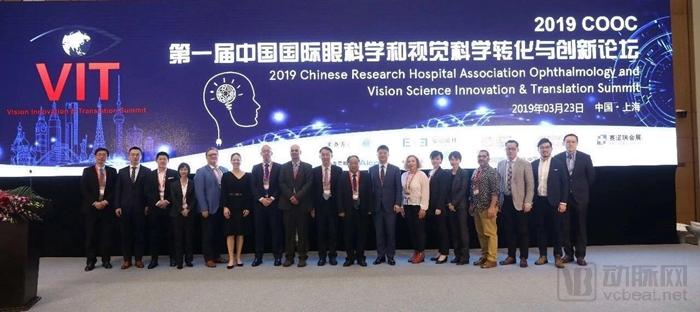
Group Photo of Some Attendees (Image Source: Provided by the Company)
Held during the 19th International Conference on Optometry, this forum was jointly organized by the Ophthalmology and Visual Science Professional Committee of the Chinese Research Hospital Association, Aier Eye Hospital Group Co., Ltd., the Singapore Eye Research Institute, Ruimengxi Capital, and Shanghai Sinorui Exhibition Co., Ltd. VCBeat (WeChat ID: vcbeat), as the official supporting media, participated in and covered the entire event.
Innovation Is the Inexhaustible Driving Force for the Development of Ophthalmology
At the outset of the conference, Professor Zhao Jialiang from Peking Union Medical College reviewed the historical development of ocular diseases in China. Professor Zhao pointed out that with advancements in technology and improvements in medical standards, traditional blinding conditions such as trachoma and infectious conjunctivitis have been conquered; however, contemporary ocular diseases are now characterized by greater complexity.
Professor Zhao pointed out that the three major blinding eye diseases recognized by the World Health Organization (WHO)—cataracts, glaucoma, and macular degeneration—remain prevalent in China. Compared with cataracts, which are treatable, and glaucoma, which is characterized by severe pain and rapid vision loss, many fundus diseases represented by macular degeneration have become a silent killer increasingly threatening people’s visual health, such as diabetic retinopathy and pathological myopia. These painless and itch-free fundus diseases are more insidious and cause irreversible, serious harm.
Professor Zhao pointed out that the high complexity of fundus diseases, the large affected population, and the low public awareness constitute the three major challenges facing the ophthalmic medical community today. To address these diseases, in addition to continuously improving physicians’ diagnostic and therapeutic capabilities, reliance on technological innovation is essential. Innovative achievements can enhance disease diagnosis, deepen understanding of pathogenic mechanisms, and thereby improve treatment outcomes.
Professor Ge Jian of the Zhongshan Ophthalmic Center at Sun Yat-sen University reviewed the major technological breakthroughs in the history of ophthalmology, pointing out that innovation and precision manufacturing are the driving forces behind the development of the field.
Ge Jian stated that today, big data from informatization, genomics, and proteomics are driving the development of precision medicine in ophthalmology, while gene therapy has opened new avenues for the prevention and treatment of many major eye diseases. The application of artificial vision, 3D retinal technology, and artificial intelligence in ophthalmology has provided ophthalmologists with new tools. Furthermore, advancements in precision manufacturing and advanced manufacturing technologies have significantly improved diagnostic and therapeutic techniques for eye diseases, offering hope for vision restoration to more patients.
The rapid advancements in new technologies, novel pharmaceuticals, advanced surgical equipment, and basic research have driven development across the entire field of ophthalmology. Professor Donald Tan from the Singapore National Eye Centre and Duke-NUS Medical School cited innovative translational achievements in corneal transplantation as an example to illustrate to attendees the powerful driving force of innovation.
Promoting Interdisciplinary Integration and Building Professional Teams
Professor Sun Xinghuai of the Eye, Ear, Nose and Throat Hospital of Fudan University pointed out the importance of interdisciplinary collaboration. Professor Sun stated that a team typically requires members with diverse disciplinary expertise. Through the cross-pollination and integration of knowledge, new concepts and theories can be developed, new research fields opened up, and new technologies and industries spawned.
Professor Sun pointed out that interdisciplinary integration, innovation, and translation in ophthalmology are the most representative, for example:
Various ophthalmic imaging scans, such as corneal topography, OCT, OCTA, UBM, B-scan ultrasound, and Doppler;
Laser therapy for ocular diseases, such as corneal refractive surgery, glaucoma surgery, cataract and after-cataract surgery, fundus diseases, and photodynamic therapy (PDT);
Chip (bio) technologies, such as cloud clips for visual behavior monitoring, genetic diagnosis of eye diseases, and artificial visual prostheses.
Professor Sun Xinghuai, one of the organizers, further stated that the forum aims to actively facilitate and organize multidisciplinary teams to collaborate on clinical issues from diverse perspectives, thereby fostering an environment conducive to disciplinary integration and innovative research, and encouraging cross-sector collaboration among clinical practice, scientific research, management, and investment.
Richel, Founder of Ruimengxi Capital, Emphasized Two Key Points on the Clinical Translation of Ophthalmology and Vision Science:
First, physicians should carefully consider their decision before resigning to start a business. Richel noted that although policies are in place to encourage such ventures, R&D and commercialization are distinct processes; therefore, physicians must thoroughly assess whether their projects can truly succeed on the path to commercialization.
Second, it is emphasized that inventors (physicians) should not try to handle everything themselves. “This is another important manifestation of the interdisciplinary collaboration mentioned by Professor Sun earlier. A team composed of multidisciplinary and diverse talents is more conducive to the overall operation of the company.” Richel emphasized that the commercialization of ophthalmic research achievements is a systematic project requiring long-term thinking, craftsmanship, and an open vision.
According to survey results from Ruimengxi Capital, there remains a significant gap between China and the United States in the fields of ophthalmology and optometry. In terms of the number of academic papers, the United States produces twice as many as China; however, regarding the concrete translation of research into projects, the United States achieves nine times the output of China.
The “2018 China Patent Survey Report” states: When asked about the biggest obstacle to patent transfer and commercialization, 54.1% of universities and research institutions identified “the lack of a professional team for technology transfer” as the primary barrier.
Richel stated that the shortage of talent is a major bottleneck in the development of ophthalmology and optometry, and called on all sectors of society to increase their attention to and investment in this field.
New Trends in Ophthalmology and Vision Science Investment
As an investment institution focused on visual sciences, including ophthalmology and optometry, Ruimengxi’s research team has developed a comprehensive industry research framework and established its own proprietary database through three years of accumulation.
The database shows that the number of global investment and financing cases in the field of optometry innovation increased from fewer than 60 in 2012 to 134 in 2018. In terms of the distribution by stage for optometry investment and financing cases in 2018, early-stage venture capital (VC) deals (pre-Series B) accounted for 41%. Mergers and acquisitions (M&A) and secondary market transactions comprised 40%, while growth-stage private equity (PE) deals (Series C and beyond) accounted for only 19%.
Wang Su, Co-founder of Ruimengxi Capital, stated that this also signifies the continuously strengthening drivers for investment and financing in the field of optometry innovation:
I. Large market size base. The total global optometry and vision care market exceeds $160 billion;
II. Strong Growth Potential Driven by Structural Societal Changes: Population Aging; Proliferation of Smart Video Terminals; Trend Toward Younger Onset of Ocular Diseases;
III. Maturity in scientific research and technology. Iterative upgrades through the interdisciplinary integration of gene therapy, artificial intelligence, and multiple fields;
IV. Clear Investment Exit Pathways. Extensive M&A by Industry Leaders and Strong Demand in the Secondary Market.
In terms of the hot sub-sectors for investment and financing in optometry, optical films account for 31%, myopia (including eyewear sales) accounts for 26%, while cataracts, dry eye, and glaucoma account for 10%, 8%, and 7%, respectively, with many other sub-sectors also present. Data shows that the hot sub-sectors in scientific research completely overlap with those in investment.
Ruimengxi further analyzed the investment hotspots in optometry technology:
I. The AI, internet, and intelligence sectors account for 27%. This sector can liberate physician labor, expand the service radius and patient volume per physician, and uncover data not identified by traditional diagnostic and treatment methods, thereby improving diagnostic and therapeutic accuracy. It is reported that the first globally approved artificial intelligence medical application was in ophthalmology.
II. Innovative therapies, such as gene therapy, laser therapy, and cell therapy, account for 15%. The relatively independent structure and environment of the eye provide a foundation for the implementation of innovative therapies. It is reported that the first globally approved gene therapy application was also in ophthalmology.
III. New materials, including those for novel drug administration routes and upgraded traditional consumables, account for 7%. Innovative combination products of drugs and medical devices, enabled by nanomaterials and biodegradable materials, further reduce product side effects.
Wang Su stated that there are many innovative technological pathways in the subfields of optometry and ophthalmology, citing six examples: the corneal field, drug delivery platforms, the glaucoma field, the retinal field, the cataract field, and the optometric field. In addition, there are nearly a hundred other directions for technological innovation.
Notably, data from Ruimengxi shows that the top ten optometry companies control more than 85% of the market share.
Aier-Ruimengxi Vision Science Incubator: Facilitating the Translation of Ophthalmic Research Achievements
Professor Sun Xinghuai stated that China has now ranked first globally in the number of SCI-indexed papers, yet the translation rate of these research findings remains very low. Chinese physician-scholars’ understanding of basic research is still confined to the level of “publishing papers and securing professional title promotions,” without having formed the awareness of “solving practical problems and serving clinical practice.” In contrast, American ophthalmologists demonstrate a strong awareness of translating research outcomes, and the entire process—from project initiation to the final realization of translational outcomes—operates smoothly.
To facilitate the clinical translation of ophthalmology and vision science in China, the Aier-Ruimengxi Vision Science Incubator was launched on March 23, 2019. The incubator provides comprehensive support across multiple dimensions, including seed funding, patents, design, preclinical animal studies, expert resources, and human capital needed by startups. This enables scientists to focus more intently on their research, thereby effectively enhancing the efficiency of translating scientific and technological achievements into practical applications.
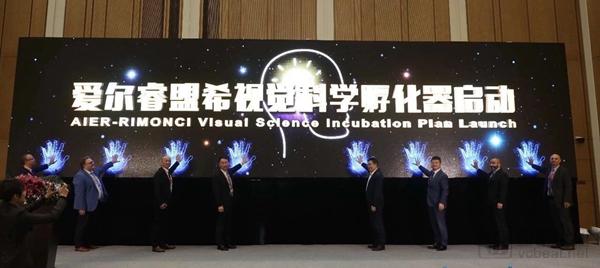
Aier-Ruimengxi Vision Science Incubator Launches (Image source: Provided by the enterprise)
To optimize its incubator investment strategy, Ruimengxi has recently launched the Rimonci Global Vision Index (Rimonci GVX). The Rimonci GVX comprises data from 99 publicly listed companies engaged in ophthalmology and optometry businesses, aiming to track stock price fluctuations of all listed eye care and vision companies worldwide.
Dai Weiwei, a partner at Ruimengxi, stated that the launch of Rimonci GVX further reveals investor perspectives and trends, facilitating more rational investment allocation for incubators. Furthermore, innovation in vision science requires enhanced synergy among policy, capital, and research to promote reasonable global competition within the industry.