

Genetesis Submits IPO Filing Following FDA Approval of CardioFlux Magnetocardiography Platform as a Non-Invasive Alternative to Traditional ECG

Genetesis
Medical Information Processing Technology R&D Provider
VCBeat (WeChat Official Account: vcbeat) has learned from foreign media that on March 22, U.S. local time, Genetesis, headquartered in Cincinnati, Ohio, announced that its cardiac imaging platform, CardioFlux, had received FDA approval. It will be paired with the integrated Faraday Analysis Cloud (FAC) for application in the treatment of heart-related diseases.
Genetesis is a medical device company dedicated to developing high-efficiency, non-invasive cardiac current density mapping. This technology leverages the body’s weak magnetic fields to reconstruct areas of high and low electrical conductivity within the heart on computer models. Genetesis was co-founded by Peeyush Shrivastava, Vineet Erasala, Manny Setegn, and Chandan Srivastava. Peeyush Shrivastava also serves as the company’s Chief Executive Officer and holds a degree in biomedical engineering from The Ohio State University; Vineet Erasala is primarily responsible for supply chain development; Manny Setegn oversees product manufacturing; and Chandan Srivastava, who holds an MBA, manages the company’s financial performance and strategic planning.
Genetesis’s CardioFlux platform enables simple, rapid, and non-invasive cardiac imaging. CardioFlux is used in conjunction with FAC to provide patients with magnetocardiography (MCG), a technique that measures the magnetic fields generated by the heart’s electrical activity. It employs a multi-channel sensor array placed on the chest to measure these magnetic fields and uses mathematical algorithms to construct cardiac magnetic field maps.
Traditional electrocardiography (ECG) records the resistance of patient tissues by measuring the extent to which electrical signals are affected as they pass through the body’s conductive tissues. It then derives potential differences from this resistance to simulate cardiac imaging on a computer. In contrast, Genetesis employs magnetic signal mapping. Magnetic signals remain unaffected by interference as they traverse the body, and the resulting measurements are vector-based. Compared with ECG, magnetocardiography (MCG) offers greater measurement precision.
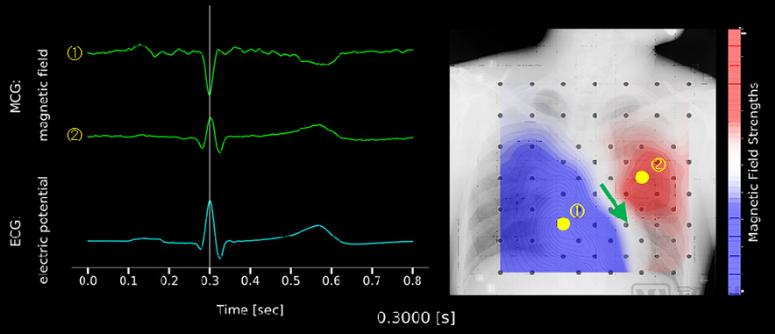
Comparison of ECG and MCG Measurements (Image Source: Official Website)
Currently, magnetocardiography (MCG) can be applied to the detection of arrhythmias, myocardial infarction, postoperative cardiac functional recovery, and fetal cardiac signals after the fourth month of pregnancy. Although many commercially available tests claim to be non-invasive, they actually require emitting a form of energy (such as radiation or magnetic fields) into the body to complete the diagnosis. MCG is a truly non-invasive technology; its system can passively scan the magnetic fields generated by cardiac electrical activity without any contact with the body surface, causing no impact on the patient. Furthermore, by using MCG, physicians can perform dynamic monitoring of the patient’s heart.
Regarding the recent FDA approval, Peeyush Shrivastava stated, “Genetesis’s technology enables emergency room physicians and cardiologists to directly access magnetocardiograms generated by the heart’s natural electrical activity.”
“Through Genetesis’s research, we have seen the value of MCG, and this technology from Genetesis will have a positive impact on the treatment process for heart disease,” said Dr. Margarita Pena, an emergency physician with the American College of Emergency Physicians (ACEP).
Genetesis was founded on September 5, 2013, and has completed four rounds of financing to date, with a total amount of $9 million.
(Compiled by Wang Chan)