

CDSS Evolves Further: BMJ Launches China's First Fully Chinese, Multi-Format Evidence-Based Clinical Decision Support System
On March 26, 2019, the VB100 New Year Strategy Launch Day, hosted by VCBeat, was grandly held at LSPACE in the 813 Creative Industrial Park in Beijing. As a key segment of the launch event, BMJ officially released the full suite of multimodal products for BMJ Best Practice, including the “Web Version,” “Mobile App Version,” and “Smart Integrated Version.”
BMJ Best Practice, or BP for short, is a world-class evidence-based clinical decision support system. This product provides physicians with authoritative and practical evidence-based diagnostic and therapeutic knowledge, helping them formulate and optimize clinical decisions anytime, anywhere.
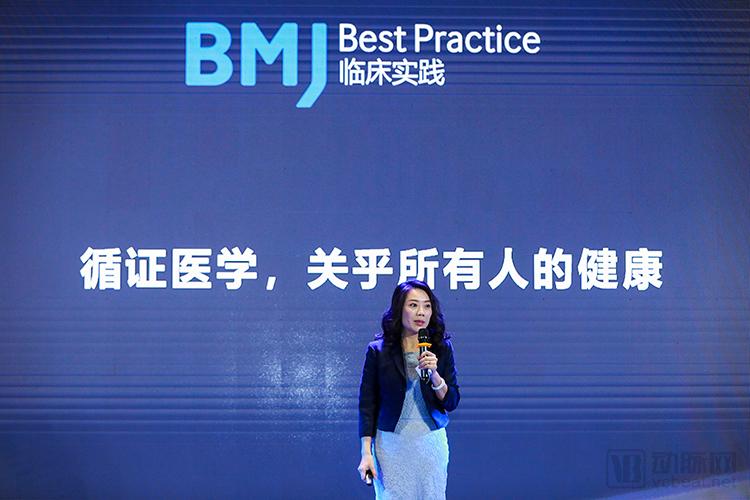
Kong Yuyan, Managing Director of BMJ China, elaborated on the value and philosophy of clinical practice at the event
At the event, Kong Yuyan, Managing Director of BMJ China, elaborated on the value and philosophy of Best Practice (BP) to the attendees. Ren Ran, Product Manager at BMJ China, provided a detailed introduction to the content and format of BP. Du Xin, Clinical Advisor at BMJ China, and Associate Professor Wu Dong from the Department of Gastroenterology at Peking Union Medical College Hospital, who also serves as Director of the National Health Commission’s Youth Innovation Center, conducted a demonstration of BP applications.
Key Highlights of the BP:
In terms of content, BP provides evidence-based medical knowledge for diagnosis and treatment that can directly guide clinical practice, rather than merely listing foundational evidence. This clinical knowledge is derived from the systematic collaboration of thousands of clinical experts and professionals worldwide. By strictly adhering to evidence-based medicine methodologies, they screen and evaluate the best available global research evidence, summarizing general principles for diagnosis and treatment. The content is rich and comprehensive, covering all key diagnostic and therapeutic processes across most known clinical specialties and common diseases, and is updated promptly in response to new and advanced evidence. Consequently, BP eliminates the time individual physicians or healthcare institutions would otherwise spend collecting, evaluating, and interpreting evidence, while also removing the need for associated training and resources. It can be directly referenced by healthcare institutions in clinical decision-making. In this sense, BP serves as an evergreen, authoritative encyclopedia of diagnosis and treatment, representing a treasure trove of human health knowledge.
Linguistically, the Chinese edition of BP is one of the nine existing language versions and has completed the translation of the entire database, with continuous updates maintained. This version is built upon millions of words of consistently updated content over many years, covering nearly all clinical specialties with a level of professional complexity that is difficult for general translation and publishing teams to achieve. By leveraging the convenience of native-language access, it saves physicians time in their daily clinical practice, truly enabling real-time decision support.
In terms of application format, the Chinese version of BP adopts multiple modalities, including web-based platforms, mobile applications, and even intelligent integration with electronic medical records (EMR). This enables physicians to access relevant, practical, and credible diagnostic and therapeutic knowledge anytime, anywhere, and across all stages of clinical care. It is akin to providing clinicians with a modern satellite navigation system for their daily practice, allowing them to stay abreast of the latest diagnostic and therapeutic knowledge and evidence, and to formulate and optimize real-time clinical decisions accordingly.

Awards Won by BP (Image source: BMJ)
The Chinese version of BP is credible, efficient, and characterized by extremely low application costs and broad accessibility. It holds immense value in enhancing both the individual clinical capabilities of Chinese physicians and the overall quality and efficiency of healthcare institutions.
“Everyone should recognize that doctors in China face a variety of challenges every day. A typical internal medicine physician at a tertiary Grade-A hospital needs to see approximately 40–50 patients, or even more, during a half-day outpatient session. They must rapidly formulate diagnosis and treatment plans for these patients. Additionally, they need to keep abreast of research advancements in their specialty, understand the latest evidence, read through new literature weighing tens of kilograms each year, and attend dozens of academic events. It is an unimaginable task to timely acquire diagnostic and therapeutic knowledge outside their own specialty and apply it in clinical practice. However, Best Practice (BP), with its authoritative multidisciplinary knowledge and instantly accessible format, can effectively help physicians address this challenge,” said Kong Yuyan, Managing Director of BMJ China, at the event.
She also mentioned that evidence-based medicine (EBM) is a transformation that began in the field of medical practice in the late 20th century, and its concepts and values have been widely recognized internationally. Clinical pathways (CPs) represent a significant innovation in the history of EBM development, helping physicians bridge the gap between theory and practice. They hold substantial significance for advancing the healthcare industry, safeguarding patient health, and conserving social resources.
Following the official launch of the full suite of multi-format BMJ Best Practice clinical products, and witnessed by attendees and media representatives, BMJ donated accounts for the BMJ Best Practice Clinical Practice mobile application to the Department of General Practice at Peking University Health Science Center and the Wu Jieping Medical Foundation. Additionally, a signing ceremony was held to formalize the partnership between BMJ and Beijing Jiahe Meikang Information Technology Co., Ltd.
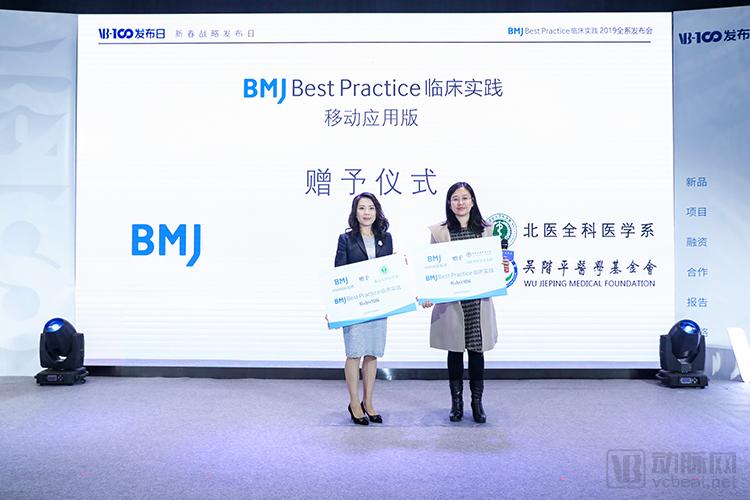
BMJ Donates BMJ Best Practice Mobile App Accounts to the Department of General Practice, Peking University Health Science Center, and the Wu Jieping Medical Foundation

BMJ Signs Collaboration Agreement with Beijing Jiahe Meikang Information Technology Co., Ltd.
Founded in 1840 and affiliated with the British Medical Association, BMJ is a leading international publisher of medical knowledge. Its core business areas include journal publishing, clinical decision support, medical education, and healthcare quality improvement, encompassing more than 70 specific products, tools, and services. Its flagship journal, The BMJ (British Medical Journal), is one of the four most prestigious general medical journals worldwide. Additionally, its publication BMJ Best Practice is a world-class evidence-based clinical decision support system.
Following the 2018 collaboration with medical AI pioneer Jiahemed to create a novel model combining an “evidence-based medicine knowledge base” with “machine learning on high-quality medical records,” BMJ launched the full suite of multimodal products under BMJ Best Practice. This marks BP as the first evidence-based medicine tool capable of comprehensively and instantly supporting clinical decision-making for Chinese physicians through web portals, mobile applications, and intelligent integration with electronic medical records (EMR), holding significant importance for improving healthcare quality and efficiency.