

Youfang Medical Revolutionizes Open-System CBCT with Novel Imaging Algorithms for Dental and Beyond
The emergence and adoption of cone-beam computed tomography (CBCT) have significantly accelerated the digital transformation of dental healthcare. Indeed, some seasoned industry experts have stated, “The advent and use of CBCT mark the watershed moment in dental digitalization.”
YOFO, established in 2017, is a medical device company dedicated to the research and development of next-generation CT imaging technologies. Its core technological advantage lies in optimizing data acquisition patterns through flexible and adaptable imaging algorithm designs, thereby enhancing product performance while reducing production costs, ultimately improving the overall cost-effectiveness of its products.
YOFO employs open-system technology, with its core imaging algorithm design applicable to various clinical CT applications. The company has filed 24 domestic patents and 2 international patents. Last year, YOFO completed the development of its self-developed dental open-architecture CT prototype, which has entered the clinical registration phase and is expected to launch on the market in 2020.
With the dental CBCT hardware market relatively mature, how will YOFO break through from the perspective of algorithm design? VCBeat conducted an exclusive interview with Dr. Zhu Lei, Founder and CEO of YOFO.
CBCT: The Key to Digitalization of Dental Imaging
CBCT, or cone-beam CT, is also referred to as open CT due to its typically open design. Compared with conventional helical CT, the two modalities share a similar foundational framework in their imaging algorithms but differ in scanning methods and mechanical structures. CBCT employs three-dimensional cone-beam X-ray scanning to generate 3D images through computational reconstruction, whereas conventional CT achieves 3D imaging using multi-slice or helical fan-beam scanning.
Through improvements in data acquisition methods, CBCT has not only enhanced the scanning resolution of medical imaging but also reduced radiation exposure to a new level.
Dr. Zhu Lei, Founder and CEO of YOFO Medical, stated that traditional CT is primarily used for precise whole-body imaging, while CBCT mainly targets single lesions. Currently, the dental market is one of the forefront areas for CBCT development.
In Dr. Zhu Lei’s view, although CBCT technology has undergone years of development in China, there remains significant room for optimization. The main areas for technological breakthrough are as follows:
Large error: Compared with conventional CT, the error is excessive. There are many error signals such as scattering, and the open-gantry system has low instrumental accuracy and is difficult to position.
Low cost-effectiveness: Large-volume imaging systems offer low cost-effectiveness. One of the features of CBCT is its ability to perform large-volume CT imaging. However, currently, the imaging field of view of CBCT products in the Chinese market is primarily determined by the detector size. Therefore, the detector area is closely related to product cost. The larger the detector area, the lower the cost-effectiveness of the imaging system.
Poor Practicality of Low-Dose Algorithms: CBCT uses a low radiation dose, but the large system signal errors make modeling difficult. Furthermore, existing low-dose imaging methods incur excessive computational costs.
Optimization potential translates to market opportunities.
Imaging Algorithm Design, Flexible Customization of Data Acquisition Modes
Dr. Lei Zhu received his bachelor’s degree from the Department of Electrical Engineering at Tsinghua University and later earned his Ph.D. in Electrical Engineering from Stanford University in the United States. He has previously served as a Research Associate in the Department of Radiology and the Department of Radiation Oncology at Stanford University, and as a tenured Associate Professor in the Department of Medical Physics at the Georgia Institute of Technology. Dr. Zhu is an internationally renowned expert in the fields of medical imaging and radiation oncology.
YOFO’s core CT imaging algorithm design technology, under the guidance of Dr. Lei Zhu, was conceived at Tsinghua University, born at Stanford University in the United States, nurtured in Silicon Valley, and matured at the Georgia Institute of Technology.
The primary factor influencing the price of CBCT is the size of the imaging field of view (FOV). The FOV is categorized into four levels: small, medium, large, and extra-large. For domestically produced dental CBCT products in China, a larger imaging range corresponds to higher costs.
Currently, most domestic CBCT products are primarily composed of hardware and software, with cost control typically achieved only by adjusting product components, such as detector size.
YOFO’s core technology enables the design of a novel algorithmic framework based on user-end requirements, guiding mechanical design through customized algorithms and optimizing data processing workflows to enhance imaging performance. Dr. Zhu Lei summarizes its key features with two terms: parallel scanning and low-redundancy reconstruction.
“In existing algorithms, the majority of data acquired by detectors cannot be fully utilized. By optimizing the data processing workflow through new algorithms and system design, imaging performance can be significantly enhanced without altering the detector size,” stated Dr. Zhu Lei. He noted that the primary advantage of parallel scanning lies in its ability to expand data capacity, thereby reducing the cost of core components while maintaining imaging quality.
Under an open-system architecture, this flexible and adaptable algorithm design technology enables the customization of imaging algorithms for different types of CT systems. This means that YOFO can tailor its algorithm framework to meet the requirements of various devices, rather than passively selecting core components based on predefined device specifications, thereby achieving greater performance optimization and cost control. For instance, a key challenge in breast imaging lies in the low contrast between glandular tissue and adipose tissue, which demands high precision from imaging algorithms. Therefore, when designing the algorithm framework for breast CT, emphasis can be placed on enhancing the precision of the imaging algorithms.
In the dental CT market, where cost-effectiveness is a primary consideration, YOFO has tailored its imaging algorithms to meet market demands by emphasizing low cost, high precision, low dose, and rapid reconstruction.
Single-case reconstruction time reduced to under 5 seconds
“Currently, there is a gap in algorithm design within China,” said Dr. Zhu Lei. “Initially, we were concerned that adjusting the intermediate algorithms without imposing stricter requirements on core components would disrupt the data, making reconstruction impossible. Therefore, we developed software packages specifically designed for CT reconstruction. After redesigning the algorithms, we found that this issue does not actually exist. Moreover, it allows for shorter reconstruction times while maintaining the same amount of data.”
Taking large-field-of-view dental CT as an example, Dr. Zhu Lei stated that traditional algorithms require approximately 40 to 60 seconds for single-case reconstruction, whereas YOFO can reduce this time to under 5 seconds.
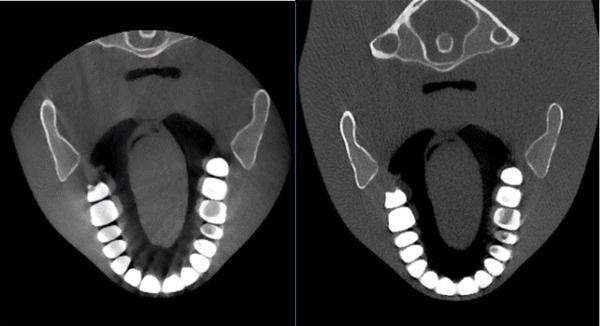
The Same Phantom in Domestically Produced DentalCBCTCompetitor (left) and YOFO DentalCBCT(Right) Comparison of imaging results. YOFO’s low-redundancy reconstruction algorithm achieves precise artifact correction, essentially eliminating imaging errors around the teeth and bone. (Image provided by the interviewee)
“The advantage of low-redundancy reconstruction lies not only in its ability to generate images within a short timeframe, but also in its capacity to perform large-scale data computations—enabling more calculations to be completed in the same amount of time. This is one of the essential prerequisites for micro-dose algorithms,” stated Dr. Zhu Lei. Using conventional computer hardware currently available in the dental market, micro-dose algorithm-based single-case reconstruction takes approximately 3–5 hours. With low-redundancy reconstruction, YOFO’s dental CT systems can reduce this time to under one minute.
With the rapid expansion of the dental market, the dental CBCT market still has significant room for growth. Both the emerging market and product iteration opportunities will present market opportunities for YOFO. Furthermore, YOFO’s core imaging algorithm design can be extended to multiple CBCT fields, including dedicated breast CT, radiotherapy-assisted CT, and mobile CBCT.
VCBeat has learned that YOFO completed the design of its prototype dedicated breast CT scanner last year.
Currently, YOFO is undergoing Pre-A round financing.