

BabyTree Reports First Post-IPO Financial Results: Annual Revenue of RMB 760 Million and 144 Million MAUs
VCBeat (WeChat: vcbeat) has learned that on the evening of March 27, Babytree, a maternal and infant platform listed on the Hong Kong Stock Exchange, disclosed its financial report for the 2018 fiscal year on the HKEX for the first time. The key data are as follows, and the annual report also presented a renewed business plan and strategic framework:
Number of Users:The average monthly active users (MAU) increased from 139 million in 2017 to 144 million in 2018, with mobile users (including WAP and mobile app users) accounting for 61.5% of the total user base in 2018. The average MAU for the mobile app grew by 35.1%, from 16.8 million in 2017 to 22.7 million in 2018. Notably, in the fourth quarter of 2018, the average MAU for mobile users reached 135 million, while the average MAU for the mobile app reached 32.1 million.
Revenue:Total revenue increased from RMB729 million for the year ended December 31, 2017 to RMB760 million for the year ended December 31, 2018. Advertising business revenue grew by 60.1% from RMB372 million for the year ended December 31, 2017 to RMB596 million for the year ended December 31, 2018.
Profit:The annual adjusted net profit in 2018 was RMB 201 million, representing a 29.7% increase from RMB 155 million in 2017. 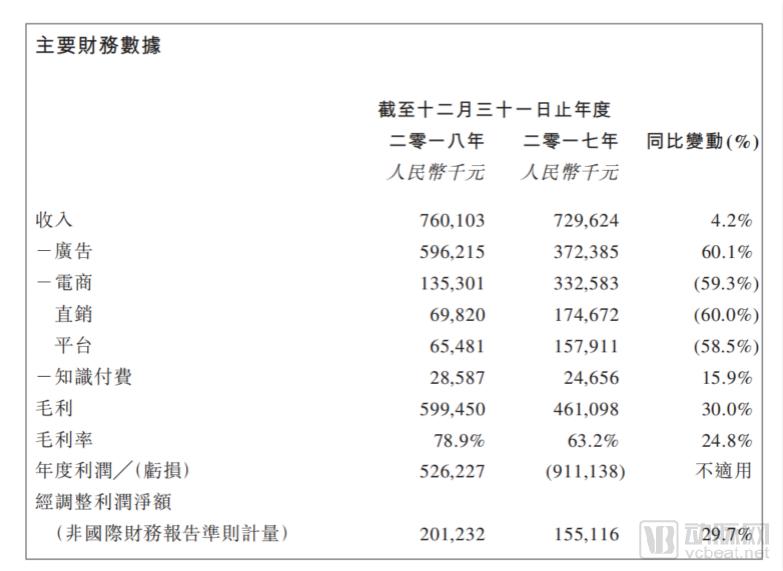
Key Financial Data: Sourced from Financial Reports
Maintain Product Leadership Through Innovation, Optimization, and User Lifecycle Extension
BabyTree’s average monthly active users (MAUs) reached 144 million in 2018. The average MAUs on mobile devices (including the WAP site and mobile applications) totaled 88.6 million in 2018, primarily driven by the growth of MAUs from its mobile application, which increased from 16.8 million in 2017 to 22.7 million in 2018, representing a year-on-year increase of 35.1%.
Notably, the average monthly active users of BabyTree Pregnancy increased from 14.9 million in 2017 to 18.4 million in 2018, representing a year-on-year growth of 23.5%. The average monthly active users of Little Time increased from 1.9 million in 2017 to 4.3 million in 2018, representing a year-on-year growth of 126.3%.
This significant user growth reflects BabyTree’s continuous innovation and optimization on the product side, as well as its efforts to extend the user lifecycle.
Product Innovation and R&D
Enhancing technology and data analytics is crucial to BabyTree’s business, particularly in the realm of product innovation. As of the end of 2018, more than one-third (34.1%) of its employees were technical professionals, and the company plans to continue recruiting technical talent in the future. Positioning itself as a technology company, BabyTree is committed to strengthening its data analytics capabilities, continuously optimizing existing products, and launching innovative new offerings to deliver high-quality, precise services that address the comprehensive needs of families across various scenarios.
Specifically, BabyTree has established an artificial intelligence development department comprising 39 employees, stationed in cities recognized for their abundant AI resources, including Beijing, Hangzhou, and Wuhan. The AI development department is responsible for conducting large-scale data analysis on user behavior and business operations to enable big data-driven intelligent decision-making, thereby enhancing user experience and user value.
R&D expenses increased from RMB78.5 million for the year ended December 31, 2017 to RMB125 million for the year ended December 31, 2018, representing a year-on-year increase of 59.6%. This increase in expenses was primarily attributable to the expansion of the technical team. Substantial efforts were made to recruit technical personnel to support the expansion in the R&D sector. R&D expenses accounted for 10.8% and 16.5% of total revenue for the years ended December 31, 2017 and 2018, respectively.
Continuous Product Optimization
BabyTree continuously upgrades the core functionalities of its main product platforms on its mobile application to further optimize user experience. For BabyTree Pregnancy, algorithms for several tools, such as prenatal check-up schedules and feeding logs, have been improved to deliver a better user interface and interaction experience. For Xiao Shiguang, high-quality suppliers of early childhood education content and tools are carefully selected and onboarded onto the platform to join the BabyTree ecosystem, thereby benefiting users while enabling suppliers to achieve substantial profits.
Extension of User Lifecycle
BabyTree is committed to extending the user lifecycle of its BabyTree Pregnancy and Xiao Shiguang platforms by catering to the needs of mothers and their older children, addressing family-oriented demands such as photo storage and sharing, early childhood education content curation, family travel, beauty and personal care, and career development. On the BabyTree platform, we accompany and engage with young families throughout their parenting journey, from preconception preparation through the preschool years.
In addition to enhancing its own platform, BabyTree has also leveraged this advantage to invest in two leading platforms within the WeChat ecosystem—Bama Ying and Momself—to further enrich our content offerings, strengthen our influence in the WeChat ecosystem, and improve our ability to monetize user traffic through advertising, e-commerce, and paid knowledge services.
“Ba Ma Ying” serves middle-class parents of children aged 2 to 12, while “Momself” addresses the emotional needs of mothers across all age groups; both WeChat-based platforms have further extended user lifecycle.
BabyTree plans to jointly launch a new paid knowledge product with Momself, addressing hot-button issues such as prenatal anxiety and postpartum depression. Further collaboration with Bama Ying and Momself will enhance BabyTree’s products and services, expanding its user base to a broader age range and covering more family members, given that Bama Ying reaches approximately 40% male users.
Profit Enhancement and Revenue Diversification
Total revenue increased from RMB729 million for the year ended December 31, 2017, to RMB760 million for the year ended December 31, 2018. This growth was primarily driven by an increase in advertising revenue, which partially offset the decline in e-commerce revenue resulting from the transition of its self-operated business to a cooperation model with Alibaba starting in the third quarter of 2018. Despite the downturn in the macroeconomic environment in 2018, total revenue still achieved steady and healthy growth.
Adjusted net profit increased from RMB155 million for the year ended December 31, 2017 to RMB201 million for the year ended December 31, 2018, representing a year-on-year growth of 29.7%. This growth reflects the resilience of the maternal and infant industry amid a downturn in the macroeconomic environment, and demonstrates BabyTree’s position as an industry leader, underpinned by significant economies of scale and robust cost control efforts.
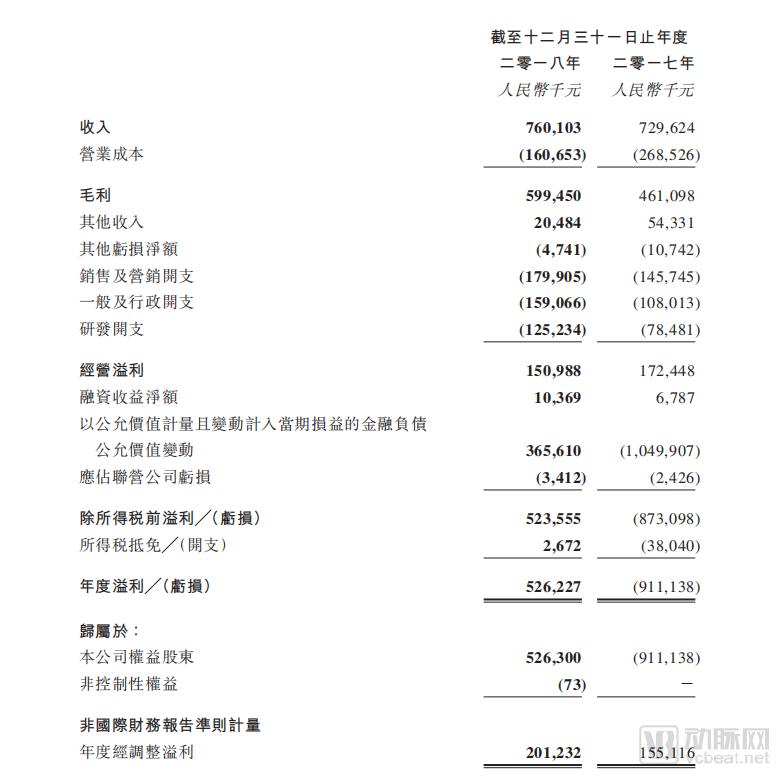
Key Financial Data: Sourced from Financial Reports
Advertisement
Advertising revenue increased by 60.1% in 2018. Advertising revenue from mobile applications continued to be the primary source of income, accounting for 63.0% and 86.9% of total advertising revenue for the years ended December 31, 2017 and 2018, respectively. BabyTree plans to further increase the percentage of mobile application advertising revenue as a proportion of total advertising revenue. The percentage of advertising revenue not directly related to maternal and infant products increased from 22.8% in 2017 to 27.4% in 2018, indicating that an increasing number of family consumption brands regard BabyTree as an effective media platform for conducting advertising and marketing campaigns.
BabyTree will continue to expand and broaden its customer base, extending into sectors such as automobile manufacturers, cosmetics, and other products and services unrelated to maternal and infant care. On the other hand, advertising revenue derived from Alibaba in 2018 (the first year of their partnership and part of that year) amounted to RMB 44.9 million, accounting for 7.5% of total advertising revenue. As the collaboration between Alibaba and BabyTree deepens, advertising revenue from Alibaba is expected to increase in the future.
E-commerce
BabyTree implemented an e-commerce strategic adjustment in 2018. BabyTree’s core strategic capabilities lie in delivering the highest-quality content to users and building a community platform that fosters warmth and strong trust among parents. The company will focus on its core strengths and capabilities, while transferring back-end e-commerce management and other functions to its most suitable strategic partner, Alibaba.
Driven by aligned philosophies and shared vision, Alibaba became an investor and strategic partner of Babytree in June 2018. Since then, Babytree has established a joint team to integrate the business systems of both parties.
In the strategic partnership with BabyTree, BabyTree is responsible for user-side management and operations, while Alibaba provides e-commerce operational services in accordance with the cooperation agreement. The scale and scope of this integration are unprecedented and are currently ongoing.
The two systems are expected to be integrated in the second quarter of 2019. The partnership between Babytree and Alibaba will reduce back-end operational costs, improve efficiency, and provide users with a superior purchasing experience through a wider product selection and lower prices.
Knowledge Payment
Revenue from the paid knowledge business increased by 15.9% in 2018. Paid knowledge precisely met platform users’ demand for accessing high-quality knowledge content from leading experts, and in line with the overall development strategy for 2019, significant investments were made in 2018 to build a dedicated paid knowledge team.
BabyTree plans to upgrade from a single-knowledge-purchase model to a subscription-based model, enabling users to systematically access a structured knowledge content library. The subscription model will be built upon an expanded and upgraded knowledge base, which is the primary task for 2019 and will be achieved through extensive collaborations with third-party knowledge and service providers.
To this end, BabyTree has recently introduced “Dr. Xiaoxing” on its platform to enrich its portfolio of paid knowledge products. Dr. Xiaoxing is a new healthcare service brand jointly developed by BabyTree and its major shareholder, Fosun. The collaboration aims to enhance the company’s ability to integrate high-quality resources, thereby meeting the needs of young families—including both children and parents—from pregnancy through the preschool years.
Industry Consolidation
As a consistently profitable leader in the maternal and infant industry, with substantial cash generated from business operations and proceeds from public offerings, BabyTree is well-positioned to drive industry consolidation both domestically and internationally by leveraging its industry leadership, brand reputation, user platform resources, and financial strength.
BabyTree has invested in two leading WeChat-based parenting platforms: BaMaYing and Momself. BaMaYing focuses on serving young families with children aged 2 to 12, thereby complementing and expanding BabyTree’s user base. In contrast, Momself aims to build a lifelong learning and support platform that places greater emphasis on mothers themselves rather than solely on their children. By offering systematic and engaging courses developed by a team of professional psychologists, Momself addresses mothers’ diverse needs, including parenting, marriage, and career development. Momself has enriched the content knowledge base and strengthened BabyTree’s paid knowledge services within the WeChat ecosystem. These two recent investments reflect BabyTree’s ongoing strategy, which prioritizes user traffic growth and age-range expansion through strategic investments.
Globalization
Babytree is committed to becoming a global company, with a mission grounded in a global perspective and a close focus on young families worldwide.
BabyTree’s products, professional expertise, and solutions can be effectively applied to key global markets, facilitating faster and more efficient growth for other global platforms. To this end, BabyTree recently invested in Healofy, one of India’s fastest-growing parenting communities. Healofy offers extensive professional knowledge and video streaming services, serving as a warm mobile community platform that caters simultaneously to Indian mothers using English and other languages.
The Indian market is a crucial component of BabyTree’s global strategy, given its annual birth rate of over 20 million and the significant growth potential in mobile user traffic. The investment in Healofy reflects BabyTree’s strategic focus on key emerging global markets for maternal and infant care. Investing in these sunrise markets represents the first step in BabyTree’s establishment of a global parenting ecosystem.
Further Reading: