

Clover Health: Leveraging Big Data to Disrupt Traditional Health Insurance Amid Controversies and $925M in Funding

Clover Health
Health Insurance Service Provider
In September 2015, it raised $100 million in Series A financing; in December of the same year, it raised $35 million in Series B financing;
In May 2016, the Series C financing round raised $160 million;
In May 2017, the company raised $130 million in its Series D financing round. Following this round, its valuation reached $1.2 billion, making it a “unicorn” enterprise;
In January 2019, the company raised $500 million in its Series E financing round, bringing its total fundraising to $925 million.
Clover Health, a U.S. innovative health insurance company founded in 2013, completed six major funding rounds within six years, rapidly becoming an industry unicorn. As an insurance enterprise, what are its standout features that have repeatedly attracted substantial investments from investors? During its six years of rapid growth, the company has also faced significant scrutiny; where does its future development lie?
Entering the Health Insurance Sector Through Chronic Disease Management: Shifting from Passive Treatment to Active Prevention
Clover Health, founded in August 2013, is a San Francisco-based Insurtech health insurance company whose primary business is providing Medicare Advantage health insurance to seniors aged 65 and older.
Medicare (the U.S. Federal Health Insurance Program) is a national health insurance program in the United States that provides health coverage to Americans aged 65 and older, certain younger individuals with disabilities recognized by the Social Security Administration, and people with end-stage renal disease and amyotrophic lateral sclerosis. According to foreign media data, as of 2017, approximately 50 million people in the United States were covered by Medicare, including over 49 million seniors aged 65 and older and about 9 million younger individuals.
Medicare Advantage, also known as Medicare Part C, is a segment of Medicare that allows its beneficiaries to obtain coverage through private insurance. Primarily, private companies contract with Medicare to provide customers with benefits from Medicare Parts A and B, typically offering prescription drug coverage through Health Maintenance Organization (HMO), Preferred Provider Organization (PPO), Private Fee-for-Service (PFFS) plans, or Medicare Medical Savings Account (MSA) plans. Clover Health operates as a PPO, offering low-premium Medicare Advantage plans.
Data provided by Clover Health shows that approximately 30% of the Medicare-covered population received coverage through Medicare Advantage plans in 2016. PwC projects that the annual market revenue for these plans will exceed $350 billion by 2020.
Of course, Clover Health offers more than just insurance; it provides chronic disease management services that include insurance coverage. The company believes that health management programs can reduce medical costs for chronic diseases, improve the overall health of patients with chronic conditions, and offer significant potential for cost control.

Traditional insurance targets unpredictable, unforeseen accidents. Therefore, its means of increasing profits or reducing costs are relatively limited, essentially amounting to expanding the customer base and spreading risk, thereby lowering claims payouts. Taking cancer prevention and treatment as an example, the medical community has not yet reached a consensus on the causes of cancer, making it difficult for insurers to predict cancer risks. In contrast, chronic disease medical insurance can align the interests of consumers and patients, because the risks faced by patients in the context of chronic disease management are predictable.
Traditional insurance companies often intervene only after a claim is filed, whereas Clover Health aims to shift the point of health management intervention to before claims occur. By leveraging data analytics to identify customers’ risk of complications, it enables early intervention to prevent major adverse events.
The company’s data processing workflow is highly complex. It begins by collecting diverse datasets—including public health records, electronic medical records (EMRs), laboratory and diagnostic test results, medication histories, and insurance claims—to comprehensively assess customers’ medical histories. The data then undergoes cleaning and preprocessing before being matched against established models in the database to predict potential complications. This process enables the identification of high-risk patient populations and the provision of targeted intervention solutions to help them improve their health outcomes.
The company also arranges for nursing staff to conduct regular in-home health check-ups for clients, or to remind them to resume treatment if they have interrupted a specific therapy, thereby helping patients avoid hospitalization.
Clover Health has committed to providing free primary care services. The company stated that members will be assigned a personal care team, comprising nurse practitioners, medical assistants, and other personnel, who will conduct in-home assessments during physician visits. Customer service representatives can assist members in selecting appropriate physicians, scheduling appointments, and ensuring safe transportation.
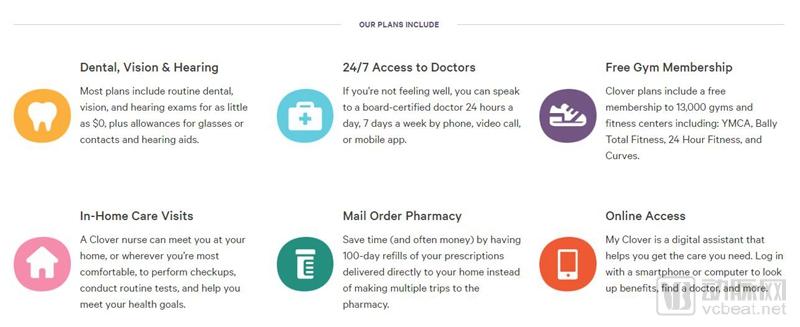
Clover Health Business Segments (Image Source: Company Website)
Clover Health’s competitive differentiation lies in targeting low-income populations and the elderly as its primary customer base, while addressing the pain point of high premium expenditures in the health insurance industry. By leveraging software platforms and big data, Clover Health enhances medical services and ultimately improves patient outcomes, thereby providing users with affordable and efficient insurance and healthcare options. This approach aims to reduce medical costs and generate savings for both policyholders and insurers. Furthermore, it can pass on a portion of the insurers’ savings to consumers in the form of lower premiums. This model aligns closely with the payment structure of the Medicare Advantage program.
The company has also adopted web search and algorithmic trading technologies. Leveraging Google’s deep learning algorithms, Clover Health developed a product to predict which patients are most likely to be hospitalized within the next 28 days. According to data released by Clover Health, the company’s technology achieves an accuracy rate of up to 85% in identifying patients at risk of hospitalization within the next 28 days, surpassing even the data models developed by the Google Brain team.
Six Years, Six Funding Rounds: Sluggish Performance Fails to Deter Major Capital Investment
Clover Health completed six financing rounds, all of which were large-scale, within six years of its establishment. However, this does not mean that the company has developed smoothly. On the contrary, Clover Health is a rather controversial company.
In 2015, Clover Health delayed reimbursing third-party laboratory testing fees for its elderly members, as the company sought to leverage laboratories for data collection. This data would help Clover Health develop predictive analytics technology capable of improving patient care and reducing costs, a key factor that attracted institutional investors to the company.
However, the laboratory did not comply with Clover Health’s request; instead, it billed the company’s elderly members directly, prompting a surge of complaints to the Centers for Medicare & Medicaid Services (CMS). The company ultimately paid the laboratory fees and, by late 2015, secured in-network contracts and data-sharing agreements with Quest Diagnostics and LabCorp, the two largest clinical laboratory testing companies in the United States. Although this incident cast a negative light on the company, internally it was regarded as a worthwhile gamble.
However, this incident triggered a chain reaction, leading to large-scale personnel changes in the company's leadership. Co-founder and Chief Technology Officer Kris Gale resigned in December 2017, and Chief Operating Officer Wilson Keenan also left the company. Clover Health’s Medicare Star Rating dropped from 3.5 out of 5 to 3, with the lower rating resulting in reduced government payments.
While the public assumed this was merely a minor episode in the company’s development and that it could achieve rapid growth with the support of major capital, foreign media reported that Clover Health’s trajectory has not been as smooth as it appeared.
Based on operational performance from 2015 to the present, Clover Health has underperformed; its application of big data has failed to drive significant breakthroughs in its Medicare Advantage business, and the company has reported consecutive annual losses. In 2015, Clover Health reported a net loss of $4.9 million, which increased sevenfold to $34.6 million in 2016.
According to national insurance documents reviewed by Business Insider, Clover Health incurred a loss of $40.9 million in its primary market, New Jersey, in 2018, exceeding the $22 million loss reported in 2017. The company stated that the increased net loss was due to efforts to expand its business into additional regions. Previously, the company primarily operated in Pennsylvania, Texas, and Georgia, and planned to expand into three more states in 2019: South Carolina, Arizona, and Tennessee.
Foreign media reported that Clover Health declined to comment on its financial performance.
In this regard, Ari Gottlieb, Head of Healthcare Services and Payment Strategy at PwC, stated that terms like “big data” serve as effective buzzwords, capable of driving higher valuations when companies seek financing or invest in growth-oriented equity funds. Ultimately, however, most established players in the industry are already leveraging big data and conducting predictive analytics.
Since late 2016, Clover Health has been committed to reducing premium fraud and abuse in an effort to lower its medical loss ratio and financial losses. According to foreign media reports, the company is also controlling costs through other measures, including halting the recruitment of technical engineers in early 2017.
Cutting back on the hiring of technical staff dealt another blow to the company’s efforts to build a sustainable competitive advantage. In 2016, a bug emerged in one of Clover Health’s most critical software projects, which was designed to prioritize member calls based on the severity of their conditions and remind them to undergo annual physical examinations.
To prioritize member phone calls, the company utilized CMS risk score data. However, due to a software glitch, the list was inverted. For several months, Clover Health representatives contacted the healthiest members first. As a result of this error, treatment for sicker members may have been delayed, leading to higher medical costs.
Although Clover Health has continuously taken measures to address technological and financial challenges since its inception, it still has a long way to go in disrupting the traditional health insurance model.
However, judging from the company’s fundraising performance, these controversies do not appear to have dampened major investors’ optimism about its growth prospects. Investors in Clover Health’s previous six rounds of financing have included prominent institutions such as GV (Alphabet’s venture capital arm), Sequoia Capital, Floodgate, Bracket Capital, and First Round Capital.
Unicorns Are Proliferating: What Is the Future of Big Data-Driven Innovative Health Insurance?
In addition to Clover Health, Alphabet has also invested in a peer company, Oscar Health. Notably, the development trajectories of these two companies are quite similar.
Oscar Health was founded in November 2012. Positioning itself as “a technology-focused health insurance company,” it integrates technological concepts with health insurance, primarily targeting young populations. By simplifying products and repricing, it aims to attract the uninsured to purchase coverage. The company seeks to transform the U.S. health insurance industry through telemedicine, healthcare-focused technical interfaces, and a transparent claims pricing system.
Since its inception, Oscar Health has been plagued by issues such as financial losses, corporate transformation, and shifting policy landscapes. Despite a journey far from smooth, the company has continued to attract the favor of major capital investors.
In March 2018, Oscar Health secured $165 million in financing led by Founders Fund. Alphabet’s two subsidiaries, Capital G and the life sciences division Verily, also participated in this round. Following the completion of this funding round, Oscar Health’s cumulative capital raised approached $900 million, with its valuation reaching $3.2 billion.
In August of the same year, Alphabet announced another investment in Oscar Health, amounting to $375 million. Alphabet acquired approximately 10% of Oscar Health’s shares, and as part of this strategic investment, Salar Kamangar, an early Google employee and former CEO of YouTube, joined the board of directors of Oscar Health.
As a unicorn in the health insurance sector, Oscar Health has faced considerable skepticism from external observers due to its high costs and a long-term loss ratio exceeding 100%. However, the company turned the tide in 2017. According to U.S. national financial reports, Oscar Health’s net loss narrowed from $131 million in 2017 to $57 million.
Last August, Oscar Health announced its entry into the Medicare Advantage market, signaling intensified competition with Clover Health. In response to this move, Vivek Garipalli, CEO of Clover Health, stated that Medicare Advantage is a substantial market and that competition driven by the pursuit of better healthcare services is good news for American seniors. “When Oscar Health truly enters the Medicare Advantage space, it will become a welcome new player in our industry.”
In addition to Oscar Health, Clover Health’s competitors include Bright Health, an innovative health insurance company founded in November 2015 that completed a $200 million Series C financing round last November, reaching a valuation of nearly $1 billion. Also among its competitors is Devoted Health, established in March 2017, which raised $300 million in a Series B financing round completed last October, achieving a valuation of $1.8 billion. Both companies also offer Medicare Advantage plans.
Foreign media report that the aforementioned companies are competing with industry giants such as Humana, UnitedHealth, and Cigna in the race to innovate among health insurers.
As competition intensifies, Clover Health is continuously expanding its strategic footprint. In addition to plans to extend its operations to three additional states in 2019, the company is also preparing for a nationwide expansion across China. Last August, Clover Health announced a strategic partnership with Cathay Life Insurance, the global subsidiary of Taiwan’s Cathay Life Insurance, leveraging Clover Health’s advanced artificial intelligence platform to provide actionable, data-driven solutions to Cathay Life.
Based on the aforementioned companies, it appears that innovative health insurance products are inextricably linked to big data. Truly valuable medical big data consists of electronic health records from healthcare providers, which help reflect more precise, real-time user data. This data enables predictions of future costs and risks, as well as the design and implementation of intervention models. However, the cost of data-driven interventions is high, and their effectiveness cannot be quantified or directly reflected in cost control. Therefore, it is likely that more insurance enterprises will enter the chronic disease medical insurance sector, leading to closer ties between insurance companies and healthcare providers.
As it stands, as an innovative health insurance company with data analytics at its core, Clover Health should give greater consideration to how big data can be applied in insurance to truly achieve cost control and profitability.
Source:
https://www.cloverhealth.com
https://cloud.tencent.com/developer/news/290111
https://techcrunch.com/2019/01/29/alphabet-backed-medicare-advantage-startup-clover-health-raises-500m/
https://www.investopedia.com/articles/insights/112816/clover-health-reviews-their-marketing-misleading.asp
https://www.cnbc.com/2018/01/03/clover-health-insurance-start-up-angered-customers-missed-financials.html
(Compiled by Nie Guanghong)