

Deloitte Report: Asia-Pacific Life Sciences and Healthcare Industry Outlook – China's Focus on AI, Biotech, and Patient-Centric Platforms
In recent years, emerging technologies such as 3D printing, artificial intelligence, and blockchain have been creating opportunities for industry transformation. Benefiting from the continued development of science and technology at a record-breaking pace, these technologies are driving change through various forms, making healthcare services more affordable, efficient, and convenient, while enabling greater flexibility in the life sciences sector.
From a macro perspective, many global trends across various sub-sectors of the life sciences industry are equally applicable to the Asia-Pacific region. However, the Asia-Pacific region is characterized by significant diversity and heterogeneity in demographics, regulatory environments, and disease profiles. These differences may represent either urgent challenges to be addressed or latent market demand awaiting release.
Deloitte recently released the “Asia Pacific Life Sciences and Healthcare Outlook” report. The report suggests that quality, outcomes, and value are the latest hot topics in the life sciences and healthcare industries, with global stakeholders seeking innovative and cost-effective ways to deliver patient-centric technological solutions.
VCBeat has compiled and organized the report, aiming to provide reference for participants in China’s healthcare industry through the following five aspects:
I. Embrace the Technological Upheaval;
II. Shifting from a focus on quantity to a focus on value;
III. Focus on patient-centered care;
IV. Data Empowering the Development of the Healthcare Industry;
V. The Emergence of New Partnership Models and Operational Frameworks.
We are in the era of the Fourth Industrial Revolution, a time of exponential change. The benefits that technological innovation has brought to human development are obvious, and among them, the development of digital technology has had the greatest impact on the healthcare field. Big data and information technology will help better manage population health data.
In the Asia-Pacific region, governments have increasingly prioritized the development of information and communication technologies (ICT) as a key component of their national reforms. For instance, as early as 2017, the Chinese government released the “13th Five-Year Plan for National Scientific and Technological Innovation,” which outlined detailed plans for the development of precision medicine technologies, the establishment of multi-tiered knowledge databases, and the creation of a national-level platform for the collection and storage of biomedical big data.
Overall, we have witnessed life sciences and pharmaceutical companies in the Asia-Pacific region leverage the following innovative technologies to address the pressures of the patent cliff (referring to the sharp decline in sales and profits that a company experiences after its patent protection expires) and rising costs:
• 3D Printing:3D printing can offer more opportunities for personalized treatment. The biologics field is exploring new methods of manufacturing cell and tissue products using 3D printing.
For example, drug and disease models can be tested on 3D-printed tissues, eliminating the need for prior testing in animals or humans. When combined with nanotechnology, 3D printing can also be applied at the molecular level: customized white blood cells can be engineered to hunt down and attack cancer cells.
Although the potential of emerging technologies such as 3D printing is widely recognized, regulations governing these technologies remain in their infancy, even in more developed markets like Australia.
• Artificial Intelligence (AI):Artificial intelligence algorithms can analyze large datasets from clinical trials, health records, genomic profiles, and preclinical studies.
Patterns and trends within these data can validate clinical hypotheses faster than researchers can, rapidly yielding new insights.
In the Asia-Pacific region, an increasing number of biopharmaceutical companies are leveraging artificial intelligence to streamline the drug research and development process, and are beginning to expand into other areas such as diagnostics (see Case Study 1).
Case Study 1: AI Diagnosis in China
One of the latest applications of AI technology is in the field of diagnosis. In 2017, Tencent launched an AI-based medical imaging diagnostic service known as the Artificial Intelligence Medical Innovation System (AIMIS). This technology has demonstrated preliminary diagnostic accuracies exceeding 90% for esophageal cancer, 95% for pulmonary nodules, and 97% for diabetic retinopathy. To date, AIMIS laboratories have been established in more than ten hospitals, with agreements signed for further deployment.
Tencent's Artificial Intelligence Research Laboratory—Youtu Lab)It also collaborates with the Esophageal Cancer Research Institute at Sun Yat-sen University Cancer Center in Guangzhou, leveraging data from thousands of anonymized patients to train the diagnostic component of its AI technology. This advancement could have a significant impact on the drug development process.
For example, images captured by Tencent’s AI technology can be integrated with XtalPi, a platform that leverages cloud computing services—such as Amazon Web Services, Tencent Cloud, Google Cloud, and Alibaba Cloud—to run algorithms across one million computational cores. This capability accelerates the discovery of novel drug candidates in silico, significantly reducing the time and substantial investment required for pharmaceutical R&D.
• Blockchain:Blockchain is constructed from blocks of transactions that are stored and linked to digital transactions. These transaction records are shareable and immutable, enabling each patient’s data source to serve as a complete, unalterable “block” that can then be securely shared with healthcare providers or other research organizations.
The application of blockchain in the healthcare sector is garnering increasing attention both domestically and internationally. Blockchain’s reach has extended across various industries, facilitating the transformation and upgrading of traditional sectors.
Currently, blockchain technology is gradually being applied in the healthcare sector. As an emerging technology, it is disrupting the industry’s business models and even its value chain. In fact, data from the Asia-Pacific region suggests that the true potential of blockchain technology may lie in fostering collaboration by enabling different companies—and even industries—to share digital assets with one another (see Case Study 2).
Case Study 2: Blockchain Development in the Asia-Pacific Region
Governments in the Asia-Pacific region have demonstrated strong interest in blockchain technology and are supporting its development through a series of policy changes and initiatives.
For example, the Monetary Authority of Singapore launched a multi-phase collaborative project called Ubin, which works with practitioners in the financial services industry to explore the effects and implications of issuing digital currency on distributed ledger technology.
Meanwhile, the Chinese government is exploring the use of blockchain to track charitable donations and plans to leverage this platform to comprehensively reform the charity tracking system.
• Gene Therapy:Gene therapy offers the potential for personalized treatments, such as novel CAR-T therapies. Although adoption rates remain low, human genetics and precision medicine are gradually transforming healthcare through innovative biotechnologies.
Given that approximately 80% of rare diseases have a genetic origin, gene therapy is expected to continue playing a pivotal role in their treatment. The Asia-Pacific region is also exploring therapeutic approaches for orphan diseases (see Case Study 3), such as replacing defective genes with healthy ones or inactivating mutated genes.
Case Study 3: China's Giant Leap in Biotechnology
China’s healthcare industry is striving to develop cheaper and more effective alternatives to Novartis’s Kymriah and Kite Pharma’s Yescarta. These two CAR-T therapies, used to treat acute lymphoblastic leukemia and B-cell lymphoma respectively, are both prohibitively expensive: Kymriah is priced at $475,000 per course of treatment, while Yescarta costs $373,000.
As of January 2018, China had a total of 153 CAR-T clinical trials, only 33 fewer than the United States. In Hainan, designated as a Chinese tourist resort island and a medical tourism free trade zone, a similar therapy developed by an innovative cell therapy company in the region has been marketed at a price of RMB 490,000 (USD 76,000) per course of treatment. Over the next three years, the cost of CAR-T therapy in China is projected to continue declining to below RMB 100,000 (USD 15,510).
As healthcare costs continue to rise, governments, healthcare providers, and other stakeholders in the Asia-Pacific region have recognized the importance of maintaining individual and public health. Consequently, an increasing number of healthcare products are shifting from treatment to prevention, and payment models are transitioning from volume-based to value-based approaches.
For example, the Japanese government has introduced a series of reforms, including the establishment of an Integrated Community Care System that unifies healthcare, long-term care, housing, and livelihood support services, enabling elderly residents in Japan to receive continuous, high-quality care within their local communities.
In fact, stakeholders across many sectors—particularly those in regions with advanced healthcare systems—are advocating for a shift from a “breakthrough”-oriented healthcare model to one focused on holistic population health, as ad hoc, transaction-based treatment approaches are falling out of favor (see Case Study 4).
Case Study 4: Population Health Management in the Asia-Pacific Region
China
In October 2016, China released the Outline of the “Healthy China 2030” Plan, declaring public health a prerequisite for future economic and social development. It detailed five specific objectives, including the necessity of improving national health, controlling major risk factors, and enhancing health system capacity.
Furthermore, the plan is based on four core principles: prioritizing health, reform and innovation, scientific development, and justice and equity. As China’s first long-term strategic plan for population health, it also aims to increase investment in the “Big Health” sector to RMB 16 trillion by 2030.
Singapore
The Singapore Ministry of Health has recently launched the “3 Beyonds” strategy to ensure the quality and capacity of future healthcare services:
• Transitioning from hospital-based care to population health: Reducing the care burden on the healthcare system by empowering individuals to adopt healthier diets and providing heavily subsidized health screenings for adults aged 40 and above.
• Shift of patient care from hospitals to the community: Enabling individuals to receive appropriate care at home or within their communities, thereby reducing frequent hospitalizations, through home visits by nurses and caregivers.
• Pursuing Value in Healthcare: Achieving cost-effectiveness while maintaining or improving the quality of care, including the introduction of cost benchmarks to enable patients to receive the highest quality medical care at the lowest possible cost.
Meanwhile, Singapore’s Ministry of Health is also investing in automation to boost productivity amid slowing workforce growth. Examples include new robotic systems for dispensing medication into vials, automated loading and packaging, and the application of waterproof and tear-resistant labels to vials.
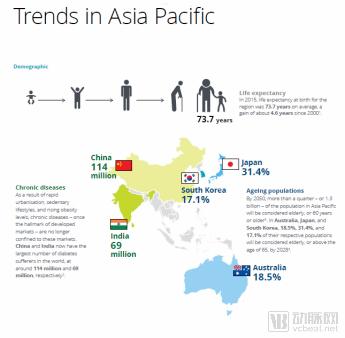
Overview of Demographic Trends in the Asia-Pacific Region (Screenshot from the Original Deloitte Report)
Globally, life sciences and healthcare companies are investing in enhancing patient-centric capabilities. Amid the evolution of the “Quantified Self” movement, consumers are becoming increasingly engaged in their healthcare experiences and raising their expectations, as they grow more aware of the effectiveness of medical interventions and gain deeper insights into their own disease conditions and health risks.
In the Asia-Pacific region, wearable devices and telemedicine are gaining increasing popularity, which will help improve access to healthcare services in certain parts of the Asia-Pacific (see Case Study 5).
Case Study 5: “Dial-A-Doc” in Southeast Asia
Driven by the growing demand for healthcare services, app-based consultations are on the rise in Southeast Asia. Although these app-based consultation platforms currently offer only limited functionalities, they hold the potential to improve healthcare access in regions with a shortage of medical personnel.
For example, Indonesia’s Halodoc currently has approximately 2 million users and 20,000 doctors. It charges a consultation fee of around 25,000–75,000 Indonesian rupiah, which is lower than the cost of in-person consultations at traditional clinics.
Currently, Halodoc conducts thousands of consultations daily. It has also established partnerships with insurance companies, enabling users to pay health insurance premiums, and collaborates with pharmacies to deliver medications to users. In Indonesia, applications like Halodoc address two types of pain points: long commutes for doctors due to congestion in urban areas, and a shortage of physicians in rural regions.
China’s largest online healthcare app, “Ping An Good Doctor,” is also expected to enter the Southeast Asian market in 2019 through a partnership with Singapore-based O2O platform Grab. It plans to leverage artificial intelligence technology to match patients with suitable doctors via AI-powered chatbots. As of June 2018, Ping An Good Doctor had approximately 228 million registered users in China.
However, the lack of interoperability among devices limits the prospects of wearable technology and telemedicine, while also hindering the coordinated development of care. If these challenges can be addressed, a more integrated omnichannel patient experience—encompassing consumer applications, patient portals, personalized digital information packages, and self-monitoring—will become possible. This will enable healthcare providers to deliver more personalized care and engage more effectively with consumers.
Life sciences companies are also placing greater emphasis on patient-centricity. In the Asia-Pacific region, we are beginning to witness the use of AR technology to deliver personalized health solutions. Pharmaceutical companies are developing new, more personalized medicines for smaller patient populations and monitoring and managing patient adherence and health outcomes. They aim to engage patients earlier in this process to better understand unmet needs, thereby informing trial design, patient recruitment, and resilience.
Current data also indicate that products and services that better meet patient needs and improve treatment regimens will be highly recognized by investors, suppliers, and regulatory authorities.
Health data is the new currency of healthcare. Faced with a continuous and growing influx of data from both internal and external sources, hospitals will rely on cognitive analytics to identify and parse the most critical nodes and trends within the data, providing actionable insights to clinicians and patients through systematic and structured analysis. Three technologies are helping the Asia-Pacific region tap into diverse data sources: the Internet of Things (IoT), cognitive computing, and cloud-based interoperable EHR systems.
• Internet of Things:The development of the Internet of Things (IoT) holds significant value for remote clinical monitoring, chronic disease management, preventive care, assisted living for the elderly, and health monitoring. In the Asia-Pacific region, IoT applications also help reduce costs, improve efficiency, and shift the focus toward high-quality patient care.
• Cognitive Computing:Cognitive computing, which encompasses machine learning, neural networks, and deep learning technologies, can help healthcare organizations process large volumes of rapidly changing data.
Cognitive computing can process various statistical algorithms and rapidly generate new models from fresh data, thereby helping to transform vast amounts of healthcare data—aggregated from sources such as medical devices, smartphones, activity trackers, and electronic health records (EHRs)—into personalized medical solutions.
More importantly, cognitive computing can also be used to predict health trends (such as disease onset), detect data patterns (such as the effects of drugs on individuals or populations), and enable the sharing of data from different sources (such as creating a 360-degree patient view).
• Cloud-based interoperable EHR system:When combined with AI, interoperable EHRs can help healthcare systems in the Asia-Pacific region better integrate data into daily care and empower patients to better manage their own data. When these data are stored in the cloud, authorized personnel can access them as needed; alternatively, they can be accessed via blockchain, a distributed, immutable digital ledger of transactions.
However, with the increasing use of data and cyberattacks such as the WannaCry ransomware, cybersecurity and data risk management have become challenges that the life sciences and healthcare industries must confront. In fact, among all sectors targeted by cyberattacks annually, healthcare ranks second only to finance. Globally, governments are exploring new regulations to empower patients to control their own data and to streamline the regulatory landscape.
For example, in May 2017, Japan’s Ministry of Health, Labour and Welfare (the primary agency responsible for healthcare, sanitation, and social security) released the latest edition of the “Guidelines for Information System Security in Healthcare,” aiming to promote a series of measures to address the risk of cyberattacks against medical institutions.
Recently, Japanese medical institutions have widely adopted closed systems to mitigate cyber threats. However, the implementation of Japan’s new national health system featuring medical IDs and data-sharing initiatives will require healthcare providers to upload data to external servers, thereby heightening the importance of cybersecurity.
To address the challenges of declining profit margins and rising costs, healthcare industries across various countries have adopted diverse collaborative approaches and operational models. Recently, China has sought to reduce the costs of cross-border operations by implementing policies related to the Information Technology Agreement; India, as the world’s largest supplier of generic drugs, has focused on developing its generics sector to tackle issues of drug affordability and supply; meanwhile, the Japanese government has launched an initiative allowing medical companies to establish non-profit holding companies without undergoing acquisitions, while Japanese healthcare firms have also enhanced their performance through overseas investments.
Due to rapid population aging and significant disparities in healthcare spending between urban and rural areas, the Asia-Pacific region is expected to experience a more substantial increase in health demand compared with developed countries. This will lead to rising healthcare costs, while affordability remains a concern for Asia-Pacific nations.
For example, hospitals in India are increasingly recognizing the need to establish more robust financial operating models to counter declining profits resulting from price controls on pharmaceuticals, consumables, and medical equipment, as well as pressure from insurers leveraging their growing patient share and purchasing power to squeeze hospital pricing. The existing high compensation structure for physicians in India has contributed to an overall shortage of medical labor, which further erodes hospital profits.
In early 2017, the Vietnamese government promulgated a new decree to regulate and control drug prices by imposing stricter requirements on manufacturers, importers, and distributors, applicable to pharmaceutical activities both domestically and internationally.
Under this regulation, if participants wish to increase drug prices, they must provide technical evidence comparing the drug’s efficacy with its cost-effectiveness and offer reasonable justifications for pricing costs. Furthermore, pharmaceutical distributors are prohibited from selling drugs whose prices have not been declared or re-declared by the manufacturing enterprises or relevant authorities.
Across the Asia-Pacific region, diverse stakeholders are beginning to pursue horizontal expansion in the life sciences and healthcare sectors through mergers and acquisitions. From Indonesia to India, local manufacturers face strong imperatives to explore advanced pharmaceutical manufacturing and venture into markets beyond their domestic borders. To solidify their global standing, these local manufacturers also recognize the need to collaborate with multinational corporations and pharmaceutical giants to leverage their marketing capabilities.
(Compiled by Xu Shengnan)