

Top 10 Insights into the Medical and Health Industry: Perspectives from HSMAP by Huoshi Creation
VCBeat (WeChat: vcbeat) has learned that on March 28, 2019, the “2019 China (Chengdu) Medical and Health Industry Investment Development Symposium and the Release Ceremony of the 2018 China Medical and Health Industry Investment Report,” co-hosted by the Biological Industry Development Bureau of Chengdu High-Tech Zone and Firetone Creation, was held in Chengdu High-Tech Zone.
Representatives from leading healthcare investment institutions, including Huagai Capital, GTJA Investment Group, and Han Investment Capital, as well as representatives from more than 70 Chengdu-based enterprises, such as Lead Discovery Medicine and HaiChuang Pharmaceutical, participated in the conference.
Firetone Releases Investment Report, Presenting Ten Key Insights into the Healthcare Industry
2018 was a pivotal year in the 13th Five-Year Plan, serving as a bridge between its earlier and later phases. The industry and capital landscape underwent rapid changes, the pace of domestic substitution accelerated, and innovative drugs gradually entered their harvest period. Against this backdrop, what changes and trends have emerged in the healthcare industry?
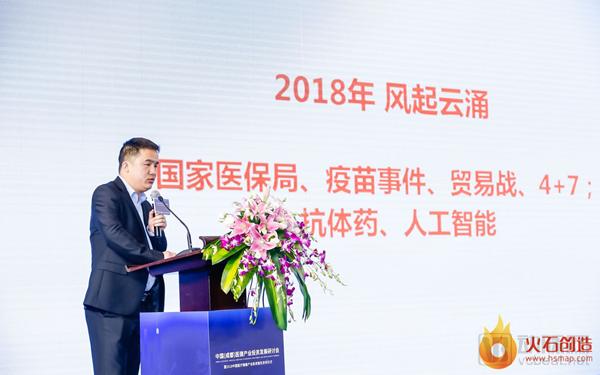
Miao Xianfeng, Dean of Hangzhou Firetone Institute (Photo provided by the interviewee)
At the seminar, Miao Xianfeng, Dean of Hangzhou Firetone Research Institute, released the “2018 China Healthcare Industry Investment Analysis Report” (hereinafter referred to as the “Report”) and provided an interpretation of its findings.
VCBeat has summarized the ten major trends in the healthcare industry proposed by Dean Miao Xianfeng in the "Report" as follows:
1. The concentration of capital among top-tier players has become increasingly pronounced. Financing data from the past three years show that both the total financing volume and the average size per financing deal reached a three-year high in 2018. Notably, deals exceeding RMB 100 million each accounted for 26% of the total number of cases but contributed 94% of the total financing amount.
2. Leading innovative drug companies demonstrate significant advantages in resource and capital aggregation. With intensified policy support, substantial capital has flowed into innovative drug enterprises. Investors maintain long-term expectations for hot sectors such as antibody drugs, cell therapy, and small-molecule drugs.
3. Accelerated Capital Deployment Propels Medical Device Innovation into Fast-Track Development. Breakthroughs in New Technologies Drive Rapid Growth in Financing for High-Value Consumables. In 2018, interventional and implantable devices topped the list of key investment categories in the medical device sector, accounting for 33% of projects. Supported by favorable policies, mergers and acquisitions in the medical device industry are accelerating, with premiumization and platform-based development emerging as future trends.
4. Consumption upgrading drives the high-end medical services market, with personalized medicine emerging as a favored investment sector. Currently, the industry remains in its early stages of development, and health management will be the primary direction for future in-depth growth.
5. Technology-driven rapid development of the genetic testing market; oncology genetic testing will continue to attract capital attention in the long term. According to data from Firetone, there were 83 financing cases in China’s genetic testing sector in 2018, with an average single-round financing amount of RMB 152 million. Capital is increasingly favoring upstream companies with high technological barriers.
6. Cross-sector integration: Medical AI transitions from exploration to industrialization, with AI-assisted drug R&D poised to become the next major growth driver. In 2018, investment in medical AI application scenarios was primarily concentrated in intelligent diagnosis and treatment and intelligent imaging, each accounting for 18 deals. Currently, companies involved in AI-assisted imaging diagnosis fall into three main categories: (1) tech giants such as Tencent, Alibaba, and iFlytek; (2) industry leaders such as GE, Philips, Siemens, and United Imaging; and (3) AI startups.
7. The spatial pattern of investment remains unchanged, with regions boasting a concentration of innovative elements continuing to be hotspots for investment. Beijing, Shanghai, and Guangzhou remain the primary hubs for investment; Zhejiang and Jiangsu maintain their momentum, while Sichuan and Hubei are building up strength.
8. Differentiation among major city clusters becomes evident, with the Yangtze River Delta further strengthening its capital appeal for innovative drugs.
9. The number of IPOs and M&A transactions has dropped sharply; the launch of the STAR Market will open new channels for capital exit. Regulatory scrutiny has become comprehensively stricter, leading to a sharp decline in the number of companies going public via IPO, while the total financing scale has increased.
10. The healthcare industry has entered a long-term phase of positive development, with the "Matthew Effect" becoming pronounced in certain sectors; dual-driven innovation in both technology and business models has become the dominant theme for investment.
President Miao Xianfeng stated that this investment report aims to interpret the investment landscape of China’s biomedical industry in 2018, including key sectors and regional capital activity, by tracking and analyzing investment trends in China’s healthcare industry during that year. The report seeks to provide references for government bodies and industrial parks in their transformation and upgrading efforts, as well as for enterprises and investment institutions in formulating their strategies. It also aims to offer valuable insights for a deeper understanding of China’s healthcare industry, grasping its development trends, and promoting its growth.
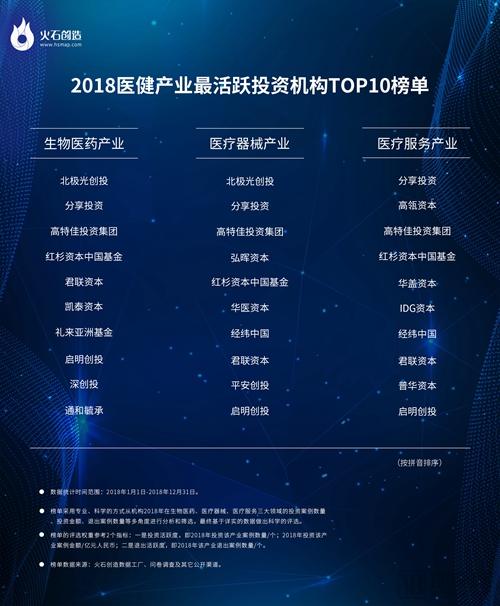
Top 10 Most Active Investment Institutions in the Healthcare Industry in 2018 Revealed
At the event, Firetone also released the Top 10 Most Active Investment Institutions in Three Major Sub-sectors of China’s Healthcare Industry.
Data-Driven Enterprise Decision-Making
Dr. Zhou Jun, Vice President of Firetone, stated that in addition to capital fueling industrial development, technological empowerment is also crucial, and leveraging data intelligence can enhance the competitiveness of innovative enterprises in the capital market.
Following the conference, VCBeat conducted an exclusive interview with Dr. Zhou Jun. He outlined two key priorities for Firetone’s future development: first, to assist local governments and industrial parks in gaining a comprehensive understanding of the overall development status of their regional healthcare industries; and second, to provide enterprises with customized big data intelligence systems and big data platforms.

Dr. Zhou Jun, Vice President of Firetone (Photo provided by the interviewee)
“Currently, enterprises face two main challenges. One is external intelligence analysis; however, market intelligence analysis from an enterprise’s perspective tends to be relatively one-sided, making it difficult to conduct a comprehensive, holistic review. The other challenge lies in the process of streamlining internal business workflows, where data loss is prone to occur and inter-departmental data silos remain difficult to break down,” said Dr. Zhou Jun. In response, they have proposed a solution that involves building customized big data intelligence systems for enterprises. Starting from the specific needs of each enterprise, the system provides tailored intelligence analysis in niche sectors, updates promptly based on industry dynamics, and helps enterprises achieve internal data standardization by establishing dedicated big data platforms.
“We aim to help enterprises transition from traditional decision-making methods to data-driven decision-making.”
VCBeat has learned that Firetone has provided industry intelligence and R&D process digitalization services to multiple renowned domestic and international pharmaceutical companies, including Hisun Pharmaceutical, HitGen, Johnson & Johnson, Philips, and YuanSong Bio. Furthermore, it has established partnerships with 15 of the top 20 industrial parks in China, such as Beijing Zhongguancun, Shanghai Zhangjiang, Hangzhou Medicine Port, and Guangzhou International Bio Island, and has served nine of the top ten central cities in China.
On that day, Chengdu High-Tech Zone established partnerships with more than 20 leading domestic private equity firms specializing in the biopharmaceutical industry, and unveiled the “Biopharmaceutical Industry Fund Network Roadshow Base” at the Chengdu Frontier Medical Center. The partner institutions have reserved an annual investment quota of RMB 1 billion for high-quality biopharmaceutical projects in Chengdu High-Tech Zone, jointly promoting the growth and strengthening of the biopharmaceutical industry.